



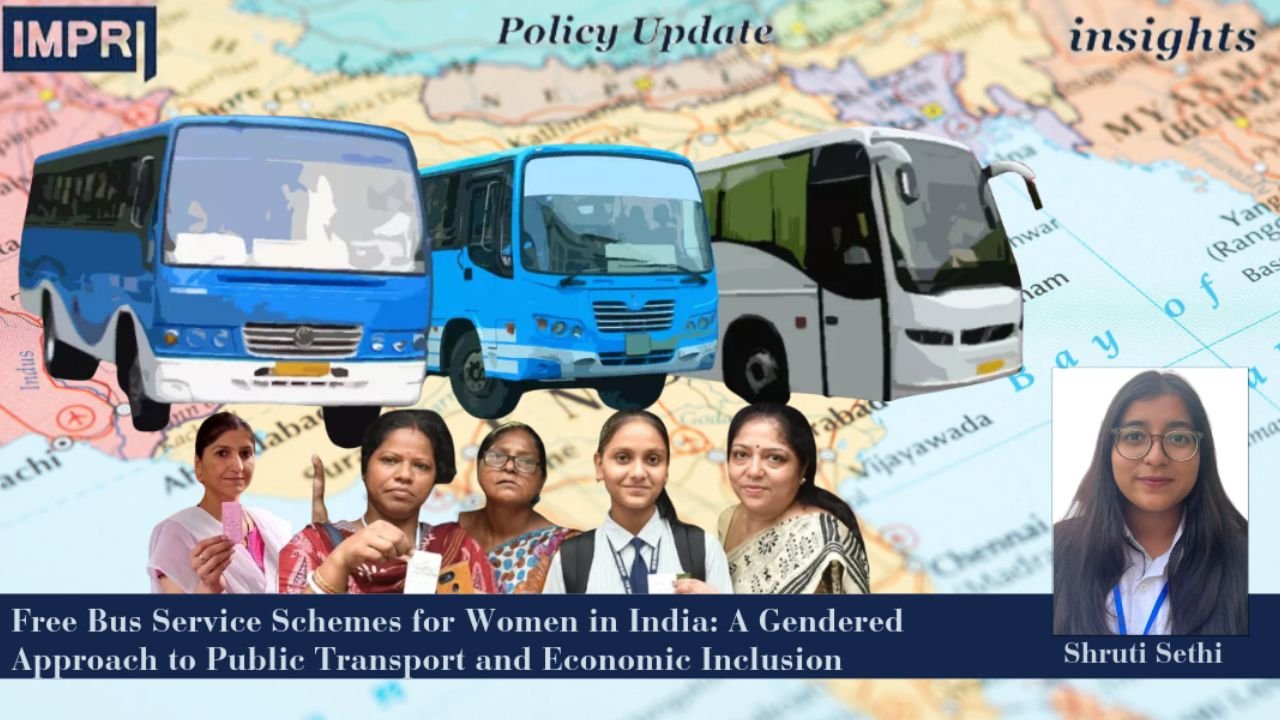
Policy Update
Shruti Sethi
Introduction
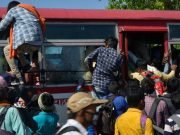
Public transportation plays a crucial role in determining access to employment, education, healthcare and social opportunities. In a country like India, where women’s labour force participation remains one of the lowest among major economies hovering around 35 – 40% , the access to affordable mobility is not a trivial concern (PLFS, Government of India). Transport costs, safety anxieties and lack of connectivity have long functioned as structural barriers that confine women to the household or restrict them to low-wage employment.
Against this backdrop, a wave of state governments across India has introduced free bus travel schemes for women, fundamentally reshaping the economics of female commuting. These initiatives aim to reduce transportation costs, improve mobility, enhance access to employment and education, and promote gender equality.
The Policy Landscape: Which States Have Taken the Leap?
- Delhi – the Pink Ticket Scheme (2019)
Introduced in October 2019 under the Aam Aadmi Party government, Delhi was the first state government in India to launch a gender-targeted fare-free public transport scheme known as ‘The Pink Ticket’ Scheme.
Source: Scroll.in
It covers Delhi Transport Corporation (DTC) and cluster buses. The policy was motivated not only by affordability concerns but also by the objective of encouraging greater female participation in public transport.
In 2026, Delhi expanded the concept through the Saheli Pink Smart Card, integrating free travel across buses, the metro system, and regional transit networks. It provided lifetime digital passes limited to Delhi residents to streamline administration and curb misuse.
According to the Delhi Government’s estimates, over 1,530 million ‘pink tickets’ had been availed as of February 2024, and women’s ridership had increased from 25% in 2020-21 to 33% in 2022-23. As per a research study, the free public transport scheme saved up to 8% of their household income per month. (WRI India)
- Tamil Nadu – Magalir Vidiyal Payanam Thittam (2021)
Tamil Nadu was the first South Indian state to extend free bus travel to women, launching its scheme on March 8, 2021 (International Women’s Day) upon Chief Minister M.K. Stalin taking office. The scheme covers all state-run buses operated by TNSTC (Tamil Nadu State Transport Corporation) across the state, including hilly regions like Nilgiris, Kodaikanal and Valparai.
As of 2025, Tamil Nadu’s scheme has facilitated over 730 crore free journeys, making it one of the most utilised public welfare programmes in the state’s history. Daily ridership under the scheme stands at approximately 57 lakh women per day. Women’s share of total bus passengers rose over 60% after the scheme’s implementation.
Average monthly savings per beneficiary are estimated at ₹888, which amounts to approximately 11.4% of a beneficiary’s monthly income. For economically vulnerable groups (street vendors and domestic workers) this saving climbs to around 14% of monthly income. Tamil Nadu’s 2025–26 budget allocated ₹3,600 crore for the Magalir Vidiyal Payanam scheme which is higher than the ₹3,050 crore figure in 2024–25, reflecting rapidly growing ridership. (SPC, Tamil Nadu Govt.)
- Punjab – Free Bus Travel for Women (2021)
Punjab introduced free bus travel for women on state-run buses in 2021. Women can travel without charge in Punjab Roadways, PRTC and city buses. However, the benefit does not extend to private operators. According to the state’s minister for social justice, empowerment and minorities, Punjab govt has spent Rs 2,042 crore under the free bus travel facility for women as of March 2026. (Ministry of Punjab)
- Karnataka – Shakti Scheme (2023)
Among all states, Karnataka’s Shakti Scheme represents the most extensive example of free public transport for women. Launched on 11 June 2023 by the Congress government as one of its five poll guarantees, the scheme allows all women and transgender persons domiciled in Karnataka to travel free on non-luxury, non-AC buses across four state road transport corporations: Karnataka State Road Transport Corporation (KSRTC), Bangalore Metropolitan Transport Corporation (BMTC), North-West Karnataka Road Transport Corporation (NWKRTC) and Kalyana Karnataka Road Transport Corporation (KKRTC). Beneficiaries must register and obtain a free smart card to avail of the service.
As of July 14, 2025, the Shakti scheme had issued over 500 crore tickets, at a total cost exceeding ₹12,669 crore to the state exchequer. In a remarkable distinction, the scheme entered the Golden Book of World Records for facilitating over 500 crore rides between June 11, 2023 and July 20, 2025. (FPI Bengaluru, Karnataka Govt.)
An Azim Premji University study reported that women constituted around 62% of passengers on state-run buses after the implementation of the scheme (Women Mobilize Women, 2024). Chief Minister Siddaramaiah credited the scheme with significantly increasing women’s participation in Karnataka’s industrial sector to broader economic participation gains.
- Telangana – Mahalakshmi Scheme (2023)
Telangana’s Congress government launched the Mahalakshmi Scheme on December 9, 2023 within just 48 hours of assuming office as part of its six election “guarantees.” The scheme covers women, girls aged 6–12 and transgender individuals travelling on TGSRTC buses, including Palle Velugu, Express, City Ordinary and City Metro services.
By March 2026, the scheme had issued over 290 crore free tickets, with women across the state saving a combined ₹10,000 crore in travel costs. Prior to the scheme, ordinary women, students and daily wage workers were spending between ₹1,500 and ₹2,500 per month on bus fares. Telangana witnessed a substantial increase in bus usage by women with daily ridership rising from 14 lakh to 35 lakh during the early days of the scheme. (Telangana Govt.)
- Andhra Pradesh – Stree Shakti Scheme (2025)
The TDP-led government in Andhra Pradesh launched the Stree Shakti Scheme on August 15, 2025, as one of its “Super Six Promises.” The programme allows women, girls and transgender persons holding Andhra Pradesh domicile status to travel free on Pallevelugu, Ultra Pallevelugu, Express, Metro Express and City Ordinary APSRTC services.
Chief Minister N Chandrababu Naidu said so far 4.29 crore journeys have been made through this welfare scheme as of February 2026. Women’s ridership has increased significantly from 40 per cent earlier to 65 per cent now, with an average of 25 lakh women commuting daily under the initiative. Beneficiaries need only present a valid photo ID to obtain a zero-fare ticket. Premium and air-conditioned services are excluded (The Hindu).
- Jammu & Kashmir – Zero-Ticket Travel Initiative (2025)
Jammu & Kashmir has also implemented a free bus travel scheme for women on all J&K Road Transport Corporation (JKRTC) buses and Smart City e-buses. Eligible women can avail of “zero-ticket” travel without needing to purchase or show a physical ticket. More than 1.66 crore women have availed free travel in government-operated buses across Jammu and Kashmir since April 1, 2025, with the financial implication of the scheme crossing Rs 47 crore, the government informed the Assembly during the budget discussions in February 2026.
- West Bengal – Free Bus Travel Scheme for Women (2026)
West Bengal under the BJP-led government introduced this major women welfare initiative during the 2026 West Bengal Assembly Election campaign. All women residing in West Bengal will be eligible to avail free travel on both short-route and long-route state-run buses.
To facilitate the scheme, the state government will issue a digital Smart Card (with a QR code), along with the beneficiary’s photograph and name. However, till the issuance of Smart Cards, women passengers will receive zero-value tickets from conductors upon ID verification. (West Bengal Govt.)
- Kerala – Keralam Free KSRTC Bus Travel Scheme
The newly sworn-in Congress-led UDF government in Kerala announced free KSRTC bus travel for women, effective June 15, 2026. The scheme applies exclusively to state-run KSRTC ordinary buses operating on various urban, semi-urban, and rural routes across the state, without any income limits or the need for a special travel card. The initiative was one of the “five Indira guarantees” outlined in the UDF election manifesto and aims to increase women’s mobility and independence.
Economic Analysis: What Do the Numbers Tell Us?
- Direct Income Effect
The most immediate economic benefit is the increase in women’s disposable income. For low-income households, eliminating transport costs functions as an indirect cash transfer – one specifically tied to mobility, incentivising women to step outside the home for work, education or social participation rather than simply supplementing household budgets.
Table: Estimated Average Monthly Savings for Women Under State-wise Free Bus Travel Schemes
| State | Monthly Savings |
| Delhi | ~8% of household income (~₹2,000+) |
| Tamil Nadu | ₹888 (avg); up to 14% of income for low-wage workers |
| Karnataka | ₹680-₹1,300 |
| Telangana | ₹1,500–₹2,500 (pre-scheme expenditure eliminated) |
| Andhra Pradesh | Estimated benefit for 2.62 crore women |
Source: Author’s compilation based on state government data and scheme reports
- Labour Force Participation and Social Inclusion
The relationship between transport access and female labour force participation is well-established in development economics. The data from these schemes bears this out: Tamil Nadu’s female bus ridership rose above 60% post-implementation and Karnataka’s scheme was credited with visibly increasing women’s industrial workforce participation. 92% of surveyed women in Chennai reported feeling safe travelling in government buses after the scheme’s introduction.
- The Fiscal Cost and the “Freebie” Debate
The schemes are expensive. Karnataka’s Shakti scheme alone has cost over ₹12,669 crore in two years. Tamil Nadu’s annual subsidy has grown from ₹1,200 crore to ₹3,050 crore. The Supreme Court of India has called the proliferation of such schemes “a serious economic issue” and described them as “a burden for future generations.” The Reserve Bank of India has warned that their fiscal cost is “unsustainable.”
Bengaluru’s BMTC fleet has shrunk to around 6,158 buses even as daily ridership crossed 40 lakh against a requirement of 10,000–12,000 buses, according to transport experts.
Since none of these schemes are means-tested, affluent women benefit equally alongside low-income beneficiaries – a horizontal inequity that has sparked public debate. Private transport operators ( auto-rickshaws and private buses) went on strike in Karnataka a month after Shakti launched, arguing the scheme amounted to unfair state-subsidised competition.
Policy Recommendations: From Welfare to Strategy
The evidence base for free bus schemes is now strong enough to move the conversation from whether to do this to how to do it better.
1. Introduce Means-Testing Without Creating Exclusion Errors: The core design flaw of every existing scheme is universality without targeting. A tiered fare model – zero fare for women below a defined income threshold (verified via ration cards or Jan Dhan accounts) and a heavily subsidised but non-zero fare for others would preserve 80-90% of the welfare benefit while meaningfully reducing fiscal cost.
2. Ring-Fence Savings for Fleet Expansion: Karnataka’s Shakti scheme costs over ₹12,669 crore in two years while BMTC’s fleet simultaneously shrunk from 6,888 to 6,158 buses as ridership crossed 40 lakh daily. This is operationally contradictory. State governments should legislatively ring-fence a minimum of 15–20% of annual scheme expenditure for fleet procurement and route expansion. The fiscal headroom exists, as Tamil Nadu’s growing subsidy trajectory (from ₹1,200 crore to ₹3,600 crore) demonstrates.
3. Expand First and Last Mile Connectivity: A free bus ticket is only useful if the bus stop is reachable. States should pair free bus travel with subsidised feeder services (auto-rickshaws or e-rickshaws) particularly in rural blocks where bus route density is lowest and unmet mobility needs are the highest.
4. Build a National Evaluation Architecture: No state currently publishes rigorous, independently verified impact assessments. The Centre should mandate annual third-party evaluations covering ridership disaggregated by income group, employment outcomes, and fiscal efficiency, so the policy debate is driven by evidence rather than electoral press releases.
5. Link Mobility with Economic Participation: Transport planning should prioritise connectivity to industrial zones, educational institutions and service hubs to maximise the scheme’s impact on women’s labour force participation.
Conclusion
Free bus service schemes for women represent one of the most significant gender-focused public transport interventions in contemporary India. The welfare gains in disposable income, mobility, safety and labour market participation are real and well-documented across states from Delhi to Andhra Pradesh.
A noticeable pattern, however, is that every major scheme was announced as a pre-election guarantee. Free bus travel for women has, in effect, become a standard item on the Indian political menu, with the risk that the policy becomes self-reinforcing regardless of its fiscal consequences. It is a sound intervention when it functions as a targeted mobility subsidy, but a blunt instrument when applied universally without parallel investment in transport capacity.
The long-term success of these schemes will depend on whether states can balance welfare objectives with efficient public transport management. If implemented alongside investments in fleet capacity, safety and service quality, free bus travel for women has the potential to become a meaningful component of inclusive economic development in India.
References:
Ministry of Statistics & Programme Implementation. (2026). Female LFPR and WPR recorded a yearly high in December, 2025 Overall Unemployment Rate broadly stable. Government of India https://www.pib.gov.in/PressReleasePage.aspx?PRID=2214908®=3&lang=1
WRI India. (2025). Fare-free bus travel scheme for women: Lessons from Delhi https://wri-india.org/sites/default/files/2025-04/Working-paper-WRI-India-Fare-free-bus-travel-scheme-for-women-Lessons-from-Delhi.pdf
State Planning Commission, Chennai. (2022). Zero-Ticket Bus Travel Scheme for Women in State-Owned Bus Transport Corporations – II https://spc.tn.gov.in/wp-content/uploads/VP-2.pdf
The Times of India. (2026). Punjab spent Rs 2,042 crore on free bus travel for women: Minister https://timesofindia.indiatimes.com/city/chandigarh/punjab-spent-rs-2042-crore-on-free-bus-travel-for-women-minister/articleshow/128985917.cms
Fiscal Policy Institute. (2024). Fiscal Effects of ‘Shakti Scheme’ in the Government of Karnataka. Government Of Karnataka https://fpibengaluru.karnataka.gov.in/storage/pdf-files/Technical%20Reports/FinalcopyofFiscaleffectsofShaktiScheme_04072024.pdf
Women Mobilize Women. (2024). Free Bus Passes For Women – A Tool For Improved Gender Equity in Urban Transportation? https://womenmobilize.org/free-bus-passes-for-women/
The Hindu. (2025). TGSRTC rumbles past 200 crore free trips milestone https://www.thehindu.com/news/national/telangana/tgsrtc-rumbles-past-200-crore-free-trips-milestone/article69846394.ece
The New Indian Express. (2026). Smart cards for free bus travel scheme soon in Telangana https://www.newindianexpress.com/states/telangana/2026/Mar/30/smart-cards-for-free-bus-travel-scheme-soon-in-telangana
The Print. (2026).Stree Shakti free bus scheme for women in Andhra offers over 4 crore rides https://theprint.in/india/stree-shakti-free-bus-scheme-for-women-in-andhra-offers-over-4-crore-rides/2857834/
The Hindu. (2026). Women ridership increased to 65% under free bus scheme, says A.P. Minister https://www.thehindu.com/news/national/andhra-pradesh/women-ridership-increased-to-65-under-free-bus-scheme-says-ap-minister/article70675565.ece
Times of India. (2026). 8 Indian states where women can travel free on government buses; West Bengal becomes the latest to join the list https://timesofindia.indiatimes.com/life-style/travel/things-to-do/8-indian-states-where-women-can-travel-free-on-government-buses-west-bengal-becomes-the-latest-to-join-the-list/photostory/131070237.cms
Kashmir Life. (2026). More than 1.66 Cr Jammu Kashmir Women Avail Free Bus Travel in 10 Months; Cost Crosses Rs 47 Cr https://kashmirlife.net/more-than-1-66-cr-jammu-kashmir-women-avail-free-bus-travel-in-10-months-cost-crosses-rs-47-cr-426418/
Indian Express. (2026). Free bus travel for women in West Bengal to begin from June 1, check details https://indianexpress.com/article/cities/kolkata/free-bus-travel-for-women-in-west-bengal-begins-june-1-no-smart-card-yet-check-alternative-documents-10716916/
Govt. Schemes India. (2026). Keralam Free KSRTC Bus Travel Scheme for Women https://www.govtschemes.in/keralam-free-ksrtc-bus-travel-scheme-women
About The Contributor
Shruti Sethi is a Research & Editorial Intern at IMPRI. She holds a bachelor’s degree in Economics from St. Xavier’s University, Kolkata. Her research interests include Gender & Labour Economics.
Acknowledgement
The author extends her sincere gratitude to the IMPRI team for their expert guidance and constructive feedback throughout the process.
Reviewed by Riddhi Suthar and Paridhi Passi.
Disclaimer
All views expressed in the article belong solely to the author and not necessarily to the organization.
Read More at IMPRI