





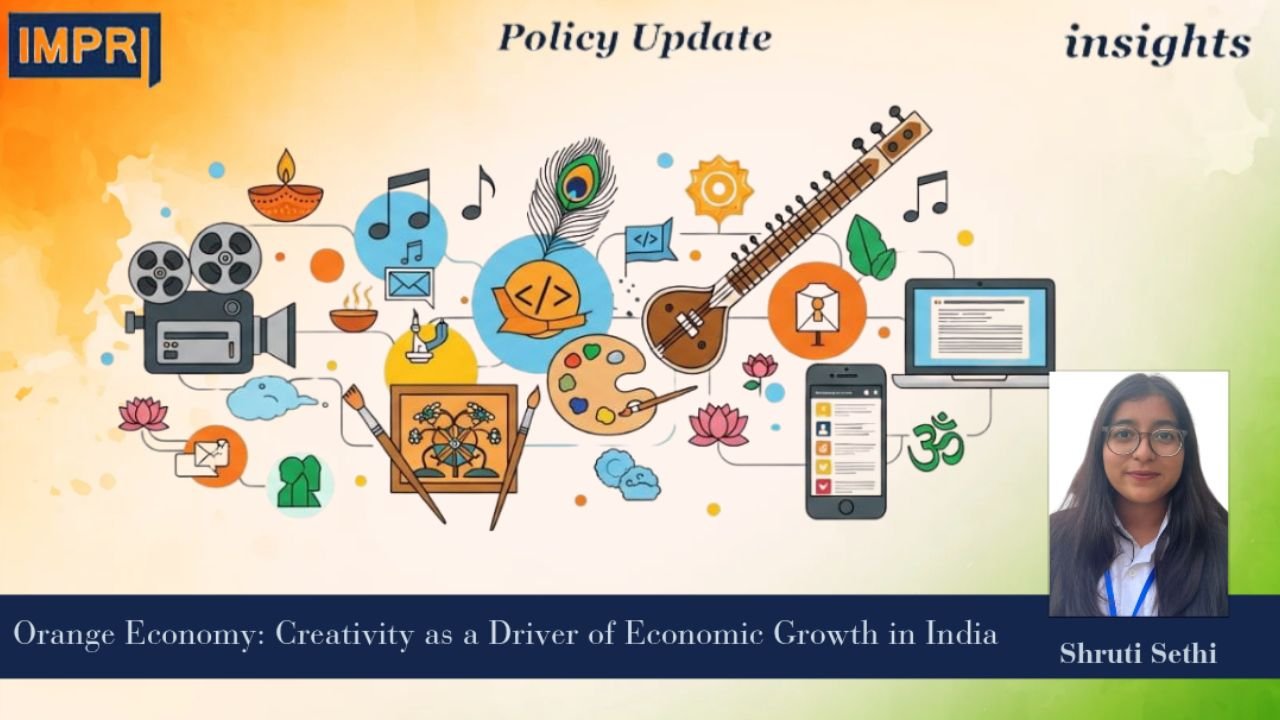
Policy Update
Shruti Sethi
Background
For decades, economic growth in India has been driven by agriculture, manufacturing and services such as IT and finance. Today, however, a different kind of sector is gaining prominence – one built not on physical assets, but on ideas.
This is the Orange Economy – a term coined by Colombian economists Iván Duque and Felipe Buitrago in their 2013 book “The Orange Economy: An Infinite Opportunity.” The colour “orange” was chosen because it blends red (the passion of culture and identity) with yellow (the optimism of economic opportunity).
Orange Economy refers to the ecosystem of activities where economic value is derived primarily from creativity, culture and intellectual property. It bridges traditional cultural expressions such as arts, crafts and festivals with modern digital domains including gaming, animation, visual effects (VFX), OTT platforms and immersive technologies.
For developing economies like India, the appeal is structural: unlike manufacturing, which requires capital-intensive infrastructure, or conventional services, which require established institutional ecosystems, the Orange Economy’s primary input is human creativity, a resource India possesses in abundance.
The timing of this shift is not accidental. India now has over 800 million internet users and one of the world’s youngest populations, with a median age of around 28 years. Combined with low-cost data and widespread smartphone access, this has created the conditions for a large-scale expansion of creative and digital industries.
The Economic Survey 2025-26 formally elevated the Orange Economy to a policy priority and the Union Budget 2026-27 followed with specific institutional commitments, marking the most ambitious creative economy policy statement in India’s post-liberalisation history.
Key Economic Characteristics of Orange Economy
Orange Economy goods and services differ from conventional goods in three critical ways that have profound implications for market structure, pricing and policy:
- Non-rivalry: A film can be viewed by millions simultaneously without depletion – a public-good characteristic that fundamentally alters market dynamics and justifies subsidised provision.
- High fixed costs, near-zero marginal costs: Creating a video game costs crores; distributing it costs nearly nothing. This creates natural monopoly tendencies, winner-take-most markets and justifies upfront public investment.
- Strong network effects: Platforms like YouTube grow more valuable as more creators and viewers join, producing lock-in, barriers to entry and structural concentration.
- Externalities: Creative industries generate positive externalities, including tourism, soft power, language learning and related-industry growth with benefits that private markets systematically underproduce creating a strong case for government intervention. On the other hand, negative externalities including platform misinformation, cultural homogenisation and gig precarity – warrant regulatory attention alongside promotional policy.
Expanding Scope of the Orange Economy
The Orange Economy in India spans twelve broad domains: performing arts, visual arts, crafts, publishing, film and television, music, advertising, design, gaming and interactive media, animation and VFX, digital content creation, and traditional knowledge systems including Ayurveda and handloom weaving. In economic terms, these sectors generate value through intellectual property rather than physical manufacturing – a distinction that makes them both high-margin and highly scalable.
| Segment | 2024 | 2025 | 2026 (E) | 2027 (P) |
| Digital Media | 802 | 903 | 1004 | 1104 |
| Television | 679 | 676 | 671 | 667 |
| 260 | 262 | 264 | 267 | |
| Online Gaming | 232 | 260 | 288 | 316 |
| Filmed Entertainment | 187 | 196 | 204 | 213 |
| Animation & VFX | 103 | 113 | 130 | 147 |
| Live Events | 101 | 119 | 142 | 167 |
| Out-of-home media | 59 | 66 | 73 | 79 |
| Music | 53 | 60 | 68 | 78 |
| Radio | 25 | 27 | 28 | 30 |
| Total | 2502 | 2682 | 2873 | 3067 |
(Note. E = Estimated; P = Projected. Source: FICCI-EY Media & Entertainment Industry Report (2025). Figures are rounded to the nearest INR Billion.)
Source: Author’s Calculations. Figure above shows the growth trends across major segments of India’s Orange Economy, highlighting the rapid expansion of digital media, gaming, and online content between 2024 and 2027.
Analysis of Growth Trends
Despite contributing less than 2% to the global M&E sector, India is the fastest-growing territory supported by its expanding economy and technological infrastructure. Advertisement and connectivity is driving the growth in the sector. (The PwC, India)
Among the high-growth segments, Animation & VFX and Live Events stand out – registering approximately 40-45% and 65% growth respectively between 2024-2027, driven by post-pandemic recovery and rising global demand for Indian production capacity. Online Gaming follows closely at 28-35% CAGR, structurally supported by a 42.5 crore active gamer base and cheap data access.
Digital Media, while growing at a comparatively moderate 37-40%, commands the highest absolute size, rising from ₹802 billion to ₹1,104 billion, underscoring its role as the anchor of the Orange Economy. At the other end, Television registers a marginal decline from ₹679 billion to ₹667 billion, reflecting structural cord-cutting already visible in mature Western markets, while Print continues its slow secular contraction consistent with global trends in physical media. The divergence between these declining legacy segments and the high-growth digital and experiential sectors captures the broader creative economy transition underway in India.
Key Sectors of the Orange Economy
- Media & Entertainment (M&E): The M&E sector is the anchor of the Orange Economy. Digital media now contributes nearly a third of total M&E revenue, driven by OTT proliferation, short-form content, and the democratisation of content creation. India’s Bollywood and regional film industries producing more films annually than any other country feed this ecosystem. The sector is expected to grow at a CAGR of 8.8% in the coming years.
- AVGC-XR: The Strategic Pillar: Animation, Visual Effects, Gaming, Comics and Extended Reality, collectively referred to as AVGC-XR, represent the most technology-driven frontier of the creative economy. India’s AVGC sector has graduated from low-cost outsourcing to co-production, with major studios such as Disney, Warner Bros and Netflix making India a preferred production hub. However, co-production is not the same as IP ownership. India risks replicating IT’s outsourcing trajectory, building world-class execution capacity while the royalties flow elsewhere.
The Economic Survey 2025-26 projects demand for nearly 2 million AVGC professionals by 2030, a human capital requirement that has directly shaped Union Budget 2026-27 allocations. The sector’s economic significance goes beyond employment: AVGC represents India’s most viable path from creative services exports to IP ownership – the difference between earning wages and earning rents.
- Online Gaming: The High-CAGR Frontier: As of 2023, India is the world’s second-largest gaming market by user base, with approximately 42.5 crore active gamers. The sector’s growth at a 28% CAGR between 2020-2023 is structurally driven by smartphone penetration, cheaper data and a young demographic. Rising monetisation, expanding domestic studios and stronger integration with global platforms are transforming gaming from mass engagement into a scalable digital industry. However, India remains primarily a consumer rather than a major creator – a critical strategic distinction with major IP and export implications.
Source: EY
- Digital Creator Economy: The creator economy is not merely a cultural phenomenon – it is an allocative mechanism redistributing advertising revenue from traditional broadcasters to individual producers. YouTube’s creative ecosystem alone is estimated to have contributed over ₹16,000 crore to India’s GDP in 2024 and supported over 9.3 lakh full-time equivalent jobs (though this figure, drawn from a platform-commissioned study, likely overstates net GDP contribution by conflating gross output with value-added.) The influencer economy influences $350-400 billion in consumer spending, making it a significant demand-side force. A new report by the Boston Consulting Group (BCG), titled “From Content to Commerce: Mapping India’s Creator Economy”, highlights that India is home to 2 to 2.5 million active digital creators, defined as individuals with over 1,000 followers. Despite the scale, only 8-10% of them currently monetize their content effectively, underscoring the untapped potential of this fast-growing sector.
- Traditional Crafts & GI-Tagged Products: This is the Orange Economy’s most underappreciated layer. From Darjeeling tea (whose GI tag drove a fivefold price increase) to Pochampally Ikat weavers and Channapatna toymakers, GI tags create market power for artisans, functioning as a form of product differentiation. The Prada–Kolhapuri chappal episode of 2025 underscored the stakes: India’s cultural IP is vulnerable to appropriation without robust legal and commercial infrastructure. Yet the critical question remains whether artisans themselves capture these premiums, or whether intermediaries absorb the gains upstream.
- Live Events: As the world’s most populous nation with over 1.47 billion people (UN World Population Prospects 2024), and with a majority of its population below the age of 35, India possesses the scale, youth capital and digital adoption levels to emerge as a global powerhouse for live entertainment. India’s organised live events sector, valued at ₹145 billion in 2025 as per industry estimates, has emerged as the highest growth segment in the media and entertainment sector.
The Policy Architecture (2024–26)
The Union Budget 2026-27 and Economic Survey 2025-26 together represent the most comprehensive creative economy policy framework in India’s post-liberalisation history.
- AVGC Skilling Initiative: The most consequential single budgetary allocation in the 2026-27 Union Budget for the Orange Economy is Rs. 250 crore provision for the establishment of AVGC Content Creator Labs in 15,000 secondary schools and 500 tertiary institutions. This investment reflects a recognition that human capital is the binding constraint in the AVGC sector: the Economic Survey’s projection of demand for two million AVGC professionals by 2030 implies an annual increment approximately ten times the current supply from accredited programmes.
- IICT Mumbai: The Indian Institute of Creative Technologies (IICT), established in Mumbai as a National Centre of Excellence for AVGC-XR skilling, provides the apex institutional anchor for this human capital ecosystem. Its mandate – to develop curriculum, certify trainers, and set quality standards for AVGC education nationwide, draws on the precedent of the Indian Institutes of Technology in the engineering and technology domain, though the creative economy’s pedagogical requirements differ substantially from those of technical engineering education.
- WAVES Bazaar: WAVES Bazaar, the global marketplace for scripts, music rights, and creative intellectual property launched at the World Audio Visual and Entertainment Summit in May 2025, draws on the logic to address a market failure in the intellectual property trading domain: Indian creators, particularly those outside the metropolitan creative hubs lack access to the market infrastructure through which their intellectual property can be efficiently priced, discovered by potential buyers, and transacted. WAVES Bazaar addresses this by creating a centralized exchange that reduces search and transaction costs.
- The National Creative Fund (NCF): The intangible nature of creative assets- intellectual property, reputation, audience relationships, makes them poor collateral for bank lending, and the high variance of creative project returns makes them unattractive to risk-averse institutional investors. The NCF’s mandate as a seed capital vehicle for ‘high-risk, high-creativity’ ventures is explicitly designed to occupy the market segment that conventional venture capital oriented toward scalable, platform-based business models systematically neglects.
- Create in India Challenge: The Create in India Challenge, a nationwide talent identification exercise spanning 33 creative categories, with winning entries linked to international festival participation in Tokyo and Madrid serves a dual function: identifying and surfacing creative talent outside the metropolitan centres and embedding Indian creators in the international circuits through which global creative careers and commercial relationships are built.
- New NID- Eastern India: In February 2026, the Ministry of Finance and DPIIT officially announced the establishment of a brand-new, premier NID to serve the eastern zone, aimed at boosting local design education, supporting the animation/gaming (AVGC) sectors and integrating IP creation with traditional eastern arts.
- AIICE Platform: The All India Initiative on Creative Economy (AIICE) is a multi-stakeholder convening platform, meaning it functions as a structured forum rather than a regulatory or funding body, launched by the Indian Chamber of Commerce (ICC) to elevate India’s $30 billion creative sector. By bringing together government officials, policymakers and creative professionals under one institutional umbrella, it aims to coordinate action on export promotion, intellectual property protection and support for local artisans and MSMEs.
- Live Events Deregulation: Historically, event organizers had to secure 10-15 different NOCs and licenses (fire safety, noise limits, traffic clearance and copyright compliance). The single-window framework on the India Cine Hub portal digitizes this process to reduce bureaucratic friction.
Strategic Recommendations:
- The Intellectual Property regime must be strengthened across three dimensions:
a. modernisation of the copyright statute to address digital-age challenges of platform liability, content scraping and AI-generated works
b. expansion of the GI registry and the development of international enforcement mechanisms for traditional cultural expressions
c. the establishment of IP literacy and legal aid programmes accessible to informal and small-scale creators.
- A unified Orange Economy authority should be established, consolidating the existing fragmented governance landscape and providing a single institutional home for creative economy strategy, investment and international promotion. The model here is South Korea’s Korea Creative Content Agency (KOCCA) , a government body founded in 2009 that integrates content promotion, export facilitation, IP protection and sector investment under one roof – adapted to India’s federal structure and the scale of its cultural diversity.
- The creative finance gap must be systematically addressed through the National Creative Fund’s expansion, the development of royalty-backed lending instruments that allow intellectual property to serve as collateral, and the creation of a secondary market in creative IP rights that would improve price discovery and liquidity.
- The formalisation of the creative workforce requires both supply-side interventions – portable social insurance, formal certification, digital market access and demand-side ones, including government procurement commitments that prefer formally certified creative producers.
- Yoga, Ayurveda, Indian cuisine, Bollywood and classical dance are global brands. The economic goal must be to capture more of the value chain – licensing, merchandise, tourism, training, rather than exporting cultural products at low prices.
- India’s diversity is its greatest creative asset. Digital inclusion and vernacular content ecosystems must be built as prerequisites, not afterthoughts, connecting tribal artists and folk musicians with global markets. This also means acknowledging that creative infrastructure (studios, incubators, design institutes and high-speed connectivity) remains concentrated in Mumbai, Delhi, Bengaluru and Chennai, and that policy must deliberately direct investment toward Tier 2 and Tier 3 cities and the Northeast if the Orange Economy is to be genuinely national rather than metropolitan.
Conclusion
The Orange Economy represents India’s most credible pathway to a post-manufacturing, innovation-driven growth model. It can simultaneously generate employment (especially for youth), expand services exports, build soft power and formalise livelihoods for millions of informal cultural workers.
The analysis has also identified binding structural constraints that the current policy framework has not yet fully addressed. India’s intellectual property regime remains inadequate to the scale of its creative output. Over sixty percent of creative practitioners remain informal, invisible to and excluded from policy. Global platforms systematically extract value from Indian creative labour. Governance remains fragmented across too many agencies to sustain a coherent national strategy. And underlying all of this is a dual risk: that the AVGC sector replicates IT’s outsourcing trap and that the Orange Economy’s shadow side, including platform misinformation, cultural homogenisation and gig precarity, goes unaddressed.
India possesses the raw inputs for creative economy leadership: demographic scale, cultural depth, linguistic diversity, digital infrastructure and an emerging generation of globally competitive creative talent. Converting these inputs into sustained competitive advantage is, ultimately, a question of institutional design and political commitment. For India, imagination is not a soft asset, it is the next hard-edged comparative advantage.
References:
Coherent Market Insights. (2026). India Creator Economy Market Size and Share Analysis – Growth Trends and Forecasts (2026-2033) https://www.coherentmarketinsights.com/industry-reports/india-creator-economy-market
Press Information Bureau. (2025). India’s Creator Economy Projected to Influence Over $1 Trillion in Consumer Spend by 2030: BCG Report to be Unveiled at WAVES 2025. Ministry of Information & Broadcasting. https://www.pib.gov.in/PressReleaseIframePage.aspx?PRID=2126106®=3&lang=2
Press Information Bureau. (2025). Creative Industries as Growth Engines – Media, Entertainment, AVGC, Gaming and the Orange Economy. https://www.pib.gov.in/PressReleasePage.aspx?PRID=2228572®=3&lang=1
India’s World. (2025). The Dawn of India’s Orange Economy https://indiasworld.in/the-dawn-of-indias-orange-economy/
PwC India. India’s digital advertising surge: Navigating growth in the changing media landscape https://www.pwc.in/india-entertainment-media-outlook-2024-28.html
BCG. (2025). From Content to Commerce: Mapping India’s Creator Economy https://www.bcg.com/publications/2025/india-from-content-to-commerce-mapping-indias-creator-economy
EY. (2026). Stories, scale and impact: Unlocking India’s M&E economy https://www.ey.com/en_in/insights/media-entertainment/stories-scale-and-impact-unlocking-india-s-m-e-economy
Press Information Bureau. 2024. AVGC: The Future of Media & Entertainment Industry https://www.pib.gov.in/PressNoteDetails.aspx?NoteId=153219&ModuleId=3®=3&lang=2
Press Information Bureau. (2025). WAVES ‘Create in India Challenge’ Crosses 85,000 Registrations with 1100 International Participants. Ministry of Information & Broadcasting https://www.pib.gov.in/PressReleasePage.aspx?PRID=2117273®=48&lang=2
EY. (2023). New frontiers – Navigating the evolving landscape for online gaming in India https://www.ey.com/en_in/insights/media-entertainment/new-frontiers-navigating-the-evolving-landscape-for-online-gaming-in-india
Press Information Bureau. (2024). AI to Revolutionize Creative Economy, Not Threaten It: Minister Hardeep S Puri. Ministry of Petroleum & Natural Gas https://www.pib.gov.in/PressReleasePage.aspx?PRID=2048272®=48&lang=2
Indian Chamber of Commerce. Creative Economy in India: Promoting Innovation and Growth https://indianchamber.org/page/sectors/creative-economy-
Ministry of Information & Broadcasting. (2025). India’s Live Events Economy – A Strategic Growth Imperative. Government of India https://mib.gov.in/sites/default/files/2025-06/india-s-live-events-economy-whitepaper-final-compressed_0.pdf
Press Information Bureau. (2026). 4th Meeting of Live Events Development Cell Reviews Roadmap to Position India as a Global Hub for Live Events. Ministry of Information & Broadcasting https://www.pib.gov.in/PressReleasePage.aspx?PRID=2257236®=48&lang=2
Department of Economic Affairs. (2025). Economic Survey 2025-26. Government of India https://www.indiabudget.gov.in/economicsurvey/doc/Infographics%20English.pdf
Department of Economic and Social Affairs. (2024). World Population Prospects 2024. United Nations https://www.un.org/development/desa/pd/sites/www.un.org.development.desa.pd/files/undesa_pd_2024_wpp_2024_advance_unedited_0.pdf
About The Contributor
Shruti Sethi is a Research & Editorial Intern at IMPRI. She holds a bachelor’s degree in Economics from St. Xavier’s University, Kolkata. Her research interests include Gender & Labour Economics.
Acknowledgement
The author extends her sincere gratitude to the IMPRI team for their expert guidance and constructive feedback throughout the process.
Reviewed by Paridhi Passi and Kavin Adithya.
Disclaimer
All views expressed in the article belong solely to the author and not necessarily to the organization.
Read More at IMPRI