






Rinreichon H Shimray
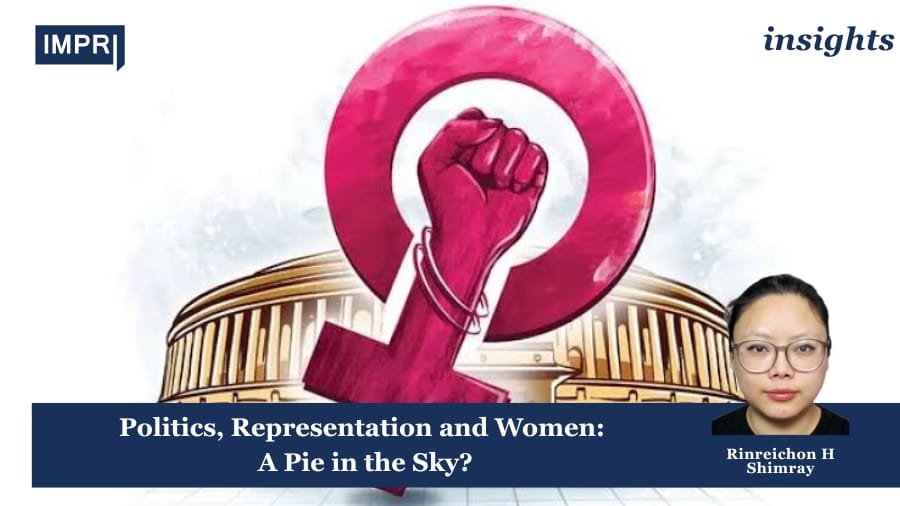
In the 18th Lok Sabha Elections, the overall female voters’ turnout was 65.78 percent, just .02 percent short of the overall male voters’ turnout, which amounted to 65.80 percent, marking the active participation of women in undertaking the democratic process of choosing our leaders. And in many states, women voters outperformed in comparison to the male counterpart reflecting their intent in performing their political duty. (Election Commission of India, 2026). Yet, in that same election, out of 543 Members of Parliament who were elected, only 74 women candidates were voted to power, amounting to only 14 percent. (Association for Democratic Reforms, 2026, p.24), a dip from 14.4 percent in the previous Lok Sabha elections. (PRS, May 2019).
While the data represent the reality in our country, the truth does not seem far behind across the globe as well. Female leaders continue to make up only 23 percent of cabinet ministers heading ministries worldwide with just 15 countries having cabinets that has parity between men and women. And there are countries that continue to have no women representation at all in the cabinet. (UN Women, 2024) At the current rate of progress, it is said, that gender parity at the cabinet level would not be reached before 2077. (UN Women, 2024).
This performance continues despite having enough evidences, both local and abroad, that has displayed the role played by women in power and women taking leadership roles in improving governance, transparency and accountability while improving efficient administration and promoting awareness, which points to challenges that impede the greater participation of women in the political realm. (UNDP, 2023)
Woman, the fairer gender, since birth is bounded by traditions, responsibilities and duties, which often reflect the expectations that she is expected to carry out throughout her life. Often identified with the values of being the adjustable and the patient one, who plays the role of being the support rather than playing the main character, the concept of her being able to play the main character in general and as a political leader in particular often does not find enough support. Significantly, more often than not, objections seem to be an easier rally point for people to come together rather than that of coming together to push for reform to ensure comprehensive inclusion of women in the platform.
Added to the struggle in trying to carve a position for herself in the political arena, there lies the onslaughts of roadblocks that come in the form of emotional and psychological judgements, trolling in various forms, stereotyping and bias towards ability in carrying out assigned duties ,(Free Network, 2021) and even often fellow women being critical among others persist affecting political women leaders or aspirational political leaders to carve a path for themselves
The fact of the matter is not that women are not capable of doing the roles expected of a leader rather it is the hurdles that she has to navigate in trying to reach a level playing field with her male counterparts. In this matter, efforts have already been adopted. Be it introducing reservations in the local bodies or the adoption of the 106th Constitutional Amendment Act of 2023 that provides 33 percent of reservation for women in the Parliament, the State Legislative Assemblies along with initiation of various policies to empower women across varied dimensions. (PIB, 2026) However, there is a need for cohesiveness and consolidation of the initiatives being introduced or adopted for women empowerment. Additionally, the need to promote greater awareness about women’s issues and challenges at a scale that reflects the brevity that women have to go through everyday without trivialising it or mocking it or even reproaching the emotions of women for raising voices about their struggles. For unless there is an actual acceptant consciousness of women’s unique challenges and struggles in all aspects, the significance of her political consciousness which mirrors the growing political participation and should ultimately reflect in political representation would fail to fructify in getting the actual equal platform where women could actually perform to their full potential.
Our nation has already shown its credentials in pushing for inclusive women empowerment. From having one of the earliest and prominent woman Prime Minister to having a tribal woman President, to having various women leaders working as the Chief Ministers across states and holding key portfolios in the Cabinet. The intent to inculcate women in the political realm to promote the sustainable democratic development of the nation has taken root right from India’s sovereign journey. However, it is taking a long and exceptional time for it to blossom. It will take the whole community and the participation of every individual to ensure that political representation of women in its truest sense come to the fore and not just become a pie in the sky.
References:
Election Commission of India. (2026, June 6). Press Note. https://elections24.eci.gov.in/docs/BnS4hhbvK9.pdf
Association for Democratic Reforms, (2026, March 8). Press Release. https://adrindia.org/sites/default/files/Womens_Political_Participation_and_Representation_in_India_2026_Eng.pdf.
PRS. (2024, May 24). Profile of the newly elected 17th Lok Sabha. https://prsindia.org/parliamenttrack/vital-stats/profile-of-the-newly-elected-17th-lok-sabha., a
UN Women. (2024, January 1). Women Political Leaders 2024. https://www.unwomen.org/sites/default/files/2024-06/Poster-Women-political-leaders-2024-en.pdf.
UN Women, (2024, September 10). Why so few women are in political leadership, and five actions to boost women’s political participation. https://www.unwomen.org/en/news-stories/explainer/2024/09/five-actions-to-boost-womens-political-participation.
UNDP, (2023, July 5) Makeda Leikun Yeshaneh, “We must dismantle barriers to women’s political participation. Here’s why.”https://www.undp.org/blog/we-must-dismantle-barriers-womens-political-participation-heres-why.
Free Network. (2021, March 8). “Why Are Women Underrepresented in Politics: Exploring Causes and Solutions.” https://freepolicybriefs.org/2021/03/08/women-in-politics/.
PIB. (2026, March 7). “Nari Shakti as the Foundation of Viksit Bharat.”2026. https://www.pib.gov.in/PressNoteDetails.aspx?NoteId=157709&ModuleId=3®=22&lang=13
About the Contributor
Dr. Rinreichon H. Shimray is an Assistant Professor in the Department of Political Science and Public Administration at Royal Global University, Betkuchi, Guwahati, Assam. Her academic interests focus on political science, public administration, governance, and contemporary socio-political issues.
Disclaimer:
All views expressed in the article belong solely to the author and not necessarily to the organisation.
Read more at IMPRI:
Heatwave Trends, Causes and Solutions
Battery Waste Management Rules (2022–2025): India’s EPR Framework for a Circular Battery Economy
Acknowledgement: This article was posted by Sudeepti Joshi, a Research and Editorial Intern at IMPRI.