



Policy Update
Paridhi Passi
Background
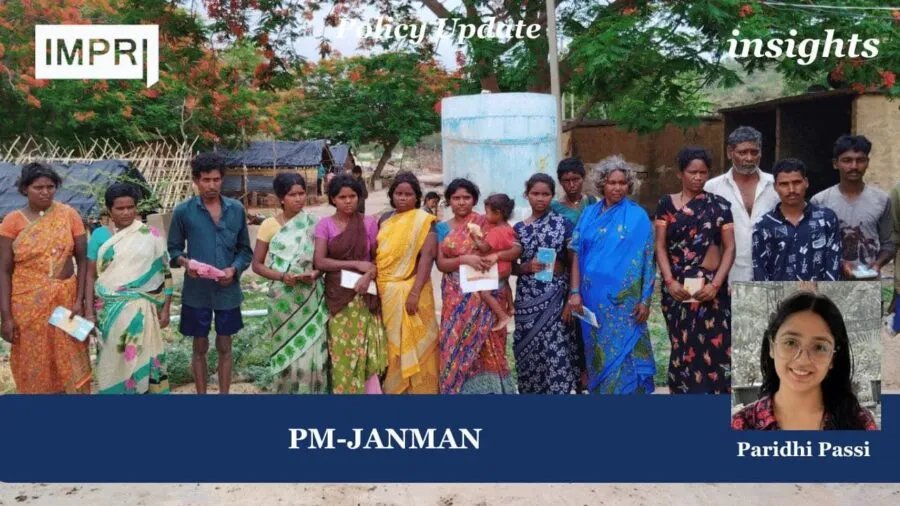
India’s welfare system has long failed to reach its most isolated communities — the Particularly Vulnerable Tribal Groups (PVTGs). These 75 communities live across 18 states and the Andaman and Nicobar Islands, in around 22,000 habitations spread over 800 blocks and 200 districts. Most depend on hunting, gathering, or shifting cultivation, literacy rates are very low, and some communities have even seen their populations decline. Mainstream schemes have repeatedly failed to reach them not because policies didn’t exist, but because delivery was never built around how these communities actually live.
The problem was recognised as far back as the Dhebar Commission of 1960-61, which led to these groups being identified during the Fourth Five Year Plan. They were originally called Primitive Tribal Groups, a term changed to PVTGs in 2006. But decades passed without any dedicated scheme with real funding. PM JANMAN (Pradhan Mantri Janjati Adivasi Nyaya Maha Abhiyan), launched in 2023, was meant to change this.
The scheme runs from FY 2023-24 to 2025-26 with a total budget of Rs. 24,104 crore, split between the centre (Rs. 15,336 crore) and states (Rs. 8,768 crore). It works through 11 interventions across 9 line ministries under the Ministry of Tribal Affairs, covering housing, drinking water, healthcare, education, mobile connectivity, and livelihoods.
Figure 1: PM JANMAN awareness poster released by PIB, Government of India.
Source: Press Information Bureau (PIB), Government of India.
Functioning
One of the more sensible design choices in PM JANMAN is that it does not try to build entirely new schemes from scratch. Instead it adapts existing central schemes to make them actually work for PVTG communities, who were often excluded earlier because of eligibility norms or cost structures that did not account for remote terrain. Housing unit costs under PM Awas Yojana-Gramin, for instance, were revised upward specifically for PVTG areas to reflect the real cost of construction in these regions.
Before implementation began, surveys were conducted across around 30,000 PVTG habitations using a mobile app on the PM Gati Shakti portal. This gave all 9 participating ministries a ground-level picture of what was missing in each habitation so that planning could start from actual data rather than assumptions.
Progress is tracked through a centralised dashboard on the PM Gati Shakti portal with real-time updates from all participating ministries. Districts are ranked monthly based on performance and the top three receive recognition, which has introduced some healthy accountability into the process. At the district level the District Collector serves as the nodal officer and quarterly reviews are held to keep track of how things are moving.
An IEC campaign launched on 25th December 2023 focused on one of the more basic but important problems, which is that many PVTG families did not have the documents needed to access any government scheme at all. Through saturation camps in tribal habitations, families were helped to get Aadhaar cards, caste certificates, and Jan Dhan accounts. In the first few months alone, over 2 lakh Aadhaar cards, 5 lakh Ayushman cards, and 50,000 Jan Dhan accounts were issued in PVTG areas.
Figure 2: PM JANMAN intervention framework showing key development initiatives for PVTG communities.

Source: Plutus IAS.
Performance
Since its launch in 2023, PM JANMAN has made progress across several intervention areas.
Table 1: Key Progress Indicators under PM JANMAN (as on 31 December 2025)
| Intervention | Ministry | Progress |
| Housing (PM Awas Yojana-G) | Rural Development | 4,73,939 houses sanctioned; 2,50,374 completed |
| Piped Water Supply | Jal Shakti | 8,199 villages saturated |
| Mobile Medical Units (MMUs) | Health and Family Welfare | 750 MMUs operational |
| Anganwadi Centres | Women and Child Development | 2,251 Anganwadi Centres operational |
| School Hostels | Education | 500 sanctioned; 8 completed |
| Electrification | Power | 1,34,995 households electrified |
| Solar Power | New and Renewable Energy | 6,154 households electrified |
| Mobile Connectivity | Communications | 3,006 habitations covered |
| Multipurpose Community Centres (MPCs) | Tribal Affairs | 375 completed |
| Van Dhan Vikas Kendras (VDVKs) | Tribal Affairs | 450 business activities started across PVTG areas |
Source: PIB, Rajya Sabha Starred Question No. 130, 11 February 2026; Ministry of Tribal Affairs.
In the first three months of the scheme, projects worth more than Rs 7,000 crore were sanctioned. Perhaps the most telling ground-level result comes from Baran district in Rajasthan, where a village of the Sahariya tribe received electricity for the first time in 78 years under PM JANMAN. This shows how neglected many of these communities had remained for decades.
Impact
The most significant thing PM JANMAN has done so far is reach households that had been effectively outside the welfare system for generations. The convergence of 9 ministries under one coordinated framework means that a single PVTG family can now receive housing, water, electricity, and healthcare through one effort rather than having to navigate several departments separately, which most of these families were never really in a position to do.
The IEC camps gave many PVTG families their first Aadhaar cards, caste certificates, and bank accounts, and that in itself opened doors. Access to PM Kisan Samman Nidhi, Ayushman Bharat, and MGNREGS, all schemes they were previously excluded from, became possible for the first time. The 750 MMUs now operational are providing OPD services, vaccinations, and TB screening in habitations that had no health facility at all before this. In Baran district alone, 123 health camps covered over 7,000 individuals in the initial phase.
There is also a constitutional dimension worth noting here, as Article 46 directly directs the state to promote the educational and economic interests of Scheduled Tribes and protect them from exploitation. Under PM JANMAN, over 5 lakh tribal families holding Forest Rights Act pattas have received PM Kisan benefits, which is a meaningful step toward connecting land rights with livelihood support in a way that had not happened before.
Emerging Issues
While the scheme has shown real progress on the ground, there are several gaps that are significant enough to question whether its stated objectives will be fully achieved.
1. Outdated Data
One of the most fundamental problems facing the scheme is the lack of updated population data. The last complete PVTG census figures available are from 2001, which recorded around 27.6 lakh individuals. Even the 2011 Census data that was placed before Parliament was incomplete, as it did not include figures from Maharashtra, Manipur, and Rajasthan. In the absence of current data, it is difficult to accurately assess whether the scheme is covering all intended beneficiaries.
2. Slow Progress on Housing and Education
By December 2025, only around 2.50 lakh houses had been completed against a target of 4.90 lakh. Issues such as land unavailability, seasonal migration of communities, and challenging terrain have been responsible for delays across multiple states. The progress on school hostels has been even slower, with only 8 out of 500 sanctioned hostels completed till date. Considering that both housing and educational access are among the scheme’s primary objectives, the scale of this gap is a matter of concern.
3. Connectivity Barriers and Uneven State Performance
Many PVTG habitations continue to have no mobile or internet connectivity, which directly affects app-based processes like Awaas Plus registration and ends up excluding some of the most vulnerable communities from receiving benefits.
Adding to this, fund release is conditional on states meeting compliance requirements on time, and states that have been slow in doing so are pulling down the overall pace of implementation. While Gujarat has been a relatively better performer, several other states have lagged behind considerably.
Policy Recommendations
Going forward, a few steps could strengthen the scheme considerably. Updated PVTG population data is urgently needed, as planning based on 2001 figures will inevitably leave gaps in coverage. Offline alternatives to app-based registration should be introduced so that poor connectivity does not exclude the most remote habitations.
On housing and hostels, district-level bottlenecks need active resolution rather than periodic review. State accountability should go beyond rankings to include public scorecards with real consequences. Finally, given how much remains incomplete, extending the scheme beyond 2025-26 with a completion-focused mandate would be far more productive than letting sanctioned projects lapse at the deadline.
Way Forward
PM JANMAN is a more serious and better-funded attempt at PVTG development than what has been attempted before. The decision to work through existing schemes rather than build new ones is practical and reduces duplication. The progress in the first two years shows that the basic model works, even if some parts have moved more slowly than expected.
With the scheme approaching the end of its planned period in 2025-26, the focus now needs to shift to completing what has already been sanctioned rather than announcing new targets.
PM JANMAN ultimately reflects a constitutional commitment to communities that have waited the longest for the most basic facilities. Articles 46 and 338A both speak to the state’s responsibility toward Scheduled Tribes. The scheme has made a real beginning and completing it well will determine whether it actually changes the lives of India’s most isolated communities in any lasting way.
References
Ministry of Tribal Affairs, GoI. (2023). PM JANMAN Official Page. https://tribal.nic.in/PM-JANMAN.aspx
PIB. (2026, February 11). Implementation of PM-JANMAN Scheme (Rajya Sabha Starred Question No. 130, as on 31 December 2025). https://www.pib.gov.in/PressReleasePage.aspx?PRID=2226306
PIB. (2025, July 30). PM-JANMAN Scheme Shows Steady Progress (Lok Sabha Statement). https://www.pib.gov.in/PressReleasePage.aspx?PRID=2147830
PIB. (2024, January 15). Projects of over Rs 7,000 crore sanctioned under PM JANMAN. https://www.pib.gov.in/PressReleasePage.aspx?PRID=2012720
PIB. (2023, December 25). IEC Campaign on PM JANMAN launched by Ministry of Tribal Affairs. https://pib.gov.in/PressReleaseIframePage.aspx?PRID=1990256
Ministry of Tribal Affairs, GoI. PM JANMAN Operational Guidelines. https://adiprasaran.tribal.gov.in/pm-janman/janman_Download/PM-JANMAN-Operational%20Guidelines.pdf
About the contributor
Paridhi Passi is a Research Intern at IMPRI and a second-year Political Science (Hons.) student at Daulat Ram College, University of Delhi. Her academic interests lie in public policy and governance.
Acknowledgement
The author extends sincere thanks to the IMPRI team for their guidance.
Disclaimer: All views and interpretations expressed in this article are solely those of the author and do not represent the views of the organization.
Read More at IMPRI