







Policy Update
Himanshi Singh
Background
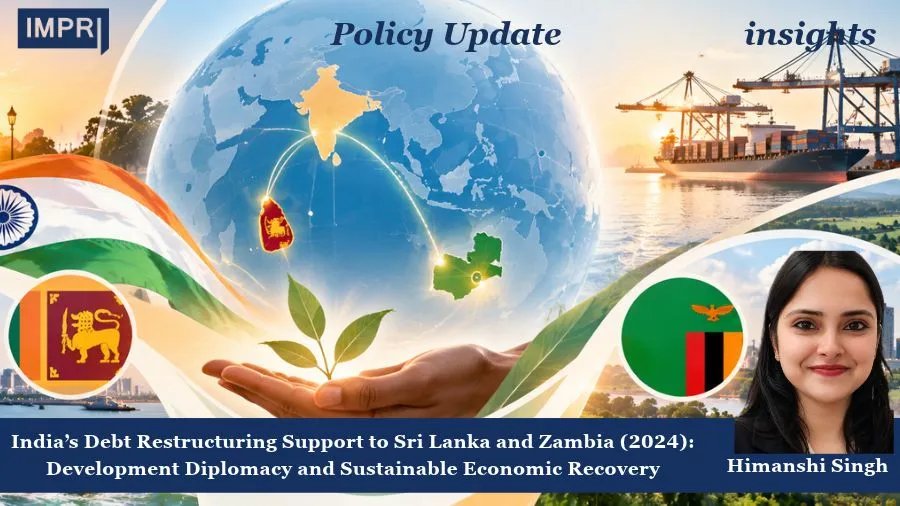
The escalating global debt crisis across the Global South has emerged as one of the most pressing challenges to post-pandemic economic recovery and sustainable development. Severe macroeconomic shocks—exacerbated by supply chain disruptions, rising international interest rates, and commodity price volatility—triggered acute balance-of-payments distress, forcing several developing nations into sovereign default. In response, India has stepped forward as a responsible regional anchor, major non-Paris Club official creditor, and proactive voice for the Global South, pioneering innovative approaches to sovereign debt relief and economic stabilization.
India’s engagement in sovereign debt restructuring is exemplified by its pivotal leadership in two landmark cases: Sri Lanka in South Asia and Zambia in Sub-Saharan Africa. When Sri Lanka faced an unprecedented economic collapse in 2022, India extended an unprecedented US$ 4 billion emergency financial and humanitarian support package, becoming the very first bilateral creditor to convey formal financing assurances to the International Monetary Fund (IMF).
Simultaneously, under the G20 Common Framework for Debt Treatments, India played a decisive role as a key official bilateral creditor in facilitating Zambia’s landmark debt relief negotiations following its 2020 default. Grounded in the principle of Vasudhaiva Kutumbakam (“the world is one family”) and reinforced during India’s 2023 G20 Presidency, New Delhi’s debt diplomacy prioritizes sustainable economic recovery, fiscal space creation for human development, and equitable creditor coordination.
Functioning
India’s sovereign debt restructuring framework operates through two main multilateral and bilateral pathways:
- The Official Creditor Committee (OCC) Framework for Middle-Income States: For Sri Lanka—a middle-income nation ineligible for the G20 Common Framework—India co-created an innovative multilateral coordination platform alongside France and Japan in April 2023. Serving as OCC Co-Chair, India helped align traditional Paris Club creditors with non-Paris Club official lenders, establishing transparent parameters for debt relief while ensuring comparability of treatment across commercial and private bondholders.
- The G20 Common Framework for Low-Income States: For low-income countries like Zambia, debt restructuring is channeled through the G20 Common Framework endorsed jointly with the Paris Club. As a major bilateral creditor acting through the Export-Import Bank of India (EXIM Bank India), India participates in the Official Creditor Committee (co-chaired by China and France) to deliver customized debt treatments—including significant maturity extensions, grace periods, and interest rate reductions—contingent on IMF-World Bank Debt Sustainability Framework assessments.
Table 1: Institutional Pathways of India’s Debt Diplomacy
| Dimension / Pillar | Sri Lanka Restructuring Framework | Zambia Restructuring Framework |
| Applicable Mechanism | Ad-hoc Official Creditor Committee (OCC) | G20 Common Framework for Debt Treatments |
| India’s Diplomatic Role | OCC Co-Chair (with France and Japan) | Key Official Bilateral Creditor (EXIM Bank India) |
| Primary Financial Vehicle | EXIM Bank Lines & Bilateral Credit Swaps | EXIM Bank Sovereign & Utility Debt Agreements |
| Policy Objective | Immediate macroeconomic balance & IMF EFF approval | Long-term debt sustainability & fiscal space creation |
Source: Ministry of External Affairs (MEA) & PIB Delhi
Recent Developments and Performance
The year 2024 and recent implementation cycles marked historic breakthroughs in formalizing sovereign debt restructuring agreements for both Sri Lanka and Zambia:
- Sri Lanka Milestone (June 2024): On June 26, 2024, the Official Creditor Committee (co-chaired by India, France, and Japan) officially signed the landmark Memorandum of Understanding (MoU) on Debt Restructuring with the Government of Sri Lanka. This MoU formalized debt treatment parameters across US$ 5.8 billion of official bilateral debt, locking in long-term repayment relief, interest rate concessions, and extended grace periods. This milestone unlocked subsequent tranches under Sri Lanka’s US$ 3 billion IMF Extended Fund Facility (EFF) program and paved the way for parallel agreements with private Eurobond holders.
- Zambia Milestone: Following the October 2023 signing of the OCC Memorandum of Understanding under the G20 Common Framework, India moved swiftly to execute its bilateral implementation agreements. Through EXIM Bank India, India finalized a bilateral debt restructuring agreement covering US$ 335 million of Zambian sovereign debt—comprising US$ 320 million in central government loans and US$ 15 million owed by ZESCO Limited (the state electricity utility). Restructured on highly concessional terms, this agreement provided immediate debt service relief for major infrastructure projects, including the Lusaka Congestion Reduction Project, the Itezhi-Tezhi Hydro Power Project, and rural health post installations.
Table 2: Comparative Performance Metrics of India’s Support (Sri Lanka vs. Zambia)
| Performance Metric | Sri Lanka Support Package | Zambia Debt Restructuring |
| Emergency Financial Support | US$ 4 billion (Currency swaps, credit lines, fuel/food) | Concessional restructuring under G20 Common Framework |
| Restructured Bilateral Claims | Part of US$ 5.8B OCC Bilateral Restructuring MoU | US$ 335 million total (US$ 320M Central Govt + US$ 15M ZESCO) |
| Key Agreement Date | OCC MoU signed June 26, 2024 | Bilateral Agreement with EXIM Bank India executed |
| Key Project Sectors Targeted | Energy, food security, fertilizer, currency stabilization | Power grid (Itezhi-Tezhi), health posts, urban roads |
Source: Ministry of External Affairs (MEA), Ministry of Finance and National Planning & PIB Delhi
Significance
India’s leadership in sovereign debt restructuring delivers multi-dimensional benefits across economic, social, strategic, and global governance domains:
- Economic and Fiscal Impact: By deferring principal repayments and lowering interest burdens, India’s debt restructuring directly frees up critical domestic fiscal space. In Zambia and Sri Lanka, this enables governments to redirect constrained public revenues away from immediate debt service toward essential public investments, health services, and education.
- Human and Social Security: Unlocking IMF financing programs and stabilizing national currencies prevents hyperinflation, secures essential imports (medicines, fuel, food grains), and protects vulnerable populations from severe poverty spikes during structural adjustments.
- Strategic and Global Governance Leadership: India’s decisive action demonstrates that non-Paris Club emerging creditors can lead transparent, rule-based multilateral debt resolution. By acting first to provide financing assurances, India bridged traditional Paris Club lenders and non-traditional bilateral creditors, positioning itself as a reliable, constructive bridge-builder between the Global South and international financial institutions.
Challenges
Despite major milestones achieved in 2024, sovereign debt restructuring under current international architectures continues to face systemic hurdles:
- Protracted Negotiation Timelines: Coordination across diverse creditor groups—including Paris Club states, non-Paris Club bilateral lenders, and private commercial bondholders—often leads to extended delays, leaving debtor nations in economic limbo for years.
- Comparability of Treatment Enforceability: Ensuring that private commercial creditors and Eurobond holders provide debt relief comparable to official bilateral concessions remains complex and legally challenging.
- Exogenous Economic Shocks: Debt-distressed developing states remain highly vulnerable to secondary climate shocks (such as droughts impacting Zambian hydropower) and global commodity price swings, which can undermine debt sustainability assumptions.
Way Forward
To strengthen international debt resolution mechanisms and ensure sustainable economic recovery across the Global South, policymakers should prioritize key structural reforms:
- Standardizing Financing Assurances: Establishing standardized timelines and automated protocols for official bilateral creditors to issue IMF financing assurances, reducing delay gaps from months to weeks.
- Expanding the G20 Common Framework Scope: Reforming the Common Framework to explicitly include middle-income vulnerable states (like Sri Lanka) alongside low-income countries, avoiding ad-hoc committee fragmentation.
- Integrating Climate Resilient Debt Clauses (CRDCs): Incorporating automatic debt service suspension clauses into sovereign loan agreements to buffer vulnerable developing nations against natural disasters and climate shocks.
References
Center for Global Development. (2024, October 24). Zambia: A case study of sovereign debt restructuring under the G20 Common Framework (Working Paper 707). https://www.cgdev.org/publication/zambia-case-study-sovereign-debt-restructuring-under-g20-common-framework
Ministry of External Affairs. (2024, June 26). MoU on debt restructuring between Official Creditors Committee and the Government of Sri Lanka [Press release]. Government of India. https://www.mea.gov.in/press-releases.htm?dtl/37909/MoU_on_debt_restructuring_between_Official_Creditors_Committee_and_the_Government_of_Sri_Lanka
Ministry of Finance and National Planning. (2023, June 22). Zambia reaches agreement with official creditors on debt treatment under the G20 Common Framework. Government of the Republic of Zambia. https://www.mofnp.gov.zm/?p=7444
Ministry of Finance and National Planning. (2023, October 14). Zambia agrees Memorandum of Understanding with Official Creditor Committee paving way for debt treatment completion. Government of the Republic of Zambia. https://www.mofnp.gov.zm/?p=7562
Press Information Bureau. (2023, April 13). Launch of the Official Creditor Committee for Sri Lanka under the co-chairmanship of India, France and Japan. Ministry of Finance, Government of India. https://pib.gov.in/PressReleasePage.aspx?PRID=1916301
About the Contributor
Himanshi Singh is a research & editorial intern at the Impact and Policy Research Institute (IMPRI). She holds a postgraduate degree in political science and international relations. Her research interests include foreign policy, strategic studies, public policy, national security, diplomacy, and global governance, with a particular focus on India’s external relations and evidence-based policy research.
Reviewer: Vyomini Nathwani & Khushi
Acknowledgement
The author sincerely thanks the IMPRI Editorial Desk for invaluable mentorship and guidance during the development of this policy update. Special thanks are also extended to fellow interns for their thoughtful inputs and support throughout the research process.
Disclaimer
The views expressed are those of the author and do not necessarily reflect the official policy of IMPRI. All information is based on publicly available official government publications and is compiled solely for academic and research purposes.
Read More at IMPRI:
Critical Mineral Recycling Incentive Scheme, 2025: Strengthening India’s Circular Mineral Security