



From Emergency Response to Sustained Air Quality Management
Policy Update
Rakesh Leel
INTRODUCTION
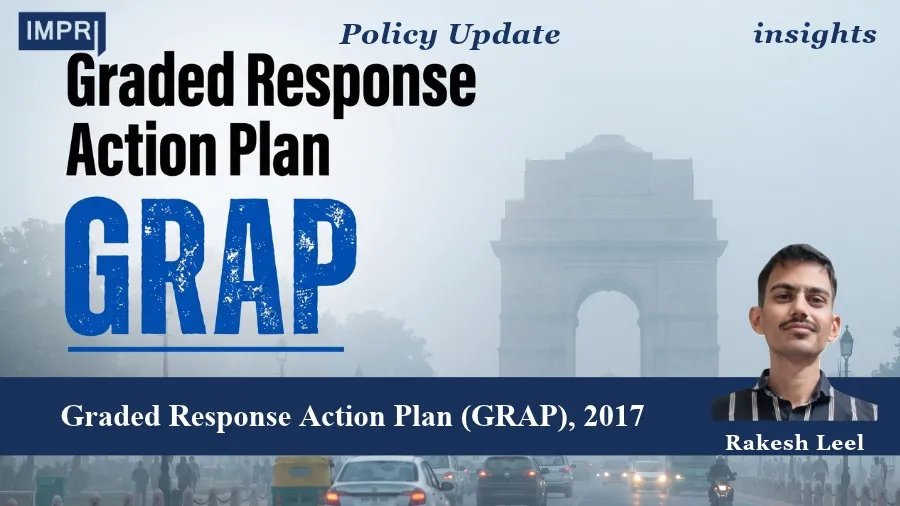
Air pollution in Delhi-NCR has evolved from a seasonal environmental concern into a recurring public health and governance challenge. Every winter, a combination of vehicular emissions, industrial activities, construction dust, biomass burning and unfavourable meteorological conditions contributes to a sharp deterioration in air quality. In this context, the Government of India introduced the Graded Response Action Plan (GRAP) in January 2017 to establish a structured mechanism for responding to different levels of air pollution. It provides a pre-defined set of preventive and restrictive measures that become progressively stringent as air quality deteriorates.
However, the repeating episodes of severe pollution raise an important policy question: can an emergency response mechanism deliver lasting improvements in air quality without addressing the structural sources of pollution? This article examines GRAP’s evolution, functioning, performance, impact and the reforms required to strengthen its effectiveness.
BACKGROUND
Institutional Foundation and Notification
The Supreme Court in November 2016, while hearing the M.C. Mehta v/s Union of India case, directed the Central Pollution Control Board (CPCB) to formulate a graded response mechanism for different categories of the National Air Quality Index (AQI). Following consultations with government departments, implementing agencies and other stakeholders, CPCB submitted its proposal to the Supreme Court. On 2 December 2016, the Court directed the Central Government to examine the proposal and issue an appropriate notification under the Environment (Protection) Act, 1986.
Consequently, the Ministry of Environment, Forest and Climate Change (MoEFCC) notified GRAP through Notification S.O. 118(E) on 12 January 2017, assigning its implementation to the Environment Pollution (Prevention and Control) Authority (EPCA). The framework was intended to address episodic increases in pollution through a graded set of actions rather than relying on emergency restrictions after pollution had already reached dangerous levels (MoEFCC, 2017).
Evolution of the Framework
The Government enacted the Commission for Air Quality Management in National Capital Region and Adjoining Areas Act, 2021. This established the Commission for Air Quality Management (CAQM) as a statutory body responsible for coordinating air pollution control across Delhi-NCR and adjoining areas. With this change, CAQM took over the role previously performed by EPCA in overseeing GRAP.
The framework was later revised several times to incorporate air-quality forecasts into decision-making:
- September 2024 revision: introduced an important change by allowing Stages II, III and IV to be invoked in advance when forecasts indicated that the corresponding AQI levels were likely to persist.
- September 2026 revision: further rationalised the schedule, moving interventions to earlier stages and increasing vehicle and construction-related restrictions.
Thus, GRAP has evolved from a primarily threshold-triggered emergency mechanism into a more anticipatory and regionally coordinated framework.
FUNCTIONING
Graded Intervention based on AQI
GRAP operates through four stages corresponding to different levels of air pollution. Each stage introduces additional restrictions and preventive measures, while actions prescribed under earlier stages generally continue.
| Stage | AQI category | AQI range | Broad nature of intervention |
| Stage I | Poor | 201–300 | Preventive measures and dust control |
| Stage II | Very Poor | 301–400 | Intensified pollution-control measures |
| Stage III | Severe | 401–450 | Restrictions on construction and selected vehicle categories |
| Stage IV | Severe+ | Above 450 | Stringent emergency restrictions |
Table 1: GRAP stages and corresponding AQI categories. [Source: CAQM, revised GRAP schedule]
Emphasis as per stages:
- Stage I: the emphasis is on road cleaning, dust suppression, proper waste management and enforcement of pollution-control norms.
- Stage II: strengthens these interventions through additional restrictions on diesel generator sets, increased public transport arrangements and other measures.
- Stage III: introduces restrictions on dust-generating construction activities and selected categories of older vehicles.
- Stage IV: brings further emergency restrictions which includes stringent controls on vehicle movement and other polluting activities.
Institutional Coordination
CAQM is responsible for coordinating the implementation of GRAP through its Sub-Committee on GRAP. The Commission reviews air-quality conditions, examines forecasts and issues directions for the invocation or withdrawal of different stages.
CPCB provides air-quality monitoring information, while the India Meteorological Department (IMD) and Indian Institute of Tropical Meteorology (IITM) provide meteorological and air-quality forecasts. Implementation responsibilities are distributed among the Delhi Pollution Control Committee (DPCC), State Pollution Control Boards (SPCB), municipal corporations, traffic police and other concerned agencies.
Figure 1: Institutional functioning of GRAP
The revised framework’s important feature is its predictive approach. Under the September 2024 revision, Stages II, III and IV can be invoked in advance when forecasts indicate that pollution is likely to reach and sustain the corresponding levels for approximately three days or more. This is intended to reduce the delay between identifying an upcoming pollution episode and implementing restrictions (CAQM, 2024).
PERFORMANCE
Evaluating GRAP requires distinguishing between administrative implementation and actual improvements in air quality. The number of inspections, deployment of machinery and invocation of restrictions indicate administrative activity, but do not independently establish a reduction in pollution exposure.
Operational Implementation
The CAQM Annual Report 2024–25 provides quantitative information on the deployment of mechanical road sweeping machines across Delhi and NCR.
| Region | Average daily machines deployed | Average roads swept (km/day) |
| Delhi | 85 | 2,837 |
| Haryana NCR | 75 | 1,950 |
| Uttar Pradesh NCR | 41 | 975 |
| Rajasthan NCR | 9 | 115 |
Table 2: Mechanical road sweeping operations during 2024–25 [Source: CAQM Annual Report 2024–25]
These figures demonstrate the scale of dust-management operations undertaken across NCR. However, they also highlight substantial differences in operational capacity across regions. The number of machines deployed must be assessed alongside the actual road length covered, frequency of cleaning and effectiveness of dust suppression.
CAQM’s wider enforcement mechanism also indicates significant regulatory activity. By 31 March 2025, its 40 flying inspection teams had inspected 20,423 sites. The Commission reported closure directions for 1,204 units identified as grossly non-compliant with statutory directions, including industrial premises, construction sites and entities using diesel generator sets (CAQM, 2025).
Frequency of GRAP invocation
The CAQM Annual Report 2024–25 recorded 37 meetings of the GRAP Sub-Committee during the reporting period. The respective stages remained in effect for approximately:
| GRAP stage | Days in effect |
| Stage I | 153 |
| Stage II | 127 |
| Stage III | 44 |
| Stage IV | 27 |
Table 3: Reported duration of GRAP stages during 2024–25. [Source: CAQM Annual Report 2024–25]
The duration of different stages indicates the recurring nature of pollution episodes and the substantial administrative response required. It also raises questions about whether repeated emergency interventions are being complemented by sufficient year-round reductions in emissions.
Compliance Gaps
CAQM’s performance review (19 January 2026) identified significant shortcomings in the implementation of GRAP Stages III and IV.
- During Stage III, inspections of construction and demolition sites with plot areas of 500 square metres and above fell short of prescribed requirements by 87% in Delhi, 99.6% in Haryana NCR, 84% in Rajasthan NCR and 96% in Uttar Pradesh NCR.
- During Stage IV, the corresponding inspection shortfalls were 87%, 100%, 79% and 97%, respectively.
The review also identified pendency in citizen complaints.
- During Stage III, 47% of complaints received in Delhi and 71% in Uttar Pradesh NCR remained unresolved.
- During Stage IV, the unresolved share increased to 68% in Delhi and 81% in Uttar Pradesh NCR.
These findings reveal a significant implementation deficit. The framework specifies responsibilities and interventions but its success depends on the capacity of local agencies to translate directions into timely action (CAQM, 2026a).
IMPACT
Environmental
GRAP’s principal contribution lies in providing a coordinated mechanism to contain pollution during periods of deteriorating air quality. Restrictions on construction activities, industrial operations and certain vehicle categories, alongside dust suppression and waste-management measures, can help reduce additional emissions during severe episodes.
Public Health
The public health significance of these interventions is considerable.
- Exposure to fine particulate matter (PM2.5) is associated with respiratory and cardiovascular illnesses, particularly among children, older people and outdoor workers.
- The World Health Organization’s 2021 guidelines recommend an annual mean PM2.5 concentration of 5 µg/m³. This highlights the public health challenge posed by these persistent particulate pollution.
However, a critical distinction must be made between reducing exposure during an emergency and achieving sustained improvements in ambient air quality. GRAP may help prevent further deterioration, but its independent contribution to changes in annual pollution levels remains difficult to establish.
Socio-Economic
Emergency restrictions also generate economic costs.
- Construction bans affect daily-wage workers, contractors and small businesses dependent on construction activity.
- Restrictions on vehicle movement affect transport operators and commercial mobility.
- School closures and hybrid learning arrangements disrupt education.
These costs are not distributed equally. Informal workers and small enterprises have limited financial capacity to absorb sudden disruptions.
Governance
GRAP has strengthened coordination among multiple institutions. However, persistent compliance gaps suggest that issuing directions does not automatically translate into effective enforcement. The framework therefore needs to balance environmental protection with implementation capacity and social considerations.
EMERGING ISSUES
Structural Nature of GRAP
A major limitation of GRAP is its dependence on emergency interventions. Vehicular emissions, road dust, industrial activities and waste burning continue throughout the year. A seasonal restriction cannot substitute for sustained reductions in these sources.
Regional and Seasonal variations
Air pollution is not confined to Delhi’s administrative boundaries. Regional transport of pollutants, agricultural residue burning and meteorological conditions influence air quality across NCR. Moreover, the dominant sources vary by season.
A report of 33 domain experts considered by CAQM in February 2026, based on source-apportionment studies conducted between 2015 and 2025, identified the following major contributors to PM2.5:
| Pollution source | Winter (%) | Summer (%) |
| Secondary particulates | 27 | 17 |
| Transport | 23 | 19 |
| Biomass burning | 20 | 12 |
| Dust | 15 | 27 |
| Industry, including thermal power plants | 9 | 14 |
| Other Sources* | 6 | 11 |
Table 4: Selected source contributions to PM2.5 in Delhi. [Source: CAQM, 20 February 2026]
*Other sources refer to small dispersed and unclassified sources not typically categorized within the above mentioned major sectors

Figure 2. Seasonal contribution of major sources to PM2.5 in Delhi. [Source: CAQM (2026b)]
The findings demonstrate that a uniform response cannot adequately address the changing composition of pollution. While secondary particulates, transport and biomass burning are prominent during winter, dust assumes greater importance during summer (CAQM, 2026b).
Accountability
January 2026 performance review underlines the gap between prescribed actions and actual implementation. Delays in inspections, unresolved complaints and uneven municipal capacity weaken the overall response. Similarly, although predictive invocation is an improvement, its effectiveness depends on the accuracy of forecasts, timely communication and preparedness of implementing agencies.
WAY FORWARD
Airshed-based approach:
- Air pollution must be addressed as a regional problem rather than a Delhi-specific concern. CAQM’s 2022 Comprehensive Policy for Air Pollution Abatement provides a useful framework through differentiated interventions for Delhi, nearby NCR districts and other regions.
- It proposes short-term (one year), medium-term (two to three years) and long-term (three to five years) measures across major pollution sources.
- This approach should be strengthened through common regional targets, coordinated action plans and periodic performance reviews involving all concerned state governments.
Source-specific interventions
- Policy measures must target the actual sources of emissions: expanding affordable public transport, improving vehicle-emission enforcement, promoting cleaner industrial fuels, strengthening construction-dust management and providing farmers with viable alternatives to crop-residue burning.
- CAQM’s 2026 expert assessment reinforces the need for seasonal and source-specific interventions instead of relying predominantly on temporary restrictions.
Improve Monitoring and Accountability
- The Commission should strengthen its compliance-monitoring framework through geotagged inspections, GPS-based tracking of road-cleaning machinery, functional CCTV systems at construction sites and publicly accessible agency-wise performance dashboards.
- Time-bound grievance redressal and independent verification of implementation are equally important.
- Performance should be measured not simply by the number of machines deployed or inspections conducted, but by actual coverage, compliance and measurable pollution reduction.
Health and Social protection
- Air-quality management should be complemented by public health surveillance, early-warning systems and targeted protection for vulnerable populations.
- At the same time, compensation or livelihood-support mechanisms should be considered for workers disproportionately affected by emergency restrictions.
Finally, performance evaluation should extend beyond daily AQI readings to include annual PM2.5 and PM10 concentrations, source-specific emission reductions and population exposure.
CONCLUSION
The Graded Response Action Plan represents an important institutional step in India’s efforts to manage air pollution. Its evolution from a judicially driven emergency framework in 2017 to a forecast-based, NCR-wide mechanism reflects improvements in coordination, monitoring and policy design. However, recurring severe pollution episodes and documented implementation gaps demonstrate that emergency restrictions alone cannot deliver lasting improvements. The effectiveness of GRAP should be assessed not by the speed with which restrictions are imposed, but by its contribution to sustained emission reductions.
REFERENCES
- Central Pollution Control Board. (2016, December 2). Graded response action plan according to pollution levels in Delhi and NCR to inform public action and to take effective steps to combat public health emergencies.
https://environment.delhi.gov.in/sites/default/files/environment/important-news/graded_response_action_plan.pdf - Commission for Air Quality Management. (2022, July 13). Comprehensive policy to abate the menace of air pollution in Delhi-NCR.
https://caqm.nic.in/WriteReadData/LINKS/24%20CAQM%20PR%2013%20Julycde27ff9-d05e-4226-b307-5e21552a822c7c8d5700-8632-4496-b043-6d36303d98f5.pdf - Commission for Air Quality Management. (2024). Graded Response Action Plan (GRAP) for NCR (Revision: September 2024).
https://caqm.nic.in/WriteReadData/LINKS/Grap%20Schedulea253967f-7436-4773-819a-9277592a1d2d.pdf - Commission for Air Quality Management. (2025). Annual report 2024–25.
https://caqm.nic.in/WriteReadData/LINKS/7bb814e6-844c-48b9-91cc-aa1909f9a7d8.pdf - Commission for Air Quality Management. (2026a, January 19). CAQM reviews performance of DPCC/SPCBs in NCR during periods of Stage-III and IV of GRAP; serious deficiencies and wide gaps flagged.
https://caqm.nic.in/FileUploadDomain/WebsiteDocument/Connect/Press%20Releases/CAQM%20PR%2019012026%20%28GRAP%20Performance%20Report%29a47e058f-4786-43a8-8246-00048db17236.pdf - Commission for Air Quality Management. (2026b, February 20). 27th meeting of the Full Commission.
https://caqm.nic.in/WriteReadData/LINKS/CAQM%20PR%2020_02_2026%20%2827th%20Full%20Commission%20Meeting%29215dd653-95ed-4eaf-8cf4-fc461245b876.pdf - Government of India. (2021). The Commission for Air Quality Management in National Capital Region and Adjoining Areas Act, 2021 (Act No. 29 of 2021).
https://www.indiacode.nic.in/bitstream/123456789/16898/1/a2021-29.pdf - Ministry of Environment, Forest and Climate Change. (2017, January 12). Notification S.O. 118(E): Graded Response Action Plan.
https://environment.delhi.gov.in/sites/default/files/environment/important-news/graded_response_action_plan.pdf - Press Information Bureau. (2024, September 18). CAQM announces revised GRAP schedule for Delhi-NCR in wake of the upcoming winter season.
https://www.pib.gov.in/Pressreleaseshare.aspx?PRID=2056075 - Press Information Bureau. (2026, September 29). CAQM approves revised GRAP schedule; tightens measures for vehicles, dust and pollution control.
https://www.pib.gov.in/PressReleseDetailm.aspx?PRID=2316597 - World Health Organization. (2021). WHO global air quality guidelines: Particulate matter (PM2.5 and PM10), ozone, nitrogen dioxide, sulfur dioxide and carbon monoxide.
https://www.who.int/publications/i/item/9789240034228
About the Contributor
Rakesh Leel is a Research and Editorial Intern at the Impact and Policy Research Institute (IMPRI). He is a B.Tech graduate (Sardar Patel College of Engg, Mumbai University) and currently pursuing a Masters in Economics (IGNOU). He has a work-ex of an NGO, Content Research, and also has cleared 3 UPSC CSE Prelims. His research interests span across macro-economics, Indian governance, and sustainable development. He is keen to build a career in public policy research and analysis.
Acknowledgements
I sincerely thank the Impact and Policy Research Institute (IMPRI) for providing me with the opportunity to research and write this Policy Update. Reviewed by Gowri Kodali and Shailja Singh. I am grateful to the IMPRI team for their valuable guidance, encouragement and support in strengthening my understanding of public policy research and analysis.
Disclaimer:
All views expressed in the article belong solely to the author and not necessarily to the organisation.
Read more at IMPRI:
Regulating Women’s Autonomy: The Link Between Moral Policing and Sexual Violence
National Coastal Mission 2.0 (Ministry of Environment, Forest and Climate Change)