




Policy Update
Aditya Chavan
Background
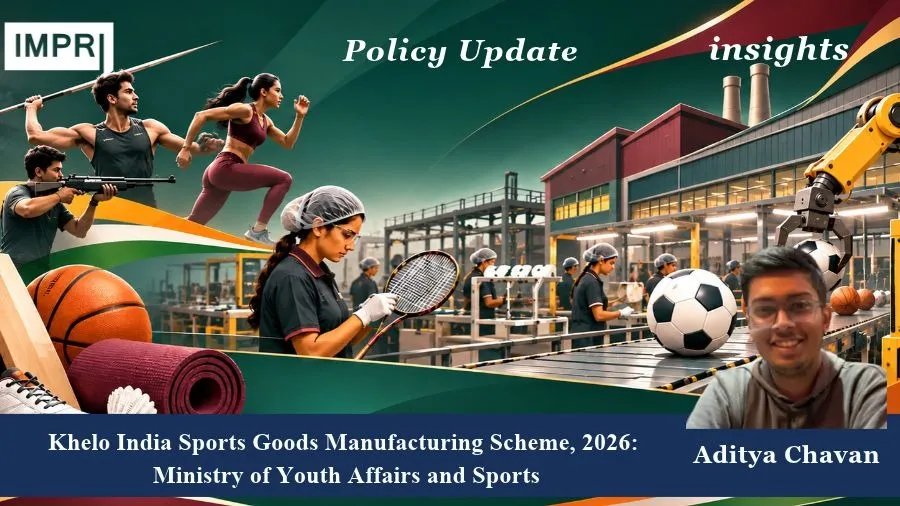
India has a large sporting population but a small place in the global sports goods trade. The Union Budget 2026–27 announced an initiative to promote sports goods manufacturing, with an allocation of Rs 500 crore, aimed at expanding domestic capacity, research in equipment design and material sciences, and India’s presence in global supply chains (Press Information Bureau, 2026c). On 28 October 2026 the Union Cabinet approved the Khelo India Sports Goods Manufacturing Scheme with a total outlay of Rs 1,856.67 crore for the period from 2026–27 to 2033–34 (Press Information Bureau, 2026a).
The Cabinet release places the scheme within the Khelo Bharat Niti 2025, Make in India, Atmanirbhar Bharat and Viksit Bharat@2047 (Press Information Bureau, 2026a). It sets two aims: to strengthen domestic manufacturing, investment, technology, skilling, certification and market development, and to improve India’s position in global sports goods supply chains and exports.
The scheme sits beside the revamped Khelo India programme for 2026–27 to 2030–31, which has a combined outlay of Rs 36,441 crore and concentrates on training, competitions and infrastructure. The new scheme addresses a different part of the sports system, namely the production of equipment. The Ministry’s budget has grown from Rs 1,219 crore in 2013–14 to Rs 4,479.88 crore in 2026–27, and Khelo India itself has Rs 924.35 crore in 2026–27. About 65 per cent of the population is under 35 (Press Information Bureau, 2026c).
The government’s own figures describe an industry that is small in trade and fragmented in structure. India’s sports equipment exports are about US$275 million, against a global market of about US$140 billion in 2024.
The domestic sports goods market is about US$2.5 billion, of which equipment is about US$0.5 billion, and micro, small and medium enterprises (MSMEs) account for nearly 90 per cent of production. Jalandhar and Meerut are the main clusters, with over 250 exporting units, more than 1,000 units serving the domestic market, over 4,000 micro enterprises and nearly 20,000 household units. India-based brands hold an estimated 75 to 80 per cent of the global cricket bat market and 30 to 35 per cent of the cricket helmet market (Press Information Bureau, 2026b).
Functioning
The scheme has seven components, which the releases describe at different levels of detail (Press Information Bureau, 2026a, 2026b). Sports Goods Manufacturing Zones (SGMZs) are cluster-based zones that bring together manufacturers, suppliers, testing facilities, and design and prototyping centres. They are to be developed through convergence with the Bharat Audyogik Vikas Yojna (BHAVYA) and the National Industrial Corridor Development Corporation (NICDC) Industrial Parks, and the release says there “may be” four such zones, each covering more than 300 acres (Press Information Bureau, 2026b). Cluster upgradation would support common facilities and shared infrastructure in existing clusters, with costs shared with the states.
Two financial incentives anchor the scheme. Anchor Investment Support offers 20 per cent capital expenditure support to investors who commit at least Rs 100 crore within an SGMZ. Turnover Linked Support offers incentives of up to 15 per cent of turnover to manufacturers who invest Rs 10 crore or more. A third incentive covers international certification, meeting 70 per cent of the cost of first-time certification and 50 per cent of renewal costs for manufacturers seeking approval from international sports federations. Start-ups registered with the Department for Promotion of Industry and Internal Trade (DPIIT) are eligible for grants of up to Rs 20 lakh (Press Information Bureau, 2026b).
The remaining components work mostly through other bodies. Centres of Excellence and research co-funding run through the Anusandhan National Research Foundation, skilling through the Ministry of Skill Development and Entrepreneurship, and market development through the India Sports Expo, a Brand India campaign and the Export Promotion Mission (Press Information Bureau, 2026a, 2026b). The scale of the schemes that the SGMZs depend on is considerable. The release records Rs 33,660 crore for BHAVYA, which is meant to develop 100 plug-and-play industrial parks, and Rs 25,060 crore for the Export Promotion Mission over 2025–26 to 2030–31. The scheme’s own outlay is small beside these, which suggests that much of its reach will come from using their infrastructure and channels. This analysis is based on official PIB releases, namely the Cabinet release, the accompanying release on the scheme and the PIB document on Khelo India. The scheme guidelines were not available in these sources.
Impact
Table 1 sets out the incentive structure as stated in the official releases.
Table 1
Principal Incentives under the Khelo India Sports Goods Manufacturing Scheme
| Component | Support and eligibility as stated |
| Anchor Investment Support | 20% capital expenditure support; investors committing at least Rs 100 crore within an SGMZ. |
| Turnover Linked Support | Incentives of up to 15% of turnover; manufacturers investing Rs 10 crore or more. |
| International certification | 70% of first-time certification costs and 50% of renewal costs; manufacturers seeking international sports federation certification. |
| Start-up support | Grants of up to Rs 20 lakh; DPIIT-registered sports start-ups. |
| Cluster upgradation | Cost-sharing with states for common facilities and shared infrastructure; further criteria not specified. |
Source: Press Information Bureau (2026b).
The releases give component outlays for only two items. Anchor Investment Support and Turnover Linked Support together have Rs 1,130 crore, and international certification has Rs 105 crore (Press Information Bureau, 2026a, 2026b). On this basis, the two lines together make up Rs 1,235 crore, or about 66.5 per cent of the total outlay. The remaining Rs 621.67 crore, about 33.5 per cent, is not assigned to any component in the releases. Figure 1 shows this split.
Figure 1
Outlay of the Scheme by Stated Component (Total Rs 1,856.67 Crore)
Source: Press Information Bureau (2026a, 2026b). The unitemised amount is calculated as the total outlay less the two stated component outlays.
The Rs 500 crore announced in the Budget and the Rs 1,856.67 crore approved by the Cabinet are different figures. The sources reviewed do not say whether the Budget amount is the first-year allocation, a part of the multi-year outlay or a separate provision. Nor do they give targets for investment, production or employment in the scheme itself.
The government’s export aspiration is stated as a potential, not a target. The release states that exports could reach about US$8.1 billion by 2036 from the current US$275 million, with about 54 lakh additional direct and indirect jobs (Press Information Bureau, 2026b). That is about 29 times the current level. The global market is projected to reach about US$283 billion by 2036, so the figure would equal about 2.9 per cent of it, against roughly 0.2 per cent now (calculated using the 2024 global figure). Exports at US$275 million equal about 11 per cent of the US$2.5 billion domestic market (calculated from the figures above), which indicates that the industry sells mainly at home. Figure 2 shows the potential stated in the release.
Figure 2
Export and Employment Potential Stated for 2036

Source: Press Information Bureau (2026b). The release describes these as potential outcomes, not targets.
The scheme moves sports policy from supporting athletes towards building an industrial base. Earlier Khelo India efforts concentrated on training centres, infrastructure and competitions, with 349 infrastructure projects approved and 1,067 centres established by July 2026 (Press Information Bureau, 2026c). Domestic equipment production adds a supply side to that demand, and the scheme’s stated aim of reducing import dependence follows from it (Press Information Bureau, 2026b).
The design resembles other industrial support measures in this series. It combines capital support, an output-linked incentive and a cluster-based approach, and it uses existing programmes (BHAVYA, NICDC parks and the Export Promotion Mission) instead of building new delivery channels (Press Information Bureau, 2026a, 2026b). The investment thresholds of Rs 100 crore for anchor investors and Rs 10 crore for turnover support indicate that the main incentives are aimed at larger and mid-sized investors, with MSMEs reached mainly through clusters, certification and start-up support. This inference rests on the thresholds stated in the release.
The scheme also connects to the export-support measures covered earlier in this series. Where the Remission of Duties and Taxes on Exported Products (RoDTEP) scheme and the Credit Guarantee Scheme for Exporters (CGSE) work on the cost and credit side of exporting, this scheme works on the supply side, by creating the capacity, quality standards and brands that exporters need. It names the Export Promotion Mission as a channel for market development (Press Information Bureau, 2026a). Whether these schemes reinforce one another will depend on how they are coordinated in practice.
The certification component targets a cost faced by manufacturers who seek approval from international sports federations. By meeting 70 per cent of first-time costs and 50 per cent of renewal costs, the scheme reduces that cost, which is likely to be most relevant to smaller manufacturers (Press Information Bureau, 2026b). It is also the only component with a separate outlay besides the main incentives.
Emerging Issues
The first issue is the unexplained portion of the outlay. About one-third of the Rs 1,856.67 crore is not assigned to a component in the releases, and the split between Anchor Investment Support and Turnover Linked Support is also not given (Press Information Bureau, 2026a, 2026b). Detailed guidelines would be needed to see how the money is meant to be used.
The second issue is the reach of the incentives. The investment thresholds suggest that the largest incentives go to bigger firms, while the industry described in the releases is nearly 90 per cent MSME and includes about 20,000 household units. How many existing units would qualify is not stated (Press Information Bureau, 2026b).
The third issue is the absence of targets. The releases give potential figures for 2036 but no annual targets for investment, production, exports or jobs, and the SGMZs are described as ones that “may be” set up (Press Information Bureau, 2026b). Without milestones, progress is harder to assess over a period that runs to 2033–34. Land for zones of more than 300 acres each, and the time needed to build them, will also affect when manufacturers can use the anchor incentives.
The fourth issue is the dependence on other schemes. SGMZs, skilling, research and market promotion all rely on programmes run by other ministries (Press Information Bureau, 2026a, 2026b). Their pace will depend on those schemes’ own allocations and timelines, which this article has not examined.
Way Forward
To strengthen implementation and allow progress to be assessed, the following policy measures are recommended.
1. Publish the full component-wise allocation. The Rs 621.67 crore not itemised in the releases, and the split of the Rs 1,130 crore between Anchor Investment Support and Turnover Linked Support, should be stated, so that investors and state governments can see how much support is available under each component and in which years.
2. Release the scheme guidelines early. The guidelines should set out eligibility rules, the application procedure, the criteria for selecting SGMZ locations and the role of the states, so that manufacturers can plan investments before the first zones are notified.
3. Set annual indicators and report against them. Targets for investment, production, exports and employment, reported each year, would allow the 2036 potential to be tracked against actual progress over a period that runs to 2033–34.
4. Extend support to MSMEs and household units. Given the Rs 100 crore and Rs 10 crore investment thresholds, specific arrangements in clusters such as Jalandhar and Meerut, including common facilities, shared testing and access to certification support, would help ensure that smaller units benefit.
5. Reconcile the Budget and Cabinet figures. A clear explanation of how the Rs 500 crore announced in the Budget relates to the Rs 1,856.67 crore approved by the Cabinet would allow annual allocations to be read correctly.
6. Publish periodic data on early outcomes. Data on certifications supported and start-up grants disbursed, which are the components most likely to show early results, would give an early indication of whether the scheme is reaching its intended beneficiaries.
7. Coordinate with the schemes on which the zones depend. Alignment of timelines with BHAVYA, the NICDC Industrial Parks and the Export Promotion Mission, under a named nodal agency, would reduce delays in developing the zones.
Conclusion
The Khelo India Sports Goods Manufacturing Scheme brings equipment manufacturing into the country’s sports policy, with an outlay of Rs 1,856.67 crore to 2033–34 and a mix of capital support, turnover-linked incentives, certification support and cluster development. It starts from a small export base of about US$275 million and a fragmented, MSME-led industry. Several details that determine its effect are not yet public: the allocation of about one-third of the outlay, the scheme guidelines and any targets. Its results will depend on how those are settled and on how well the support reaches the clusters that now produce most of India’s sports goods.
References
- Press Information Bureau. (2026a, October 28). Cabinet approves Khelo India Sports Goods Manufacturing Scheme for building a globally competitive sports manufacturing ecosystem [Press release]. Ministry of Youth Affairs and Sports, Government of India. https://www.pib.gov.in/PressReleasePage.aspx?PRID=2329481®=48&lang=2
- Press Information Bureau. (2026b, October 28). Khelo India Sports Goods Manufacturing Scheme [Press release]. Ministry of Youth Affairs and Sports, Government of India. https://www.pib.gov.in/PressReleasePage.aspx?PRID=2329701®=48&lang=2
- Press Information Bureau. (2026c, August 3). The making of a sporting nation: Khelo India and the road to international excellence [Backgrounder]. Government of India. https://static.pib.gov.in/WriteReadData/specificdocs/documents/2026/aug/doc202683941901.pdf
About the Contributor
Aditya Chavan is an Economics undergraduate at Symbiosis School of Economics, Pune, with research interests spanning public policy, MSME development, financial inclusion, and economic governance. His work focuses on analysing government policies and institutional reforms aimed at fostering inclusive and sustainable economic development.
Acknowledgement
The author is grateful to IMPRI – Impact and Policy Research Institute for the opportunity to prepare this policy update, and acknowledges the guidance and feedback received during the review process, which helped strengthen the quality of this article.
Disclaimer
The views expressed in this article are solely those of the author and do not necessarily reflect the views of IMPRI or any affiliated institution.
Reviewers: Gowri Kodali, Shiva Karthik