








Policy Updates
Manisha Kumari
Background
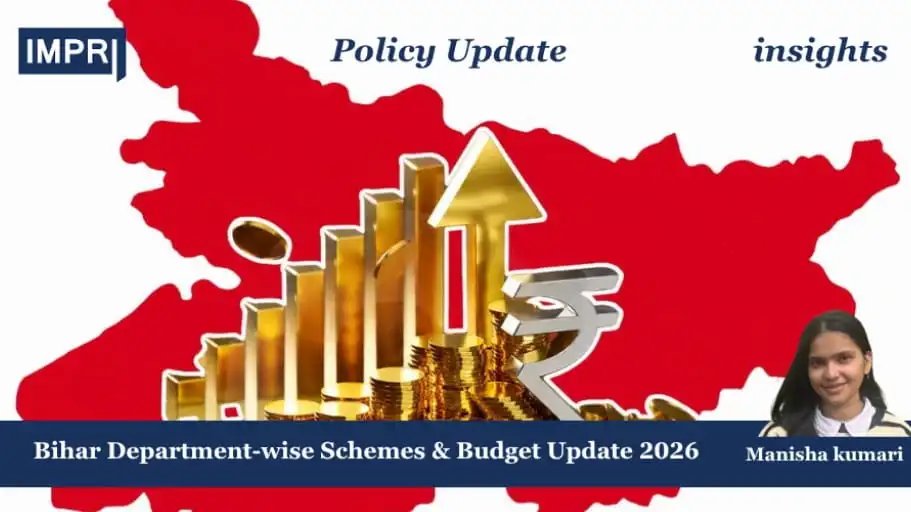
Bihar’s 2026 Budget reflects a development approach that combines long-standing welfare programmes with newer priorities such as employment, women’s economic participation, infrastructure, tourism and water management. The state has provided for total expenditure of ₹3,47,589.76 crore in 2026 , including scheme expenditure of ₹1,22,155.42 crore.
The department-wise pattern of schemes and allocations indicates that Bihar’s policy priorities are gradually expanding beyond traditional welfare delivery. Rural development, education and urban development remain major spending areas, highlighting the continued importance of rural livelihoods, human capital and basic infrastructure. At the same time, newer initiatives in areas such as women’s employment, tourism and resource management point towards a greater focus on economic participation and development-oriented interventions.
This shift can also be seen in the timeline of Bihar’s schemes. Long-running programmes such as Integrated Child Development Services (ICDS), launched in 1975; Lok Adalat, introduced in 1987; and the Building and Other Construction Workers (BOCW) Welfare Scheme, launched in 1996, represent the continuity of the state’s welfare and social-protection framework. In comparison, recent initiatives such as Mukhyamantri Mahila Rojgar Yojana (2025) and 2026 initiatives related to heli-tourism, air-tourism and river interlinking reflect newer policy concerns.
However, budget allocation by itself does not establish the success or impact of a scheme. Allocations indicate the government’s stated priorities, while actual performance needs to be assessed through implementation, expenditure, beneficiary coverage and measurable outcomes. Therefore, this article examines Bihar’s schemes department-wise, linking budgetary priorities with available evidence on implementation and impact to understand how the state’s policy approach is evolving.
This framing directly addresses your reviewer’s concern about a central argument, empirical analysis, department-wise categorisation, and performance/impact, while keeping the language natural and publication-friendly.
Functioning
Bihar’s schemes are implemented through individual departments, directorates, boards and district-level administrative structures. The Finance Department coordinates the state’s budgetary process, expenditure planning and financial management. The official Finance Department portal provides access to the 2026 budget documents and related financial information. The functioning of older welfare programmes demonstrates the continuity of Bihar’s social-policy system. Integrated Child Development Services (ICDS) operates through the state’s social-welfare machinery and focuses on early childhood care, nutrition and support for pregnant and lactating women.
Lok Adalats in Bihar operate through the Bihar State Legal Services Authority (BSLSA) under the Legal Services Authorities Act, 1987. They provide an alternative dispute-resolution mechanism through compromise and settlement, offering citizens a simpler and less formal route to resolve eligible disputes.
Newer programmes reflect a stronger emphasis on economic participation. The Mukhyamantri Mahila Rojgar Yojana provides financial assistance to women to begin livelihood or self-employment activities. The Bihar Chief Minister’s Secretariat reported that the scheme initially provides ₹10,000 and that women whose activities perform well can receive further assistance of up to ₹2 lakh.
Tourism has emerged as an important growth-oriented sector within Bihar’s recent development strategy, with heli-tourism and aviation connectivity receiving dedicated policy support.
Performance
The performance of Bihar’s schemes can be seen in both the continuation of established programmes and the scale of newer initiatives.
The Mukhyamantri Mahila Rojgar Yojana has demonstrated particularly large-scale implementation. In October 2025, the Chief Minister’s Secretariat reported that ₹10,000 crore had been transferred to 1 crore beneficiary women, with transfers made through Direct Benefit Transfer.
By January 2026, official government communication continued to highlight women using the initial assistance for activities such as agriculture, dairy, tailoring and small businesses.
The government has also placed employment and income generation at the centre of its medium-term development strategy.
Under the Saat Nischay-3 framework, Bihar has announced objectives including increasing employment opportunities, strengthening industries, improving agriculture and expanding women’s economic participation.However,since Saat Nischay-3 has only recently been introduced, its employment outcomes will need to be evaluated through future labour-market indicators.
In the aviation and tourism sector, the government has prioritised development of airport infrastructure, aviation training and improved air connectivity. An official Chief Minister’s Secretariat update notes that action is being taken to strengthen international connectivity from Patna and Gaya.
The 2026 budget itself indicates a significant increase in overall public expenditure compared with the previous budget estimate. Official figures show total expenditure rising from ₹3,16,895.02 crore in 2025–26 BE to ₹3,47,589.76 crore in 2026 BE.
Impact
The impact of Bihar’s department-wise schemes can be understood through four interconnected areas: social protection, women’s economic participation, infrastructure and economic diversification. The pattern also shows a gradual move from programmes focused mainly on welfare delivery towards initiatives that seek to create employment, improve connectivity and support new economic activities.
First, social protection remains an important part of Bihar’s policy framework. Long-running programmes such as Integrated Child Development Services (ICDS) continue to provide institutional support for nutrition, early childhood care and vulnerable groups. At the same time, newer schemes are expanding the focus from welfare assistance towards livelihood creation. This indicates that Bihar’s policy approach is retaining its social-protection base while attempting to respond to changing economic needs.
Second, women’s economic participation has become a more visible policy priority. The Mukhyamantri Mahila Rojgar Yojana, introduced in 2025, provides financial support aimed at helping women start income-generating activities. The scheme is therefore different from a conventional welfare transfer because its stated objective is to support women’s self-employment and livelihood generation. The Government of Bihar’s YuvaSaathi portal identifies Mahila Rojgar Yojana as an initiative for women’s self-employment. This represents a shift towards linking social support with economic participation.
Third, newer infrastructure and water-management initiatives show an emphasis on long-term development. The River Interlinking initiatives are intended to improve water management, irrigation and flood-related outcomes. In July 2026, the Bihar government reported the inauguration of the Belwa–Minapur link channel under the Bagmati–Budhi Gandak river-linking project and described it as part of a broader approach to integrated water-resource management. Such projects have the potential to affect agricultural productivity and water availability, although their long-term impact will need to be assessed through indicators such as irrigation coverage, agricultural outcomes and flood management.
Fourth, Bihar is increasingly using tourism and aviation as areas of economic diversification. The Mukhyamantri Bihar Heli-Tourism and Air Tourism Service Scheme, 2026 provides a clear example of this newer direction. The scheme has moved beyond the planning stage: the state launched Patna’s helicopter joy ride in July 2026, while the Civil Aviation Department has also initiated processes for heli-tourism services and the preparation of DPRs for proposed greenfield airports at Sonpur and Sultanganj. The official tourism platform now lists the Patna helicopter joy ride as an operating service, providing an early example of implementation of the new tourism initiative.
Overall, these examples suggest that Bihar’s policy framework is broadening from welfare delivery towards livelihood generation, infrastructure development and economic diversification. However, the evidence available for some of the newer initiatives is still limited because several programmes were introduced only recently. Therefore, their long-term effectiveness should be assessed through measurable indicators such as beneficiary coverage, actual expenditure, employment or income generated, infrastructure completed and service utilisation, rather than through budget allocation alone.
Emerging Issues
The biggest challenge is implementation quality. A large budget allocation does not automatically guarantee equivalent improvements on the ground. Departments need effective monitoring, timely fund utilisation and transparent reporting.
A second challenge is coordination between departments. Women’s employment, rural development, agriculture, skill development, industries and finance increasingly overlap. Better coordination can prevent duplication and improve the effectiveness of schemes.
A third issue is outcome measurement. Monitoring should move beyond simply counting beneficiaries or reporting expenditure. For employment schemes, the government should track whether beneficiaries establish sustainable businesses, increase income and create additional employment.
For large infrastructure and river-management initiatives, environmental sustainability, land requirements, cost management and long-term maintenance also require careful assessment.
Way Forward
Bihar’s priority should be to move from “more schemes” to “better-performing schemes” by focusing on measurable outcomes, effective implementation and stronger coordination.
First, major schemes should have clearly defined annual outcome indicators rather than focusing only on expenditure or the number of beneficiaries. Departments should publish simple, publicly accessible progress reports showing targets, achievements and implementation gaps.
Second, digital monitoring should be expanded wherever feasible. Greater use of DBT, Aadhaar-based authentication where appropriate, geo-tagging and digital dashboards can improve transparency, reduce duplication and minimise leakages. However, digital systems should be accompanied by accessible offline mechanisms so that beneficiaries who face digital barriers are not excluded.
Third, Bihar should introduce periodic third-party evaluations and social audits for major and long-running schemes. Programmes that consistently fail to achieve their intended outcomes should be redesigned, merged with similar programmes or reconsidered for continued funding.
Fourth, financial assistance should increasingly be connected with skills, credit, market access and mentoring. For example, women receiving support under the Mukhyamantri Mahila Rojgar Yojana can achieve stronger and more sustainable outcomes when financial assistance is followed by training, access to institutional credit and market linkages.
Fifth, beneficiary feedback should become a regular part of scheme evaluation. District-level grievance mechanisms, social audits and periodic beneficiary surveys can help identify problems that may not be visible through administrative data alone.
Finally, Bihar should strengthen coordination between departments with large budgets and emerging policy priorities. Greater convergence between Rural Development, Education, Urban Development and initiatives related to women’s employment, tourism and river management can help create a more integrated development strategy.
Bihar’s development trajectory cannot be assessed simply by the number of schemes launched or the amount of money allocated to them. The real measure of policy success lies in whether public spending translates into better livelihoods, improved human development, employment opportunities and sustainable infrastructure.
The budget data shows that Bihar is investing across a wide range of sectors, from rural development and education to women’s employment, tourism and river management. However, the next stage of development requires greater attention to implementation quality, measurable outcomes and institutional accountability.
Moving forward, Bihar should adopt an outcome-oriented approach to budgeting, where schemes are regularly evaluated on the basis of their actual impact. Stronger digital monitoring, social audits, independent evaluations, beneficiary feedback and inter-departmental convergence can help reduce implementation gaps.
Ultimately, the objective should not be to have more schemes, but to ensure that existing and new schemes deliver better and more sustainable results for citizens. This shift from expenditure-driven governance to outcome-driven governance can make Bihar’s public policy framework more effective, transparent and responsive to its changing development needs.
References
Bihar Finance Department. (2026). Finance Department, Government of Bihar. https://betastate.bihar.gov.in/finance/
Department of Tourism, Government of Bihar. (2026). Important links. https://tourism.bihar.gov.in/en/travel/important-links
Bihar State Tourism Development Corporation. (2026). Bihar Heli Yatra. https://bookingtourism.bihar.gov.in/
Bihar State Tourism Development Corporation. (2026). Patna heli joy ride. https://bookingtourism.bihar.gov.in/services/h
Press Information Bureau. (2025, September 26). Prime Minister Shri Narendra Modi launches Bihar’s Mukhyamantri Mahila Rojgar Yojana. Government of India.
https://www.pib.gov.in/PressReleasePage.aspx?PRID=2171606&lang=2®=48
About the Contributor
Manisha Kumari is a Research and Editorial Intern at the Impact and Policy Research Institute (IMPRI) and a B.A Liberal Studies (Major Public Policy) graduate from Jagran Lakecity University ,Bhopal . Her research interests lie in public policy , governance , sustainable development ,social justice , and evidence based policymaking with a particular focus on analysing government policies and programmes to assess their effectiveness and contribution to inclusive and sustainable development.
Acknowledgement
The author extends sincere gratitude to Sneha Kohli, Dolly Kaushik and IMPRI team for their invaluable guidance and support.
Disclaimer
All views expressed in the article belong solely to the author and not necessarily to the organization.
Read more at IMPRI: