








Mayank Shekhar Tiwari
Next time your food shows up hot and on time, think about the person who brought it. Ten-hour shift, two apps running at once just to make the math work, and under Indian law, they’re now technically eligible for social security benefits. Technically.
Earlier this year, the government notified the Social Security (Central) Rules, the implementation framework for the Code on Social Security, 2020. For the first time, gig and platform workers, including the millions of delivery riders across Indian cities, are formally part of India’s social security system. Aggregators like Zomato and Swiggy now have to register every worker on a central portal, put a share of their turnover into a welfare fund, and link workers to eShram. That’s real progress on paper.
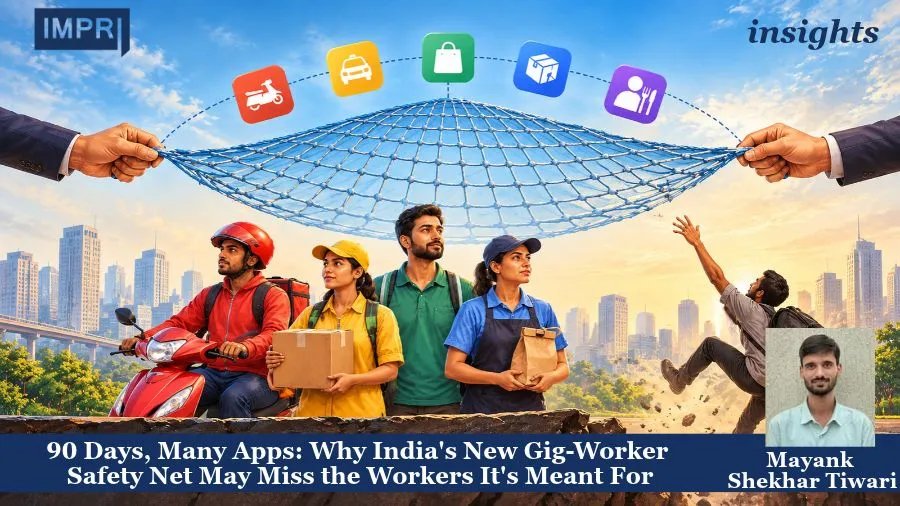
But here’s where it gets complicated. To actually draw on these benefits, a worker needs 90 continuous days with one platform, or 120 days spread across platforms, in a year. Sounds reasonable as a rule. Except, is that how delivery work actually happens?
What a rider’s week really looks like
A 2023 study of Hyderabad’s gig workforce gives a pretty clear answer: no. Researchers interviewed drivers and delivery workers and found 27% of riders and 52% of drivers had worked for more than one platform, usually because rate cards kept shifting, not because they wanted variety (Chintala, 2023). Jump ship when the money’s better elsewhere. That’s just how the market works right now.
A newer study from Tamil Nadu makes it even more vivid. Riders put in 8 to 13 hours a day for ₹11,000–16,000 a month, no insurance, nothing. What stood out to me reading it wasn’t even the money, it was the emotional cost. Riders blamed themselves for things they couldn’t control, a slow kitchen, a wrong GPS pin, because one bad rating could mean a penalty or getting locked out entirely (Kariveliparambil et al., 2026).
That last bit matters a lot. If one bad rating can knock you off an app for days, “90 continuous days” isn’t a technicality anymore. It’s a wall.
“Delivery partner” is doing a lot of work
Some of this traces back to how companies describe the relationship in the first place. A 2021 study of Zomato and Swiggy workers in Jaipur found aggregators leaning hard on words like “delivery partner” and “independent entrepreneur”, language that conveniently skips past normal employer responsibilities (Parwez & Ranjan, 2021). Workers paid for their own bike, phone, fuel, worked 10–12 hour days for barely-there wages, and it only got worse during COVID lockdowns.
That’s not just wording. It’s the legal foundation everything else sits on. Call someone an “entrepreneur” instead of an employee, and suddenly every protection has to be built back in from scratch, through exactly this kind of registration-and-threshold system.
Haven’t we seen this before?
Here’s the part that makes me a little skeptical. Even before the 2020 Code, India’s informal-worker social security system had the same problems — different rules in different states, no guaranteed floor of protection, too much left to government discretion instead of actual rights (Bordoloi et al., 2020). The new Code brings gig workers into this system, sure. But it’s the same scaffolding that didn’t quite work for informal workers for over a decade already.
And the numbers keep climbing. NITI Aayog puts India’s gig workforce at 7.7 million in 2020–21, heading toward 23.5 million by 2029–30 (NITI Aayog, 2022). Even the government’s own “RAISE” plan for rolling this out assumes a kind of steady, continuous registration that, based on everything above, a lot of workers just won’t have.
So what would actually help?
None of this makes the 2026 Rules a failure, recognizing gig workers at all is a real step forward. But a rule only works if it fits how people actually work, not how a spreadsheet imagines they should. A few things worth pushing for: count days across all platforms from day one instead of rewarding loyalty to one app; register workers automatically through aggregator data instead of leaving it to them to sign up on eShram; and build in some room for the gaps that aren’t the worker’s fault, like a sudden deactivation, so one bad week doesn’t reset the whole clock.
Delivery work isn’t going anywhere. The real question is whether the safety net built for it actually reaches the people riding through the rain to get your order there — or keeps missing them, 90 days at a time.
References
Bordoloi, M., Farooqui, M. H., & Pandey, S. (2020). Social security for informal workers in India: Exploring India’s labour market policies on provisioning of social security to informal workers in the unorganised sector (Research Brief). Centre for Policy Research.
Chintala, S. R. (2023). Emerging patterns of collective action in India’s platform economy: A study of drivers and delivery workers. Relations industrielles / Industrial Relations, 78(3).
Kariveliparambil, A., Rasi, R. A., Ahmad, M. S., Ramesh, S., & Kuriakose, A. (2026). Invisible burdens of platform work: A qualitative study of food-delivery riders’ lived experiences in urban India. International Journal of Qualitative Studies on Health and Well-being, 21(1), Article 2644577.
NITI Aayog. (2022). India’s booming gig and platform economy: Perspectives and recommendations on the future of work. Government of India.
Parwez, S., & Ranjan, R. (2021). The platform economy and the precarisation of food delivery work in the COVID-19 pandemic: Evidence from India. Work Organisation, Labour & Globalisation, 15(1), 11–25.
About the Contributor
Mayank Shekhar Tiwari is a postgraduate student pursuing a Master’s in Public Policy and Governance at the Tata Institute of Social Sciences (TISS), Hyderabad, with a concentration in Regulation. His interests lie in evidence-based policymaking, regulatory governance, and the use of data analytics in public policy. He is particularly interested in understanding how data and quantitative research can help identify policy challenges and contribute to better-informed public decisions.
Disclaimer: All views expressed in the article belong solely to the author and not necessarily to the organisation.
Read More at IMPRI:
Beyond the US: India’s Opportunity to Champion Global Rules
Selective Regulation: Why Power Escapes but Gig Workers Don’t
Acknowledgement
This article was posted by Pritha Chowdhury, a research intern at IMPRI.