



Policy Update
Gowri Kodali
Introduction
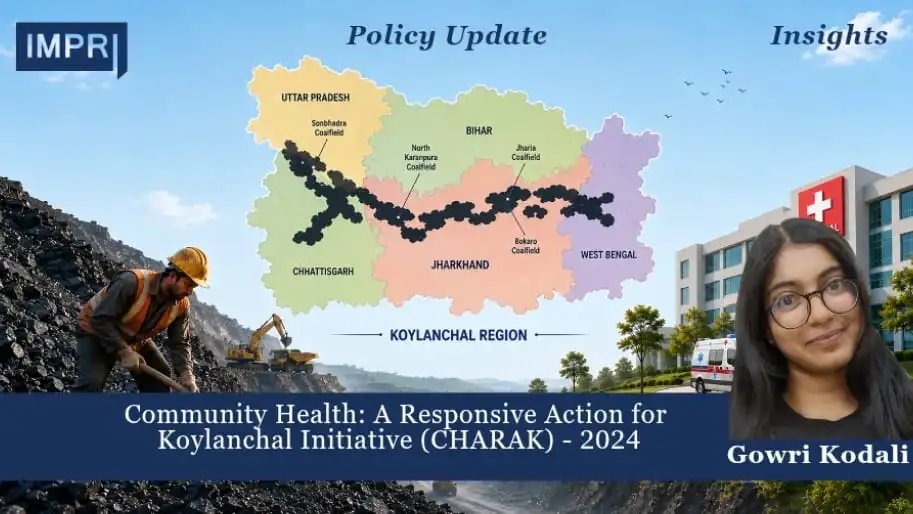
The CHARAK initiative is a targeted corporate social responsibility intervention designed to address specialised healthcare challenges in India’s coal-mining regions. Unlike national health schemes such as Ayushman Bharat PM-JAY which identify beneficiaries primarily through socio-economic deprivation criteria CHARAK covers households with an annual income of up to ₹8 lakh, protecting the vulnerable “missing middle” who often fall outside standard welfare safety nets. Additionally, rather than operating purely as an insurance payout, CHARAK serves as an institutional bridge by using Northern Coalfields Limited’s (NCL) Nehru Shatabdi Chikitsalaya (NSC) to coordinate direct referrals to empanelled super-speciality hospitals nationwide.
Background
Healthcare expenditure can become a financial burden for economically vulnerable households, especially when treatment involves critical illnesses and specialised medical procedures. Although India has expanded public health financing and financial protection mechanisms, households incur out-of-pocket expenditure. The National Health Accounts Estimates for 2013-14 show that out-of-pocket expenditure accounts for 64.2% of health expenditure.
CHARAK is an innovative, socially responsible initiative designed to address a specific healthcare challenge in India’s coal-mining regions. It focuses on economically disadvantaged families who face significant barriers to accessing specialised healthcare services. By addressing this particular gap, CHARAK differs from conventional corporate social responsibility programmes, which typically emphasise broader welfare and community development interventions.
The initiative covers residents of Singrauli and Sonbhadra districts whose annual family income from all sources is below ₹8 lakh. Treatment is provided through NCL’s dedicated Nehru Shatabdi Chikitsalaya (NSC) or through empanelled hospitals across India.
The initiative is legally situated within India’s CSR framework. Section 135 of the Companies Act, 2013, and Schedule VII permit CSR activities related to healthcare, including healthcare and sanitation.
Functioning
CHARAK follows a targeted healthcare support model that offers universal medical coverage. Eligible residents with specified conditions can receive treatment at NCL’s hospital or at specialised institutions.
The conditions covered include malignancy, tuberculosis and its complications, HIV‑related complications, cardiovascular diseases, organ transplantation, severe burns, liver disorders, neurological and neurovascular disorders, accidental trauma, acute surgical emergencies, serious disabilities, sudden loss of vision or hearing and other serious conditions.
This model is important because many of these conditions require treatment that may not be available in smaller or peripheral health facilities. By enabling patients to receive treatment at empanelled hospitals nationwide, CHARAK seeks to overcome the geographical limitations of relying solely on local infrastructure.
The initiative’s framework reflects the principle of financial risk protection in healthcare. The World Health Organisation says that high out‑of‑pocket spending causes hardship and stresses the need for mechanisms that keep households from paying directly at the point of care.
In practice, the operational implementation relies on a sequential referral and verification pipeline: first, eligible residents from Singrauli and Sonbhadra present for preliminary screening with income verification documents (certifying annual income below ₹8 lakh); second, NCL’s nodal Nehru Shatabdi Chikitsalaya (NSC) evaluates the clinical severity against the approved schedule of critical conditions; and third, cases requiring tertiary or super-speciality interventions receive administrative clearance and formal referral to designated empanelled hospitals nationwide. The overall effectiveness of the initiative ultimately hinges on the efficiency of this multi-tier approval process and the continuity of post-treatment care.
Performance
Since CHARAK was launched in December 2024, the performance record of CHARAK is still at an early stage. Therefore, evaluating CHARAK against a three-year performance period would be premature.
Early official data provides initial insight into the programme’s rollout across three distinct indicators: financial commitment, patient coverage, and surgical interventions. A budgetary provision of ₹8.50 crore was allocated to operationalise CHARAK. In terms of early clinical milestones, a Lok Sabha response recorded that seven major surgeries had been completed under the scheme by 25 February 2025. Furthermore, cumulative administrative records indicate that 13 patients had received direct financial assistance for specialised medical care by June 2026.
.These early performance indicators should not be interpreted as conclusive evidence of either failure or success.. The program had been operational for a few months, and complex medical procedures naturally involve diagnosis, eligibility verification, referral and treatment timelines.
At the time, the absence of a publicly visible, regularly updated CHARAK-specific dashboard limits independent assessment of the program’s reach.
Future performance reporting should ideally include:
- Applications received versus approvals granted;
- Demographic and socio-economic beneficiary profiles (including disease-wise and gender-wise coverage);
- Number and type of specialised treatments and surgeries completed;
- Fund allocation, utilisation rate, and average expenditure per beneficiary;
- Average turnaround time for application processing, referrals, and treatment commencement;
- Geographical distribution of beneficiaries across mining and non-mining blocks; and
- Post-procedure recovery, treatment completion rates, and follow-up outcomes.
Such indicators would allow CHARAK to move from measuring inputs and procedures to measurable health outcomes.
How CHARAK Can Improve Healthcare Access and Reduce Financial Burden
CHARAK addresses a critical challenge located at the intersection of poverty, limited healthcare access, and geographical remoteness.. Accessing specialised healthcare for severe medical conditions extends well beyond direct clinical costs.People also have to pay for travel, lose wages, and endure long periods of care. Because of this, a special programme like CHARAK that covers the cost of expert treatment can offer both financial and medical help at the same time.
The geographical focus of the initiative is particularly significant. Studies in the Singrauli coalfield show that communities living and working near mining clusters face significant health risks from particulate and dust exposure (Yadav & Jamal, 2018). Even though CHARAK is not an environmental health programme, the fact that CHARAK started in this area shows that mining regions really need health support.
This initiative demonstrates how CSR frameworks can evolve from conventional philanthropy into structured institutional mechanisms for social protection.According to official launch disclosures, NCL reported reaching approximately 10 lakh people and spending over ₹1,000 crore on CSR initiatives over the preceding decade (PIB, 2024).
However, we should see CHARAK as a way to help healthcare, not as a way to replace public healthcare. The way India pays for healthcare is improving. The 2022–23 National Health Accounts show that the share of health spending paid out of pocket fell to 43.4%. At the same time, the money the government spends on health has increased significantly over the last ten years. This means targeted CSR initiatives, like CHARAK, can help close gaps while the government continues working to ensure everyone has reliable, lasting healthcare.
Key Challenges Emerging from the Implementation of CHARAK
- Limited performance data: This initiative is still new. We need to share information about who benefits, how money is spent and what results are achieved. This will help keep us accountable.
- Awareness and accessibility: Families who qualify might not know about CHARAK. They also might not understand how to apply or get referred. We need to make this clearer.
- Barriers: Getting treatment at specialized hospitals far away can add extra costs for travel, staying somewhere and follow‑up visits. This can be a problem for patients.
- Continuity of care: Paying for a surgery or one treatment is not enough for diseases that need long‑term care, rehab and monitoring. We must plan for care.
- Coordination with public programmes: Working more closely with government health institutions and current health‑financing schemes can cut duplication and make care more continuous.
- CSR, versus public responsibility: Corporate social responsibility can fill some gaps. However, lasting healthcare equity must not rely mainly on help. It should come from action.
Way Forward
The impact and sustainability of CHARAK can be substantially strengthened by adopting a transparent, outcomes-oriented framework.
First, NCL should build a way for people to see how the program is doing. This system should show how many people get help, what kinds of diseases they have, the treatments they receive, the money spent and the final results. NCL must ensure all privacy is protected while doing this.
Second, the program needs ways to manage cases and check in on patients. This is very important for people dealing with cancer, transplantation, neurological conditions and other illnesses that need long-term care.
Third, we need to examine the costs patients incur when they have to travel outside Singrauli and Sonbhadra. We should find ways to support these patients whenever possible.
Fourth, NCL should work more closely with district hospitals, state health authorities, and existing public health financing schemes. Better teamwork will help with finding patients, sending them to the places and making sure their treatment does not stop.
Finally, after sufficient implementation time, an independent impact evaluation should assess CHARAK’s reach, treatment outcomes,financial protection (specifically the prevention of catastrophic out-of-pocket expenditure), and continuity of care.
Conclusion
CHARAK represents a promising and innovative CSR model that directly addresses the critical barriers vulnerable households face in accessing specialised, tertiary medical care across India’s coal-mining corridors. By bridging geographical isolation and offering financial risk protection up to an ₹8 lakh income threshold, the initiative demonstrates significant potential to complement state public health architecture.
However, as the programme remains in its nascent operational phase, existing data is insufficient to conclusively determine its long-term clinical efficacy, cost-effectiveness, or institutional sustainability. CHARAK’s ultimate success must not be measured solely by budgetary inputs or isolated surgical counts, but by treatment completion rates, speed of referral delivery, and tangible reductions in catastrophic household health spending. Its lasting value will depend on transparent performance reporting, robust multi-tier public health coordination, and institutional mechanisms that guarantee continuous post-treatment care.
Selected References
- Press Information Bureau, 2024. NCL Launches ‘CHARAK’ – “Community Health: A Responsive Action for Koylanchal” in Singrauli. Ministry of Coal, Government of India. PIB – CHARAK Initiative
- Ministry of Coal, 2024. NCL Launches CHARAK – Community Health: A Responsive Action for Koylanchal. Ministry of Coal – CHARAK document
- Lok Sabha, 2025. Parliamentary response on CSR-supported life-saving healthcare initiatives; reports seven surgeries completed under CHARAK as of 25 February 2025. Lok Sabha – Parliamentary Response
- Ministry of Health and Family Welfare, 2026. National Health Accounts Estimates for India 2022–23. National Health Accounts – 2022–23
- Ministry of Corporate Affairs. Companies Act, 2013 – Schedule VII: CSR activities. Schedule VII – CSR Activities
- Yadav, B. & Jamal, A., 2018. Impact of mining on human health in and around mines. Environmental Quality Management.Research on health impacts in the Singrauli coalfield
About the Author
Gowri Kodali is pursuing a Master’s in Economics and currently works as a Research and Editorial Intern at the Impact and Policy Research Institute (IMPRI). She is also actively preparing for the UPSC Civil Services Examination, with a keen interest in public policy, governance, and socio-economic development.
Acknowledgement
I sincerely thank Sruti Halder, Aryan Bordoloi and the IMPRI team for providing the opportunity to research and write this Policy Update. I am grateful for the guidance and feedback that helped strengthen the analysis and presentation of this article.
Disclaimer
All views expressed in the article belong solely to the author and do not necessarily represent the views or policies of the organisation.
Read more at IMPRI: