






NINCHEN TAMANG
“The world was sick, and the ills from which it was suffering were mainly due to the perversion of man, his inability to live at peace with himself.” – Dr. George Brock Chisholm, First Director-General, World Health Organization
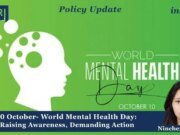
Every year on 10 October, World Mental Health Day draws attention to a concern that affects individuals, families and communities across the world. In 2026, the observance comes with a particularly important message: “Lived experiences heard: real voices, real change.” The theme calls for people with lived experience of mental health conditions to play a meaningful role in shaping policies, services and decisions that affect them (World Health Organization [WHO], 2026).
India’s own experience reflects the growing need to move from awareness towards accessible and responsive care. Tele-MANAS, launched on 10 October 2022, has handled more than 34.34 lakh calls since its inception as of March 2026. The programme now operates through 53 Tele-MANAS cells across 36 States and Union Territories and provides services in 20 languages (Press Information Bureau [PIB], 2026a). The scale of its use indicates both the demand for accessible mental-health support and the importance of expanding services beyond conventional clinical settings.
Background and History
World Mental Health Day was established by the World Federation for Mental Health (WFMH) in 1992. The observance was intended to draw international attention to mental-health issues and encourage greater awareness and action. WFMH itself was founded in 1948, initially bringing together member organisations from 46 countries. It now has members and contacts in more than 90 countries (WFMH, n.d.-a).
A theme for World Mental Health Day was introduced for the first time in 1994, at the suggestion of WFMH Secretary-General Eugene Brody. The theme was “Improving the Quality of Mental Health Services Throughout the World” (WFMH, n.d.-b). This early emphasis on the quality of services remains relevant today, although the global discussion has expanded to include prevention, rights, community-based care, inclusion and the experiences of people using mental-health services.
WHO has supported the observance as an opportunity to raise awareness and mobilise efforts to make mental-health care more accessible. In 2026, WHO is working with WFMH and other partners around the theme of lived experience, placing particular emphasis on ensuring that people with lived experience are not merely asked to share their stories but are able to influence decisions and participate in designing, implementing and evaluating services (WHO, 2026).
Significance of the Day — Beyond Awareness
The significance of World Mental Health Day lies partly in the changing nature of public discussion around mental health. Awareness can help challenge stigma, but awareness alone cannot address shortages of professionals, limited services, affordability barriers or unequal access to care. The challenge is therefore to connect greater public understanding with stronger systems of support.
Public figures have also contributed to this change in how mental health is discussed. In India, actor Deepika Padukone has spoken about her experience with anxiety and depression. According to the Live Love Laugh Foundation, she was diagnosed with anxiety and depression in 2014 and founded the organisation in 2015. She later spoke publicly about her experience, helping bring mental health into wider public discussion (Live Love Laugh Foundation, n.d.). The significance of such disclosures lies not in celebrity endorsement alone, but in their potential to make conversations about mental health more visible and less stigmatised.
A similar development has taken place in sport. American gymnast Simone Biles’ decision to withdraw from several events at the Tokyo 2020 Olympics, while discussing the importance of her mental well-being and safety, brought renewed attention to the psychological pressures faced by elite athletes. Her experience contributed to a wider public discussion about whether sporting success should come at the expense of mental well-being.
These developments point to an important distinction: awareness does not replace treatment, but it can help create conditions in which people are more willing to seek support. The next challenge is ensuring that support is actually available when people seek it.
Current Global Scenario
The scale of the mental-health challenge remains substantial. WHO reported in 2025 that more than one billion people were living with mental health conditions, yet median government spending has stayed at only 2% of health budgets, unchanged since 2017. Per-person spending reaches up to US$65 in high-income countries but falls to as little as US$0.04 in low-income ones (WHO, 2025a).
Part of this gap reflects differences in overall health budgets: high-income countries devote a little under 5% of health spending to mental health, compared with about 1% in low-income countries. The policy implication is that low spending is both a priority problem and a capacity problem. Where funding is this thin, services stay concentrated in a few urban facilities, and prevention and early intervention are likely to be crowded out. Access then depends largely on the income level of the country a person lives in.
The burden is concentrated in common, treatable conditions. Approximately 322 million people live with depression, which is about 1.5 times more common among women than men (WHO, 2025b). An estimated 727,000 people died by suicide in 2021, and suicide was the third leading cause of death among those aged 15–29 (WHO, 2026). Because these conditions are widespread, they call for integrated primary care and gender-sensitive services rather than specialist provision alone.
Progress on suicide has been insufficient. Current trends point to a reduction of only about 12% by 2030, against the SDG target of one-third (WHO, 2025c). This suggests that commitments are not matched by investment in the workforce, crisis services and means-restriction measures that prevention depends on.
The 2026 World Mental Health Day theme highlights a further weakness. WHO argues that people with lived experience hold knowledge that professional training and research alone cannot supply, yet only 37% of countries responding to the Mental Health Atlas 2024 had included them in primary healthcare worker training (WHO, 2026). Without their input, services risk being less responsive to actual needs. Participation should therefore be built into planning, training and evaluation.
The organisation of care compounds the problem. Only about 9% of countries have fully moved from institution-based to community-based models (WHO, 2026). WHO stresses that deinstitutionalisation requires a planned shift in funding, services and support. It is therefore a resource question as much as a rights question: money must follow people into accessible, person-centred community services.
India’s Mental Health Challenge
India reflects many of these global pressures while facing its own structural constraints. The National Mental Health Survey 2015–16, conducted by NIMHANS, estimated that 10.6% of adults in India were living with mental disorders, while the lifetime prevalence was estimated at 13.7%. The survey also identified substantial treatment gaps, with approximately 70–92% of people with mental disorders not receiving adequate treatment (PIB, 2025).
The shortage of specialised professionals remains another major constraint. India has been estimated to have around 0.75 psychiatrists per 100,000 population, compared with the WHO benchmark of at least three per 100,000. These figures illustrate why increasing awareness without expanding the mental-health workforce and service infrastructure is unlikely to close the treatment gap (PIB, 2025; Suhas et al., 2026).
The Mental Healthcare Act, 2017 represents an important rights-based development in India’s mental-health framework. The Act establishes a statutory right to access mental healthcare and includes provisions relating to community living, equality and non-discrimination, confidentiality, legal aid and protection from cruel, inhuman or degrading treatment (Government of India, 2017). Its importance therefore extends beyond the provision of treatment to the recognition of rights and dignity in mental healthcare.
Digital public-health initiatives have also expanded access. The National Tele Mental Health Programme, commonly known as Tele-MANAS, was launched on 10 October 2022 as a 24×7 service. By March 2026, more than 34.34 lakh calls had been handled through the helpline, with 53 cells operating across 36 States and Union Territories and services available in 20 languages (PIB, 2026a). A 2026 study by psychiatrists from NIMHANS reported that Tele-MANAS had handled more than 3.43 million calls by March 2026 and described it as the world’s largest government-led tele-mental-health initiative (Suhas et al., 2026).
The programme’s scale is significant, but the number of calls should not automatically be treated as evidence that the treatment gap has been resolved. Rather, it demonstrates the demand for accessible support and the potential of digital platforms to supplement conventional services. Its longer-term effectiveness will depend on the quality of counselling, referral mechanisms, continuity of care and integration with local health systems.
The Union Budget 2026–27 also placed mental-health infrastructure on the policy agenda. It announced the establishment of NIMHANS-2 in northern India and the upgradation of premier mental-health institutions at Ranchi and Tezpur into Regional Apex Institutions (PIB, 2026b). The Budget documents provide ₹917.21 crore for NIMHANS Bengaluru and ₹51.14 crore for the National Tele Mental Health Programme in 2026–27 (Government of India, 2026). These allocations should be read alongside the broader need to strengthen community and primary-level services rather than viewing institutional expansion alone as a solution.
The challenge is visible beyond national statistics. Kota, Rajasthan, has received considerable attention because of student suicides associated with its highly competitive coaching environment. According to reports, 17 coaching students died by suicide in 2024 compared with 26 in 2023. The district administration attributed the decline to measures including compliance with guidelines for coaching institutes and hostels, gatekeeper training and SOS services. However, officials did not provide a detailed breakdown establishing the contribution of individual interventions (The New Indian Express, 2024). The figures therefore indicate a decline in reported cases, but should not be presented as conclusive evidence that any particular intervention caused the reduction.
The Way Forward
The first priority should be to move beyond awareness towards sustained investment. Globally, the median government allocation of 2% of health budgets to mental health remains low, while India’s direct mental-health allocations have also remained modest relative to the scale of need. For India, increasing investment should include not only specialised institutions but also primary care, district-level services, community outreach and rehabilitation
Second, community-based care needs greater attention. The 2026 WHO campaign’s focus on deinstitutionalisation provides an opportunity to rethink mental healthcare around community support, dignity and continuity of care. Institutional services will continue to be necessary for people requiring specialised or intensive treatment, but they need to function within a wider system of community-based support rather than as isolated centres of care.
Third, people with lived experience should have a meaningful role in policymaking. The 2026 theme is important precisely because it challenges a model in which people are invited to share their experiences but excluded from decisions. Consultation should extend to service design, monitoring, evaluation and training. This would help ensure that policies respond not only to institutional assessments but also to the practical barriers experienced by people seeking care.
Fourth, India needs to strengthen its mental-health workforce. The gap between the estimated 0.75 psychiatrists per 100,000 population and the WHO benchmark of three demonstrates the scale of the challenge. Expanding specialist training is important, but so is strengthening psychologists, psychiatric social workers, counsellors, nurses, community health workers and primary-care providers. Tele-MANAS can complement this workforce, but cannot substitute for an adequate local care system.
Finally, prevention needs to become more systematic, particularly among vulnerable groups such as students and young people. The experience of Kota suggests that suicide prevention requires coordination between educational institutions, hostels, families, health professionals and local administrations. Reported declines should be monitored carefully over time, while interventions should be assessed for effectiveness rather than credited solely on the basis of year-to-year changes.
Conclusion
World Mental Health Day is no longer only a reminder to speak openly about mental health. Its larger significance lies in asking whether societies are building systems capable of responding when people do speak.
The global burden remains substantial, with more than one billion people living with mental-health conditions and suicide continuing to claim hundreds of thousands of lives each year. India faces its own persistent challenges, including a substantial treatment gap, shortages of mental-health professionals and unequal access to services. At the same time, initiatives such as Tele-MANAS, the Mental Healthcare Act and the proposed expansion of national mental-health institutions show that the policy response is evolving.
The task now is to connect these initiatives into a stronger continuum of care. Awareness can reduce silence, but it cannot by itself provide treatment. Digital platforms can improve access, but they cannot replace community services. New institutions can expand specialised care, but they cannot substitute for a wider mental-health workforce.
The 2026 theme — “Lived experiences heard: real voices, real change” — therefore offers a useful test of progress. The question is not simply whether people are being heard, but whether their experiences are influencing how mental-health policies and services are designed. Moving from awareness to action ultimately means building a system in which people can seek help early, receive appropriate care, retain their rights and dignity, and participate in decisions affecting their own mental health.
References
Government of India. (2017). The Mental Healthcare Act, 2017. India Code. https://www.indiacode.nic.in/indiacode/handle/123456789/2249?view_type=browse
Press Information Bureau. (2025, November 9). Understanding mental health [PIB backgrounder]. Government of India. https://www.pib.gov.in/Pressreleaseshare.aspx?PRID=2188003&lang=2®=48
Press Information Bureau. (2026, February 11). Advancing India’s mental healthcare and well-being. Government of India. PIB: Advancing India’s Mental Healthcare and Well-Being
Press Information Bureau. (2026, March 23). Update on Tele-MANAS. Government of India. PIB: Update on Tele-MANAS
50 per cent decline in student suicides in Kota compared to last year, says city’s district magistrate. The New Indian Express. The New Indian Express: Kota student suicides
Suhas, S., Mittal, A., Manjunatha, N., Naveen Kumar, C., Math, S. B., & Murthy, P. (2026). India’s Tele-MANAS: Evolution, early outcomes and a scalable blueprint for digital public mental health. The British Journal of Psychiatry. Advance online publication. https://doi.org/10.1192/bjp.2026.10733 British Journal of Psychiatry article
World Federation for Mental Health. (n.d.). About World Mental Health Day. WFMH: About World Mental Health Day
World Federation for Mental Health. (n.d.). History. WFMH: History
World Health Organization. (2025, September 2). Over a billion people living with mental health conditions – services require urgent scale-up. WHO: Over a billion people living with mental health conditions
World Health Organization. (2025, December 16). World leaders adopt a historic global declaration on noncommunicable diseases and mental health. WHO: Global declaration on NCDs and mental health
World Health Organization. (2026). Depressive disorder (depression). WHO: Depressive disorder (depression)
World Health Organization. (2026). World Mental Health Day 2026: Lived experiences heard: Real voices, real change. WHO: World Mental Health Day 2026
World Health Organization. (2026). World Mental Health Day webinar. WHO: World Mental Health Day webinar
About the Contributor
Ninchen Tamang is a Research & Editorial intern at Impact and Policy Research Institute (IMPRI). She holds a Master’s degree in Political Science, with primary research interests spanning geopolitics, international relations, foreign policy, and South Asian studies.
Acknowledgement
The author extends sincere gratitude to the Impact and Policy Research Institute (IMPRI) team for their expert guidance and constructive feedback throughout the process.
Disclaimer: All views expressed in the article belong solely to the author and not necessarily to the organization.
Reviewers
Nivedya Murali and Pragya Raghav
Published by:- Mahenoor Imam, a researcher and Editorial Intern at IMPRI
Read more at IMPRI:
Mera Pani Meri Virasat (2020): Incentivising A Shift Towards Water-Saving Crops
Haryana AI Mission (2026): Building An AI-Enabled State – IMPRI Impact And Policy Research Institute