





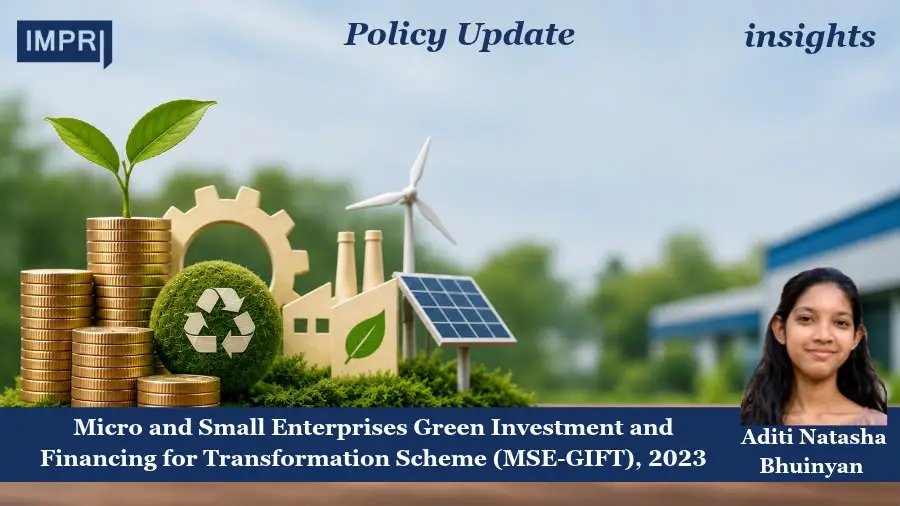
Policy Update
Aditi Natasha Bhuinyan
Background
Micro, Small and Medium Enterprises (MSMEs) play an important role in India’s industrial and economic development. According to the Ministry of Micro, Small and Medium Enterprises (2025), the sector contributes approximately 30% to India’s Gross Domestic Product (GDP) and over 45% to its exports (Ministry of MSME, 2025).
However, many micro and small enterprises (MSEs) continue to depend on conventional machinery and production methods, which can result in high energy consumption, carbon emissions and inefficient waste management. Transitioning towards environmentally sustainable production requires investments in modern machinery, renewable energy and cleaner production technologies. But, the high initial cost of these investments, along with difficulties in accessing institutional credit, makes this transition challenging for smaller enterprises. This creates a need for financing mechanisms that make green investments more affordable and accessible.
To address these challenges, the Ministry of Micro, Small and Medium Enterprises introduced the MSE Green Investment and Financing for Transformation (MSE-GIFT) Scheme under the Raising and Accelerating MSME Performance (RAMP) programme. Launched on 20 December 2023, the scheme was designed to support the green transition of MSEs during FY 2023–24 to FY 2025–26. The Small Industries Development Bank of India (SIDBI) is its implementing agency (Press Information Bureau [PIB], 2023, 2024).
The scheme focuses on helping MSEs meet the additional costs associated with adopting cleaner and more efficient technologies. These include renewable energy systems, energy-efficient machinery, green buildings, cleaner transportation and waste management and recycling facilities. Its primary objectives are to encourage environmentally sustainable production, improve access to institutional finance, reduce the cost of green investments and promote energy efficiency and resource conservation (Ministry of MSME, 2024).
With a total financial outlay of ₹478 crore, MSE-GIFT seeks to strengthen institutional financing support for smaller enterprises. By combining concessional interest rates with credit-risk support, it aims to ease the financial burden of adopting cleaner technologies while improving resource efficiency and long-term business competitiveness (PIB, 2024).
Functioning
The MSE-GIFT Scheme operates through a combination of financial assistance and credit-risk support to encourage MSEs to invest in environmentally sustainable technologies. Implemented by SIDBI, the scheme works through participating banks and financial institutions that provide loans to eligible enterprises. Its financial structure consists of two major components: the Interest Subvention Facility (ISF) and the Risk Sharing Facility (RSF), supplemented by an Information, Education and Communication (IEC) component (SIDBI, 2024).
The Interest Subvention Facility, with an allocation of ₹350 crore, aims to reduce borrowing costs for enterprises undertaking green investments. Under this provision, eligible MSEs can receive an interest subvention of 2% per annum on eligible term loans, subject to a maximum loan limit of ₹2 crore and a maximum support period of five years. The assistance is intended to make investments in energy-efficient machinery, renewable energy and other eligible green technologies more affordable. By lowering borrowing costs, the scheme seeks to encourage enterprises that might otherwise postpone such investments because of financial constraints (SIDBI, 2024).
The second component, the Risk Sharing Facility, has an allocation of ₹125 crore. It provides credit guarantee coverage of up to 75% of eligible loans, subject to the scheme’s conditions. This mechanism is particularly relevant for smaller enterprises that may find it difficult to secure institutional credit. By sharing a portion of the lending risk, the facility seeks to encourage financial institutions to extend loans for environmentally sustainable projects. Specified concessions in guarantee fees are also available to eligible categories of enterprises (SIDBI, 2024).
In addition to these financial provisions, ₹3 crore has been allocated towards Information, Education and Communication activities. This component focuses on creating awareness about the benefits of green technologies and informing enterprises about the financial assistance available under the scheme. Awareness generation is important because smaller businesses may lack information about suitable technologies, investment requirements and available financing options (PIB, 2024).
The scheme is implemented through participating lending institutions that have entered into agreements with SIDBI. Eligible Udyam-registered MSEs can approach these institutions with proposals for green investments. The lending institution assesses the proposal and sanctions the loan based on applicable eligibility and credit requirements. SIDBI subsequently facilitates the relevant interest subvention or risk-sharing support in accordance with the scheme guidelines (SIDBI, 2024).
Through this arrangement, MSE-GIFT attempts to address both the cost of financing and the risks associated with green investments. For example, if a bank provides an MSE with a loan of ₹10 lakh to purchase energy-efficient machinery and the business defaults, the credit guarantee may cover up to ₹7.5 lakh of the eligible loan amount. This reduces the bank’s potential loss and encourages green lending. However, the extent to which these provisions improve access to credit depends on institutional participation and the ability of smaller enterprises to meet lending requirements.
Performance
The implementation of the MSE-GIFT Scheme indicates progress in establishing an institutional financing mechanism for green investments among micro and small enterprises. Its performance can be assessed through the participation of lending institutions, beneficiary coverage and the volume of credit facilitated under the scheme.
According to the MSE-GIFT dashboard on the RAMP portal, as of 7 July 2026, 29 lending institutions had been onboarded under the scheme. A total of 6,272 applications for interest subvention had been received, of which 3,277 were approved. The approved applications accounted for an interest subvention amount of ₹29.11 crore, while the number of MSEs covered stood at 5,549. The portal also reported term loans worth ₹4,631.87 crore sanctioned to eligible enterprises, with ₹28.73 crore disbursed as interest subvention (Ministry of MSME, 2026a).The ₹4,631.87 crore represents the total loans sanctioned to MSEs, while the ₹28.73 crore represents the interest subsidy disbursed to reduce their borrowing costs. Thus, the scheme supports green investments by making institutional credit more affordable.
The approval of 3,277 applications against 6,272 applications received represents an approval rate of approximately 52.3%. This indicates that slightly more than half of the applications had received approval. But, the difference between applications received and approved also raises questions about the factors affecting access to the scheme, including eligibility requirements, lending criteria and the ability of smaller enterprises to complete the application process.
Another important aspect is the credit facilitated through the scheme. By 7 July 2026, loans worth ₹4,631.87 crore had been sanctioned to MSEs. Against the ₹350 crore allocated for interest subvention, ₹28.73 crore had been disbursed, amounting to around 8.2% of the allocation. While the sanctioned loan amount reflects credit approved by lending institutions, the interest subvention represents the financial assistance released to eligible enterprises. However, data on the actual utilisation of the sanctioned loan amount is not separately reported on the dashboard (Ministry of MSME, 2026a).
The utilisation of the allocated funds also requires closer examination. Against the ₹350 crore earmarked for the Interest Subvention Facility, the reported disbursement stood at ₹28.73 crore, representing approximately 8.2% of the allocation. While this figure provides an indication of the assistance released, it should be interpreted in the context of the scheme’s implementation period and reimbursement mechanism rather than treated as an independent measure of underperformance.
SIDBI’s Annual Report 2024–25 provides additional evidence of implementation. During FY2024–25, 1,958 green loans were covered under MSE-GIFT for interest subvention, of which more than 560 MSMEs had availed themselves of the assistance. This provides an indication of actual beneficiary participation during the financial year (SIDBI, 2025).
The scheme’s expected outcomes also provide a basis for assessing its progress. According to the RAMP portal, MSE-GIFT aims to benefit approximately 12,000 enterprises, generate annual energy savings of 1,600 GWh, achieve annual financial savings of ₹1,200 crore and reduce carbon emissions by 1.5 million tonnes annually. These projections reflect the broader ambition of linking financial assistance with improvements in industrial sustainability. However, they represent expected outcomes rather than independently verified achievements (Ministry of MSME, n.d.).
The Ministry’s MSME Performance Dashboard separately reported 6,670 approved applications under MSE-GIFT as of 12 October 2026. Since this figure differs from the RAMP portal’s interest-subvention application count, the two indicators should not be treated as equivalent without clarification regarding their reporting categories (Ministry of MSME, 2026b).
Overall, the available figures indicate that MSE-GIFT has established an operational financing mechanism and facilitated green lending. However, a comprehensive assessment requires more consistent reporting on actual loan disbursements, enterprise-level investments and the geographical and sectoral distribution of beneficiaries.
Impact
The potential impact of MSE-GIFT extends beyond the provision of concessional credit. By reducing borrowing costs and sharing lending risks, the scheme seeks to encourage technological modernisation while improving the environmental performance of smaller enterprises.
- Environmental sustainability: Investments in renewable energy, energy-efficient machinery and waste-management systems can reduce dependence on conventional energy sources. But, the extent to which MSE-GIFT has generated measurable reductions in energy consumption and carbon emissions requires enterprise-level evidence.
- Financial accessibility: The 2% interest subvention reduces borrowing costs for eligible green investments. Similarly, the risk-sharing mechanism provides partial credit protection to participating institutions. These provisions may encourage lending towards green projects that could otherwise face financing constraints, particularly among smaller enterprises (SIDBI, 2024).
- Technological modernisation: Access to concessional finance can enable smaller enterprises to upgrade production equipment and introduce cleaner manufacturing processes. Such investments may improve operational efficiency, reduce resource wastage and lower long-term production costs.
- Economic competitiveness: Improved energy and resource efficiency can strengthen the competitiveness of MSEs by lowering operating expenses and improving production standards. Environmentally sustainable production may also help enterprises respond to changing market requirements and environmental standards in domestic and international supply chains.
SIDBI’s Annual Report 2024–25 provides broader evidence of the institution’s green financing activities. Since FY2022, its green finance portfolio has assisted more than 9,500 MSMEs, with sanctioned financing exceeding ₹16,600 crore. It also reported estimated annual energy savings of 1,106 GWh and reductions of approximately 2.95 million tonnes of greenhouse gas emissions. However, these figures relate to SIDBI’s overall green finance portfolio and should not be attributed exclusively to MSE-GIFT (SIDBI, 2025).
Therefore, while the scheme contributes to the broader institutional framework for sustainable MSME financing, its specific environmental and economic impact requires a deeper evaluation. Establishing the relationship between financial assistance, technology adoption and measurable environmental improvements will be essential to assessing its effectiveness.
Emerging Issues
- Limited awareness and accessibility: Smaller enterprises may lack adequate information about the scheme, its eligibility requirements and application procedures. Moreover, interest subvention and credit guarantees do not eliminate the requirement to satisfy lending institutions’ credit appraisal criteria. Enterprises with limited credit histories or inadequate documentation may therefore continue to face difficulties obtaining loans.
- High cost of green technologies: The adoption of energy-efficient machinery and cleaner production technologies often requires substantial initial investment. Although the scheme reduces borrowing costs, the financial assistance may not fully address the investment constraints faced by smaller enterprises.
- Institutional and technical constraints: Many MSEs lack the technical knowledge required to identify suitable green technologies and assess their financial and environmental benefits. Similarly, differences in the capacity of financial institutions to evaluate green investment proposals may affect the implementation of the scheme.
- Monitoring and regional coverage gaps: Existing performance indicators largely focus on applications, loan approvals and financial assistance. Limited information on actual energy savings, emissions reductions and resource efficiency makes it difficult to assess the scheme’s environmental outcomes. Further, the absence of sufficiently disaggregated state-wise and sector-wise beneficiary data restricts an assessment of the distribution of its benefits.
- Continuity of financial support: Green investments generally involve substantial initial expenditure and longer repayment periods. The original scheme period covered FY2023–24 to FY2025–26. Therefore, the status of any subsequent extension or successor financing arrangement requires clarification to provide greater certainty to enterprises planning long-term investments (PIB, 2024).
Way Forward
Strengthening the MSE-GIFT Scheme requires greater attention to both financial accessibility and measurable environmental outcomes. Awareness initiatives should be expanded through district industries centres, industry associations and participating financial institutions to improve outreach among smaller enterprises.
The application and approval processes should be made more accessible and transparent, while participating institutions should receive technical support to assess green investment proposals. Greater emphasis should also be placed on extending financial assistance to enterprises in underserved industrial regions and smaller manufacturing clusters.
Furthermore, monitoring mechanisms should incorporate indicators beyond loan sanctions and disbursements. These should include actual energy savings, renewable energy adoption, resource efficiency and reductions in greenhouse gas emissions among beneficiary enterprises. Regular publication of state-wise, sector-wise and enterprise-category-wise performance data would strengthen transparency and facilitate more comprehensive evaluation.
Finally, continuity in green financing support is important for enterprises undertaking investments with relatively long repayment periods. An assessment of the scheme’s implementation experience can inform the design of subsequent financing arrangements under the broader MSME sustainability framework.
The MSE-GIFT Scheme is a useful step towards helping smaller enterprises adopt greener and more sustainable production practices. By providing financial support and reducing lending risks, it attempts to make green investments more affordable for MSEs. However, the scheme’s success will ultimately depend on how easily enterprises can access this support and whether it leads to actual improvements in energy efficiency and resource use. Better implementation, wider outreach and regular monitoring will be important to ensure that the benefits reach smaller businesses and contribute to India’s broader green transition.
References
- Ministry of Micro, Small and Medium Enterprises. (2025). Annual report 2024–25. Government of India.https://msme.gov.in/sites/default/files/MSME-ANNUAL-REPORT-2024-25-ENGLISH.pdf
- Ministry of Micro, Small and Medium Enterprises. (2026a). MSE-GIFT: Interest subvention performance dashboard. Raising and Accelerating MSME Performance Programme. https://ramp.msme.gov.in/ramp/RAMP-initiative/mse-gift/gift-interest-subvention
- Ministry of Micro, Small and Medium Enterprises. (2026b). MSME performance dashboard. Government of India. https://www.dashboard.msme.gov.in/
- Ministry of Micro, Small and Medium Enterprises. (n.d.). MSE-GIFT scheme: Interest subvention and expected impact. Raising and Accelerating MSME Performance Programme. https://ramp.msme.gov.in/ramp/RAMP-initiative/mse-gift/gift-interest-subvention
- Press Information Bureau. (2023, December 20). Shri Narayan Rane launches three sub-schemes under the RAMP programme. Government of India. https://www.pib.gov.in/Pressreleaseshare.aspx?PRID=1988800
- Press Information Bureau. (2024, July 22). Climate change awareness and financing for MSMEs. Ministry of Micro, Small and Medium Enterprises, Government of India. https://www.pib.gov.in/PressReleasePage.aspx?PRID=2035103
- Small Industries Development Bank of India. (2024). Scheme on MSE Green Investment and Financing for Transformation (MSE-GIFT): Scheme guidelines. Ministry of Micro, Small and Medium Enterprises, Government of India. https://www.sidbi.in/assets/front/pdf/Circular_MSE_GIFT.pdf
- Small Industries Development Bank of India. (2025). Annual report 2024–25. https://www.sidbi.in/annualreport/AnnualReport202425/business-performance.php
About the Contributor
Aditi Natasha Bhuinyan is an Economics postgraduate from the Delhi School of Economics, University of Delhi, with research interests in public policy, development economics, governance and environmental sustainability. With experience in empirical analysis and data-driven research, she is keen to explore how evidence-based research can inform policy solutions to contemporary development challenges.
Acknowledgement
The author sincerely expresses gratitude to the reviewers Gowri and Shiva, and the IMPRI team for their expert guidance and constructive feedback throughout the process.
Disclaimer
The views and opinions expressed in this article are solely those of the author and do not necessarily reflect the views, policies, or positions of IMPRI (Impact and Policy Research Institute) or any other affiliated organisation.
Read more at IMPRI:
Low Incomes, Persistent Poverty: Examining India’s Economic Reality
PM- e Bus Seva 2023: Examining Electric Bus deployment for Sustainable Urban Mobility