







Policy Update
Akanksha Sukka
Background:
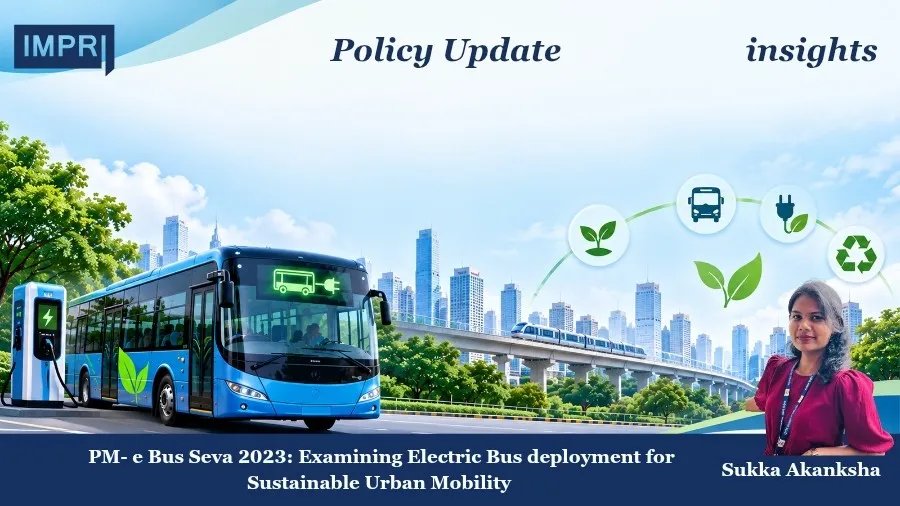
The PM- e Bus Seva scheme will be a breakthrough in the sustainable urban mobility aspect in India. This is what makes it different and modern from all the previously existing bus schemes. In accordance with the Ministry of housing and urban affairs, the PM e Bus Seva scheme was launched on 16th August, 2023. The scheme aimed to deploy 10,000 buses in a few selected cities. It seeks to augment the city bus operations in urban areas through the Central Assistance 20,000 crore for the deployment of electric buses under the Public Private Partnership model. This scheme is deployed in two segments.
1. Augmentation of City Bus Services and Associated Infrastructure (169 cities)
2. Green Urban Mobility Initiatives (181 cities)
This scheme also generates 45,000 to 55,000 direct jobs through deployment of around 10,000 buses in city bus operation (PIB, 2023)
The PM-e Bus Sewa scheme is mostly important as it seeks to look though both the environmental and institutional challenges in accordance with urban transportation. This scheme has the participation of the private sector, central financial assistance, and infrastructure development, through which it aims to expand public transport networks. Even then, the complete effectiveness of this scheme will be seen, with the timely deployment of the buses along with the integration of the existing urban transport systems present in the cities.
In this aspect, evaluation of the implementation of PM- eBus Sewa provides an opportunity to understand how electric bus deployment can contribute to sustainable urban mobility in India. This evaluation is essential in determining if at all the scheme can deliver the expected outcomes of cleaner transportation, accessibility and reduced urban emissions.
Functioning:
PM e-Bus Sewa works differently from older bus schemes, where the government bought buses and handed them to State Transport Undertakings (STUs). Under the scheme, a PPP operator or Original Equipment Manufacturer (OEM) procures, maintains and operates the electric buses on a Gross Cost Contract (GCC) model, and the city authority pays the operator a fixed rate per kilometre (Tribune India, 2025). The operator carries the capital and maintenance risk, while the city keeps control of routes and fares.
The scheme is aimed at cities with a population between 3 lakh and 40 lakh, many of which have no organised bus service. Of the 178 cities eligible, 116 participated, and 10,000 air-conditioned buses have been sanctioned across 116 cities in 20 states and six Union Territories (Outlook Business, 2025; Kashmir Life, 2026). Sanctions range from 400 buses each for Bihar and Odisha to 347 for Punjab, 200 for Jammu and Kashmir and 48 for Ladakh.
The Centre supports the model in three ways:
- Operational support. Central assistance is paid on a per-kilometre basis as Viability Gap Funding, which bridges the gap between operating cost and fare revenue (WRI India, n.d.).
- Infrastructure support. The Centre gives 100 per cent assistance for behind-the-meter power infrastructure and 60 to 100 per cent for civil depot infrastructure (Kashmir Life, 2026). The scheme sets a normative depot cost of ₹10 crore for 50 buses, or about ₹20 lakh per bus (GreentechLead, 2026).
- Payment security. The Ministry of Heavy Industries notified the PM-eBus Sewa Payment Security Mechanism (PSM) on 28 October 2024, with an outlay of about ₹3,435 crore to support up to 38,000 e-buses until 2028-29 (UITP India, 2025; Autocar Professional, 2024). If an STU defaults on payment, the central agency CESL pays the operator and recovers the amount from the STU later. Operators and OEMs had asked for this guarantee because many STUs are in weak financial health
Deployment follows a fixed sequence. A city submits a proposal, the buses are sanctioned, a tender is issued, and a concession agreement and Letter of Award are signed. The buses reach the road only after depot and power infrastructure is ready and the conditions precedent in the tender are met (Lok Sabha, 2025)
Performance:
The scheme has moved quickly on paper and slowly on the road. All 10,000 buses are sanctioned, but only about one in ten was running by October 2026, three years after launch. Letters of Award cover about half the sanctioned fleet, yet buses in operation are a fraction of that. Infrastructure spending shows the same gap: about 39 per cent of the ₹1,254 crore sanctioned had been spent by March 2026, with behind-the-meter power works well ahead of civil depot works (₹398 crore against ₹85 crore).
Gandhinagar launched 40 of its 100 sanctioned midi buses in June 2026, and the Prime Minister flagged off buses at Chandigarh’s ISBT in February 2026. Tirupati already runs 100 e-buses. Andhra Pradesh plans 750 buses across 11 cities but was still preparing its action plan in March 2026. Odisha was allocated 400 buses and had deployed none as of 3 August 2026 (PIB, 2026). A report in mid-2026 counted only four cities with operational buses about two and a half years after launch, so the count of operating cities has grown from four to 28 within months.
Impact:
The scheme’s impact is still partial, because most of the fleet is not yet on the road. The evidence available so far points to gains in access and jobs, a narrow cost advantage over diesel, and no measured emissions result yet.
- Access and ridership: The scheme targets mid-sized cities that have little or no organised bus service, so its main benefit is for low-income commuters, students and daily wage workers who depend on public transport (IMPRI India, 2026). A news report puts daily ridership above one lakh with just over 500 buses operating, and the government expects about 20 lakh daily riders once the full fleet of 10,000 is running (The Aarch News, 2026). That figure is a projection, not a measured outcome, and it should be read as such.
- Employment: The Cabinet note estimated 45,000 to 55,000 direct jobs from about 10,000 buses (PIB, 2023). These jobs depend on deployment, so they follow the pace of the rollout. Nothing published so far counts jobs actually created.
- Operating cost: An October 2026 study by the International Council on Clean Transportation used operating data from 49 electric buses in Indore. Its nine-year model puts the cost of an electric bus at ₹59.84 per km, against ₹61.54 per km for a diesel bus (GreentechLead, 2026). The margin is small, about 3 per cent, so the result is sensitive to battery life, electricity tariffs and the contract rate. It is one city’s evidence and does not yet show a national pattern.
- Emissions: No published measurement of emissions avoided is yet available for the buses now in service. Electric buses produce no tailpipe emissions and should lower local air pollution and noise, but the net climate gain depends on how clean the electricity grid is and on whether the buses replace private vehicles or only older buses. Until the cities report per-route data, claims of reduced emissions remain an expectation.
Sustainability of the scheme
The scheme can be sustained over time only if three things hold together: the buses cut emissions in practice, their running cost is covered without permanent central support, and cities can keep the service going after the sanctioned buses arrive. The evidence so far is encouraging on the first two and weakest on the third.
- Environmental sustainability: Electric buses remove tailpipe emissions and noise from city streets, which helps air quality where buses run. The wider climate benefit depends on the electricity mix that charges them, so it will grow as the grid becomes cleaner. The benefit is also larger when electric buses replace older diesel buses or draw riders away from cars and two-wheelers than when they only replace buses that were already carrying the same riders. The sources reviewed for this article do not address how batteries will be reused or recycled at the end of their life, which is a gap for long-term sustainability.
- Financial sustainability: The gross cost contract places vehicle and maintenance costs on the operator, and the Indore study suggests electric buses can run at a cost close to diesel (₹59.84 against ₹61.54 per km over nine years) (GreentechLead, 2026). That narrow margin means the model is financially sound only if cities pay operators on time. The payment security mechanism is built for this purpose, with about ₹3,435 crore sanctioned to cover up to 38,000 e-buses until 2028-29 (Autocar Professional, 2024), and about ₹500 crore was disbursed in 2025-26 (IMPRI India, 2026). Sustained payment still depends on states repaying what the mechanism advances, so a guarantee fund that is repeatedly drawn down would not last.
- Institutional sustainability: Depots, chargers and power connections built with central assistance are lasting assets that later buses can use. The government has also said that a follow-on scheme will provide another 35,000 e-buses after 2027 (Outlook Business, 2025), which signals long-term intent. But urban transport remains a state subject, and the service will continue only if cities build the skills to manage contracts, keep fares and subsidies in balance, and keep the buses part of one connected network.
On balance, the scheme is on a sustainable path in design but not yet in evidence. Its long-term sustainability will be settled by whether payments stay on time, grid power becomes cleaner and states take over the running of the service as central support tapers.
Key Challenges
The main obstacle is not money for the buses. It is the ability of cities and states to pay operators, build depots and run a bus service.
- Payment risk: Operators are paid per kilometre by STUs and city bodies, many of which are financially weak. Delays in budget sanction lead to late payments, which makes it hard for operators to service their loans (WRI India, n.d.). Large manufacturers stayed away from recent tenders because the payment guarantee was not finalised (Financial Express, 2025).
- Slow funding of the guarantee: The PSM was meant to be backed by a joint India–US fund of $390 million, but the government was still waiting for the US share of $150 million after the scheme was sanctioned (Autocar Professional, 2024). A guarantee only reassures lenders if it is funded.
- State capacity: Urban transport is a state subject, so the Centre can sanction buses but cannot compel cities to prepare tenders, sign agreements or release funds (Outlook Business, 2025). Odisha’s 400 allocated buses, none deployed by August 2026, show how state-level delay holds up the whole scheme (PIB, 2026).
- Integration with the city system.:Electric buses run by private operators have to fit into existing routes, fares, ticketing and feeder services. Without that, they risk competing with existing buses or leaving gaps for riders.
Way Forward
- Fully fund and publish the payment guarantee: The PSM fund should be fully capitalised, with clear rules on when it pays and how states repay it, so lenders and manufacturers can rely on it. States that default repeatedly should face automatic recovery from their central transfers.
- Prepare depots before awarding buses: Cities should show land, grid connection and depot readiness before buses are sanctioned, and the Centre should release infrastructure funds in step with progress, so buses are not waiting on works.
- Build state-level capacity: A dedicated unit in each state, with trained staff for tendering, contract management and monitoring, would reduce delay. Cities that deploy fastest could be rewarded with additional allocations.
- Integrate buses into the city system: Electric buses should share ticketing, fares and route planning with existing services and with metro and feeder links, so that they add to the network instead of duplicating it.
- Publish city-wise data: A public dashboard should report buses operating, kilometres run, ridership, uptime and payments made, and the programme should measure emissions avoided on the routes served, so outcomes can be checked.
- Strengthen local finance for transport. In the long run, states need a stable source of funds for public transport, such as the dedicated state bus scheme in Gujarat that WRI India points to, so that the scheme does not depend on year-to-year budget decisions (WRI India, n.d.).
Conclusion
PM e-Bus Sewa has a sound design: a gross cost contract that moves capital risk to private operators, central help for depots and power, and a payment guarantee aimed at the weakest link in earlier schemes. Its sanctions and contracts are well ahead of its deployment, and by October 2026 only about a tenth of the 10,000 buses were reported on the road.
Whether the scheme delivers cleaner transport, wider access and lower urban emissions will depend less on the buses themselves than on how well states prepare depots, pay operators on time and fit the buses into existing city transport. The early evidence from cities such as Gandhinagar, Tirupati and Indore is encouraging but limited. A fair judgment needs the measured data on ridership, cost and emissions that the scheme has not yet published.
References:
- Cabinet approves “PM-eBus Sewa” for augmenting city bus operations; priority to cities having no organized bus service. (n.d.-b). https://www.pib.gov.in/PressReleasePage.aspx?PRID=1949429
- Autocar Professional. (2024). Govt faces delay in US’ $150 million fund for e-bus PSM, expects this year
- Financial Express. (2025, July 23). E-bus majors take a back seat on payment delays
- GreentechLead. (2026). Electric bus charging infrastructure in India: ₹57,613 crore PM-eBus Sewa scheme drives depot, charger and grid investment
- IMPRI India. (2026). PM eBus Sewa and the future of urban bus governance in India
- Kashmir Life. (2026). Jammu Kashmir gets 200, Ladakh 48 electric buses under Centre’s 10,000-bus PM-eBus Sewa scheme
- Lok Sabha. (2025, February 13). Unstarred Question No. 1479: Status of PM eBus Sewa scheme. Ministry of Housing and Urban Affairs.
- Lok Sabha. (2026, March 10). Written reply on amount sanctioned and spent under PM-eBus Sewa. Ministry of Heavy Industries.
- Outlook Business. (2025). Govt to deploy 10,000 AC e-buses in 116 cities by 2027, 35,000 more planned
- Press Information Bureau. (2023, August 16). Cabinet approves PM-eBus Sewa
- Press Information Bureau. (2026, August 4). Update on PM-eBus Sewa and PLI scheme progress. Ministry of Heavy Industries.
- The Aarch News. (2026). PM e-Bus Sewa crosses 1 lakh daily ridership
- The Tribune. (2025). Ludhiana, Amritsar, Jalandhar, Patiala to get 347 e-buses
- UITP India. (2025, March). Payment security mechanism: Ushering a new era of electric bus deployment in India
- WRI India. (n.d.). Exploring payment security mechanism for e-bus expansion
- Gandhinagar launch: IANS via The Hawk (2026, June 28). Andhra Pradesh plan: All India Radio (2026, March 25).
About the Author
Akanksha Sukka is a Public Administration and Governance postgraduate from the Central University of Karnataka, interested to contribute to governance through research that translates into practical impact. She works on urban governance, policy making and digital public infrastructure, with a focus on how policies are experienced by citizens
Disclaimer
The views and opinions expressed in this article are those of the author and do not necessarily reflect the official policy or position of IMPRI (Impact and Policy Research Institute) or any other affiliated organisation. The information presented in this article is based on publicly available government sources and is intended solely for academic and research purposes.
Acknowledgement
The author sincerely expresses gratitude to the reviewers Gowri and Anamika for their guidance and feedback through the writing process. I also express my sincere gratitude to IMPRI (Impact and Policy Research Institute) for providing me with the opportunity to prepare this policy update article and for fostering a rigorous learning environment that connects research with public policy practice
Read more at IMPRI:
Himalayan Governance: Balancing Environmental Protection, Development and Local Rights
BRICS Delhi Summit 2026: Addressing the People’s Concerns Beyond Political Leadership