



Policy Update
Asmatwali
Background
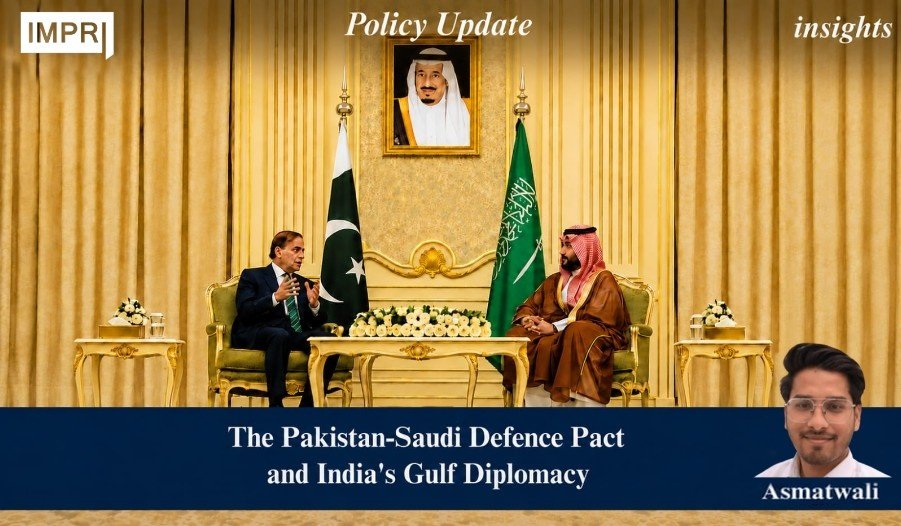
On 17 September 2025, Saudi Crown Prince and Prime Minister Mohammed bin Salman and Pakistani Prime Minister Shehbaz Sharif signed the Strategic Mutual Defence Agreement (SMDA) in Riyadh, formalising decades of informal Pakistan-Saudi security cooperation into a binding collective-security commitment under which “any aggression against either country shall be considered an aggression against both” (Wikipedia contributors, 2026a). The pact followed closely on Israeli airstrikes on Doha on 9 September 2025, which unsettled Gulf states’ confidence in US security guarantees and accelerated Saudi Arabia’s search for diversified defence partnerships (Wikipedia contributors, 2026a; Eurasia Review, 2026).
India’s Ministry of External Affairs responded within a day of the signing, with spokesperson Randhir Jaiswal stating that the government was aware the pact formalised a “long-standing arrangement” and that New Delhi would “study the implications of this development for our national security as well as for regional and global stability” (Ministry of External Affairs, Government of India [MEA], 2025). At a subsequent weekly press briefing, the MEA underlined that India’s own wide-ranging strategic partnership with Saudi Arabia had “deepened considerably” in recent years, and that both sides would be expected to keep “mutual interests and sensitivities” in mind (Tribune News Service, 2025).
Ambiguity has persisted over the pact’s nuclear dimension: Pakistani Defence Minister Khawaja Asif suggested Saudi Arabia could benefit from Pakistan’s nuclear capabilities under the agreement, though the treaty text itself makes no explicit reference to nuclear-umbrella provisions, and independent analysts have characterised such claims as largely unsubstantiated (Wikipedia contributors, 2026a; Defence Horizon Journal, 2025). The pact was operationalised militarily during the 2026 Iran war, when Pakistan deployed a squadron of JF-17 fighter jets, air defence systems and thousands of troops to Saudi Arabia’s King Abdulaziz Air Base (Fortune, 2026; Modern Diplomacy, 2026a).
Functioning
Analysts describe the SMDA as functioning less as a conventional military alliance and more as a deliberate strategy of hedging and deterrence, allowing both Riyadh and Islamabad to preserve strategic flexibility while institutionalising joint committees, intelligence sharing, and training programmes (Eurasia Review, 2026). Saudi Arabia’s own gains from the pact are concrete and long in the making: Pakistan has trained more than 8,000 Saudi military personnel since the late 1960s and has periodically stationed 1,500 to 2,000 troops in the Kingdom, giving Riyadh access to a battle-tested, comparatively low-cost conventional partner at a moment when confidence in US security guarantees was faltering (Stimson Center, 2025).
More significantly, decades of Saudi financial support for Pakistan’s nuclear programme have long fuelled expectations, which the SMDA’s deliberately ambiguous nuclear language does little to dispel, that Riyadh could in extremis draw on Pakistan’s nuclear deterrent to help narrow a strategic gap vis-à-vis a nuclear-capable Israel (Stimson Center, 2025; Defence Horizon Journal, 2025). The agreement is further designed to support Saudi Arabia’s longer-term defence-industrial autonomy through technology transfer and co-production arrangements, while for Pakistan, the pact provides a platform to demonstrate continued strategic relevance despite economic difficulties and strained relations with the West (Atlantic Council, 2025; Eurasia Review, 2026).
In practice, the pact’s activation during the 2026 Iran war exposed real constraints: reports indicated Pakistan was reluctant to be drawn into direct military confrontation with Iran, which enjoyed considerable domestic public sympathy in Pakistan, with a source described as familiar with Pakistani military decision-making telling the Financial Times that “the Saudi pact is becoming a problem for us” (Drop Site News, 2026). The functioning of the SMDA has also become entangled with wider regional alignments: by mid-2026, Saudi Arabia, Qatar, Pakistan, Turkey and Egypt had coalesced into a loose grouping distinct from a separate India-UAE-Israel-centred axis, reflecting a broader fragmentation of Gulf security architecture after the Iran war (Foreign Policy, 2026; The Week, 2026).
Performance
India’s Gulf diplomacy since the SMDA’s signing has emphasised deepening bilateral partnerships rather than reactive bloc-formation. In January 2026, UAE President Sheikh Mohamed bin Zayed Al Nahyan’s visit to India yielded a USD 3-billion, ten-year LNG agreement between Hindustan Petroleum and ADNOC Gas, alongside continued institutional defence cooperation through the Defence Partnership Forum and Joint Defence Cooperation Committee (Diplomatist, 2026). During Prime Minister Modi’s May 2026 visit to Abu Dhabi, India and the UAE signed agreements on strategic petroleum reserves, LPG supply and defence cooperation, alongside roughly USD 5 billion in new investment commitments, with bilateral trade crossing USD 101 billion for a second consecutive year (Modern Diplomacy, 2026b).
India has similarly elevated ties with Qatar, establishing a formal Strategic Partnership that made Doha the fifth GCC state to hold such status with India, alongside the UAE, Saudi Arabia, Oman and Kuwait, following Prime Minister Modi’s personal intervention in securing the release of Indian naval veterans previously sentenced in Qatar (KBS Sidhu, 2025).
India’s Ministry of Petroleum and Natural Gas also conducted a dedicated visit to Qatar, India’s largest natural gas supplier, during which Doha reaffirmed its commitment to remain “a reliable energy supplier to India” amid the West Asian crisis (Modern Diplomacy, 2026a). Consular engagement, including through India’s diplomatic missions such as the Consulate General of India, Jeddah, has continued to support the roughly 2.7 million-strong Indian community resident in Saudi Arabia, which remains among India’s largest sources of Gulf remittances (Consulate General of India, Jeddah, 2026; Global Security Review, 2025).
Impact
The SMDA has direct implications for India’s strategic calculus. Pakistan’s formal defence integration with Saudi Arabia adds a Gulf dimension to Islamabad’s security posture at a time when Pakistan is already stretched by the ongoing Afghanistan-Pakistan conflict, raising questions about how a two-theatre commitment, one western and one Gulf-facing, affects Pakistan’s overall military bandwidth vis-à-vis India (Wikipedia contributors, 2026a). At the same time, India’s own deepening defence and energy partnerships with the UAE, exercises such as Desert Cyclone, Gulf Waves and the India-UAE-France Desert Knight, and the planned Strategic Defence Partnership Framework, demonstrate that New Delhi is pursuing parallel, non-bloc security relationships across the Gulf rather than treating the SMDA as requiring a matching alliance response (Diplomatist, 2026).
The wider Gulf order has itself begun to fragment along two loose axes: a Saudi-Qatar-Pakistan-Turkey-Egypt grouping on one side, and an economically and technologically oriented UAE-India-Israel convergence, sometimes termed an “Indo-Abrahamic alignment”, on the other, with the UAE’s departure from OPEC in April 2026 underscoring intra-Gulf divergence even among traditional partners (Foreign Policy, 2026; Modern Diplomacy, 2026b).
China adds a further, less visible layer to this picture: without being party to the SMDA, Beijing’s long-standing defence, nuclear and infrastructure ties with Pakistan, together with its deepening trade and investment relationship with Saudi Arabia, position it to gain quietly from closer Gulf-Pakistan security cooperation, whether through expanded arms sales, nuclear-energy cooperation, or a future mediating role between regional rivals (Middle East Institute, 2025; Defence Horizon Journal, 2025).
For India, this raises the prospect of China consolidating influence across the Gulf and South Asia simultaneously, adding a further variable to New Delhi’s own China-related calculations even as closer UAE and Qatari ties provide energy security and connectivity gains through initiatives such as the India-Middle East-Europe Economic Corridor; deeper alignment with the UAE and Israel, meanwhile, could generate friction with Saudi Arabia and other Organisation of Islamic Cooperation members at a time when Riyadh’s centrality to regional security remains difficult to circumvent (Middle East Institute, 2025; Modern Diplomacy, 2026b; Diplomatist, 2026).
Table 1: India’s Gulf Partnerships at a Glance
| Country | Trade | Defence Cooperation | Energy Partnership |
| Saudi Arabia | ~USD 43 billion (FY 2023-24); India’s 5th-largest trading partner | Defence Cooperation Committee under the Strategic Partnership Council; USD 225 million ammunition-export deal (2024); regular Army and Navy staff talks | Saudi Arabia is India’s 2nd-largest crude oil supplier |
| UAE | Over USD 101 billion for a second consecutive year (2026) | Desert Cyclone, Gulf Waves and India-UAE-France Desert Knight exercises; planned Strategic Defence Partnership Framework | USD 3 billion, ten-year LNG deal (HPCL-ADNOC Gas, Jan. 2026); strategic petroleum reserve and LPG agreements (May 2026) |
| Qatar | ~USD 14 billion (FY 2024-25); target to double to USD 28 billion by 2030 | India-Qatar Defence Cooperation Agreement (2008, extended 2018); joint naval exercise Za’ir-Al-Bahr | Qatar is India’s largest LNG supplier (~40% of imports); 20-year Petronet-QatarEnergy supply deal from 2028 |
Emerging Issues
i. Persistent nuclear ambiguity: The absence of explicit treaty language on nuclear extension leaves open questions about whether any future crisis involving Pakistan could indirectly implicate Saudi Arabia’s security calculus, a matter India’s MEA has said it continues to study (MEA, 2025; Wikipedia contributors, 2026a).
ii. Strain on Pakistan’s Gulf commitments: Pakistan’s own reported reluctance to be drawn into direct confrontation with Iran during the 2026 war suggests the SMDA’s practical deterrent value may be more limited than its text implies, a gap India will need to continually reassess (Drop Site News, 2026).
iii. Fragmenting Gulf security architecture: The emergence of competing Saudi-Pakistan-Turkey-Egypt-Qatar and UAE-India-Israel groupings complicates India’s traditional strategy of multi-alignment across the GCC without becoming entangled in intra-Gulf rivalries (Foreign Policy, 2026; Modern Diplomacy, 2026b).
iv. Balancing Saudi and UAE ties: With Saudi Arabia and the UAE themselves diverging over Yemen, oil policy and regional strategy, India’s growing tilt toward Abu Dhabi carries the risk of under-investing in its equally vital and larger-trade-volume relationship with Riyadh (Modern Diplomacy, 2026b).
v. GCC free trade and energy negotiations: India’s pursuit of a Free Trade Agreement with the GCC and continued reliance on Gulf energy imports require sustained ministerial engagement even amid regional security uncertainty, as reflected in Commerce Minister Piyush Goyal’s virtual consultations with UAE, Saudi, Bahraini and Kuwaiti counterparts during the 2026 crisis (Modern Diplomacy, 2026a).
Way Forward
India’s response to the Pakistan-Saudi defence pact should continue to prioritise deepening independent, bilateral strategic partnerships across the Gulf, with the UAE, Saudi Arabia, Qatar, Oman and Kuwait, rather than pursuing a matching bloc or alliance structure, consistent with the multi-alignment approach that has underpinned India’s Gulf policy since 2014 (Modern Diplomacy, 2026b; Springer Nature, 2025). Sustaining and expanding institutional mechanisms such as the India-UAE Strategic Defence Partnership Framework, the India-Saudi Strategic Partnership Council, and the newly formalised India-Qatar Strategic Partnership will help ensure India retains strategic depth across the Gulf even as Pakistan formalises its own Gulf security role (Diplomatist, 2026; KBS Sidhu, 2025).
At the same time, India’s Ministry of External Affairs should continue its calibrated, non-escalatory public posture on the SMDA, monitoring the pact’s evolving nuclear and operational dimensions while avoiding rhetoric that could be seen as forcing Gulf states to choose sides amid their own intra-regional rivalries (MEA, 2025; Tribune News Service, 2025). Progressing the long-pending India-GCC Free Trade Agreement, deepening energy-security cooperation following the lessons of the 2026 Strait of Hormuz crisis, and continuing consular and diaspora engagement through missions such as the Consulate General of India, Jeddah, will further reinforce India’s standing as an indispensable Gulf partner independent of the shifting Pakistan-Saudi security relationship (Modern Diplomacy, 2026a; Consulate General of India, Jeddah, 2026).
References
1. Atlantic Council. (2025, September 26). The Saudi-Pakistan defense pact highlights the Gulf’s evolving strategic calculus. https://www.atlanticcouncil.org/blogs/menasource/the-saudi-pakistan-defense-pact-highlights-the-gulfs-evolving-strategic-calculus/
2. Consulate General of India, Jeddah. (2026). Indian community in the Kingdom of Saudi Arabia. Government of India. https://cgijeddah.gov.in/content-page-MTE=.html
3. Defence Horizon Journal. (2025, November 10). The Pakistan-Saudi defence pact. https://tdhj.org/blog/post/smda-pakistan-ksa/
4. Diplomatist. (2026, February 24). Deeper India-UAE strategic partnership: Outcomes of the 2026 UAE presidential visit. https://diplomatist.com/deeper-india-uae-strategic-partnership-outcomes-of-the-2026-uae-presidential-visit/
5. Drishti IAS. (2026). India-Qatar trade and economic cooperation. https://www.drishtiias.com/daily-updates/daily-news-analysis/india-qatar-trade-and-economic-cooperation
6. Drop Site News. (2026, April 14). Leaked documents reveal details of the secret Saudi Arabia-Pakistan mutual defense pact. https://www.dropsitenews.com/p/leaked-saudi-arabia-pakistan-mutual-defense-pact-iran
7. Embassy of India, Riyadh. (2026). India-Saudi bilateral relations. https://www.eoiriyadh.gov.in/page/india-saudi-bilateral-relations/
8. Eurasia Review. (2026, January 5). Saudi-Pakistani defence pact: Operationalizing hedging and deterrence in 2026 – Analysis. https://www.eurasiareview.com/05012026-saudi-pakistani-defence-pact-operationalizing-hedging-and-deterrence-in-2026-analysis/
9. Foreign Policy. (2026, July 1). The Middle East has a new Saudi-led axis with Qatar, Turkey, Pakistan, and Egypt, but not the UAE. https://foreignpolicy.com/2026/07/01/saudi-qatar-pakistan-turkey-egypt-uae-axis-alliance-iran-middle-east/
10. Global Security Review. (2025). Understanding the Pakistan-Saudi defense agreement. https://globalsecurityreview.com/wp-content/uploads/2025/11/saudi-Pak-defense-pact-pdf
11. Gulf Research Center. (2025). Saudi-Pakistan mutual defense agreement. https://www.grc.net/documents/68dd1614b17b4SaudiPakistanMutualDefenseAgreement2.pdf
12. IBEF. (2026). Exploring India Saudi Arabia trade and economic relations. https://www.ibef.org/indian-exports/india-saudi-arabia-trade
13. KBS Sidhu. (2025, February 20). India-Qatar strategic partnership: PM Modi’s diplomatic triumph in resurrecting sagging bilateral ties. https://kbssidhu.substack.com/p/india-qatar-strategic-partnership
14. Middle East Institute. (2025, November 20). Silent leverage, quiet gains? China and the Saudi-Pakistan defense pact. https://mei.edu/publication/silent-leverage-quiet-gains-china-and-saudi-pakistan-defense-pact/
15. Ministry of External Affairs, Government of India. (2025, September 18). Response to media queries on reports of the signing of a strategic mutual defence pact between Saudi Arabia and Pakistan. https://www.mea.gov.in/response-to-queries.htm?dtl%2F40146
16. Modern Diplomacy. (2026a, April 18). Diplomacy in motion: India’s Gulf calculus amid regional crisis. https://moderndiplomacy.eu/2026/04/18/diplomacy-in-motion-indias-gulf-calculus-amid-regional-crisis/
17. Modern Diplomacy. (2026b, May 24). India’s growing Gulf footprint: What the UAE partnership means for regional stability. https://moderndiplomacy.eu/2026/05/24/indias-growing-gulf-footprint-what-the-uae-partnership-means-for-regional-stability/
18. Springer Nature. (2025, April 1). India’s Gulf policy in the context of China-U.S. strategic competition. Asian Review of Political Economy. https://link.springer.com/article/10.1007/s44216-025-00048-6
19. Stimson Center. (2025, September 22). Pakistan-Saudi pact reveals growing distrust of US-led security architecture. https://www.stimson.org/2025/pakistan-saudi-pact-reveals-growing-distrust-of-us-led-security-architecture/
20. The Week. (2026, May 16). Why PM Modi’s UAE visit signals a new strategic axis in the Middle East. https://www.theweek.in/news/middle-east/2026/05/16/why-pm-modis-uae-visit-signals-a-new-strategic-axis-in-the-middle-east.html
21. Tribune News Service. (2025, September 19). ‘Expect strategic partnership will keep in mind mutual interests, sensitivities…’: MEA responds to Saudi-Pakistan defence pact. The Tribune. https://www.tribuneindia.com/news/world/expect-strategic-partnership-will-keep-in-mind-mutual-interests-sensitivities-mea-responds-to-saudi-pakistan-defence-pact/amp
22. Wikipedia contributors. (2026a, July 15). Strategic Mutual Defence Agreement. Wikipedia. https://en.wikipedia.org/wiki/Strategic_Mutual_Defence_Agreement
About the Contributor
Asmatwali is a research and editorial intern at IMPRI. He is a scholar in the Department of West Asian and North African Studies at Aligarh Muslim University. Earlier, he worked on two project reports based on semi-structured interviews for the think tank JINF, Japan.
Acknowledgment
I am writing to express my sincere gratitude to IMPRI (Impact and Policy Research Institute) for providing me with the opportunity to prepare this policy update article and for fostering a rigorous learning environment that connects research with public policy practice. I also extend my sincere thanks to Pragya Raghav & Sruti Halder for their valuable feedback, useful suggestions, and support in shaping this article in the required policy-update format.
Disclaimer
All views expressed in the article belong solely to the author and do not necessarily represent the views or policies of the organisation.