








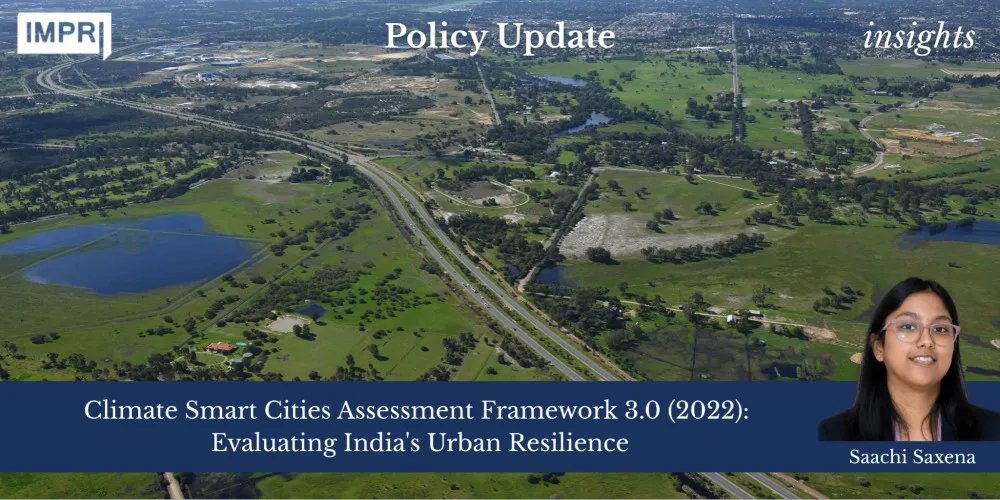
Policy Update
Saachi Saxena
Background
India’s rapid urbanization has made cities the engines of economic growth while simultaneously increasing their exposure to climate-related risks. According to the World Bank (2025), India’s urban population is projected to increase from 480 million in 2020 to nearly 951 million by 2050, almost doubling over the next three decades. Although cities occupy less than 3% of India’s land area according to world urbanization prospects report by the United Nations, they contribute nearly two-thirds of the country’s Gross Domestic Product, making urban resilience a critical component of India’s long-term economic development.
Rapid urbanization has intensified climate vulnerabilities. Indian cities increasingly experience extreme heat waves, urban flooding, water scarcity, deteriorating air quality, sea-level rise in coastal regions, and infrastructure stress caused by changing climate patterns. This calls for an urgent need for climate-resilient urban planning.
Recognising these emerging challenges, the Government of India has progressively integrated climate action into its urban development strategy. The National Action Plan on Climate Change (NAPCC), launched in 2008, defined sustainable urbanization under the National Mission on Sustainable Habitat. Building on this vision, the Government launched the Smart Cities Mission (SCM) in 2015 under the Ministry of Housing and Urban Affairs (MoHUA). Aligning with the National Mission on Sustainable Habitat, MoHUA introduced the Climate Smart Cities Assessment Framework (CSCAF) in February 2019 to mainstream climate considerations into urban governance.
ClimateSmart involves integrating climate initiatives into urban development activities. This includes municipal services such as water supply and solid waste management, as well as infrastructure projects, including housing, planning, and land development. Climate-smart development responds to changing climatic conditions while fostering sustainable actions that enhance the quality of life within cities.
The Climate Smart Cities Assessment Framework serves as a tool for cities to assess their present situation and provides a roadmap to adopt and implement relevant climate actions. Beyond assessment, the framework facilitates the dissemination of best practices adopted by Indian cities, helping establish contextual standards for green, sustainable and resilient urban development. The objective is to enable cities to assess their preparedness for climate change while continuously improving their performance through successive rounds of assessment.
CSCAF 3.0 builds upon previous editions by allowing cities to learn from earlier evaluations and scale up their climate interventions. While the first two editions primarily focused on establishing a baseline for climate action and encouraging cities to adopt climate-sensitive planning, the latest framework incorporates lessons from previous assessment cycles, adopts more outcome-oriented indicators, and encourages cities to integrate climate resilience into long-term urban governance and infrastructure planning. This evolution makes CSCAF 3.0 a significant policy advancement in mainstreaming climate resilience into India’s urban development agenda.
Functioning
The CSCAF 3.0 is a performance assessment and benchmarking framework. It enables cities to systematically evaluate their climate preparedness using a structured scoring mechanism and identify priority areas for improvement.
The CSCAF 3.0 is based on an integrated scoring system that evaluates cities across five thematic areas comprising 28 indicators. Each indicator contains five levels representing different stages of development, with corresponding weightages to measure progress objectively. The five themes include:
- Urban Planning, Green Cover and Biodiversity
- Energy and Green Buildings
- Mobility and Air Quality
- Water Management
- Waste Management
Importantly, the framework evaluates both climate mitigation and climate adaptation measures, recognising that resilient cities must simultaneously reduce emissions and strengthen their capacity to respond to climate risks.
Cities undertake a self-assessment by submitting evidence against predefined indicators through an online platform. Following technical verification, cities receive scores that help benchmark their performance, identify gaps, and prepare climate action plans. Thus, the framework transforms climate resilience from an abstract policy objective into measurable governance outcomes.
The framework also complements emerging technological approaches to urban resilience. Recent research highlights that cities increasingly rely on Geographic Information Systems (GIS), Internet of Things (IoT) sensors, remote sensing, Artificial Intelligence, climate dashboards, predictive modelling and early warning systems to monitor environmental risks. Rather than promoting technology as an end in itself, CSCAF encourages cities to integrate these tools into evidence-based governance and long-term planning.
Performance
Since its introduction, the Climate Smart Cities Assessment Framework has witnessed increasing participation while also strengthening the implementation of climate action across Indian cities.
The first phase established a baseline assessment for 96 participating cities, while the second phase expanded coverage to 126 cities, reflecting growing institutional commitment towards climate-resilient urban development. To support implementation, the Ministry of Housing and Urban Affairs (MoHUA) organised 56 training and mentoring sessions, trained over 1,000 officials, established a dedicated 15-member helpdesk, engaged six thematic experts, 15 Executive Committee members, and 57 sub-thematic committee members, while resolving more than 800 technical queries through nearly 2,200 interactions with participating cities. These capacity-building interventions enabled local bodies to successfully complete the assessment process and improve the quality of data reporting.
Beyond participation, all participating cities prepared Climate Action Plans based on the assessment outcomes, enabling municipalities to identify sector-specific climate risks and prioritise interventions in areas such as energy, water, mobility, waste management, green spaces and air quality. Rather than functioning as a one-time assessment exercise, CSCAF has established a continuous monitoring framework that allows cities to benchmark their performance, identify implementation gaps, and improve their climate preparedness across successive assessment cycles. Several cities also demonstrated measurable progress by advancing from basic compliance towards more integrated climate governance as they incorporated assessment findings into municipal planning and investment decisions.
Surat strengthened its flood forecasting and early warning systems, Pune expanded innovative solid waste management practices, and Kochi developed climate dashboards to support data-driven urban governance. These examples illustrate how cities have moved beyond assessment towards implementing context-specific climate adaptation measures.
The Economic Survey 2025–26 has further reinforced this approach by recognising climate resilience as an essential pillar of urban economic development. Its vision of developing “Economic Cities” acknowledges that resilient infrastructure improves productivity, reduces disaster-related economic losses, and enhances investment attractiveness, positioning CSCAF as an important policy instrument linking climate resilience with sustainable urban growth.
Impact
Although CSCAF is a non-regulatory assessment framework, it has already generated several institutional impacts across urban governance.
First, it has strengthened awareness of climate risks within local bodies. Climate resilience has shifted gradually from being viewed largely as an environmental concern to becoming an integral component of urban planning and municipal governance.
Second, the framework has promoted evidence-based decision-making by providing cities with a common set of indicators to assess performance across sectors such as energy, water, mobility, waste management and green spaces. This has enabled municipalities to identify priority areas for intervention and integrate climate considerations into planning processes.
Third, CSCAF has improved policy coherence by aligning local urban planning with national initiatives such as the Sustainable Development Goals (SDGs), India’s Nationally Determined Contributions (NDCs), the Smart Cities Mission, AMRUT 2.0 and the National Clean Air Programme (NCAP). The benchmarking process has also encouraged peer learning and the replication of successful practices across participating cities.
While these institutional outcomes are already evident, many of the framework’s broader economic and environmental benefits are expected to materialise over the longer term. According to the World Bank (2025), more than half of India’s future urban infrastructure, buildings and services are yet to be constructed, presenting a significant opportunity to incorporate climate resilience into urban development. The report further notes that integrating resilience during the planning and design stage is considerably more cost-effective than redeveloping infrastructure after climate vulnerabilities emerge. If cities continue to implement the recommendations generated through CSCAF assessments, the framework is expected to reduce future disaster-related losses, improve infrastructure resilience, enhance resource efficiency, and support more sustainable urban economic growth.
Thus, CSCAF long-term success will ultimately depend on the extent to which assessment findings are translated into measurable improvements in urban infrastructure, service delivery, and climate resilience on the ground.
Emerging Issues
While CSCAF has strengthened climate-responsive urban planning, its implementation continues to face institutional, financial and operational challenges that limit its effectiveness.
One of the most important concerns is fragmented urban governance, where responsibilities for land use planning, transport, water supply, waste management, and environmental regulation are distributed across multiple agencies. This often leads to weak inter-departmental coordination, limiting the effectiveness of integrated climate planning. The World Bank report notes that resilient urban development requires coordinated governance and integrated planning mechanisms rather than sector-specific interventions.
Another critical challenge is the limited technical and institutional capacity of local bodies , particularly in Tier-II and Tier-III cities. While larger cities have relatively better access to technical expertise and climate data, many smaller municipalities continue to face shortages of trained personnel, digital infrastructure, and analytical capabilities necessary for conducting robust climate assessments.
Financial constraints also remain a major barrier. Although CSCAF provides a framework for assessment, it is not linked to dedicated financial assistance, making implementation of identified climate actions dependent on municipal resources and convergence with other schemes. The World Bank’s Towards Resilient and Prosperous Cities in India (2025) stresses that inadequate municipal finance continues to constrain investments in resilient infrastructure and climate adaptation.
Concerns have also been raised regarding data quality and consistency. Since the framework relies substantially on self-reported evidence submitted by cities, variations in data availability, documentation standards, and technical expertise can influence assessment outcomes.
Furthermore, while CSCAF has successfully encouraged benchmarking and peer learning, assessment does not necessarily translate into implementation. Benchmarking frameworks can be effective in identifying gaps and promoting healthy competition, but their long-term impact depends on whether assessment outcomes are integrated into statutory master plans, municipal budgets, climate action plans, and investment decisions.
Addressing these issues will require dedicated climate cells within these local bodies, independent third-party audits, stronger municipal finance through green bonds and climate funds, greater capacity-building support from State and Central Governments, improved urban governance, and committed citizen participation.
Way Forward
India’s urban future depends on building cities that are not only technologically advanced but also climate resilient. The next phase of urban resilience aims to move beyond assessment towards implementation. CSCAF 3.0 can serve as the institutional backbone for integrating climate data, smart technologies, municipal finance and evidence-based governance into mainstream urban planning.
Going forward, assessment outcomes should be integrated into statutory master plans, municipal budgets and long-term investment strategies. The framework should also be expanded beyond the Smart Cities Mission to include rapidly growing Tier-II and Tier-III cities. Strengthening municipal capacity, promoting nature-based solutions, improving access to climate finance, and leveraging the National Urban Digital Mission will further enhance India’s urban resilience.
As India moves towards the vision of sustainable and economically competitive cities, the Climate Smart Cities Assessment Framework has the potential to become a cornerstone of climate-responsive urban governance. The CSCAF’s success will ultimately depend not merely on measuring resilience but on enabling cities to act upon the insights generated through the assessment process.
References
World Bank. (2025). Towards Resilient and Prosperous Cities in India. World Bank Group. https://thedocs.worldbank.org/en/doc/d67ef885fc1c5b4ca43cf4465b3e7241-0310012025/original/Urban-Resilience-India.pdf
Sharma, M., & Kumar, P. (2025). Leveraging Technology for Resilient Urban Futures: A Framework for Smart Environmental Management. International Journal for Research in Applied Science and Engineering Technology (IJRASET). https://www.ijraset.com/best-journal/leveraging-technology-for-resilient-urban-futures-a-framework-for-smart-environmental-management
Ministry of Housing and Urban Affairs. (2021). Climate Smart Cities Assessment Framework 2.0 Technical Document.
CSCAF_3_0_Technical_document.pdf
Government of India. (2026). Economic Survey 2025–26: Chapter 15 – Urbanization: Making India’s Cities Work for Its Citizens. Ministry of Finance, Department of Economic Affairs. https://www.indiabudget.gov.in/economicsurvey/doc/eschapter/echap15.pdf
About the Contributor
Saachi Saxena is an undergraduate student pursuing B.A. (Hons.) Economics at Gargi College, University of Delhi. Her research interests include climate economics, public policy, sustainable development, healthcare economics, and development policy. She has actively contributed to policy research and social impact initiatives and is passionate about evidence-based policymaking for inclusive and resilient development.
Acknowledgement
The author is grateful to IMPRI – Impact and Policy Research Institute for providing the opportunity to prepare this policy update. The author sincerely acknowledges the valuable guidance, feedback, and constructive suggestions provided by Purbaa Jagannath and Pallavi Lad during the review process, which significantly strengthened the quality and analytical depth of this article.