









Policy Update
Simona Miriam Hughes
Background:
India has undergone a significant change especially in the defence sector over the past few years mainly due to important indigenous manufacturing schemes like the Atmanirbhar Bharat Abhiyan and the Make In India initiative. The main objective of such initiatives is to reduce dependence on imported defence equipment and raw materials while at the same time, strengthening domestic manufacturing capabilities and India’s most priced foreign policy principle, Strategic Autonomy.Defence-grade steel is a strategic resource as it is essential for manufacturing critical military platforms such as warships, submarines, armoured vehicles, and missiles.
Indigenous production by the Steel Authority of India Limited strengthens India’s defence preparedness by ensuring a secure domestic supply chain, reducing import dependence, and enhancing strategic self-reliance. The Ministry of Defence has also introduced several reforms such as positive indigenisation lists, increased Foreign Direct Investment limits in defence manufacturing, procurement preference for domestic firms and participation of private and public sector enterprises.
One of the most important sectors in this ecosystem is the steel sector as advanced naval manufacturing requires high strength steel that meets operational and combat standards. The Steel Authority of India Limited (SAIL), a Maharatna public enterprise under the Ministry of Steel, has emerged as India’s primary supplier of India’s defence grade steel especially for naval shipbuilding.
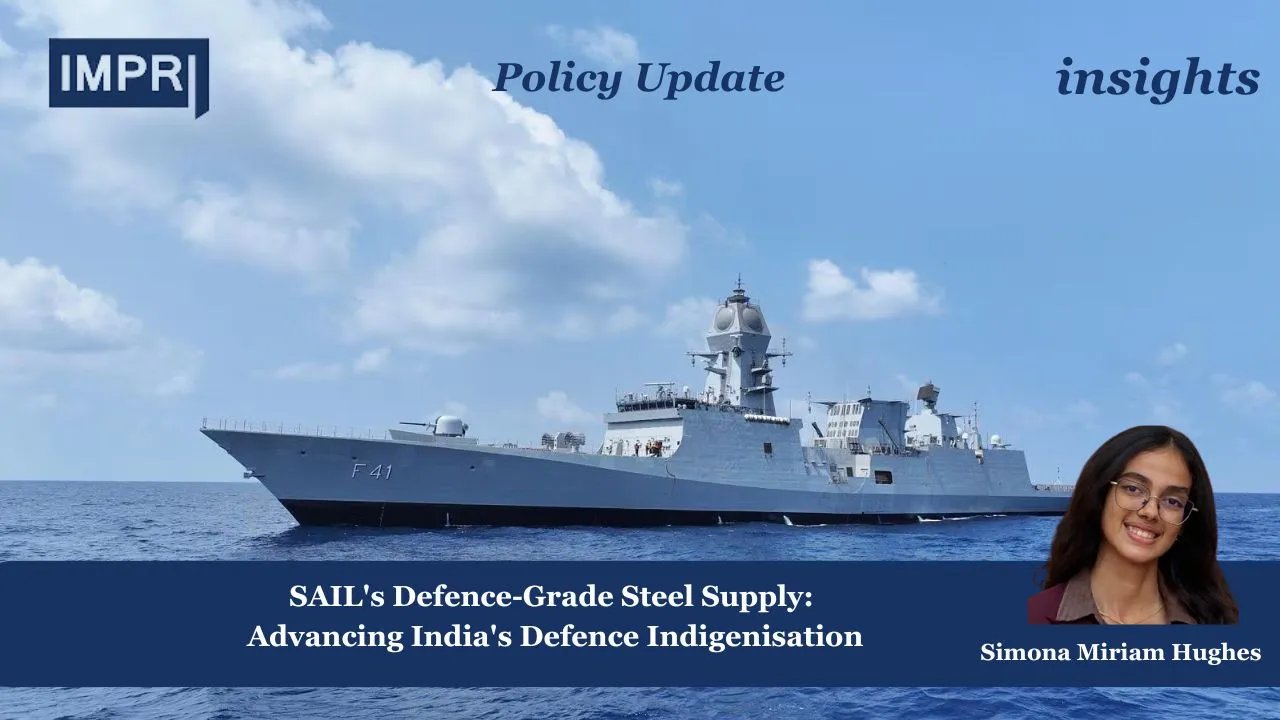
The company has been sponsoring steel for several naval platforms such as INS Vikrant aircraft carriers, Project 17A frigates, anti-submarine warfare vessels and survey ships. The latest development involving SAIL, is the sponsorship of an entire 5,700 tonnes of DNR 249A defence grade steel for three newly commissioned Indian Navy vessels – INS Dunagiri, INS Agray and INS Sanshodhak on 21 June 2026 at Syama Prasad Mookerjee Port, Kolkata.
Functioning:
SAIL manufactures specialised DNR 249A steel for Indian naval shipbuilding that includes hot rolled sheets and plates. The steel is produced at its steel centres located at Bokaro, Bhilai and Rourkela, equipped entirely with metallurgical facilities capable of meeting the quality requirements of defence production. Defence-grade steel differs entirely from conventional structural steel as it must possess high tensile strength, excellent weldability, superior toughness, corrosion resistance in marine environments and the ability to withstand shock loads in combat operations.
The production process involves close coordination between SAIL, the Ministry of Steel, defence shipyards such as Garden Reach Shipbuilders & Engineers (GRSE), Mazagon Dock Shipbuilders Limited (MDL), and the Indian Navy. Defence requirements has been growing in the past years and to meet this growing demand, SAIL has expanded the production of DNR-grade steel plates through the Special Plate Plant and the Rourkela Steel Plant. This requirement ensures availability of indigenous steel for defence projects while simultaneously reducing dependence on imported specialised alloys.
The three naval platforms commissioned demonstrate the versatility of indigenous steel. INS Dunagiri is an advanced stealth guided missile frigate under Project 17A, INS Agray is an anti Submarine-Warfare Shallow Water Craft designed to counter underwater threats and INS Sanshodhak is a survey vessel responsible for hydrographic surveys and maritime domain awareness. Together, these vessels strengthen India’s blue-water naval capability and maritime security architecture.
Performance:
SAILS contribution and performance in India’s defence sector have been expanding over recent years. With the sponsorship of 5,700 tonnes of steel for naval vessels such as the INS Dunagiri, INS Agray and INS Sanshodhak, SAILS has fulfilled the entire steel requirement for these vessels. This expansion also demonstrates India’s growing capability of domestically manufacturing strategic materials that were previously dependent on imports.
Beyond supplying steel for major naval platforms, the Steel Authority of India Limited has steadily expanded its capability to produce specialised defence-grade steel through continuous technological upgrades and capacity enhancement. Its growing role in supplying indigenous steel for defence projects reflects increasing participation in India’s defence procurement ecosystem, supporting faster domestic production, reducing import dependence, and strengthening long-term strategic self-reliance.
Beyond these recent performances, SAIL has continuously been sponsoring steel for other naval defence vessels such as the indigenous aircraft INS Vikrant, Project 17A stealth frigates INS Nilgiri, INS Himigiri and INS Udaygiri, as well as vessels such as INS Ajay, INS Nistar and INS Anjadeep. The company’s constant involvement with multiple classes of warships also reflects its central role in India’s Defence manufacturing ecosystem.
To meet future demand, SAIL has undertaken significant capacity expansion at its Special Plate Plant in Rourkela, enabling larger production volumes of DMR-grade steel and ensuring uninterrupted supply for upcoming indigenous naval programmes. This investment supports the Government’s long-term strategy of defence indigenisation and import substitution.
Impact:
The successful indigenous production of defence grade steel has several impacts across the strategic, economic and technological domains. Strategically, domestic production reduces the dependence on foreign suppliers for India, thereby strengthening India’s manufacturing domain. As a result of this, national security and supply chain resilience during geopolitical disruptions are also strengthened.
Economically, increased domestic manufacturing improves employment, supports the growth of ancillary industries, promotes technological innovation, and enhances the competitiveness of India’s steel sector. It also reduces foreign exchange outflows associated with imports of specialised defence materials.
Technologically, the ability to manufacture DMR 249A steel reflects India’s growing metallurgical expertise and industrial capability. It demonstrates the successful collaboration between public sector enterprises, research institutions and defence manufacturers in achieving technological self-reliance. The latest commissioning of three indigenous naval vessels using entirely Indian-produced defence-grade steel further reinforces India’s vision of becoming a global hub for defence manufacturing under the Atmanirbhar Bharat initiative.
Emerging Issues:
Despite having several positive impacts, SAIL continues to face challenges. These challenges are not on a major level and have been in the process of resolving in recent years.
Dependence on Public Sector Production: Defence-grade steel production remains concentrated primarily within SAIL, limiting supply diversification. Greater participation from the private sector can complement the Steel Authority of India Limited by expanding production capacity, encouraging innovation, and improving supply chain resilience for defence manufacturing. However, such collaboration should be supported by stringent quality assurance, certification, and security protocols to ensure that defence-grade steel continues to meet the reliability and performance standards required for national security.
Capacity Constraints: India’s expanding naval modernisation programme will require significantly larger quantities of specialised steel. Continuous investment in production facilities and advanced metallurgical technologies will be necessary.
Research and Development: Defence steel technology must evolve continuously to meet the changing requirements of next-generation warships, submarines and aircraft carriers.
Supply Chain Integration: Stronger coordination among steel producers, shipyards, defence research organisations and the armed forces is required to ensure timely delivery and efficient project execution.
Global Competitiveness: While India has achieved substantial progress in self-reliance, improving quality standards and production efficiency will also enable future exports of specialised defence materials.
Way Forward:
India’s growing emphasis on defence indigenisation has transformed strategic manufacturing from a policy objective into an operational reality. SAIL’s successful supply of indigenous DMR 249A steel for INS Dunagiri, INS Agray and INS Sanshodhak demonstrates the increasing maturity of India’s defence-industrial ecosystem. Going forward, sustained investment in advanced metallurgy, research and development, production capacity, and public-private collaboration will be essential for supporting the Indian Navy’s long-term modernisation plans.
Expanding indigenous capabilities across the entire defence value chain—from raw materials to finished platforms—will strengthen India’s strategic autonomy, reduce import dependence, improve economic resilience, and contribute to the country’s aspiration of becoming a leading global defence manufacturing hub. Continued policy support under Atmanirbhar Bharat and Make in India will remain critical in achieving these objectives.
Selected References and Important Links:
Press Information Bureau. (2026, June 24). SAIL powers India’s naval might: supplies defense-grade steel for INS Dunagiri, Agray, and Sanshodhak. Government of India. https://www.pib.gov.in/PressReleasePage.aspx?PRID=2277522®=3&lang=1
Steel Authority of India Limited. (2026, June 24). SAIL powers India’s naval might: supplies defense-grade steel for INS Dunagiri, Agray, and Sanshodhak. https://www.sail.co.in/en/sail-news/sail-powers-indias-naval-might-supplies-defense-grade-steel-ins-dunagiri-agray-and
Civilsdaily. (2026, June 25). SAIL supplies defence-grade steel for Indian Navy warships. https://www.civilsdaily.com/news/sail-supplies-defence-grade-steel-for-indian-navy-warships/
Steel Times International. (2026, June 25). SAIL supplies over 5MT of special steel to the Indian Navy. https://www.steeltimesint.com/news/sail-supplies-over-5mt-of-special-steel-to-indian-navy
SteelOrbis. (2026, June 25). SAIL supplies entire defense-grade steel for three Indian Navy vessels. https://www.steelorbis.com/steel-news/latest-news/sail-supplies-entire-defense-grade-steel-for-three-indian-navy-vessels-1460722.htm
About the Contributor:
Simona Miriam Hughes is a research and editorial associate intern at IMPRI. She is currently pursuing her Master’s degree in International Relations at Loyola College and has worked in several Non Governmental Organisations during her Undergraduate years. She has attended the 2025 Global Citizenship programme which is associated with the Washington DC university.
Reviewers:
Sneha Sharma and Pallavi
Disclaimer:
The content in the article belongs solely to the author and not exactly related to the organization
Read more at IMPRI:
Building India’s Credit Backbone: The National Financial Information Registry (2023)