








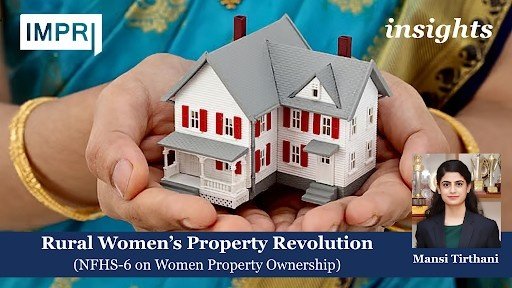
Mansi Tirthani
Background
In India property ownership is one of the most significant pillars of socio-economic empowerment but for an individual Indian woman it is a source of her dignity, financial security and to gain gender equality in the society. Historically, Indian women have faced deeply rooted challenges from systemic and legal to cultural barriers regarding their rights of asset acquisition, inheritance and land management. To track the progress in dismantling these inequalities, the National Family Health Survey (NFHS) serves as India’s multi-round demographic and health cycle by providing significant insights into changing household dynamics and resource distribution as a pathway leading to gender empowerment.
A recently released NFHS-6 survey revealed a significant shift in both data representation and empirical results. Under the updated dimension ‘Population and Households Profile,’ decided by the Ministry of Health and Family Welfare (MoHFW), the survey tracks a key socio-economic indicator titled as Households with any usual female members owning a house and/or land (alone or jointly with others). These latest findings from NFHS-6 show an upward trend in women’s institutional control over fixed assets.
While data from the NFHS-5 survey (2019-21) recorded that only 14.0% of households with women featured a female member who held structural rights over property. Whereas in the latest report of NFHS-6 survey this figure has experienced a substantial jump by scaling up to 18.8%. This 4 point increase indicates an expansion with macro-level growth in properties registered or held with female inclusion across Indian households.
Further geographical division of this 18.8% national households average reveals a picture against general urban-centric development theories. That is rural households exhibit a higher concentration of female property ownership integration compared to urban households. In rural India the indicator stands at 19.1% whereas in urban settings this proportion of households drops slightly to 18.2%. This structural difference highlights the unique socio-economic dynamics, land tenure patterns and state schemes that drive the asset distribution in agrarian and industrialized spaces.
Function
The primary function of tracking household level asset ownership on the basis of gender is to map out structural changes on ground in wealth distribution, fixed asset security and legal empowerment across rural and urban regions. By measuring whether a household contains any usual female member holding individual or joint titles to lands or houses, the indicator functions as an important gauge for monitoring the formalization of women’s property rights.
At a policy level, this data helps policymakers and government to view the impact of legislative frameworks like the Hindu Succession (Amendment) Act, 2005 and state-level fiscal incentives which are laid out to encourage property registrations in women’s names. Furthermore, the indicator highlights the operational dynamics of rural versus urban financial models.
The higher percentage of about 19.1 households at rural level is a direct reflection of localized state land distribution schemes, agricultural reforms and housing scheme mandates (such as the Pradhan Mantri Awas Yojana- Gramin) which incentivize joint or sole ownership in the name of women within the house. Whereas the lower urban percentage of about 18.2 highlights the complex, commercialized real estate markets where corporate ownership and high asset valuations can alter the regular mechanisms of family-based property distribution.
Impact
The positive shift from 14.0% to 18.8% carries both transformative social implications and economic implications for the women in Indian society. Asset ownership primarily modifies the balance of power within the domestic sphere as well as elevating a woman’s competence in financial decision making, child healthcare expenditures and educational allocations.
From an economic point of view, such a rise in property ownership grants women access to formal institutional credit. Land and real estate serve as primary collateral for credit and hence having a female member listed as an owner enables access to business, startup, SHG empowerment or agricultural loans quietly breaking the cycle of financial dependency on informal lending channels prevalence of which is still there in rural landscape.
On social grounds, secure property rights function as a strong structural buffer against domestic violence, marital vulnerability and displacement. A woman who holds a legal stake in her residential structure possesses a degree of physical safety and bargaining leverage that women with low or no asset ownership lack. In rural areas, where female agricultural labor is high, the 19.1% ownership rate helps to formalize the status of women from being farm hands to a well recognized, asset backed agricultural stakeholders starkly aligning economic contribution with statutory recognition.
Concerns
While the expansion to 18.8% reflects macro-level progress, a deep dive into the indicator’s design reveals a critical methodological change that poses an analytical concern.
The primary limitation of this newly added indicator is its structure as a collective household indicator rather than an individualized demographic and gendered focus indicator. The number of women who are owners of any fixed asset and number of households with women as owners of land and house are totally separate measurement indicators. It measures the percentage of households that have any female member who owns property rather than tracking individual women directly.
This marks a fundamental exit from the data model which were previously available in NFHS-4 and NFHS-5. In an earlier survey cycle data focused on individualized metrics by interviewing sampled women directly within a specific age bracket of 15- 49 years by asking whether they owned property alone or jointly. This individual approach yielded an exact percentage of the female population that held assets.
By shifting towards a collective household level indicator in NFHS-6 this new data represents an unclear picture rather than previous individual counting of property owners. For example, in a large multi-generational joint household containing three adult female members and if just one elderly matriarch holds a small plot of land or a joint title to a home then the entire household is considered positively (“Yes”). The remaining five younger women in that household remain assetless and economically dependent, yet the macro statistic records a successful indicator for that household unit.
Therefore, this collective indicator can artificially increase the perception of widespread female economic empowerment but not the true individual percentage of women who enjoy property rights, making data of NFHS-5 and NFHS-6 methodologically mismatched and complex for policy tracking.
Further, due to fiscal incentives such as lower property registration taxes and stamp duties for female buyers in various states many properties are registered in a woman’s name due to tax optimization. But in reality the male or karta of the family control the asset which reduces the female owner to a mere on a paper as a proxy titleholder.
Way Forward
To transform these statistical data into meaningful and real empowerment on ground India must adopt a multi-faceted strategy. Dual track survey methodology where surveys should consider dual data tracking by capturing both the collective household and individual women owning property. This would allow policymakers to identify gaps within households and prevent statistical distortion.
Legal and financial literacy must be expanded to translate ownership into true control. Indian women must be educated on how to utilize their property titles to access banking, agricultural credits and assert their inheritance rights without fear of social backlash. This can be done by tying incentives to state level administrative bodies by joining stamp duty waivers with educational workshops to ensure that women understand the legal protections and financial mechanisms associated with their names.
Though the NFHS-6 survey provides an encouraging snapshot of progress indicating that 18.8% of Indian households now include at least one female property owner with rural regions leading at 19.1%. This rise reflects positive policy outcomes and evolving family structures, the methodological shift to a collective indicator reminds us to interpret these figures with caution. True entitlement and empowerment will be achieved when asset ownership transitions from a collective household metric or mere a tax-saving strategy into an individual reality for every Indian woman.
References
International Institute for Population Sciences (IIPS) and ICF. 2017. National Family Health Survey (NFHS-4), 2015-16: India. Mumbai: IIPS. https://dhsprogram.com/pubs/pdf/fr339/fr339.pdf
International Institute for Population Sciences (IIPS) and ICF. 2021. National Family Health Survey (NFHS-5), 2019-21: India. Mumbai: IIPS. https://dhsprogram.com/pubs/pdf/FR375/FR375.pdf
International Institute for Population Sciences (IIPS) and ICF. (2026). National Family Health Survey (NFHS-6), 2023-24: India and State/UT Fact Sheets. Mumbai: IIPS. national family health survey (nfhs-6) 2023-24 fact sheets
The Hindu Succession (Amendment) Act, 2005, No. 39, Acts of Parliament, 2005 (India). Hindu Succession (Amendment) Act, 2005
About the Author:
Mansi Tirthani is the recipient of the National Award by the President of India for her contributions to community services. She has been Indian Youth Ambassador to China by Government of India to analyse startup and innovation ecosystem. Currently serves with the Research and Editorial team with a renowned policy think tank, where her work centers on evidence-based governance and policies analysis. With a strong commitment to advancing gender equity and welfare governance, she brings together rigorous data analysis, strategic communication and development to impact research and policy.
Disclaimer: All views expressed in the article belong solely to the author and not necessarily to the organisation.
Acknowledgement: This article was posted by Yashkirti Pal, a Research and Editorial Intern at IMPRI.
Read more at IMPRI:
The Gendered Cost of Depreciating Rupee
The Trilemma of Direct Benefit Transfers and Welfare Fiscal Policies on Governments During Inflation