









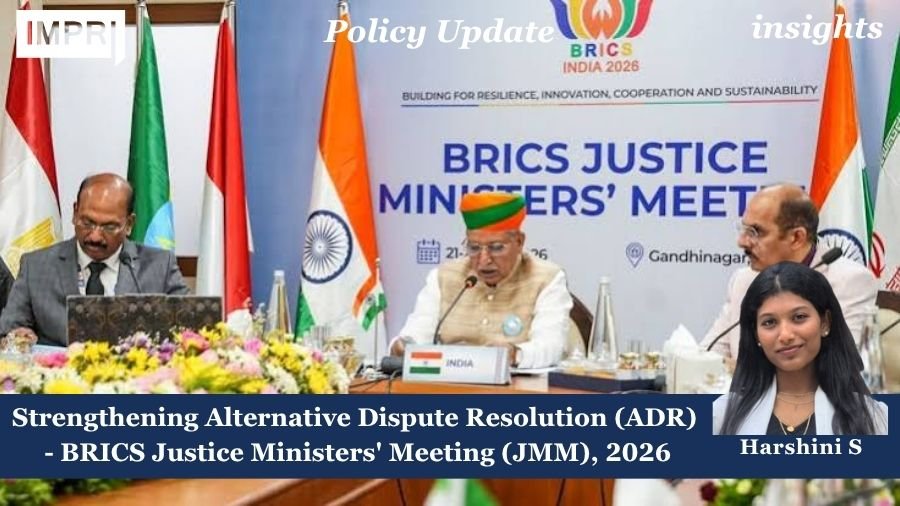
Policy Update
Harshini S
Background
Alternative Dispute Resolution (ADR) has become an integral component of modern justice systems by providing accessible, efficient, and cost-effective mechanisms for resolving disputes outside conventional court proceedings. Mediation, arbitration, conciliation, and negotiation have gained prominence globally as governments seek to reduce judicial backlogs, improve access to justice, and facilitate commercial certainty. Within the BRICS framework, judicial cooperation has increasingly focused on strengthening legal institutions and promoting ADR as a means of supporting economic integration, cross-border investment, and sustainable development. The expansion of BRICS in 2024 further underscored the need for harmonized legal cooperation among member states with diverse legal traditions (Ministry of Law and Justice [MoLJ], 2026a).
The BRICS Justice Ministers’ Meeting (JMM), held in Gandhinagar, Gujarat, in May 2026 under India’s BRICS Chairship, placed “Strengthening Alternative Dispute Resolution (ADR)” at the centre of discussions. Recognizing the growing volume of international commercial transactions, infrastructure investments, and cross-border business relations among BRICS members, the ministers emphasized the importance of developing efficient, transparent, and technology-enabled dispute resolution mechanisms. The meeting reaffirmed that accessible justice systems and robust ADR frameworks are essential for enhancing investor confidence, reducing litigation costs, promoting ease of doing business, and strengthening the rule of law. The ministers also acknowledged the role of ADR in achieving timely dispute resolution while preserving commercial relationships and reducing the burden on national judicial systems (MoLJ, 2026a).
The Gandhinagar meeting built upon previous BRICS legal cooperation by encouraging greater collaboration among member states in promoting mediation, institutional arbitration, judicial capacity-building, digital dispute resolution, and the exchange of best practices. The Joint Statement highlighted the need to strengthen cooperation among legal institutions, encourage training programmes for ADR professionals, facilitate knowledge sharing, and explore technological innovations, including online dispute resolution (ODR), to improve access to justice. These priorities align with India’s broader judicial reforms aimed at institutionalizing mediation and modernizing dispute resolution mechanisms through legislative and digital initiatives (MoLJ, 2026a; Press Information Bureau [PIB], 2026).
Functioning
The BRICS Justice Ministers’ Meeting functions as the principal ministerial platform for cooperation among the justice ministries of BRICS member countries. It facilitates dialogue on legal reforms, judicial administration, rule of law, access to justice, digital governance, anti-corruption measures, and alternative dispute resolution. Unlike treaty-based judicial organizations, the JMM operates through consensus and voluntary cooperation, encouraging the exchange of experiences and the development of common approaches while respecting the domestic legal systems and sovereign equality of member states. Decisions adopted during the meetings guide future collaboration through expert consultations, capacity-building programmes, and institutional partnerships (MoLJ, 2026a).
During the Gandhinagar meeting, the ministers deliberated on strengthening ADR ecosystems across BRICS by promoting institutional mediation, commercial arbitration, conciliation, and online dispute resolution. Discussions emphasized improving legal certainty for cross-border commercial transactions, enhancing cooperation between arbitration and mediation centres, sharing judicial best practices, and strengthening the professional capacity of mediators and arbitrators. The meeting also encouraged the adoption of technology-driven dispute resolution mechanisms to improve accessibility, efficiency, and transparency, particularly for commercial and investment-related disputes. These deliberations reflected the increasing recognition of ADR as an essential component of modern justice delivery and economic governance (MoLJ, 2026a).
Another significant outcome of the meeting was the emphasis on collaborative legal capacity-building among BRICS countries. The ministers supported greater cooperation through judicial exchanges, research collaborations, training programmes, and dialogue among legal institutions to strengthen dispute resolution frameworks. They also acknowledged the importance of developing citizen-centric justice systems that reduce procedural delays while ensuring fairness, neutrality, and enforceability. By integrating ADR into broader judicial cooperation, the Gandhinagar meeting demonstrated BRICS’ commitment to strengthening legal institutions that support economic development, investment security, and international commercial cooperation (PIB, 2026; United Nations Commission on International Trade Law [UNCITRAL], 2018).
Performance
The BRICS Justice Ministers’ Meeting in Gandhinagar marked a significant step in advancing legal cooperation by placing Alternative Dispute Resolution (ADR) at the forefront of the BRICS justice agenda. Rather than introducing a new institutional framework, the meeting reinforced the implementation of existing national ADR mechanisms through greater collaboration, exchange of best practices, and capacity-building among member states. The Joint Statement emphasized strengthening mediation and arbitration institutions, promoting legal cooperation, encouraging judicial dialogue, and leveraging digital technologies to improve access to justice. These commitments reflect the growing recognition that efficient dispute resolution mechanisms are essential for fostering investor confidence and facilitating cross-border commercial activities among BRICS economies (Ministry of Law and Justice [MoLJ], 2026a).
The meeting also demonstrated progress in aligning ADR with contemporary judicial reforms. India highlighted its recent initiatives to institutionalize mediation and modernize dispute resolution through legislative reforms, while member states agreed to enhance cooperation on professional training, judicial exchanges, and online dispute resolution (ODR). The ministers further acknowledged the importance of sharing experiences in commercial arbitration, cross-border dispute settlement, and technology-enabled justice delivery. Such collaborative efforts are expected to improve institutional capacity and promote greater consistency in ADR practices across BRICS countries without undermining the diversity of their respective legal systems (Press Information Bureau [PIB], 2026; UNCITRAL, 2018).
From a broader governance perspective, the meeting strengthened BRICS’ role as a platform for legal and judicial cooperation beyond traditional diplomatic engagement. Scholars have argued that harmonizing ADR practices can reduce transaction costs, improve commercial certainty, and enhance the investment climate among emerging economies (Born, 2021; Strong, 2016). By reaffirming political commitment towards accessible, efficient, and technology-driven dispute resolution, the Gandhinagar meeting contributed to the gradual development of a cooperative legal architecture capable of supporting expanding economic and trade relations within BRICS.
Impact
The emphasis on strengthening ADR has important implications for improving access to justice and enhancing the efficiency of judicial systems across BRICS countries. By promoting mediation, arbitration, conciliation, and online dispute resolution, the ministers recognized that alternative mechanisms can significantly reduce the burden on conventional courts while ensuring timely and cost-effective settlement of disputes. Efficient ADR systems not only improve judicial administration but also strengthen public confidence in legal institutions by providing flexible and accessible avenues for resolving civil and commercial disputes (MoLJ, 2026a).
The meeting also reinforced the role of ADR in supporting economic cooperation within BRICS. As trade, investment, and infrastructure partnerships among member states continue to expand, predictable and reliable dispute resolution mechanisms become increasingly important. The ministers’ commitment to strengthening commercial mediation, institutional arbitration, and legal cooperation is expected to improve the ease of doing business, reduce litigation risks, and encourage greater cross-border investment. International legal scholarship similarly recognizes ADR as a critical component of modern commercial governance, particularly in promoting business confidence and preserving long-term commercial relationships (Born, 2021; UNCITRAL, 2018).
Beyond commercial considerations, the Gandhinagar meeting demonstrated BRICS’ commitment to promoting inclusive and people-centric justice systems. The focus on digital innovation, judicial capacity-building, and international cooperation reflects a broader vision of modernizing justice delivery while respecting national legal traditions. Strengthening ADR through technology-enabled platforms and institutional collaboration can improve access for individuals, businesses, and marginalized communities, thereby contributing to Sustainable Development Goal 16, which emphasizes access to justice and effective institutions. Consequently, the meeting positioned ADR not merely as a legal reform initiative but as an important instrument for strengthening governance, economic resilience, and international legal cooperation among BRICS members (United Nations, 2015; PIB, 2026).
Emerging Issues
- Divergent legal and institutional frameworks: BRICS members follow different legal traditions and procedural rules governing mediation and arbitration, which may create inconsistencies in the recognition and enforcement of ADR outcomes. Strengthening legal dialogue and encouraging convergence with internationally accepted standards, particularly those developed by UNCITRAL, can improve cross-border legal certainty (UNCITRAL, 2018).
- Limited institutional capacity and awareness: Despite significant policy support, ADR institutions in several BRICS countries continue to face shortages of trained mediators, arbitrators, and specialized infrastructure. Expanding professional training, accreditation programmes, and public awareness campaigns can improve the quality and accessibility of ADR services (Ministry of Law and Justice [MoLJ], 2026a).
- Challenges in cross-border enforcement: Differences in domestic legislation and judicial procedures may affect the enforceability of mediated settlements and arbitral awards. Strengthening cooperation among BRICS justice ministries and encouraging greater alignment with international legal instruments can facilitate smoother recognition and enforcement of dispute resolution outcomes (United Nations Commission on International Trade Law [UNCITRAL], 2018).
- Digital divide in Online Dispute Resolution (ODR): While digital technologies can significantly improve access to justice, unequal digital infrastructure, cybersecurity concerns, and varying levels of digital literacy remain obstacles to the effective implementation of ODR platforms. Investment in secure digital infrastructure and capacity-building initiatives will be essential to ensure equitable access to technology-enabled dispute resolution (Press Information Bureau [PIB], 2026).
- Need for stronger institutional coordination: The implementation of ADR reforms requires sustained coordination among governments, judicial institutions, arbitration centres, legal professionals, and the private sector. Developing regular monitoring mechanisms and institutional partnerships within the BRICS framework can improve the continuity and effectiveness of collaborative initiatives (MoLJ, 2026a).
Way Forward
The BRICS Justice Ministers’ Meeting in Gandhinagar reaffirmed that Alternative Dispute Resolution is an essential pillar of efficient, accessible, and modern justice systems. Moving forward, BRICS countries should focus on translating the meeting’s commitments into concrete institutional reforms by strengthening mediation and arbitration centres, expanding judicial cooperation, and promoting the wider adoption of technology-enabled dispute resolution mechanisms. Regular exchanges of best practices and capacity-building programmes can further enhance the quality and credibility of ADR institutions across member states (MoLJ, 2026a).
Future cooperation should also prioritize harmonizing legal standards, strengthening cross-border enforcement mechanisms, and encouraging greater collaboration with international organizations such as UNCITRAL. Investment in digital infrastructure, professional training, and public awareness will be critical to ensuring that ADR becomes more accessible, transparent, and efficient for individuals and businesses alike. Such measures would strengthen investor confidence, facilitate international commercial transactions, and reduce the burden on conventional judicial systems (UNCITRAL, 2018; Born, 2021).
By integrating ADR into broader judicial modernization efforts, BRICS has the opportunity to promote a more resilient and inclusive legal ecosystem that supports sustainable economic growth and international cooperation. The Gandhinagar meeting demonstrated that strengthening ADR extends beyond judicial efficiency; it contributes to improving the business environment, advancing the rule of law, and achieving Sustainable Development Goal 16 on peace, justice, and strong institutions. Continued political commitment and effective implementation will therefore be essential to realizing the long-term objectives outlined by the BRICS Justice Ministers (United Nations, 2015; PIB, 2026).
References
Alexander, N. (Ed.). (2019). Global trends in mediation (2nd ed.). Kluwer Law International.
Born, G. B. (2021). International commercial arbitration (3rd ed.). Kluwer Law International.
Dezalay, Y., & Garth, B. G. (1996). Dealing in virtue: International commercial arbitration and the construction of a transnational legal order. University of Chicago Press.
Ministry of Law and Justice. (2026, May). Joint Statement of the BRICS Justice Ministers’ Meeting, Gandhinagar. https://www.pib.gov.in/PressReleasePage.aspx?PRID=2262219®=3&lang=1
Ministry of Law and Justice. (2026a). Joint Statement of the BRICS Justice Ministers’ Meeting, Gandhinagar. https://lawmin.gov.in/
Press Information Bureau. (2026). BRICS Justice Ministers’ Meeting under India’s Chairship emphasizes strengthening Alternative Dispute Resolution. https://www.pib.gov.in/PressReleasePage.aspx?PRID=2263902®=48&lang=2
Strong, S. I. (2016). International commercial mediation: From legal problem to dispute resolution. Cambridge University Press.
Susskind, R. (2019). Online courts and the future of justice. Oxford University Press.
United Nations. (2015). Transforming our world: The 2030 Agenda for Sustainable Development. https://sdgs.un.org/2030agenda
United Nations Commission on International Trade Law. (2018). UNCITRAL Model Law on International Commercial Mediation and International Settlement Agreements Resulting from Mediation. https://uncitral.un.org/en/texts/mediation/modellaw/commercial_conciliation
United Nations Commission on International Trade Law. (2019). United Nations Convention on International Settlement Agreements Resulting from Mediation (Singapore Convention on Mediation). https://uncitral.un.org/en/texts/mediation/conventions/international_settlement_agreements
World Bank. (2020). Doing Business 2020: Comparing Business Regulation in 190 Economies. https://documents1.worldbank.org/curated/en/688761571934946384/pdf/Doing-Business-2020-Comparing-Business-Regulation-in-190-Economies.pdf
About The Contributor
Harshini S is a research intern at IMPRI. She’s pursuing M.A.( International Relations) from Loyola College, University of Madras as of May, 2026. Belonging from a humanities background, she has developed strong critical thinking, research skills and creative writing skills. Her interest lies in Strategic studies, Human Rights and Public Policy.
Acknowledgment
The author extends sincere gratitude to C. B. Kavin Adithya, Shivali Yadav and IMPRI team for their expert guidance and constructive feedback throughout the process.
Reviewers
The article was reviewed by C. B. Kavin Adithya and Shivali Yadav
Disclaimer
All views expressed in the article belong solely to the author and not necessarily to the organisation.
Read more at IMPRI
11th Quad Foreign Ministers’ Meeting, New Delhi, May 2026
16th India-Japan Annual Summit Joint Statement – New Delhi (July 2026)