









PRISHA SACHDEVA
Background
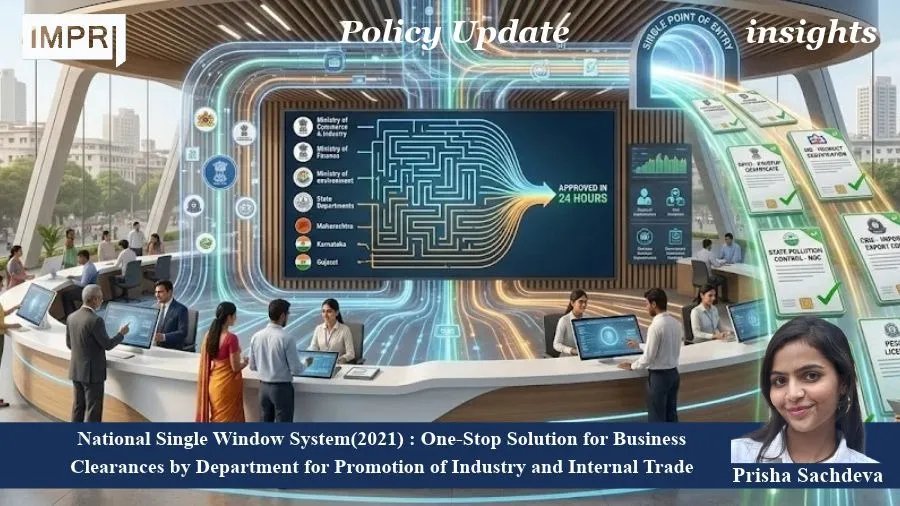
The National Single Window System (NSWS) was launched in September 2021 by the Department for Promotion of Industry and Internal Trade (DPIIT), Ministry of Commerce and Industry, as a digital platform to streamline business approvals and facilitate investment in India. The initiative addresses the long-standing challenge of regulatory fragmentation, where businesses previously had to navigate multiple portals and departments to obtain the necessary clearances for establishing and operating enterprises.
The NSWS serves as India’s comprehensive business approval infrastructure, integrating 327 Central approvals and 3,452 State approvals across 34 States and Union Territories through a unified interface. The platform’s Know Your Approvals (KYA) module covers 32 Central Departments, enabling businesses to identify, apply for, and track regulatory clearances from a single portal rather than interacting with multiple government agencies separately. (Press Information Bureau, 2026; National Single Window System)
This initiative aligns with India’s broader Digital Public Infrastructure (DPI) strategy, complementing other platforms such as the Government e-Marketplace (GeM), UPI, and the Account Aggregator framework to create an integrated ecosystem for business facilitation, trade promotion, and regulatory compliance.
Functioning
The National Single Window System functions as a digital aggregator platform that enables businesses to identify, apply for, and track regulatory approvals through a unified interface, reducing the need to interact with multiple government departments separately. The platform operates through several integrated modules that streamline the approval process from initial identification to final clearance.
Key Modules and Features
- Know Your Approvals (KYA) Module
This is the core feature of NSWS, providing businesses with a customised checklist of required approvals based on their sector, location, investment size, and business activity. The module covers 32 Central Departments and 34 States/UTs, generating a tailored roadmap for regulatory compliance. (Press Information Bureau, 2026)
- Common Registration Form (CRF)
Businesses can submit a single application form for multiple approvals, eliminating the need to fill separate forms for each department. The form captures comprehensive business information that is shared with relevant approving authorities, reducing duplication of effort.
- Applicant Dashboard
A real-time tracking interface where businesses can monitor the status of their applications across all departments. The dashboard provides visibility into which stage each approval is at, pending actions, and expected timelines.
- Document Repository with DigiLocker Integration
Enables once-only document submission, where businesses can upload documents to DigiLocker and share them with multiple departments without repeated uploads. This reduces paperwork and ensures document authenticity.
- E-Communication Module
Facilitates electronic communication between businesses and departments for responding to queries, seeking clarifications, and submitting additional information. This eliminates the need for physical visits to government offices.
- Payment Gateway
Integrated payment system for processing application fees across different departments through a single transaction interface.
How to Apply Through NSWS
Beneficiaries
The NSWS serves a wide range of users, including:
- Domestic investors establishing new businesses or expanding existing operations
- MSMEs requiring multiple state and central clearances
- Large corporations undertaking significant industrial projects
- Startups in regulated sectors requiring specific approvals
- Exporters and importers needing trade-related clearances
Integration with Other Systems
The NSWS is integrated with several other government platforms to create a seamless business facilitation ecosystem:
DigiLocker : For document storage and verification
ICEGATE: For customs and trade-related single window services
Industrial Entrepreneur Memorandum (IEM) system: Fully migrated to NSWS since October 2025
Industrial Licence (IL) system: Fully migrated to NSWS since October 2025
State-level single window systems: Aggregated through NSWS for unified access
This integrated functioning reduces the time and effort required for businesses to obtain regulatory clearances, addressing a critical bottleneck in India’s Ease of Doing Business landscape.
Performance
The National Single Window System has demonstrated significant progress since its launch in September 2021, with substantial expansion in coverage, user adoption, and approval processing capacity over the five-year period.
Coverage Expansion Timeline
| Year | Central Departments | States/UTs | Central Approvals | State Approvals |
| 2021(Launch ) | 18 | 9 | Not specified | Not specified |
| 2026(Sep) | 32 | 34 | 327 | 3452 |
Source – Compiled by author ((Press Information Bureau, 2026 ; National Single Window System)
The National Single Window System has expanded considerably since its initial launch. In July 2021, the beta version covered approvals from 18 Central Departments and 9 States. After its soft launch on 22 September 2021, the platform gradually expanded its coverage to 27 Central Ministries/Departments and 19 States by January 2023. By September 2026, NSWS had integrated approvals from 32 Central Ministries/Departments and 34 States and Union Territories, providing access to more than 327 Central approvals and 3,452 State approvals.
User Adoption and Processing Metrics
As of September 2026, the NSWS has achieved the following milestones:
5.69 lakh+ business entities onboarded on the platform
327 Central approvals available through the platform
3,452 State approvals across 34 States/UTs
32 Central Departments integrated into the system
Comparison with Pre-NSWS Era
Before NSWS, businesses typically had to Visit multiple government offices physically , Submit separate applications to each department ,Track application status through individual portals or in-person visits , Submit the same documents multiple times to different departments
With NSWS, businesses can Access all approvals through a single portal ,Submit one common application form for multiple approvals , Track all applications in real-time through a unified dashboard and Upload documents once via DigiLocker for all departments
This represents a significant improvement in the ease of obtaining business clearances, though challenges remain in terms of actual processing times and state-level integration depth.
Impact
The National Single Window System has created meaningful impact across India’s business ecosystem by reducing regulatory friction, improving transparency, and enabling faster business establishment and expansion.
- Ease of Doing Business
The NSWS directly addresses one of the most significant barriers to business formation in India — the complexity and time required to obtain regulatory clearances. By consolidating 327 Central and 3,452 State approvals onto a single platform, the initiative has reduced the administrative burden on businesses, particularly for MSMEs and startups that lack dedicated compliance teams.
The platform’s Know Your Approvals module generates customised checklists based on sector, location, and investment size, enabling businesses to understand their compliance requirements upfront rather than discovering them through trial and error. This proactive guidance reduces the risk of businesses operating without mandatory clearances, which previously exposed them to penalties and operational disruptions.
- Investment Facilitation
For foreign investors, the NSWS provides a streamlined pathway to obtain Foreign Investment Promotion and Protection Board (FIPB) approvals and other investment-related clearances through a unified interface. The platform’s integration with the Industrial Entrepreneur Memorandum and Industrial Licence systems since October 2025 has further simplified the investment approval process, reducing the time and documentation required for establishing manufacturing and production facilities.
The migration of IEM and IL processes to NSWS has created a single point of contact for industrial approvals, enabling investors to track their applications in real-time and respond to departmental queries electronically without physical visits. This has improved India’s attractiveness as an investment destination, particularly for manufacturing projects that require multiple clearances across central and state jurisdictions.
- MSMEs and Startups
Small and medium enterprises, which constitute the backbone of India’s economy, have benefited significantly from the NSWS’s simplified approval process. MSMEs typically lack the resources to navigate complex regulatory frameworks, and the platform’s common registration form, once-only document submission, and real-time tracking have reduced compliance costs and administrative overhead.
Startups in regulated sectors such as manufacturing, healthcare, and food processing can now identify their approval requirements upfront through the KYA module, enabling them to factor compliance timelines into their business planning rather than facing unexpected delays. This predictability is particularly valuable for startups seeking to scale operations or raise funding, where regulatory clearances can be a critical milestone.
- Transparency and Accountability
The NSWS has introduced greater transparency into the approval process by providing real-time visibility into application status, pending actions, and departmental response times. The Applicant Dashboard enables businesses to track which department is holding up their application, creating accountability and reducing opportunities for rent-seeking.
The e-communication module creates an auditable trail of interactions between businesses and departments, reducing ambiguity and ensuring that queries and responses are documented. This digital trail can be used to identify bottlenecks and improve departmental performance over time.
Emerging Issues
Despite significant progress, the National Single Window System faces several challenges that limit its effectiveness and prevent it from achieving true single-window clearance status.
- Incomplete State Integration
Not all 36 States and Union Territories have fully integrated their approval systems with NSWS, creating gaps in coverage and user experience. While 34 States/UTs are listed on the platform, the depth of integration varies significantly some states offer full end-to-end processing through NSWS, while others use it only as an information portal with actual processing occurring through separate state systems.
- Technical Challenges and System Reliability
Users have reported technical issues including server crashes, slow loading times, and integration problems between NSWS and departmental systems. The platform’s dependence on multiple external systems (DigiLocker, state portals, departmental databases) creates multiple points of failure, where issues in one system can disrupt the entire approval workflow.
- Federated vs. Centralised Structure
The NSWS operates as an aggregator rather than a true single-window system, meaning that actual approval processing still occurs through individual departmental authorities rather than through NSWS itself. This federated structure is necessitated by India’s constitutional framework, where many approvals fall under state jurisdiction, but it limits the platform’s ability to enforce uniform timelines and standards.
- Limited Awareness and Adoption Among MSMEs
Despite 5.69 lakh businesses being onboarded, awareness of NSWS remains limited among smaller businesses, particularly in rural and semi-urban areas. Many MSMEs continue to rely on traditional channels such as consultants or physical visits to government offices, missing out on the platform’s benefits.
Way Forward
To realise the full potential of the National Single Window System and move closer to true single-window clearance, several strategic interventions are required across technical, institutional, and policy dimensions.
- Achieve Complete State Integration
The Department for Promotion of Industry and Internal Trade should prioritise achieving 100% integration of all 36 States and Union Territories with NSWS, with clear timelines and milestones. States that have not yet fully integrated should be provided with technical assistance and capacity-building support to upgrade their IT systems and align with NSWS standards.
- Enforce Service-Level Agreements
The government should establish clear service-level agreements (SLAs) for each approval type, specifying maximum processing times and consequences for delays. Departments that fail to process applications within SLA timelines should face automatic escalation to senior officials, with explanations required for delays.
- Enhance Common Application Form Functionality
The Common Registration Form should be expanded to cover all approvals on the platform, with no exceptions for departments requiring additional forms. Data pre-fill functionality should be made universal, enabling information from one application to automatically populate related applications across departments.
- Invest in Technical Infrastructure
Significant investment is required to upgrade NSWS’s technical infrastructure to handle growing user volumes and ensure system reliability. This includes scaling server capacity, improving load balancing, and implementing robust disaster recovery mechanisms.
- Publish Performance Metrics and Create Accountability
The government should publish regular performance reports on NSWS, including metrics such as average approval times by department and approval type, rejection rates, user satisfaction scores, and state-wise integration depth. This transparency would enable businesses to make informed decisions and create pressure for departments to improve performance.
References
- Department for Promotion of Industry and Internal Trade. (2021, July 21). National Single Window System for investors and businesses. Press Information Bureau.https://www.pib.gov.in/PressReleasePage.aspx?PRID=1756966
- Department for Promotion of Industry and Internal Trade. (2021, December 14). Year-end review—2021. Press Information Bureau.https://www.pib.gov.in/PressReleaseIframePage.aspx?PRID=1786148
- Department for Promotion of Industry and Internal Trade. (2023, January 5). National Single Window System portal for various approvals. Press InformationBureau.https://www.pib.gov.in/Pressreleaseshare.aspx?PRID=1888936
- IMARC Engineering. (2026, May 11). National Single Window System in 2026: Is India moving toward integrated industrial approvals.https://www.imarcengineering.com/blog/national-single-window-system-industrial-approvals-india
- Kanakkupillai. (2025, February 22). National Single Window System (NSWS).https://www.kanakkupillai.com/learn/national-single-window-system-nsws/
- National Single Window System. (n.d.-a). Frequently asked questions.https://www.nsws.gov.in/faqs
- National Single Window System. (n.d.-b). National Single Window System.https://www.nsws.gov.in/about-us
- National Single Window System. (n.d.-c). NSWS: India’s National Single Window System for Business.https://www.nsws.gov.in/
- National Single Window System. (2026, September 1). Portal updates and technical notices.https://www.nsws.gov.in/node
- Press Information Bureau. (2026, September 21). 12 years of Make in India.https://www.pib.gov.in/PressReleasePage.aspx?PRID=2314447
- Press Information Bureau. (2026, September 27). National Single Window System.https://www.pib.gov.in/PressReleaseDetail.aspx?PRID=2313670®=3&lang=1
Contributor:
Prisha Sachdeva is a Research & Editorial intern at IMPRI. She’s pursuing Bachelors in psychology (Honours) from the University of Delhi. Her interest lies in cognitive science and human behavior with a focus on evidence-based policy and behavioral research.
Acknowledgement:
The author sincerely expresses gratitude to the reviewers and the editorial team for their valuable comments, constructive suggestions, and continuous guidance throughout the preparation of this article. Their insightful feedback significantly enhanced the clarity, organisation, and analytical quality of the manuscript. The author also acknowledges the support and encouragement received during the research and writing process, which contributed to the successful completion of this work.
Reviewers: Anamika P K and Aditya Chavan
Published by: Mahenoor Imam, a Research and Editorial Intern at IMPRI
Disclaimer:
All views expressed in the article belong solely to the author and not necessarily to the organisation.