




Policy Update
Angela Rajeev
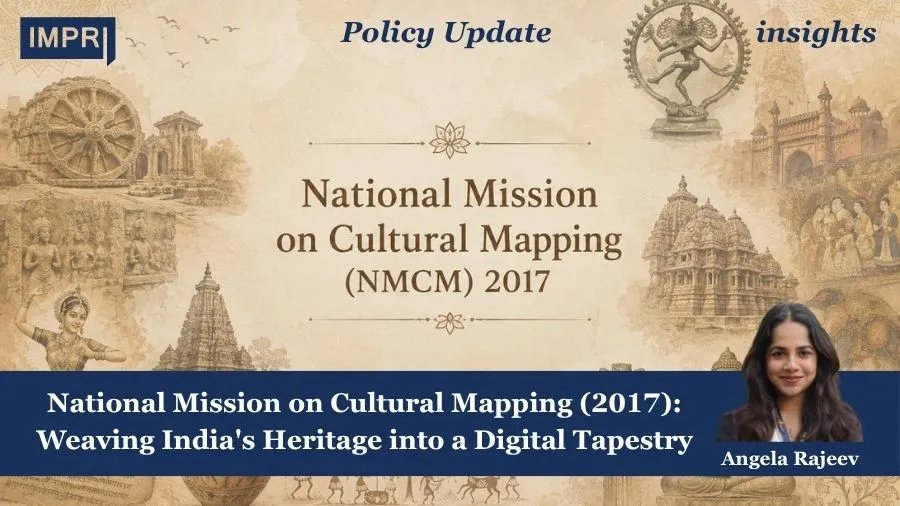
Jawaharlal Nehru once described India as an ‘ancient palimpsest on which layer upon layer of thought and experience had been written, with no succeeding layer ever wholly erasing what had gone before.’ The National Mission on Cultural Mapping (NMCM) – a Ministry of Culture initiative launched in 2017 to translate India’s artisanal & village-level heritage into a national database – takes this Nehruvian idea as its working premise (Ministry of Culture, 2026a). After nearly a decade of the scheme running and roughly 97 percent of its village target reportedly covered, making it a valuable case study in the sustained & data-driven implementation of a large-scale rural mission.(Ministry of Culture, 2026b).
Background
The NMCM was approved by the Ministry of Culture in 2017 and worked on a clear administrative logic: the ministry would run dozens of grant and welfare schemes for artists and cultural organisations but had no consolidated inventory of who these artists were, where they were located, or what traditions they practised (Ministry of Culture, 2026a). The scheme was designed to run for an initial five years from 2017 and was placed under the technical stewardship of the Indira Gandhi National Centre for the Arts (IGNCA).
On-ground data collection outsourced to CSC e-Governance Services India Limited which is a body under the Ministry of Electronics and Information Technology (MeitY) (CSC/IGNCA Village Cultural Mapping Manual, n.d.). The core deliverables set out at inception were threefold:
i) a national register of artists and art practices,
ii) a ‘village level cultural gazetteer’ covering roughly 6.5 lakh inhabited villages identified in the 2011 census (Ministry of Culture, 2026b),
iii) a web/mobile platform called the ‘National Cultural Workplace (NCWP)’ to host this data (Ministry of Culture, 2026b).
The mission’s underlying premise was that cultural heritage goes hand in hand with rural development and identity. This very fact situated it as much within the Ministry’s rural-revival agenda as within its conservation mandate (Ministry of Culture, 2026a).
Functioning
Operationally, NMCM works through several interlocking components rather than a single scheme. Mera Gaon Meri Dharohar (MGMD) is its flagship survey initiative which was formally rolled out on 27 July 2023 and was a part of the ‘Azadi Ka Amrit Mahotsav’ commemoration. Moreover the village-level data collected across seven broad categories such as Arts and Crafts Villages and Ecologically Oriented Villages (Ministry of Culture, 2026). There are Village Level Entrepreneurs (VLEs) who have the responsibility of operating under the CSC network conduct primary surveys (these range from interviews, photographs, to audio/video production) and which are then validated by IGNCA-appointed Fellows before being uploaded to the public Mera Gaon Meri Dharohar portal (IGNCA Village Cultural Mapping Manual, n.d.).
A more recent structural shift which was announced in the Ministry’s March 2026 reply to Parliament has brought the Ministry of Panchayati Raj into the data pipeline. The initiative is largely to bring in local Gram Sabhas who now are entrusted to assist with collection, sanitisation and validation of village data. This is essentially a convergence that the Ministry says has reduced the scheme’s own fund requirement (Ministry of Culture, 2026d). Supporting sub-programmes include the ‘Hamari Sanskriti Hamari Pahchan’ cultural-awareness campaign, a Unique Cultural ID (UCID) system for grading and identifying artists and physical “Kala Gram” cultural hubs meant to anchor these digital records in real infrastructure (Ministry of Culture, 2026a).
Performance
The clearest performance indicators available are found in its coverage, website data and fund utilisation. Coverage and funds are drawn from Ministry replies in Parliament. The Ministry’s most recent announcement has announced that around 6.23 lakh of the 6.38 lakh villages targeted under MGMD had been culturally mapped and uploaded to the portal (Ministry of Culture, 2026b). This is essentially a coverage rate of roughly 97% percent against the revised target (Ministry of Culture, 2026d).
However it is key to point out that State-level figures may vary. One hand let us consider how West Bengal has mapped 40,429 of its 41,116 targeted villages, Odisha has covered 47,209 villages with two districts (Bhadrak & Balasore) fully complete and Uttar Pradesh’s Siddharthnagar district alone accounts for 2,542 mapped villages (Ministry of Culture, 2026e, 2026d). Financially, on the other hand, the record is far more uneven. Looking at the Ministry’s own year-wise expenditure data (Table 1) shows.
Table 1: NMCM Fund Allocation and Utilisation, 2017-18 to 2025-26
| Financial Year | Allocated (₹ lakh) | Utilised (₹ lakh) | Utilisation Rate |
| 2017-18 | 2,000.00 | 55.72 | 2.8% |
| 2018-19 | 3,000.00 | 17.44 | 0.6% |
| 2019-20 | 1,278.00 | 101.56 | 7.9% |
| 2020-21 | 420.00 | 209.06 | 49.8% |
| 2021-22 | 412.00 | 99.28 | 24.1% |
| 2022-23 | 1,913.00 | 1,894.38 | 99.0% |
| 2023-24 | 1,982.00 | 1,971.71 | 99.5% |
| 2024-25 | 1,806.00 | 738.79 | 40.9% |
| 2025-26 | 2,246.00 | 205.50 | 9.1%* |
Source: Ministry of Culture, written reply in Lok Sabha, 23 March 2026 (Ministry of Culture, 2026d). 2025-26 figure reflects utilisation up to the date of reply; the Ministry attributes the low figure partly to reduced fund requirement following convergence with Panchayati Raj Institutions.
A stark pattern can be mapped out. For the mission’s first five years (between 2017-18 to 2021-22) utilisation did not even cross 50 percent. On the contrary it touched a low of 0.6 percent in 2018-19. Evidently this appears to be a period during which the mission existed largely on paper (Ministry of Culture, 2026d).
The turnaround coincides almost exactly with the formal Mera Gaon Meri Dharohar launch in mid-2023. Thereafter, 2022 onwards we can see near-total utilisation of allocated funds. A period of evident uptick in rapid village coverage (Ministry of Culture, 2026d). The Ministry’s 2025-26 budget continued to grow the scheme to ₹22.46 crore even as broader Ministry of Culture allocations rose to ₹3,360.96 crore for the year (Indian Archaeology, 2025).
Impact
India is a country with a rich tradition of physical, archival as well as oral history and one where NMCM has demonstrably delivered is towards creating a searchable public record of intangible heritage that did not previously exist in any centralised form. These exist in the form of oral traditions, festivals, cuisines, traditional dress and local landmarks across hundreds villages are now viewable on a single government portal (Ministry of Culture, 2026e). The Ministry frames this as strengthening rural cultural identity and enabling planning for heritage tourism and cultural-cluster development. This is done in light of the fact that departments outside the Ministry of Culture can now draw on a structured dataset rather than commissioning fresh surveys.
For artists, the ‘Unique Cultural ID (UCID)’ system and ‘National Cultural Workplace (NCWP)’ portal are intended to link individual practitioners to existing welfare schemes and grants. This will potentially formalise a segment of the informal cultural economy that has historically been alien to state documentation (Ministry of Culture, 2026a). UNESCO’s Policy Monitoring Platform has separately noted that the Mera Gaon Meri Dharohar component has fostered community engagement in participating villages and contributed to the broader documentation of traditional knowledge (UNESCO, 2026). It is important to note that the Ministry itself has clarified in Parliament that NMCM’s mandate is documentation and not promoting commerce – it does not directly create income opportunities for them through sales. (Ministry of Culture, 2026d).
Emerging Issues
Several gaps are visible once the scheme’s own data is read closely.
First, the six-year gap between approval (2017) and the formal MGMD rollout (2023) represents a substantial implementation lag. During which allocated funds were repeatedly returned largely unspent. This is a pattern consistent with broader concerns the Parliamentary Standing Committee on Transport, Tourism and Culture has raised about fund utilisation across culture and tourism schemes more generally (PRS Legislative Research, 2026).
Second, the shift of core data-collection responsibility to Gram Sabhas under the Ministry of Panchayati Raj has been framed as an efficiency gain but in reality this devolution of power also means the very burden of primary verification rests with local panchayat capacity and lifts the onus from actual trained personnel and the very ‘Village Level Entrepreneurs (VLEs)’ who were originally envisaged would be responsible for data consistency (Ministry of Culture, 2026d).
Third, upon going through a brief survey of the MGMD website it is evident that coverage statistics merely measure villages “uploaded” and not in the holistic institutional depth or accuracy that the culture of a region requisites. The portal’s own design allows crowd-sourced “Contribute” submissions pending moderation. However, while it is useful for scale, it leaves quality control largely reactive (Ministry of Culture, 2026e).
Fourth, the mission’s explicit exclusion of any artist e-commerce or monetisation layer limits its ability to convert cultural documentation into direct economic upliftment for the very artisan communities it was designed to serve (Ministry of Culture, 2026d).
Way Forward
Firstly, the Ministry should institutionalise a standard and publicly reported data-quality audit for MGMD entries. The aim should be for documentation to go beyond the “villages uploaded” metric to assess field verification i) depth, (ii) currency of information and (iii) mechanisms set in place for cross-checking against Census and Panchayati Raj records. As headline coverage numbers can otherwise mask uneven documentation quality across states.
Secondly, the Gram Sabha convergence model needs codified training and accountability standards. Shifting verification duties to local bodies without a matching capacity-building push results in a dangerous precedent in policy-making that is willing to risk trading fiscal efficiency for inconsistent data reliability across roughly 6 lakh villages all of which will obviously have vastly differing administrative capacity.
Thirdly, the Ministry could explore calibrated linkages between the National Register of Artists and existing livelihood or marketing schemes run by other departments (for instance the Ministry of Textiles’ handicraft portals). This does not necessarily mean building e-commerce infrastructure in-house but rather creating a mechanism in such a way that documentation converts more visibly into artisan income rather than just being a symbolic static archive.
Fourthly, the government should provide more consistent funding instead of arbitrarily increasing and decreasing the budget unpredictably between 2017 and 2022. This would help maintain the uptick in progress made since the Mera Gaon Meri Dharohar (MGMD) launch in 2023, especially because the mission is nearing its goal of mapping all villages. All in all, cultural policy must move beyond administrative documentation and towards meaningful and sustained outcomes for the subaltern.
References
Ministry of Culture, Government of India. (2026a). National Mission on Cultural Mapping and Roadmap. https://culture.gov.in/offering/mission/national-mission-cultural-mapping-and-roadmap
Ministry of Culture, Government of India. (2026b). Mission. https://culture.gov.in/ministry/mission
Ministry of Culture, Government of India. (2026c, February). Mera Gaon Mera Dharohar programme showcases India’s village heritage. https://culture.gov.in/latest-news/mera-gaon-mera-dharohar-programme-showcases-indias-village-heritage
Ministry of Culture, Government of India. (2026d, March 23). National Mission on Cultural Mapping and Roadmap [Press release]. Press Information Bureau. https://www.pib.gov.in/PressReleasePage.aspx?PRID=2243792
Ministry of Culture, Government of India. (8 De). ‘Mera Gaon Meri Dharohar’ programme [Press release]. Press Information Bureau. https://www.pib.gov.in/PressReleasePage.aspx?PRID=2200360
Press Information Bureau. (2025, 8th December). National Mission on Cultural Mapping (NMCM) and Mera Gaon Meri Dharohar (MGMD) [Press release]. https://www.pib.gov.in/PressReleasePage.aspx?PRID=2240537
Indira Gandhi National Centre for the Arts / CSC e-Governance Services India Limited. (n.d.). National Mission on Cultural Mapping – Mera Gaon Meri Dharohar: Village cultural mapping manual for Village Level Entrepreneurs. https://ds6jlmnundspw.cloudfront.net/static/admin/pdf/NMCM_PPT_Village_Cultural_Mapping_Manual%20_VLE.pdf
Indian Archaeology. (2025, February 3). Ministry of Culture’s 2025-26 budget: Major allocation to ASI. https://www.inarchcenter.com/post/ministry-of-culture-s-2025-26-budget-major-allocation-to-asi
PRS Legislative Research. (2026). Transport, Tourism and Culture: Department-related Parliamentary Standing Committee. https://prsindia.org/parliamentary-committees/transport-culture-and-tourism
UNESCO. (2026). Mera Gaon Meri Dharohar [Policy Monitoring Platform entry]. https://www.unesco.org/creativity/en/policy-monitoring-platform/mera-gaon-meri-dharohar
PolSci Institute. (2026, May 26). Nehru’s nationalism: Unity in diversity for India’s progress. https://polsci.institute/social-political-thought-modern-india/nehru-nationalism-unity-diversity-india/
About the Contributor
Angela Rajeev is a graduate in Political Science and History, with a minor in Economics, from Christ University, Bangalore. She approaches her research with a passion for gender, public policy, and geopolitics. As a Research and Editorial Intern at IMPRI, she works at the intersection of policy and culture while exploring issues related to governance, society and international relations.
Acknowledgements
The author extends sincere gratitude to the IMPRI team for their guidance and support along with the reviewers Ms. Nivedya Murali and Ms. Madhuritha for their valuable feedback and insights.
Disclaimer
All views expressed in the article belong solely to the author and not necessarily to the organization
Read More at IMPRI:
Community Health: A Responsive Action for Koylanchal Initiative (CHARAK)
India Innovation Centre for Graphene: Kerala’s 2022 Push Toward a Knowledge Economy