







Policy Update
Ashi Verma
Background
The safe harbour framework for intermediaries in India flows from Section 79 of the Information Technology Act, 2000, operationalized by the Information Technology (Intermediary Guidelines and Digital Media Ethics Code) Rules, 2021. Under Rule 3(1)(d), intermediaries had to disable access to unlawful content upon receiving actual knowledge through a court order or government notification. The phrase “Appropriate Government or its agency” was, however, not hierarchically defined, which in practice permitted officers as low as Inspector rank to issue takedown directions, leading to risks of arbitrary action, lack of transparency, and chilling effect on Article 19(1)(a), as cautioned in Shreya Singhal v. Union of India.
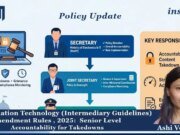
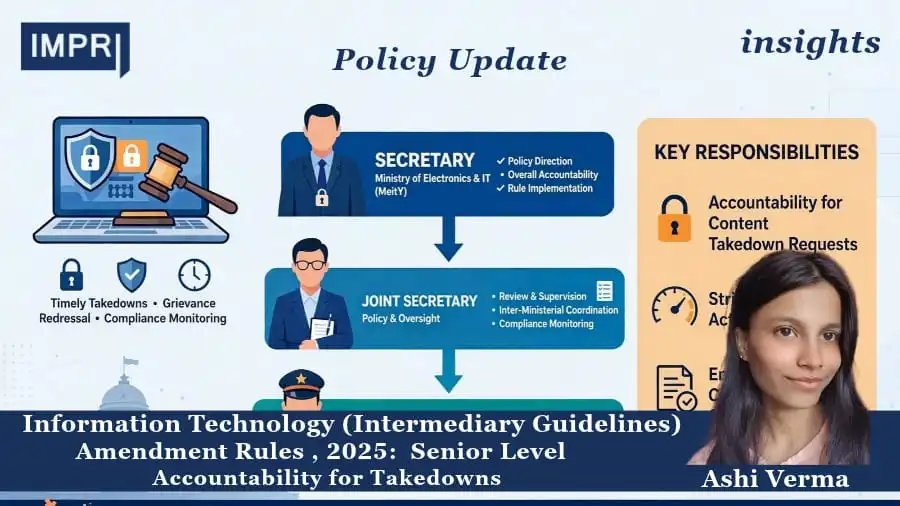
Recognizing these gaps, the Ministry of Electronics and Information Technology (MeitY) introduced the Information Technology (Intermediary Guidelines) Amendment Rules, 2025, effective from November 1, 2025. The amendment strengthens Rule 3(1)(d) by institutionalizing senior-level accountability. It mandates that only officers not below Joint Secretary/Director equivalent in civil administration and Deputy Inspector General (DIG) in police, duly authorized, can issue takedown intimations. It further requires reasoned orders with specific legal grounds and URL-level identification, and establishes a mandatory monthly review by a Secretary-level officer to ensure necessity, proportionality, and compliance.
Functioning
- Re-calibration of Issuing Authority: The amendment redefines who can trigger a takedown under Rule 3(1)(d).
It creates a dual track hierarchy to eliminate discretion at lower levels. For civil departments and ministries, the competence is elevated to officers of the rank of Joint Secretary or above, and only in the absence of such a post, to a Director-level officer routed through a notified nodal agency. In the police framework, this power is exclusively vested in an officer not below Deputy Inspector General (DIG), who must have prior special authorization from the appropriate government. This institutional filter ensures that content restriction decisions carry senior administrative ownership.
- Procedural Formalization of Takedown Notices : Functionally, the Rules now prescribe a mandatory format for compliance. An intermediary cannot be expected to act on ambiguous intimations. Therefore, every notice must be reasoned, speaking order which clearly identifies the violated legal provision, explains the specific nature of illegality, and pinpoints the content through exact URLs or unique identifiers. This operationalizes the principle of “actual knowledge” under Section 79(3)(b) of the IT Act and reduces interpretative burden on intermediaries.
- Built-in Accountability through Review: The most significant operational innovation is the monthly oversight loop. All directions issued during a month are mandatorily placed before an officer not below Secretary rank for review. The reviewing authority examines whether the takedown was necessary, proportionate, and legally tenable. This prevents indefinite continuation of restrictive orders and introduces a self-correcting mechanism within the executive itself.
Performance
The performance of the IT Amendment Rules, 2025 has to be evaluated on the touchstones of transparency, restraint and institutional accountability. In its initial phase of implementation since November 2025, the amendment has shown a tangible improvement in curtailing arbitrary executive action.
By restricting the power of issuing takedown intimations to Joint Secretary and DIG-level officers, the number of casual, low-level notices has significantly declined, thereby reducing compliance burden on intermediaries and preventing routine censorship. The requirement of a reasoned, URL-specific order has enhanced legal clarity, enabling platforms like social media intermediaries to assess the legality of requests more objectively and to maintain better audit trails for judicial scrutiny.
Furthermore, the monthly review by Secretary-level officers has introduced an internal check that was previously absent, ensuring that takedown directions do not remain operative indefinitely without evaluation of necessity and proportionality.
However, the effectiveness remains dependent on faithful implementation, as the absence of independent judicial oversight and the lack of a user notification or counter-notice mechanism still leaves scope for opacity. Overall, while the amendment marks a progressive shift towards senior level accountability, its long-term performance will be determined by how rigorously the review mechanism is enforced and whether it translates into actual protection of free speech.
Impact
The introduction of senior-level accountability under the IT Amendment Rules, 2025 has created a multi-dimensional impact on the digital governance ecosystem.
First, on free speech and user rights, It has strengthened protection against arbitrary censorship. By eliminating the discretion of junior officers like Inspectors to order content removal, it ensures that any restriction on expression carries senior administrative responsibility, aligning more closely with the proportionality principles laid down in Shreya Singhal and Puttaswamy.
Second, on intermediaries, the impact is operational and legal. Platforms now receive precise, reasoned, and URL-specific intimations instead of vague complaints, which reduces compliance ambiguity, lowers the risk of over-removal, and provides a stronger legal record to defend their actions before courts. This restores a degree of confidence in the safe-harbour regime under Section 79.
Third, on State accountability, the mandatory monthly review by a Secretary level officer introduces an institutional self correction mechanism, making executive action more transparent and accountable. It shifts content regulation from a fragmented, low level practice to a structured, hierarchical process.
However, the impact is not without limitations. The absence of prior judicial review, lack of transparency to the affected content creator, and non-existence of a counter-notice or appeal mechanism mean that while arbitrariness at the lower level is reduced, the concentration of power at senior levels without external checks still raises concerns about potential chilling effects on digital discourse.
Emerging Issues
1. Lack of Independent Oversight : The amendment confines both issuance and review within the executive DIG/Joint Secretary issues, Secretary reviews. There is no provision for independent judicial or quasi-judicial scrutiny before a takedown takes effect. This retains an executive-dominated model, unlike Section 69A blocking which has a Review Committee under Rule 419A of Indian Telegraph Rules.
2. Absence of User Side Due Process : The Rules do not mandate prior or post-facto notice to the content creator whose content is being removed. Without a right to be heard, counter notice, or effective appeal mechanism, the affected user remains invisible in the process, violating principles of natural justice.
3. Vagueness in “Unlawful Content” : The amendment improves who can issue the notice but does not clearly define what constitutes unlawful content under Rule 3(1)(d). The broad categories under Rule 3(1)(b) still leave scope for subjective interpretation, even at senior levels.
4. Risk of Centralization and Delay : Elevating authority to senior levels may create administrative bottlenecks. Urgent cases involving hate speech, non-consensual imagery, or national security may suffer due to lack of delegation and lengthy approval chains at the Joint Secretary/DIG level.
5. Transparency Deficit : There is no mandatory requirement for publication of monthly takedown reports, anonymized data, or reasons for decisions. Without public disclosure norms, the monthly review by the Secretary risks becoming a mere procedural formality without external accountability.
Way Forward
While the IT Amendment Rules, 2025 have successfully introduced senior level accountability to curb arbitrary takedowns, its effectiveness needs to be strengthened through a rights based approach. The immediate way forward should be to integrate principles of natural justice by mandating post-facto notice to the content originator along with a reasonable opportunity to file a counter representation before an independent appellate forum. To prevent the review mechanism from becoming a mere internal formality, the government must institutionalize transparency through mandatory publication of anonymized monthly transparency reports detailing the number of takedown orders, grounds invoked, and outcome of Secretary level reviews.
Further, the broad and open-ended definition of “unlawful content” under Rule 3(1)(b) needs to be narrowed through clear guidelines to avoid subjective interpretation even at senior levels. A balanced framework should also create an expedited fast track procedure for genuinely urgent categories like child sexual abuse material or incitement to violence, so that senior level authorization does not lead to administrative delay. In the long term, aligning Rule 3(1)(d) takedowns with the judicial oversight model of Section 69A will ensure that digital regulation remains proportionate, accountable and constitutionally compliant.
References
Ministry of Electronics and Information Technology. (2021, February 25). The Information Technology (Intermediary Guidelines and Digital Media Ethics Code) Rules, 2021. Gazette of India. https://www.meity.gov.in/writereaddata/files/Intermediary_Guidelines_and_Digital_Media_Ethics_Code_Rules-2021.pdf
Ministry of Electronics and Information Technology. (2025, October 22). The Information Technology (Intermediary Guidelines and Digital Media Ethics Code) Amendment Rules, 2025, G.S.R. 775(E). e-Gazette of India. https://egazette.gov.in/WriteReadData/2025/266982.pdf
Press Information Bureau. (2025, October 23). Government notifies amendments to IT Rules 2021 to enhance safeguards and transparency in takedown process. Ministry of Electronics and Information Technology, Government of India. https://pib.gov.in/PressReleasePage.aspx?PRID=2182534
The Information Technology Act, 2000, No. 21, Acts of Parliament, 2000 (India). https://www.indiacode.nic.in/handle/123456789/1999
Shreya Singhal v. Union of India, AIR 2015 SC 1523 (India). https://indiankanoon.org/doc/110813550/
Ministry of Electronics and Information Technology. (2009). The Information Technology (Procedure and Safeguards for Blocking for Access of Information by Public) Rules, 2009. https://www.meity.gov.in/content/blocking-rules
About the Contributor
Ashi is pursuing B.A Program (History and Political Science) from Maitreyi College (NCWEB) South Campus Delhi University with a major in Political Science. She is passionate about governance, public policy, social issues and digital innovation, with a keen interest in research, academic writing, and data documentation. Through research and policy analysis, she aims to contribute to evidence-based policymaking and create meaningful social impact.
Acknowledgement
I would like to express my sincere gratitude to IMPRI (Impact and Policy Research Institute) for giving me the opportunity to work as an intern and write on such an important topic. I would also like to acknowledge the official MeitY and IndiaAI Mission for making authentic data available on the PIB Portal that helped me to complete this article.
Disclaimer
The views and opinions expressed in this article are those of the author and do not necessarily reflect the official policy or position of IMPRI (Impact and Policy Research Institute) or any other affiliated organisation. The information presented in this article is based on publicly available government sources and is intended solely for academic and research purposes
Reviewed By – Ayana , Kaustav