







Policy Update
Vishvaney Agarwal
Background
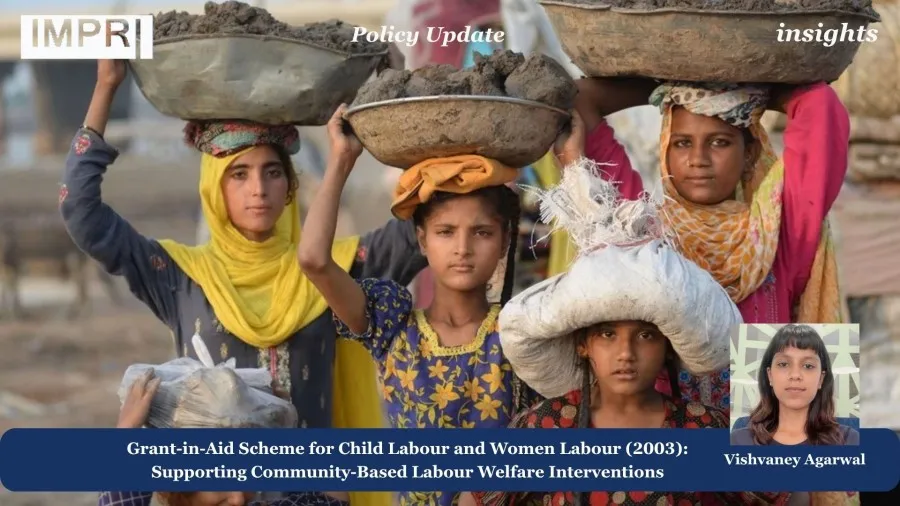
The Grant-in-Aid Scheme for Child and Women Labour occupies a relatively overlooked position within India’s labour welfare framework. Originally introduced in 1981-82 and revised in 2003, the scheme was designed to provide financial assistance to voluntary organizations working with child and women labourers through education, rehabilitation, awareness generation, skill development, and welfare interventions.
During the 1980s and early 2000s, a significant proportion of child labour and informal women workers were concentrated in sectors that were difficult for state welfare agencies to reach consistently. Child labour was particularly prevalent in industries such as carpet weaving in Uttar Pradesh, glass manufacturing in Firozabad, brassware production in Moradabad, slate production in Madhya Pradesh, and match and fireworks units in Sivakasi, Tamil Nadu.
Women workers were similarly concentrated in informal and home-based occupations with limited regulatory oversight. In this context, voluntary organizations were often viewed as important intermediaries capable of identifying vulnerable populations, mobilizing communities, and delivering welfare interventions in areas where state capacity remained limited. The Ministry of Labour sought to strengthen civil society organizations that possessed local knowledge and established community networks.
More than two decades after the scheme’s revision, however, the policy landscape has changed considerably. Child protection mechanisms have expanded, social protection programmes have multiplied, and labour welfare initiatives increasingly rely on digital monitoring systems and direct benefit transfers. Against this backdrop, an important question emerges – does the scheme continue to play a distinct role within India’s labour welfare architecture, or has it been overshadowed by newer interventions? Examining the scheme’s design, implementation structure, and publicly available information provides insight into both its continuing relevance and its limitations.
Performance
Assessing the performance of the Grant-in-Aid Scheme presents an unusual challenge. Unlike many contemporary welfare programmes, publicly available information on the scheme’s implementation remains limited. The revised guidelines provide extensive details regarding eligibility conditions, financial norms, monitoring procedures, and project design, but recent information on project sanctions, beneficiary coverage, expenditure trends, or geographical reach is not readily available in the public domain.
This absence of publicly accessible performance data is itself a significant policy concern. Modern welfare programmes are typically accompanied by annual reports, dashboards, beneficiary statistics, or outcome indicators that allow policymakers and researchers to evaluate effectiveness. In contrast, the available documentation on this scheme focuses primarily on administrative procedures rather than implementation outcomes.
The lack of transparency makes it difficult to answer basic questions. How many organizations currently receive assistance under the scheme? How many child labourers or women workers benefit annually? Which states receive the largest share of funding? Has coverage expanded or contracted over time? Without answers to these questions, meaningful assessment becomes challenging.
The issue is particularly important because the scheme relies heavily on partnerships with voluntary organizations. While civil society organizations can provide localized and flexible interventions, the effectiveness of such a model depends on continuous monitoring, institutional support, and public accountability. In the absence of regularly published implementation data, it becomes difficult to determine whether the scheme remains an active instrument of labour welfare policy or functions primarily as a legacy programme operating with limited visibility.
Impact
The intended impact of the scheme is clear. For child labourers, supported projects seek to combine education, vocational training, nutrition, healthcare, and rehabilitation services to reduce vulnerability and improve future opportunities. For women workers, interventions focus on legal awareness, skill development, self-employment, and collective organization.
However, evaluating actual impact is considerably more difficult than understanding intended objectives. While the scheme documents provide detailed descriptions of eligible activities and implementation mechanisms, publicly available evidence on programme outcomes remains limited. Existing documentation offers insufficient insight into whether supported educational interventions contribute to sustained reductions in child labour, whether vocational training translates into improved employment outcomes, or whether women beneficiaries experience measurable gains in income, economic agency, or access to labour rights. Consequently, although the scheme’s objectives are clearly articulated, assessing its effectiveness in achieving these objectives remains challenging.
This gap highlights a broader challenge within welfare policy. The existence of a programme does not automatically demonstrate its effectiveness. While the scheme’s objectives remain relevant, particularly in sectors where vulnerable workers continue to face exploitation and exclusion, the absence of outcome-based reporting limits assessment of its real-world impact.
Emerging Issues and Challenges
1. A Scheme Operating with Limited Public Visibility
One of the most striking aspects of the Grant-in-Aid Scheme is the absence of recent publicly available information on its implementation. While the revised guidelines remain accessible, information on annual fund allocation, project sanctions, beneficiary coverage, and geographical distribution is difficult to locate. This creates uncertainty regarding the scheme’s present scale and relevance within India’s labour welfare framework.
2. Financial Norms Reflect an Earlier Policy Era
The scheme’s financial norms continue to reflect assumptions from the early 2000s. The model budget included in the guidelines allocates ₹1,500 per month for educational instructors and ₹100 per month as a stipend for child beneficiaries. While these figures may have been reasonable at the time of revision, they are unlikely to support meaningful service delivery in the present context. If funding norms have not been periodically updated, organizations may struggle to implement projects effectively.
3. Dependence on NGO Initiative and Capacity
The scheme places substantial responsibility on voluntary organizations to identify beneficiaries, design interventions, mobilize resources, and implement programmes. However, NGO capacity varies significantly across regions. Organizations operating in remote or economically weaker areas may face greater difficulties in meeting administrative requirements or raising the 25 percent contribution required under the scheme. This can create unequal access to funding and services.
4. Overlap with Newer Welfare Programmes
Since the scheme’s revision in 2003, India has introduced a range of programmes relating to child protection, skill development, women’s empowerment, and social security. In the absence of clearly defined linkages with these initiatives, there is a risk that the scheme operates in isolation, reducing its potential effectiveness and creating duplication of efforts.
5. Limited Evidence of Long-Term Outcomes
The scheme focuses on activities such as education, vocational training, legal awareness, and rehabilitation. However, publicly available information provides little indication of whether these interventions lead to sustained improvements in educational attainment, labour-force participation, income generation, or reduction in child labour. This makes it difficult to determine whether projects are producing lasting change or merely delivering short-term services.
Way Forward
1. Conduct a Comprehensive Review of the Scheme
More than two decades have passed since the scheme’s last major revision. The Ministry of Labour and Employment should undertake a comprehensive review to assess whether the scheme’s objectives, funding structure, and implementation mechanisms remain aligned with contemporary labour welfare challenges. Such a review could determine whether the scheme requires restructuring, expansion, or integration with newer programmes.
2. Update Funding Norms to Reflect Present-Day Costs
The financial assumptions embedded in the 2003 guidelines should be revised to reflect current costs associated with education, vocational training, staffing, nutrition, and programme implementation. Without realistic funding norms, even well-designed projects may struggle to deliver meaningful outcomes.
3. Create a Public Reporting Mechanism
The Ministry should publish annual information on sanctioned projects, expenditure, beneficiary coverage, and project outcomes. Even a simple online dashboard would significantly improve transparency and allow policymakers, researchers, and civil society organizations to assess the scheme’s effectiveness.
4. Prioritise Outcome Tracking Over Activity Reporting
Current monitoring mechanisms focus primarily on financial compliance and project implementation. Future assessments should examine whether children return to formal education, whether women beneficiaries secure sustainable livelihoods, and whether supported interventions contribute to measurable improvements in well-being.
Conclusion
The Grant-in-Aid Scheme for Child Labour and Women Labour reflects an earlier phase of Indian labour welfare policy in which voluntary organizations were expected to play a central role in reaching vulnerable populations. The scheme’s objectives remain relevant. Child labour, precarious employment, limited access to skills, and gender-based inequalities continue to affect millions of workers across the country.
At the same time, the scheme raises important questions about policy continuity and institutional relevance. More than twenty years after its revision, publicly available information on implementation remains limited, making it difficult to assess the scale of its operations or its contribution to labour welfare outcomes. This lack of visibility is particularly significant in a policy environment where transparency and evidence-based evaluation have become increasingly important.
The future challenge is therefore not simply to continue the scheme but to determine how it can be adapted to contemporary realities. Updating funding norms, improving transparency, strengthening outcome measurement, and integrating the scheme with broader labour and social protection initiatives would help ensure that it remains a meaningful instrument of support rather than a legacy programme operating on the margins of public policy.
References
- Ministry of Labour and Employment. (2003). Grant-in-Aid Scheme for Financial Assistance to Organisations (Voluntary and Non-Governmental) for Taking Up Action Programmes/Projects for the Benefit of Child Labour and Women Labour (Revised 2003). https://childlineindia.org/pdf/Grant-in-Aid-on-Child-Labour.pdf
- Government of India. Ministry of Labour and Employment. Guidelines and Funding Norms under the Grant-in-Aid Scheme for Child Labour and Women Labour. https://www.labour.gov.in/schemes/grant-aid-child-labour-and-women-labour
About the Contributor
Vishvaney Agarwal is an undergraduate student of Political Science at Ashoka University and a Research Intern at IMPRI. Her interests lie in public policy, governance, and questions of social inclusion and institutional accountability.
Acknowledgement
The author sincerely thanks Ms Mansi, Mr Nagul Pranav and the IMPRI team for their constructive comments and editorial guidance during the review of this policy update.
Disclaimer: Any views expressed in this article are those of the author and do not necessarily reflect the views of IMPRI.
Read More at IMPRI:
Van Dhan Vikas Kendra (VDVK), 2018: Promoting Tribal Entrepreneurship