


Policy Update
Vishvaney Agarwal
Background
Forest-based livelihoods remain central to the economic and social life of many tribal communities in India. Minor Forest Produce (MFP), also known as Non-Timber Forest Produce (NTFP), provides a significant source of income for tribal households, particularly in remote and forested regions where alternative livelihood opportunities are limited. Products such as tamarind, mahua flowers, lac, honey, medicinal plants, sal leaves, chironji, and wild fruits contribute substantially to household earnings and seasonal income security.
Despite their dependence on forest produce, tribal gatherers have historically received only a small share of the final market value of these products. Most MFPs were sold in raw form to traders and intermediaries, who captured a significant proportion of the profits generated through processing, packaging, branding, and retail marketing. Recognizing this structural imbalance, the Ministry of Tribal Affairs launched the Pradhan Mantri Van Dhan Yojana (PMVDY) on 14 April 2018 under the existing Scheme for Marketing of Minor Forest Produce through Minimum Support Price (MSP) and Development of Value Chain for MFP. The scheme is implemented by the Tribal Cooperative Marketing Development Federation of India (TRIFED).
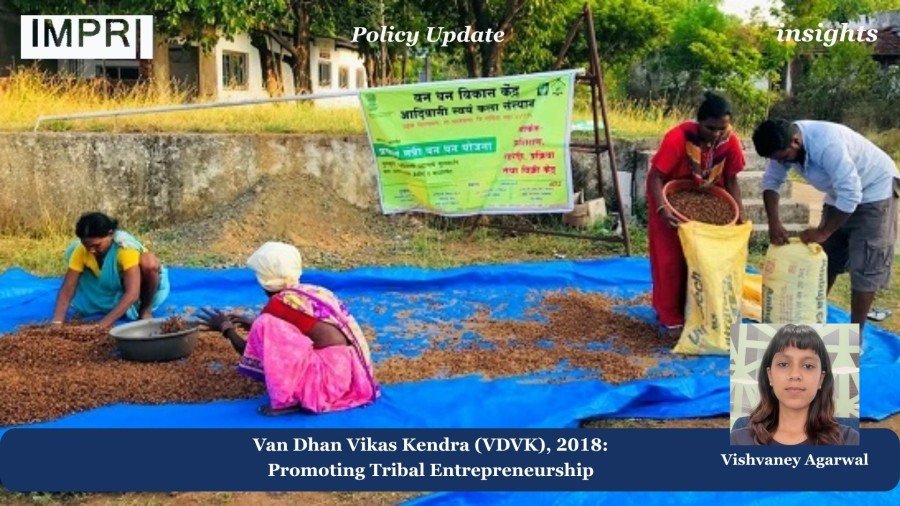
The Van Dhan initiative was designed to move beyond procurement and price support by enabling tribal communities to participate in value addition, processing, branding, and marketing activities. At its core are Van Dhan Vikas Kendras (VDVKs), which function as tribal enterprise clusters aimed at converting forest produce into marketable products and increasing the share of income retained by tribal gatherers.
Functioning
The VDVK model follows a cluster-based approach to tribal entrepreneurship. A typical Van Dhan Vikas Kendra consists of fifteen Van Dhan Self Help Groups (SHGs), each comprising up to twenty members, resulting in approximately 300 beneficiaries per cluster.
The Kendras function as common facility centres where tribal members undertake activities such as:
- Collection and aggregation of MFPs.
- Primary processing and value addition.
- Packaging and branding.
- Storage and transportation.
- Market linkage and retail marketing.
The scheme supports beneficiaries through training, equipment, and institutional handholding. Processing equipment such as dryers, graders, cutting tools, decorticators, packaging tools, and storage facilities are provided to facilitate value addition.
Each VDVK cluster receives financial assistance of ₹15 lakh for training and equipment support. The scheme is implemented through State Nodal Departments, State Implementing Agencies, District Implementation Units, and mentoring organizations, creating a multi-tier governance structure.
A distinctive feature of the scheme is its emphasis on entrepreneurship. Participating SHGs contribute working capital and are encouraged to develop business plans, establish market linkages, and operate as commercially viable enterprises rather than welfare beneficiaries.
Performance
The growth of the programme since its launch has been substantial.
By December 2019, TRIFED had sanctioned 676 VDVKs across eighteen states, covering approximately 2,00,740 tribal beneficiaries with a sanctioned amount of ₹99.81 crore.
Examples from the initial implementation phase demonstrate rapid expansion:
- 139 VDVKs were sanctioned in Chhattisgarh covering around 41,700 beneficiaries.
- 64 VDVKs were sanctioned in Maharashtra covering approximately 19,200 beneficiaries.
- 31 VDVKs were sanctioned in Nagaland covering around 9,300 beneficiaries.
The programme expanded significantly in subsequent years.
Table 1: VDVK Progress (July 2021)
| Indicator | Achievement |
| VDVK Clusters | 2,275 |
| Van Dhan SHGs | 37,904 |
| Beneficiaries | 6.77 lakh |
| States Covered | 25 |
| Districts Covered | 253 |
| Funds Sanctioned | ₹336.95 crore |
Source: TRIFED Progress Report.
The pace of expansion indicates strong institutional adoption across tribal regions. The programme also introduced digitization of beneficiary records, SHGs, and VDVKs through mobile applications and GIS-based systems, strengthening monitoring and data management.
The scale of expansion is particularly noteworthy given that the programme was launched only in 2018. Within three years, VDVKs had become one of India’s largest tribal livelihood interventions.
However, while coverage indicators demonstrate rapid growth, publicly available information remains more comprehensive regarding cluster formation and beneficiary numbers than enterprise profitability, income growth, or long-term sustainability.
Impact
The most significant contribution of VDVKs has been the shift from raw produce collection to value-added tribal enterprise.
Traditional forest produce supply chains often left tribal gatherers with only 20–25 percent of the final value generated from their products. According to PMVDY guidelines, the value-addition model seeks to increase the tribal share to approximately 70–75 percent by enabling processing, packaging, and direct market participation.
The programme has also strengthened collective bargaining power. By organizing gatherers into SHGs and cluster-level institutions, VDVKs reduce dependence on intermediaries and improve access to markets, training, and financial resources.
Evidence from operational VDVKs demonstrates the potential of value addition. In Tamil Nadu, VDVK clusters engaged in processing honey, minor millets, and tamarind reported substantially higher selling prices for processed products compared to raw produce. Honey valued at approximately ₹225 per kilogram in raw form was marketed at around ₹800 per kilogram after value addition.
The scheme has also encouraged convergence with agriculture, floriculture, medicinal plant cultivation, and other livelihood activities, thereby reducing seasonal dependence on forest produce and creating opportunities for year-round income generation.
Furthermore, VDVKs contribute to local economic development by creating decentralized processing infrastructure in tribal regions. This enables value creation closer to the source of production and reduces the economic leakage associated with external processing networks.
Emerging Issues and Challenges
1. Sustainability of Enterprises
While VDVKs have expanded rapidly, long-term sustainability remains a challenge. The success of a cluster depends on continued market access, business planning, product quality, and managerial capacity. Not all VDVKs possess the same level of entrepreneurial capability.
2. Limited Outcome-Based Evaluation
Current reporting focuses heavily on the number of VDVKs formed, SHGs organized, beneficiaries covered, and funds sanctioned. There is comparatively limited publicly available data on income enhancement, enterprise profitability, survival rates of clusters, and long-term livelihood outcomes.
3. Market Competition
Value-added tribal products must compete with established private-sector brands. Packaging, quality certification, branding, and marketing require continuous investment and professional support.
4. Regional Variations
Implementation capacity differs across states and districts. Variations in institutional support, mentoring quality, infrastructure availability, and market access can lead to uneven performance across VDVKs.
5. Dependence on MFP Availability
Climate variability, forest degradation, and fluctuations in MFP production can affect the availability of raw materials, thereby influencing the viability of tribal enterprises dependent on forest resources.
Way Forward
1. Strengthen Outcome Monitoring
Performance assessment should move beyond beneficiary coverage and include indicators such as income growth, profitability, enterprise survival rates, market penetration, and employment generation. A robust monitoring framework supported by periodic third-party evaluations would help identify successful models, assess long-term sustainability, and improve evidence-based policymaking.
2. Expand Professional Market Support
Greater emphasis should be placed on providing professional business development support, including assistance with product design, digital marketing, e-commerce integration, and participation in national and international trade fairs. Strengthening these market linkages can improve the competitiveness of tribal products and enable producers to capture a larger share of the value chain.
3. Promote Tribal Producer Companies
Successful VDVKs should be encouraged to evolve into larger tribal producer enterprises and producer companies capable of achieving economies of scale and negotiating better market terms. This transition requires improved access to affordable credit, working capital support, and financial literacy programmes. Expanding institutional financing options can help tribal enterprises increase production capacity, invest in processing infrastructure, and reduce dependence on external traders and middlemen.
4. Promote Product Diversification and Local Resource-Based Enterprises
To reduce vulnerability to fluctuations in individual forest produce markets, VDVKs should be supported in diversifying into a wider range of products, including medicinal plants, agri-processing activities, natural health products, eco-friendly consumer goods, and other locally available resources. Diversification can strengthen income resilience, create new employment opportunities, and improve the long-term viability of tribal enterprises while promoting sustainable utilisation of forest resources.
Conclusion
The Van Dhan Vikas Kendra initiative represents an important shift in India’s approach to tribal development. Rather than focusing solely on welfare transfers or procurement support, it seeks to integrate tribal communities into higher-value segments of the forest-produce economy through entrepreneurship, value addition, and market participation.
The scheme has achieved considerable scale within a short period, expanding from a pilot initiative in 2018 to thousands of clusters covering lakhs of beneficiaries across multiple states. Its emphasis on collective enterprise, skill development, and value-chain integration distinguishes it from traditional livelihood programmes.
However, the long-term success of VDVKs will depend not only on the number of clusters established but also on their ability to generate sustainable incomes, compete in markets, and function as viable tribal enterprises. Future policy efforts should therefore focus on strengthening market linkages, improving outcome measurement, and ensuring that tribal communities retain a larger share of the value generated from India’s forest resources.
References
- Ministry of Tribal Affairs. (2018). Pradhan Mantri Van Dhan Yojana (PMVDY): Scheme Guidelines. https://trifed.tribal.gov.in/sites/default/files/2020-05/Scheme_Guidelines.pdf
- TRIFED. (2020). Van Dhan Monthly Progress Report. https://trifed.tribal.gov.in/sites/default/files/2020-05/TRIFED%20Van%20Dhan%20MPR_Jan%202020.pdf
- TRIFED. (2021). TRIFED’s Journey: A Report to All Friends and Partners of Tribes. https://static.pib.gov.in/WriteReadData/specificdocs/documents/2021/aug/doc20218631.pdf
- TRIFED. Ready Reckoner for Implementation of Van Dhan Yojana. https://tntribalwelfare.tn.gov.in/assets/pdf/Ready_Reckoner_VDY.pdf
- Ministry of Tribal Affairs. Scheme for Marketing of Minor Forest Produce through MSP and Development of Value Chain for MFP. https://tribal.nic.in/downloads/Livelihood/Guidelines/MECHANISM%20FOR%20MARKETING%20OF%20MFP%20THROUGH%20MSP%20AND%20DEVELOPMENT%20OF%20VALUE%20CHAIN%20FOR%20MFP%20(B).pdf
About the Contributor
Vishvaney Agarwal is an undergraduate student of Political Science at Ashoka University and a Research Intern at IMPRI. Her interests lie in public policy, governance, and questions of social inclusion and institutional accountability.
Acknowledgement
The author sincerely thanks Ms Sneha Sharma, Samah K and the IMPRI team for their constructive comments and editorial guidance during the review of this policy update.
Disclaimer: Any views expressed in this article are those of the author and do not necessarily reflect the views of IMPRI.