







Policy Update
Sneha Sharma
Introduction :
Measuring India’s Labour Market – The PLFS Architecture
The Periodic Labour Force Survey (PLFS), conducted by the national statistical office under Ministry of Statistics and Programme Implementation (MOSPI), is the country’s primary institutional mechanism for tracking labour force participation across various divisions, employment and unemployment.
The survey operates through two distinct frameworks, each designed to capture a different temporal dimension of labour market behaviour. The first is Usual Status framework that is primary status combined with subsidiary status which assigns a worker’s economic identity based on their domain activity over a 365 day reference period.The second is Current Weekly Status (CWS) framework, which determines a person’s labour market status based on activity during a reference week.
The shorter reference periods helps capturing short term volatility. This framework is seen as monthly bulletins by MoSPI. The dual structure is not just for administrative purposes, it has analytical importance.The monthly bulletins presents key market indicators such as Labour force participation rate, worker population ratio, women participation ratio and unemployment rate at the all india level following CWS approach. Similar data is presented by the annual reports. The only difference is the annual report is to analyse the data over the course of one year.
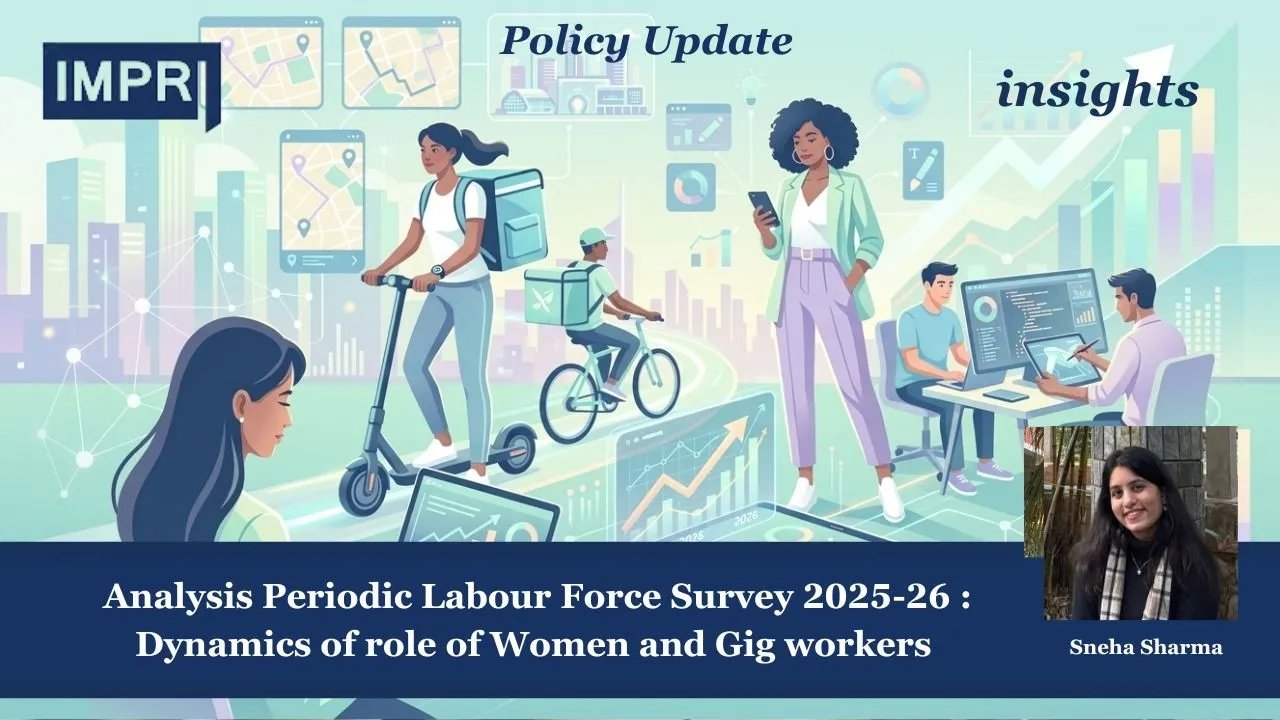
In this article, we dive deeply into, women in urban workforce and workers in the gig platform economy, making comparison of Annual report of 2025 and Monthly report published in April 2026.The aim is not to present a catalogue of statistics, but to interrogate what those statistics reveal about the design of work in contemporary India, and what gaps in that design still demand urgent redress.
Macroeconomic Realities: Gig workers and Women by numbers
India’s labour market is often discussed as a single story of progress such as rising participation rate, falling unemployment, and formalization of workforce. But when you look more closely at who is actually entering the workforce, on what terms and under what constraints, that’s what the reality is. Majorly focusing on Women – whose relationship with formal employment remains stubbornly uneven despite years of work, and the gig workers whose number are growing rapidly but there is protection for them, rather sometimes it is hardly recognised.
– The Female Workforce Paradox
The headlines from PLFS Annual Report 2025 sounds encouraging. The national female Labour Force Participation Rate measured across the calendar years has reached 40%, which shows a commendable improvement since 2017-18, but the decline of the unemployment rate for women is just 3.2%.
But the Monthly bulletin of April 2026 represents female labour force participation for the 15 years and above at 33.9%, with urban female LFPR rural and urban areas standing at 38.2% and 25.0% respectively. The city – the urban areas where the economic opportunities are greater fail to pronounce it in the participation rate for women.
Rural participation rate is relatively higher for women because it includes agricultural and household enterprise work, which the usual status framework captures over the year. But urban formal employment is a kind of work which women still have difficulty accessing. In all the chaos, there is one positive sign that the female unemployment rate declined by 8.5% in April 2026, it is the lowest since April 2025.
– The Gig Workforce Surge
The gig economy’s story is more explosive of the fragile foundation. The numbers of economic survey 2025-26 states from 77 lakh workers in FY 21 the gig sector witnessed a 55% increase to 120 lakh workers in FY25 driven by smartphone penetration among over 80 crore users and 15 billion UPI transactions per month. Now representing over 2% of the total workforce in India, growth of the gig sector can be seen in the overall employment rate; it is projected to contribute Rs. 2.35 lakh crore to GDP.
The gig economy is growing on the digital infrastructure that is impressive, such as a smartphone, and an easy finance mechanism such as UPI has created an entire new labourforce ecosystem in delivery, domestic services and freelance work.
But the scale is not the same as security, and this is a central tension. The workers driving growth in the sector are operating without formal employment contracts, without employer linked social security and without income floor that characterises even the basic formal sector employment. As of January 2026, the eShram portal has over 31 crore registered unorganised workers and women account for 54% of this total.
The relationship between female labor participation and gig economy expansion is a key intersection that is often missed or overlooked. The labor force is seeing an increase in women who were originally performing unpaid, invisible, or unrecorded household work. Urban areas are structurally limiting female participation in traditional 9 to 5 jobs due to the constraints placed on female workers by formal urban labor markets e.g., long working hours, lack of childcare facilities, etc.
As a result, the primary avenue available for urban women to enter the workforce has been through app-based companies; thus, women are entering the labor market at its most precarious and vulnerable level—by trading exclusion from the formal labor market for the algorithmic uncertainty and social insecurity of gig work.
The stories of women identified as gig workers demonstrate that women’s participation in labor compared to the expansion of gig work are not two different trends, but rather two different narratives of one trend.
Research on women workers in India’s gig economy highlights that the platforms like Uber, Ola, urban company and zomato have built upon the existing large informal economy and that the gig economy promises flexibility, which is particularly a draw for women.
In one of the research papers of Ghosh, Ramachandran and Zaidi (2021), by the Institute of Social Studies Trust, shows flexibility is not neutral or equally distributed. Women tend to cluster in lower earning services, face additional safety constraints of location, time of travel, and they often lack digital literacy.
The gig work platform is valuable for women to provide them the entry point, the 54% of registration of women on the e-Shram portal is significant step towards increasing female participation rate – one can say women has now shifted from invisible informal work to counted informal work to an extent, as the now the app based services from salon to cook, to regular cleaning services are also available, giving the maids also a chance to get formal recognition for their work.
The question is not whether India’s market is growing, which it clearly is. The question is whether it is growing in a way that brings these workers in on equitable terms.
The “why” behind the data – structural diagnostics
The data of annual report and month bulletin shows low urban female LFPR and the gig economy is rapid but precarious expansion, the disproportionate presence of women in its most vulnerable tiers all points to structural forces that operate well below the surface of participation rates and unemployment figures.
1. The invisible tax : unpaid work and the care economy
One of the most important datasets for understanding female LFPR is The Time Use Survey (TUS) 2024, conducted by MoSPI, measures something that employment surveys routinely miss: what people do with hours that are not counted as work. It finds women spend an average 363 minutes a day on unpaid activities, while men spend only 123 minutes a day. Consequently male participants spent 414 minutes in paid activities, against 302 minutes spent by female participants.
Roughly women in India spend six hours everyday on unpaid domestic and care work like cooking, cleaning, caring for children etc. compared to just two hours for men.over the course of week it compounds to a structural barrier, that no skill programme or job can cover. 41% of women aged 15-59 were involved in caregiving for household members compared to 21.4% of men, nearly half of all the working age women carry an unpaid responsibility, this unpaid infrastructure is something on which our whole country runs.
Hence the consequences are direct and visible. For such unpaid work a woman is structurally excluded from the job which demands fixed hours of work, long commutes and full time presence. Regular salaried employment in urban India accounts for 49.8% is built for full time commitment. All 9 to 5 culture is designed for people who can commit to long shifts, and primarily does not have much to do at home.
The women who are being counted in annual figures of 40% are largely those in rural areas doing agricultural and household enterprise work on flexible self directed schedules, urban formal employment remains slightly inaccessible not because women lack qualification but because its infrastructure assumes domestic reality which still a lot of women don’t have.
2. The gig promise and its limits
This sector runs on the idea of having flexibility at work such as there are no fixed hours, no mandatory commute, no supervisor demanding presence. People want to work as independent contractors who have the choice of workings when they want to and where they want to. For women this kind of flexibility is often restrictive, but also becomes an entry point for counted work. The J-PAL evaluation on improving female labour force participation through flexible, internet gig work makes gig work an entry point for women in urban employment. Now this comes with a variety of drawbacks-
The first is algorithmic volatility – as on gig platforms the income is not determined by negotiated wage or affixed salary is determined by algorithms, ratings and reviews, hours of availability, platform level decisions etc. The second is piece-rate wage trap, most of the gig workers are compensated per task, like per delivery per service etc.this means income scales as the volume scales, for instance one day if the person was not available for a full day leads almost zero earnings for the day.
Also this per task creates a competition among the workers which is not healthy. The third is absence of career progression, like in formal employment even at modest levels, there are increments, promotions and skill development. Gig offers none of it. There is no institutional mechanism for skill recognition, wage growth based experience or transition into better quality work. Many call gig work an occupational lock, meaning gig offers a door but not a staircase. We need to acknowledge that the flexibility of the gig workers is not enough, the trade offs must be addressed
The regulatory intersections – new labour codes and policy initiatives
- The labour codes: a historic first step
The government of India consolidated 29 central labour laws into four broad labour codes between 2019 and 2020. These are the Code on Wages (2019), the Industrial Relations Code (2020), the Code on Social Security (2020), and the Occupational Safety, Health and Working Conditions Code (2020). The implementation of these codes was notified on 21 November 2025 making their provisions legally operative for the first time after years of drafting.
Out of the codes, code on social security 2020, is most essential with respect to the gig economy. This code gave formal definition for gig workers and platform workers, beyond this it has made a mandate for the companies to contribute 1-2% of their annual turnover to a dedicated social security fund for gig and platform workers.
- The digital infrastructure : e-Shram and Ayushman Bharat
Two digital public infrastructure tools have emerged alongside the labour codes
- The e-shram portal managed by the ministry of labour and employment functions as a national database of unorganised works. As of January 2026 the portal has over 31 cr registered unorganised workers, making significant advancement in formalization of the workforce. Registration on this portal gives a universal account number which is intended to serve as a portable identitycard for accessing social security benefits across states and schemes.
- The Ayushman Bharat Pradhan Mantri Jan Arogya Yojana (AB-PMJAY) which extends cover to gig and platform workers. Health expenditure is one of the primary shocks that pushes informal workers into poverty a single hospitalisation can wipe out months of savings for a delivery worker or domestic service provider
Limitations
- The social security mandate is still being operationalised. The fund’s governance structure, contribution tracking mechanisms, and benefit delivery systems are work in progress.
- The policy initiatives are highly weighted towards individual registration and benefit delivery but it does not yet address the structural features of platform work, the algorithmic wage setting, the absence of minimum income guarantee, lack of career progression.
- Women workers in the home based and domestic gig segment remain hardest to reach through any of these, because their relationship with platforms is least formalised.
Policy Recommendations
The data and analysis in the preceding sections points to a clear conclusion that India’s labour market is moving in the right direction, but the pace and design of that movement is leaving two major groups behind, which is women and gig workers. Here are few areas which needs more focus after from the already made policy initiatives
- Legal to real gap for gig workers
The code for social security 2020, has done the major work of recognising the profession legally, the next task is to mandate the social security from the platform owners. This requires a complete strict roadmap, from standardising the tracking mechanism to simplifying the claim process.
For women in home based domestic service gig roles a specific outreach programme needs to be there to create awareness, more enrollment so that their visibility increases, and they also avail the benefits of the policy.
- Invest in care infrastructure to free up women’s time
The most direct intervention for this section is expanding the anganwadi networks that would allow young women to enter into the labour market without having to choose between work and caregiving. A stronger case would be to make flexible and part time work arrangements in legal form, so that more women can utilize their skills and time, from anywhere, as the economic survey of 2025-26 suggested the need for flexible work hours amid rising female LFPR, recognising the burden of paid and unpaid work.
- Build financial inclusion pathways for informal workers
Least discussed consequence of the informal and gigworkers is the absence of a verifiable income trail. Formal employment generates payslips provident fund records and tax filings documents that banks and lenders can use to assess the creditworthiness. For addressing this requires creating alternative credit assessment treating platform transaction data, the earning records as legitimate income documentation.the upi system and other financial interfaces developed by india somewhere meets this purpose, just more recognition and acceptance is required.
Way forward
India‘s gig economy is projected to grow significantly in the years ahead and female labour force participation, if supported by right policies, could rise by 55% by 2050. The annual report of PLFS 2025 and the monthly bulletin of April 2026 shows that the labour market is stable and growing, but stability is coming with a deeper inequity at individual level.
The woman spending six hours on unpaid work before she thinks about paid employment, and the gig worker delivering without any contract or health insurance are both the stories of growing India’s labour force participation. The policies are coming up in the legislation now there’s a need for proper implementation, more focus on this emerging sector, formalization of this sector and funding to reach the targets.
References
- Ministry of Statistics and Programme Implementation. (2026). Periodic Labour Force Survey (PLFS) – Annual Report 2025 (F_REV_29052026). Government of India. https://www.mospi.gov.in/uploads/publications_reports/publications_reports1780040415321_0624fb13-fb47-40bc-b470-7c7e9635c3ef_PLFS_2025_F_REV_29052026.pdf
- National Portal of India. (n.d.). New labour code for New India: Biggest labour reforms in independent India. https://www.india.gov.in/spotlight/details/new-labour-code-for-new-india-biggest-labour-reforms-in-independent-india
- Press Information Bureau. (n.d.). Press release page (PRID: 2219940). Ministry of Information and Broadcasting, Government of India. https://www.pib.gov.in/PressReleasePage.aspx?PRID=2219940®=48&lang=2
- Press Information Bureau. (n.d.). Press release page (PRID: 2261386). Ministry of Information and Broadcasting, Government of India. https://www.pib.gov.in/PressReleasePage.aspx?PRID=2261386®=3&lang=1
- Abdul Latif Jameel Poverty Action Lab (J-PAL). (n.d.). Improving female labor force participation through flexible internet-mediated gig work. https://www.povertyactionlab.org/evaluation/improving-female-labor-force-participation-through-flexible-internet-mediated-gig-work
- National Council of Applied Economic Research (NCAER). (n.d.). India’s new labour reforms: Code on Social Security. https://ncaer.org/publication/indias-new-labour-reforms-code-on-social-security/
- PRS Legislative Research. (2026). Report summary: Economic Survey 2025-26. https://prsindia.org/policy/report-summaries/economic-survey-2025-26
- Down To Earth. (2026). Economic Survey 2026: Employment steady, women’s participation could rise to 55% by 2050. https://www.downtoearth.org.in/governance/economic-survey-2026-employment-steady-womens-participation-could-rise-to-55-by-2050
- ETCFO. (2026). Economic Survey 2025-26: India’s job market grows with women leading informal sector. The Economic Times. https://cfo.economictimes.indiatimes.com/news/economy/economic-survey-2025-26-indias-job-market-grows-with-women-leading-informal-sector/127766984
- ForumIAS. (2025). Female labour force participation explained pointwise. ForumIAS Blog. https://forumias.com/blog/female-labour-force-participation-explained-pointwise/
- The Hindu. (2026). Economic Survey 2025-26 advocates minimum per-task earnings for gig workers. https://www.thehindu.com/business/budget/economic-survey-2025-26-advocates-minimum-per-task-earnings-for-gig-workers/article70564744.ece
- Rahman, M., & Das, A. (2023). Women workers in the gig economy in India: An exploratory study. ResearchGate. https://www.researchgate.net/publication/367628164_”Women_Workers_in_the_Gig_Economy_in_India”_An_Exploratory_Study
About the Contributor
Sneha Sharma is a recent graduate from University of Delhi with a strong interest in the development sector relating to education, gender and public policy. She is currently a Research and Editorial Intern at IMPRI Impact and Policy Research Institute, where she contributes to policy update articles and research focused on strategic affairs and policy initiatives.
Reviewer
Paridhi Passi
Gautham Shine
Acknowledgement
I would like to extend my sincere gratitude to the team at IMPRI India for their guidance and support.
Disclaimer
All views expressed in the article belong solely to the author and not necessarily to the organisation.
Read More at IMPRI
Beyond Connectivity: The Urban and Regional Impact of the Mumbai-Pune Missing Link Project
CITIIS Program: Redefining Urban Development for a Sustainable Future