




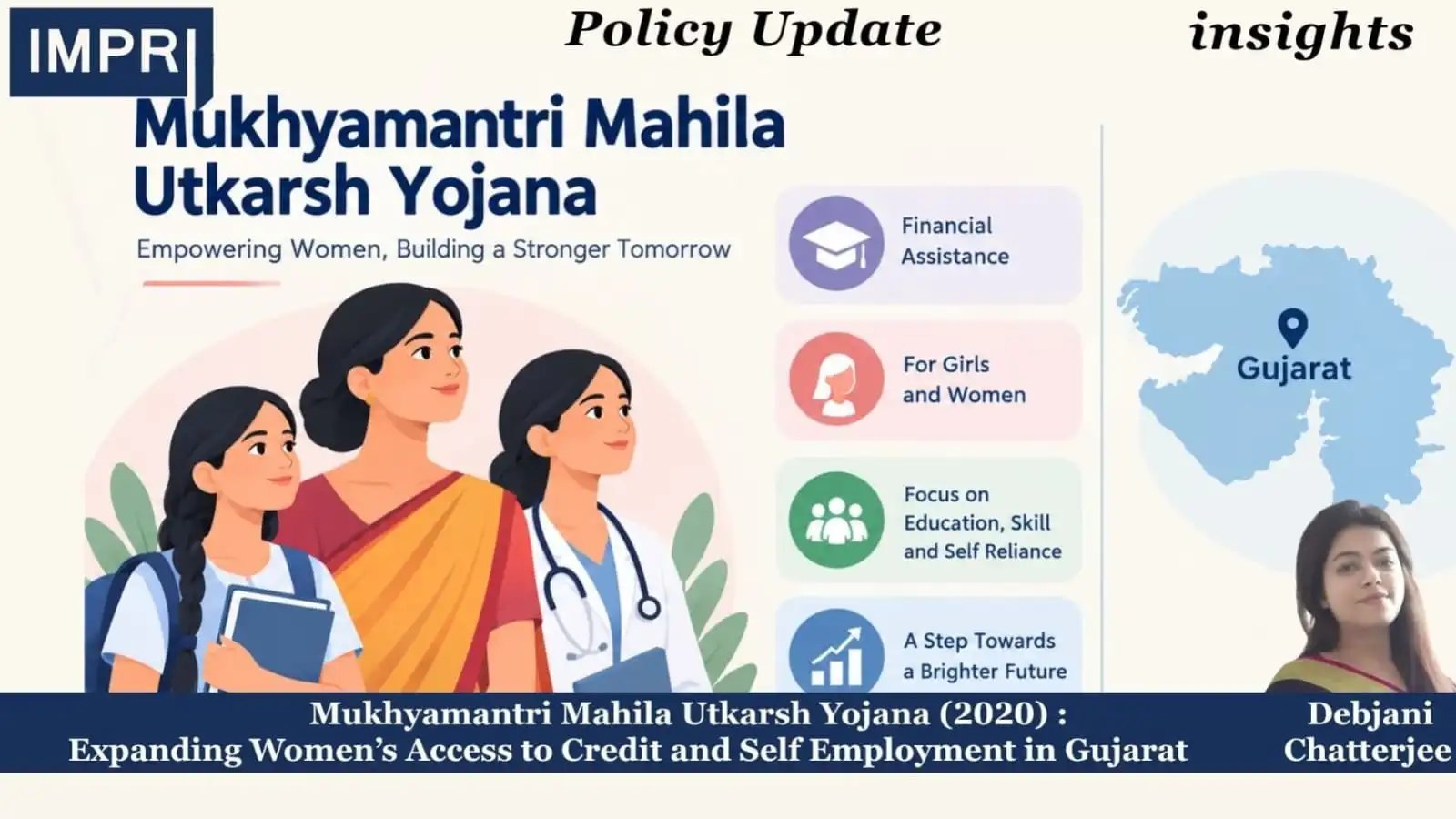
Policy Update
Debjani Chatterjee
Background
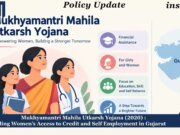
Women in Gujarat, particularly those from low income households, have often faced difficulties in accessing affordable bank loans to start small businesses or expand existing livelihood activities. Limited access to credit and delays in loan approvals restricted their opportunities for self employment and financial independence. Women’s self help groups offered a way to improve access to finance through collective savings and support, but affordable credit remained an important challenge.
To address this issue, the Gujarat government launched the Mukhyamantri Mahila Utkarsh Yojana on 17 September 2020. The scheme provides interest free loans of ₹1 lakh to eligible groups of ten women for income generating activities. Its main objective is to promote entrepreneurship, strengthen women’s financial independence and encourage economic participation in both rural and urban areas.
Functioning
1. Formation of women’s groups: The Gujarat government launched the scheme in 2020 to help women access credit through Joint Liability and Earning and Saving Groups. The original target was to form 1 lakh groups covering 10 lakh women across rural and urban areas.
2. Eligibility: Women applying should be residents of Gujarat and members of an eligible group formed under the scheme. The programme is designed to support women who want to start or expand income generating activities. Group membership and bank verification are part of accessing the loan.
3. Interest free loans: Each eligible group can receive a loan of up to ₹1 lakh through participating banks and other lending institutions. The government covers the interest under the scheme, helping women borrow without the usual interest burden.
4. Bank and government coordination: Government, private, rural and cooperative banks work with the state to process eligible groups’ loans. The scheme also provides an interest subsidy for eligible borrowers who repay on time, according to published scheme information.
5. Support for self employment: Members can use the credit for group based economic activities and small businesses. The aim is to help women increase earnings, strengthen savings and become more financially independent.
| Indicator | Government reported information |
| State | Gujarat |
| Original target | 1 lakh groups |
| Intended coverage | 10 lakh women |
| Rural target | 50,000 groups |
| Urban target | 50,000 groups |
| Loan limit | Up to ₹1 lakh per eligible group of 10 women |
| Interest support | Interest free credit for eligible groups, subject to scheme conditions |
Performance
1. Group formation and coverage: Launched on 17 September 2020, Mukhyamantri Mahila Utkarsh Yojana aimed to establish 1 lakh Joint Liability Earning and Saving Groups, covering 10 lakh women across Gujarat. This target established the scale of the state’s proposed women focused credit programme.
| Indicator | Reported Figure |
| Original target for groups | 1,00,000 |
| Original target for women | 10,00,000 |
| Groups reported to have received loans | 14,000 |
| Interest free loans disbursed | ₹140 crore |
| Groups reached as a share of the original target | 14% |
| Loan amount per group | ₹1 lakh |
2. Interest free credit disbursement: In August 2021, the Gujarat government announced the disbursement of ₹140 crore in interest free loans to 14,000 women’s self help groups. This was a measurable early achievement, although it represented only part of the original target of 1 lakh groups.
3. Financial assistance per group: The scheme provides loans of ₹1 lakh per eligible group of ten women. The government pays the interest on eligible loans, reducing borrowing costs for women seeking to establish or expand small income generating activities.
4. Rural and urban coverage: The original implementation plan allocated 50,000 groups each to rural and urban areas. Rural implementation was assigned to Gujarat Livelihood Promotion Company, while Gujarat Urban Livelihood Mission was responsible for urban areas. However, comparable official achievement figures for both categories were not available in the sources reviewed.
5. Financial resource commitment: Gujarat’s 2020 to 2021 planning documents set a target of ₹1,000 crore in lending for women through the scheme. This indicated the intended scale of credit support, but the target should not be confused with the amount actually disbursed.
6. Budgetary provision: Government scheme information reported a budget provision of ₹168 crore. This reflects the financial commitment associated with implementation, although a complete year wise series of expenditure and utilisation was not available in the reviewed sources.
7. Support for timely repayment: The scheme provides interest assistance to groups that repay regularly. Government scheme descriptions specify interest support of up to ₹6,000 annually per group, helping reduce the effective cost of credit for compliant borrowers.
8. Access to institutional finance: The scheme permits lending through public sector, private, cooperative and rural banks and other eligible lending institutions. This arrangement was designed to reduce dependence on informal borrowing and improve access to formal credit.
9. Recent implementation evidence: As of October 2026, the sources reviewed did not establish a verified, current government total for cumulative beneficiaries, active groups or total loans disbursed after the 2021 announcement. Therefore, the scheme’s latest performance cannot be reliably assessed against its original targets using the available figures alone.
Impact
1. Greater financial independence: The Gujarat government introduced Mukhyamantri Mahila Utkarsh Yojana in September 2020 to help women access formal credit for income generating activities. The scheme aims to cover 10 lakh women through 1 lakh groups, creating an institutional pathway towards greater financial independence.
2. Reduced dependence on costly borrowing: The scheme provides interest free loans to eligible women’s groups, with the government bearing the interest cost. This can reduce the financial burden on women who otherwise depend on informal lenders or expensive microfinance credit.
3. Support for women led enterprises: The Gujarat government’s scheme documents identify small business creation and expansion as key objectives. Access to group based credit can help women invest in petty trade, home based businesses and other income generating activities, although the government has not published verified figures showing how many enterprises remain active over time.
4. Strengthening collective decision making: Each group consists of ten women. This group based structure can encourage members to discuss financial decisions, share responsibilities and develop collective repayment practices. However, official outcome data measuring changes in women’s participation in household or community decisions remain limited.
5. Rural economic opportunities: The Gujarat government’s 2020 scheme announcement planned 50,000 groups in rural areas. This approach sought to improve access to credit beyond urban centres, where women may face additional barriers in reaching formal financial institutions.
6. Urban livelihood support: The original implementation plan also targeted 50,000 groups in urban areas. This recognised the needs of women seeking self employment in towns and cities, including small service activities and local businesses. Separate verified outcome figures for rural and urban participants are not available in the sources reviewed.
7. Improved access to formal banking: The scheme works through eligible lending institutions, including public sector, private, cooperative and rural banks. This can strengthen women’s connection with formal financial services and create opportunities to build a banking relationship through group based borrowing.
8. Potential contribution to household income: The state government’s stated objective is to encourage self employment and help women contribute to family earnings. However, no verified government evaluation was identified that quantifies changes in household income attributable specifically to this scheme.
9. Long term empowerment and evidence gaps: Gujarat’s wider women led livelihood programmes continue to receive government attention. In November 2025, the state reported 2.86 lakh rural self help groups under the Deendayal Antyodaya Yojana National Rural Livelihoods Mission. This figure reflects a broader programme, not Mukhyamantri Mahila Utkarsh Yojana alone. Scheme specific data on sustained employment, business survival and women’s income growth remain necessary to establish its long term impact.
Emerging Issues
1. Improve awareness and group formation
The Gujarat government should organise awareness camps through local bodies, banks and women’s organisations to explain eligibility, loan procedures and repayment conditions. Special attention should be given to rural women who may have limited information about formal credit. Existing community networks can help women form eligible groups without creating an expensive new administrative structure.
2. Simplify loan applications
Banks should provide a clear checklist of required documents and a simple application tracking system. District level help desks can assist women with account opening, verification and incomplete applications. Regular coordination between banks and government departments would help identify and resolve delays in loan approval and disbursement.
3. Connect credit with practical business training
Access to loans should be supported by basic training in bookkeeping, pricing, digital payments and business planning. Partnerships with existing skill development centres and local business organisations could provide this support at relatively low cost. Training should reflect local demand, including tailoring, food processing, handicrafts and small retail activities.
4. Improve market access
Women receiving loans need reliable opportunities to sell their products and services. The government can connect participating groups with local fairs, cooperative outlets, online marketplaces and suitable government procurement opportunities. This would help women generate regular revenue rather than depend only on borrowed capital.
5. Strengthen repayment support
Banks should explain repayment schedules clearly and help borrowers identify financial difficulties early. The government should monitor overdue loans and provide financial counselling where needed. The aim should be responsible borrowing without placing unnecessary pressure on women facing temporary income disruptions.
6. Publish transparent performance data
The government should release annual district wise data on groups formed, loans approved, amounts disbursed, repayment rates and businesses sustained. Short follow up surveys could measure changes in women’s income and financial independence. This would help officials identify gaps and improve implementation using evidence.
7. Encourage continued economic participation
Successful groups should receive guidance on savings, reinvestment and expanding viable businesses. Linking them with existing livelihood programmes can support growth without establishing a separate funding system.
Way Forward
1. Improve awareness and group formation
The Gujarat government should organise awareness camps through local bodies, banks and women’s organisations to explain eligibility, loan procedures and repayment conditions. Special attention should be given to rural women who may have limited information about formal credit. Existing community networks can help women form eligible groups without creating an expensive new administrative structure.
2. Simplify loan applications
Banks should provide a clear checklist of required documents and a simple application tracking system. District level help desks can assist women with account opening, verification and incomplete applications. Regular coordination between banks and government departments would help identify and resolve delays in loan approval and disbursement.
3. Connect credit with practical business training
Access to loans should be supported by basic training in bookkeeping, pricing, digital payments and business planning. Partnerships with existing skill development centres and local business organisations could provide this support at relatively low cost. Training should reflect local demand, including tailoring, food processing, handicrafts and small retail activities.
4. Improve market access
Women receiving loans need reliable opportunities to sell their products and services. The government can connect participating groups with local fairs, cooperative outlets, online marketplaces and suitable government procurement opportunities. This would help women generate regular revenue rather than depend only on borrowed capital.
5. Strengthen repayment support
Banks should explain repayment schedules clearly and help borrowers identify financial difficulties early. The government should monitor overdue loans and provide financial counselling where needed. The aim should be responsible borrowing without placing unnecessary pressure on women facing temporary income disruptions.
6. Publish transparent performance data
The government should release annual district wise data on groups formed, loans approved, amounts disbursed, repayment rates and businesses sustained. Short follow up surveys could measure changes in women’s income and financial independence. This would help officials identify gaps and improve implementation using evidence.
7. Encourage continued economic participation
Successful groups should receive guidance on savings, reinvestment and expanding viable businesses. Linking them with existing livelihood programmes can support growth without establishing a separate funding system.
References and Links
Government of Gujarat, Social Justice and Empowerment Department. (2021). Social justice and empowerment department: Scheduled Caste Sub Plan, 2020–21. https://sje.gujarat.gov.in/assets/downloads/SCSP_202021_09072021.pdf
State Level Bankers’ Committee, Gujarat. (2022). 173rd SLBC Gujarat agenda. https://slbcgujarat.in/wp-content/uploads/2022/06/173-SLBC-Agenda_Final.pdf
Government of Gujarat, Social Justice and Empowerment Department. (2021). Social justice and empowerment department: Scheduled Caste Sub Plan, 2020–21. https://sje.gujarat.gov.in/assets/downloads/SCSP_202021_09072021.pdf
Government of Gujarat, Social Justice and Empowerment Department. (2021). Social justice and empowerment department: Scheduled Caste Sub Plan, 2020–21. https://sje.gujarat.gov.in/assets/downloads/SCSP_202021_09072021.pdf
State Level Bankers’ Committee, Gujarat. (2022). 173rd SLBC Gujarat agenda. https://slbcgujarat.in/wp-content/uploads/2022/06/173-SLBC-Agenda_Final.pdf
Government of Gujarat. (n.d.). Mukhyamantri Mahila Utkarsh Yojana. Startup Gujarat. https://startup.gujarat.in/schemes/mukhyamantri-mahila-utkarsh-yojana/
Government of Gujarat. (n.d.). Mukhyamantri Mahila Utkarsh Yojana: Government resolution. https://mmuy.gujarat.gov.in/assets/img/Tharav_Final.pdf
About the Contributor
Debjani Chatterjee is a policy researcher with a background in Finance and Political science. Her work focuses on leveraging data analytics to support evidence based policy research.
Acknowledgement
My sincere thanks to the Impact and Policy Research Institute (IMPRI) for the opportunity to prepare this policy update article. IMPRI’s dedication to connecting research with actionable policy practice provides an invaluable platform for learning.
Reviewed by Madhuritha D and Anamika P K
Disclaimer
The opinions expressed in this article are strictly those of the author and do not reflect the official position or views of the organization.