

Policy Update
Debjani Chatterjani
Background
Girls in Rajasthan have historically faced barriers to higher education due to household financial constraints, limited transport facilities and the distance between villages and colleges. These challenges can make daily commuting difficult and discourage girls from continuing their studies after school, particularly those from economically weaker families.
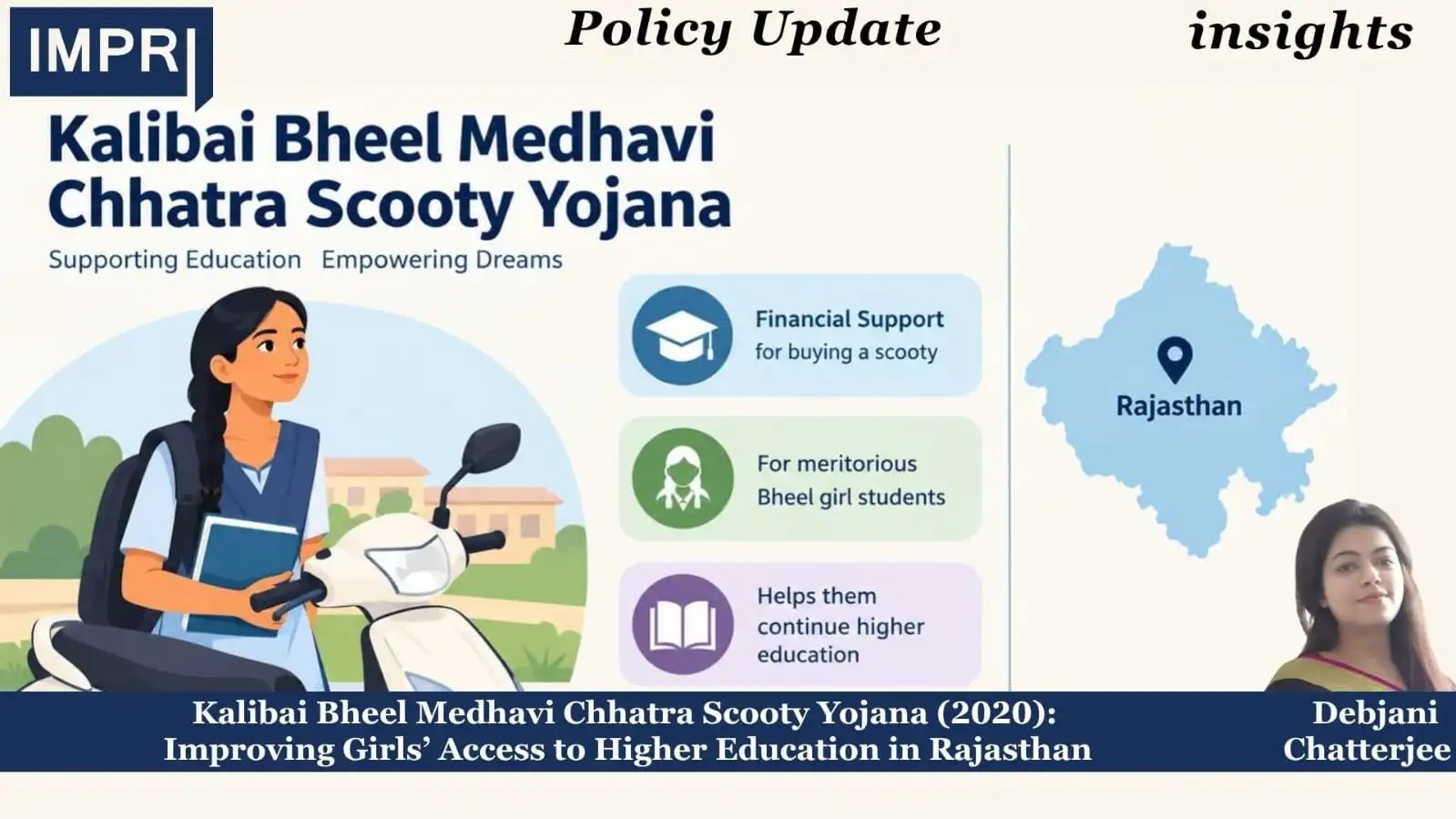
To address these concerns, the Rajasthan government introduced the Kalibai Bheel Medhavi Chhatra Scooty Yojana in 2020, naming it after tribal education activist Kalibai Bheel. The scheme provides free scooters to eligible meritorious girls who complete secondary education and enrol in higher studies. It aims to improve access to colleges, reduce transport difficulties, encourage academic achievement and promote girls’ educational participation and independence across different social and economic groups.
Functioning
1. Eligibility criteria: The Rajasthan government provides scooters to eligible meritorious female students to support higher education. Applicants must be Rajasthan residents, score at least 65% in the Rajasthan Board Class 12 examination or 75% in the CBSE examination, have annual family income up to ₹2.5 lakh, and enrol as regular students in a bachelor’s degree course at a Rajasthan college.
| Indicator | Eligibility requirement |
| Domicile | Resident of Rajasthan |
| Rajasthan Board Class 12 | Minimum 65% marks |
| CBSE Class 12 | Minimum 75% marks |
| Annual family income | Up to ₹2.5 lakh |
| Higher education | Regular enrolment in an eligible undergraduate course at a Rajasthan college |
2. Application process: Students apply online through the Rajasthan Single Sign On portal or the state scholarship portal. They submit documents such as marksheets, domicile and income certificates, Aadhaar details and college fee receipts. Applications are checked by the relevant department before selection.
3. Merit based selection: Applications are assessed against eligibility rules and category wise merit lists. The Higher Education Department publishes provisional and final lists, including separate lists for different eligible categories.
4. Scooter distribution: Selected students receive a scooter free of cost under the scheme. The government’s 2022–23 executive summary reported that 17,537 eligible applicants were scheduled to receive scooters under the scheme that year.
5. Support for higher education: By helping students travel to college, the scheme aims to reduce transport difficulties and encourage girls to continue their studies. The government also allows eligible students to receive scholarships under other schemes, subject to applicable rules.
Performance
1. Beneficiary Coverage: The Rajasthan Government’s Economic Review 2022–23 stated that 17,537 eligible applicants were to receive scooters under the scheme in 2022–23. This reflected the planned scale of assistance for girls entering higher education. However, the figure does not confirm that all the scooters were actually delivered (Government of Rajasthan, 2023).
2. Budget Expenditure: Up to December 2022, expenditure under the scheme reached ₹4,464.89 lakh, according to the state government’s Economic Review 2022–23. This indicates substantial reported spending during the period, although expenditure alone cannot establish the number of beneficiaries who received scooters.
3. Recent Financial Performance: Rajasthan’s Economic Review 2025–26 reported expenditure of ₹67.67 crore against a budget allocation of ₹299.69 crore up to December 2025. This provides a recent indicator of financial implementation. However, the reported expenditure should not be treated as evidence of equivalent progress in scooter distribution (Government of Rajasthan, 2026).
4. Departmental Budget Utilisation: The Economic Review 2023–24 recorded an allocation of ₹2,351.66 lakh and expenditure of ₹11.24 lakh under the Higher Education entry. A separate School Education entry recorded ₹80.11 lakh in allocation and ₹8.36 lakh in expenditure by March 2024. These figures require separate interpretation because they relate to different departmental entries (Government of Rajasthan, 2024).
5. Merit Based Selection: The scheme sets minimum marks of 65 percent for Rajasthan Board students and 75 percent for CBSE students, alongside an annual family income limit of ₹2.5 lakh. Applicants must also meet the prescribed higher education enrolment conditions. These criteria link mobility assistance with academic performance and financial eligibility.
6. Social Inclusion: Official merit lists cover applicants under different departmental categories, including SC, ST, EBC, minority and denotified or nomadic communities. This reflects an administrative effort to extend assistance across eligible social groups, although category wise lists alone do not establish actual distribution totals.
7. Continued Implementation: The official scholarship portal published final merit lists for 2024–25 on 26 May 2025 and for 2025–26 on 27 July 2026. These updates demonstrate continued administrative processing across academic years, rather than confirming the number of scooters delivered.
8. Transparency and Monitoring: The department publishes merit lists, revised lists and district wise or course wise cut off information. These records help applicants check selection outcomes. Publishing consolidated figures on applications approved, scooters delivered and funds spent would make performance assessment more complete.
Impact
1. Improved Mobility: The scheme provides free scooters to eligible girls entering higher education after Class 12. This can make college travel easier for students living far from educational institutions, although official data measuring reductions in commuting time are not available in the sources reviewed.
2. Support for Household Finances: The government covers scooter registration and transfer expenses and provides insurance benefits. These provisions reduce some initial costs associated with owning a vehicle, which may be particularly helpful for families with limited financial resources.
3. Greater Transport Convenience: The scheme includes two litres of petrol at the time of distribution. Although this is a limited benefit, it provides initial travel support and may help recipients begin using their scooters for educational commuting.
4. Attention to Road Safety: The provision of a helmet, one year of general insurance and five years of third party insurance adds safety related support to the scheme. However, the actual effect on road safety depends on regular helmet use, responsible riding and compliance with traffic rules.
5. Support for Educational Continuity: The scheme is intended to encourage girls to pursue undergraduate education after school. Easier transport may help students attend colleges more conveniently, but its effect on attendance, retention and graduation requires separate evidence.
6. Inclusion of Students with Disabilities: Government scheme information provides for a motorised tricycle instead of a scooter for eligible students with disabilities when requested. This provision recognises that mobility assistance may need to be adapted to individual requirements.
7. Wider Relevance to Girls’ Education: Rajasthan’s Economic Review 2023–24 reported that 316 Kasturba Gandhi Balika Vidyalayas were functional, with 41,865 girls studying in them. Although this is not a direct outcome of the scooty scheme, it reflects the wider state effort to support girls’ education at different stages.
8. Need for Outcome Assessment: The available government information describes the scheme’s benefits and eligibility arrangements, but does not establish its effect on recipients’ educational outcomes. Tracking attendance, continuation, graduation and commuting experiences would help determine whether mobility support translates into lasting educational benefits.
| Financial year | Government reported performance | Budget allocation / expenditure | Analytical observation |
| 2020–21 | Final merit lists were published for eligible Class 12 pass students, including category wise lists. | Consolidated scheme level allocation and actual expenditure not verified from the sources reviewed. | Establishes the scheme’s initial implementation, but a verified distribution total is needed. |
| 2021–22 | Final merit lists were published for Class 12 pass students and eligible Class 10 pass ST students. | Consolidated annual allocation and expenditure not verified. | Selection records establish implementation, but not the number of scooters actually delivered. |
| 2022–23 | 17,537 students were reported as scheduled to receive scooters. | Expenditure reported up to December 2022: ₹4,464.89 lakh (₹44.65 crore), according to the figures compiled for this article. | Scheduled coverage should not be presented as completed distribution. |
| 2023–24 | First selection list published on 6 October 2023; final merit list published on 29 November 2024. | Higher Education: allocation ₹2,351.66 lakh, expenditure ₹11.24 lakh up to March 2024. School Education: allocation ₹80.11 lakh, expenditure ₹8.36 lakh up to March 2024. | Reported spending was low against the listed allocations. The two departmental entries should be kept separate unless their accounting scope is confirmed. |
| 2024–25 | Final merit list published on 26 May 2025, with separate lists for different categories and departments. | The 2026–27 Output Outcome Budget reports financial achievement of ₹0.02 crore for 2024–25 and records “Tender process exp.” as the physical achievement. | The budget document raises a question about implementation and expenditure, but its reported figure should be checked against departmental accounts before drawing a final conclusion. |
| 2025–26 | Final merit lists for the scheme were published on 27 July 2026. | Figures compiled for this article: allocation ₹299.69 crore; expenditure ₹67.67 crore up to December 2025. | Expenditure was approximately 22.6% of the stated allocation by December 2025. This is an interim figure, not final annual utilisation. |
| 2026–27 | The state Output Outcome Budget sets a physical target of 14,130 scooters. | Proposed outlay: ₹211.28 crore, entirely from state funds. | These are budgeted targets, not completed achievements. |
Sources: Government of Rajasthan, Economic Review 2023–24 and Output Outcome Budget 2026–27; Rajasthan Department of College Education merit list portal; figures supplied in the article draft. Amounts and coverage should be cross checked against the original departmental records before publication.
Emerging Issues
1. Delays in Benefit Delivery: The Rajasthan Department of College Education issued a circular on 5 May 2026 asking students to clear pending objections and upload bank details for the 2024–25 scooty schemes. Such administrative requirements may delay benefit delivery for applicants whose documents remain incomplete (Government of Rajasthan, 2026).
2. Strict Academic Eligibility: The scheme requires at least 65 percent marks for RBSE students and 75 percent for CBSE students. Although merit based selection encourages academic achievement, girls facing unequal school facilities or household responsibilities may find it harder to meet these thresholds (Government of Rajasthan, 2023).
3. Income Based Exclusion: The annual family income ceiling of ₹2.5 lakh may exclude some households that face financial pressure but exceed the prescribed limit. Periodic review of eligibility rules could help assess whether assistance reaches students with significant transport needs.
4. Limited Evidence on Educational Outcomes: Official records document eligibility and selection, but these do not establish whether recipients attend college more regularly, continue into later academic years or complete their degrees. Outcome tracking remains necessary to assess the scheme’s educational contribution.
5. Continuing Transport Expenses: A free scooter does not eliminate recurring costs such as fuel, servicing and routine maintenance. These expenses may remain difficult for low income households, particularly when students travel long distances to college.
6. Road Safety and Accessibility: Scooter use requires safe riding practices, valid documentation and awareness of traffic rules. Although the scheme provides a helmet and insurance benefits, the extent of safety awareness among recipients is not established by the available scheme records. Students unable to use a conventional scooter may also require suitable mobility arrangements.
7. Need for Better Monitoring: The official scholarship portal publishes provisional and final merit lists across departments and categories. However, selection records alone cannot show actual delivery, continued educational participation or graduation. A consolidated public report covering these outcomes would strengthen accountability and help identify gaps in implementation.
Way Forward
1. Ensure Timely Distribution of Scooters: The Rajasthan government should establish a clear annual timeline for application verification, merit list publication and scooter distribution. Colleges could notify students about pending documents and application status through SMS or the official portal. This would reduce uncertainty and help eligible girls receive assistance before the academic year progresses significantly.
2. Improve Budget Utilisation and Monitoring: The Higher Education Department should review scheme expenditure every quarter and identify reasons for unspent funds. District level officers could report delays in verification, procurement and distribution through a common monitoring system. Publishing annual figures on funds allocated, expenditure and scooters actually delivered would make implementation more transparent and help officials address bottlenecks.
3. Support Girls from Disadvantaged Backgrounds: The government should provide application assistance through colleges and district education offices for students from rural areas and economically weaker households. Simple guidance on eligibility, income certificates, academic records and other required documents could prevent deserving students from missing the application deadline. Awareness campaigns should also reach girls who are the first in their families to pursue higher education.
4. Track Educational Outcomes: The department should maintain a simple annual record of beneficiaries, including scooter delivery, college attendance, continuation into the next academic year and graduation. Colleges could collect this information through existing student records rather than creating a separate reporting burden.
5. Address Safety and Maintenance Costs: Scooter distribution should be accompanied by practical road safety guidance, information on helmet use and basic vehicle maintenance. Colleges could organise short awareness sessions with local traffic police. Students should also receive information about insurance, servicing and safe riding practices. These measures would help beneficiaries use their scooters responsibly and reduce avoidable transport related difficulties.
6. Review Eligibility and Beneficiary Feedback: The government should periodically review eligibility rules and collect feedback from applicants, selected students and those who were not selected. This would help identify difficulties related to academic thresholds, documentation and household circumstances. Publishing a brief annual review with clear findings and corrective actions would strengthen accountability and make the scheme more responsive to girls’ educational needs.
References and Links
About the Contributor
Debjani Chatterjee is a policy researcher with a background in Finance and Political science. Her work focuses on leveraging data analytics to support evidence based policy research.
Acknowledgement
My sincere thanks to the Impact and Policy Research Institute (IMPRI) for the opportunity to prepare this policy update article. IMPRI’s dedication to connecting research with actionable policy practice provides an invaluable platform for learning.
Reviewed by Khusi and Aditi Bhuinyan
Disclaimer
The opinions expressed in this article are strictly those of the author and do not reflect the official position or views of the organization.