



Policy Update
Shivali Yadav
Background
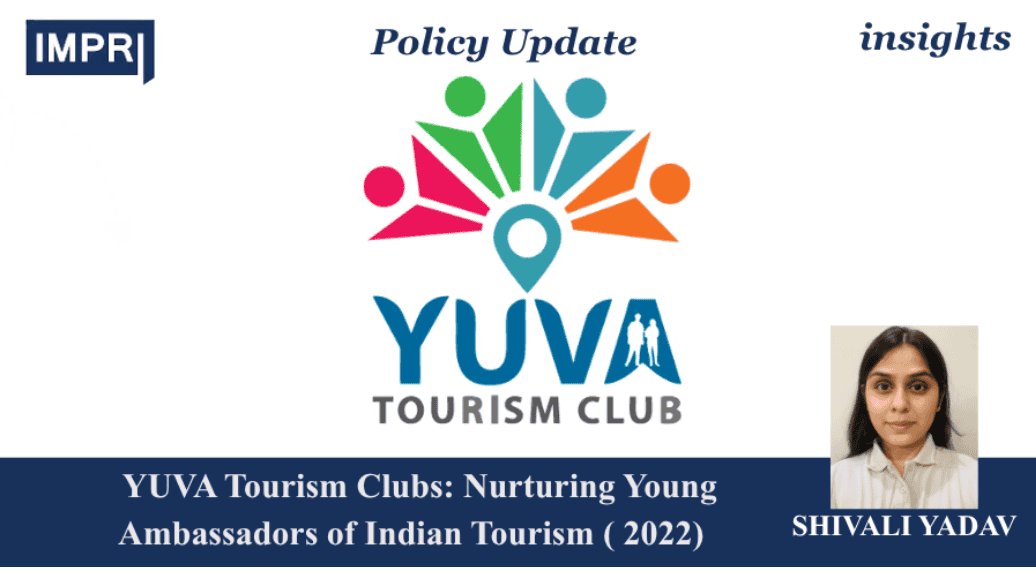
The YUVA Tourism CLUBS initiative was started by the Ministry of Tourism, Government of India, in 2022 as part of Azadi Ka Amrit Mahotsav. This was done to raise young people’s awareness of tourism and to encourage them to appreciate India’s cultural heritage, natural beauty, and historical sites. The YUVA Tourism CLUBS initiative also aims to promote tourism that is beneficial to the environment and does not harm it.
The Ministry of Tourism published a book called YUVA Tourism CLUBS: Handbook for Schools in 2022 to support this initiative. This handbook instructs schools on how to conduct tourism activities that help students learn about India’s heritage. The YUVA Tourism CLUBS initiative encourages students to travel responsibly and consider working in the tourism and hospitality sectors.
The YUVA Tourism CLUBS initiative started in schools that are affiliated with CBSE. It was then expanded to colleges, Institutes of Hotel Management, Kendriya Vidyalayas, Jawahar Navodaya Vidyalayas, and other educational institutions. The YUVA Tourism CLUBS initiative also supports national initiatives like Ek Bharat Shreshtha Bharat and Dekho Apna Desh. The YUVA Tourism CLUBS initiative does not receive dedicated budgetary support from the government. Instead, it is implemented with the help of institutions and local communities that support the YUVA Tourism CLUBS initiative.
Functioning
The YUVA Tourism CLUBS Handbook for Schools from the Ministry of Tourism (2022) states that every Tourism Club must have at least 25 student members. The School Management appoints a School Teacher Coordinator who forms a team consisting of a Student Head, a Treasurer, and other members from Class XII.
This team is called the Student Body. Students from Classes VII to X take part in activities such as competitions, visits to heritage sites, and tourism projects. Students from Class XI help with organising events and participating in community outreach activities. The Student Body from Class XII is responsible for ensuring that everything runs smoothly. They hold meetings every month. At the end of the year, the Treasurer prepares a report and submits it to the School Management.
All Tourism Clubs must register and be monitored through the YUVA Tourism Clubs Portal (ytc.tourism.gov.in). The National Informatics Centre manages this portal. It keeps track of registered clubs and their members. The Ministry of Tourism does not provide direct funding to the clubs. Instead, the clubs are expected to raise their own funds, while the Treasurer and School Management oversee financial matters. The Handbook also states that the clubs must follow child safety guidelines. This means that adults must be present during club activities, and students need parental consent for travel. The YUVA Tourism CLUBS: Handbook for Schools, published by the Ministry of Tourism in 2022, outlines all these guidelines.
Performance
According to the Government of India, the initiative expanded rapidly during its initial phase. By April 2023, there were already around 30,000 clubs in schools, colleges, and Institutes of Hotel Management across India. The Ministry of Tourism announced the 100th episode of the Prime Minister’s Mann Ki Baat on 30 April 2023. They aimed to establish 50,000 YUVA Tourism CLUBS in 100 days.
Students in the YUVA Tourism CLUBS participated in various activities, such as visiting 71 lighthouses and taking part in a design competition to reduce the use of single-use plastics in Institutes of Hotel Management. The YUVA Tourism Clubs’ initiatives have significantly helped students get more involved, learn more about tourism, and gain hands-on experience. Government support contributed to the programme’s expansion.
Table 1: YUVA Tourism CLUBS, Key Milestones per Official Government Sources
| Date | Milestone | Government Source |
| April-May 2022 | YUVA Tourism CLUBS officially launched under Azadi Ka Amrit Mahotsav (India@75); Handbook for Schools released; CBSE announces support and directs affiliated schools to form clubs | PIB (2022); MoT Handbook (2022) |
| 23 March 2023 | Rajya Sabha confirms Kendriya Vidyalaya Sangathan (KVS) and Navodaya Vidyalaya Samiti (NVS) have extended support to the initiative | Rajya Sabha USQ No. 2702 (2023) |
| ~April 2023 | 30,000 YUVA Tourism CLUBS constituted nationally across schools, colleges, and Institutes of Hotel Management | PIB (2023) |
| 1 May 2023 | Ministry sets target to expand to 50,000 clubs within 100 days, tied to the 100th episode of ‘Mann Ki Baat’ and a ‘100 Days of Action’ campaign | PIB (2023) |
Source: PIB (2022, 2023); Ministry of Tourism, Handbook for Schools (2022); Rajya Sabha Unstarred Question No. 2702 (2023)
Impact
The programme expanded rapidly with help from people joining and also from official instructions. In 2022, CBSE told its schools to start YUVA Tourism CLUBS. In 2023, Kendriya Vidyalaya Sangathan and Navodaya Vidyalaya Samiti also supported the programme. This helped the programme reach people. However, the government has not shared information about the programme.
There are no numbers on how many YUVA Tourism CLUBS are active, how many students are part of them, or where they are located. The official YUVA Tourism Clubs website shows who is registering. The Ministry has not shared updated numbers or details on club activities since 2023. This makes it hard to know how well the programme is doing now.
Emerging Issues
Issue: No consolidated and up-to-date official data on the total number of active clubs, current student membership, or State/UT-wise distribution have been published since the 2023 milestone announcements.
Suggestion: The Ministry should publish annual progress reports with updated statistics on registered and active clubs, disaggregated by State/UT, institution type, and student membership to improve transparency and facilitate monitoring.
Issue: The initiative does not have a dedicated central budget, requiring individual clubs to rely on their own fundraising to finance activities.
Suggestion: A modest need-based seed grant could be introduced, particularly for government and rural schools, to reduce disparities in resources and ensure more equitable implementation across institutions.
Issue: There is no independent evaluation framework to assess whether the programme is achieving its intended outcomes, such as leadership development, increased interest in tourism careers, and promotion of national integration.
Suggestion: The Ministry should commission a periodic impact evaluation through an independent public institution, such as NCERT or another government research organisation, to measure programme outcomes against its stated objectives.
Issue: Club operations depend largely on student volunteers and a single School Teacher Coordinator, which may lead to variations in implementation quality across schools.
Suggestion: Regular orientation programmes and capacity-building workshops should be organised for Teacher Coordinators to strengthen programme management and ensure greater consistency in implementation.
Issue: The programme’s documented expansion has largely been within CBSE, KVS, and NVS institutions, with limited publicly available information on its adoption in State Board schools, which educate the majority of India’s students.
Suggestion: Targeted outreach and simplified registration procedures should be introduced to encourage greater participation from State Board schools and colleges, thereby improving the programme’s overall reach and inclusiveness.
Issue: Although the Handbook outlines important child safety measures, such as adult supervision and parental consent for educational visits, there is no public mechanism to monitor compliance with these guidelines.
Suggestion: A standardised safety compliance report should be incorporated into each club’s annual reporting process to ensure adherence to child protection and safety protocols.
Issue: The Ministry has not clarified whether reported figures, such as 30,000 clubs or the target of 50,000 clubs, represent currently active clubs or cumulative registrations.
Suggestion: The official YUVA Tourism Clubs Portal should include a periodic renewal or re-verification process so that published statistics accurately reflect active and functioning clubs rather than one-time registrations.
Way Forward
We need to share information about YUVA Tourism Clubs every year. This information should include each state or union territory, the type of institution, and the number of members in each YUVA Tourism Club. This will help us understand how many YUVA Tourism Clubs there are and how they are performing. It will also improve transparency for stakeholders in YUVA Tourism Clubs to know what is happening.
We should help schools that lack sufficient funds to conduct YUVA Tourism Club activities. Someone from outside should check if YUVA Tourism Clubs are really working and achieving intended outcomes. Teacher coordinators should receive regular training to manage YUVA Tourism Clubs’ activities. We should ask schools and colleges that follow state boards to join YUVA Tourism Clubs and help them if they need it.
We need to check if YUVA Tourism Clubs are still active and if their records are correct. Every year, YUVA Tourism Clubs should also report on what they are doing to ensure child safety. If we work together with initiatives like Dekho Apna Desh and Swadesh Darshan, we can get more students to participate in YUVA Tourism Clubs. Talking about problems that are emerging and what we can do about them is important. It gives us ideas on how to make YUVA Tourism Clubs better by being more open, responsible, and fair.
If we do all these things, YUVA Tourism Clubs will become stronger and more sustainable. Adequate financial support will strengthen implementation and improve program sustainability, and we will make sure they are doing what they are supposed to do. This will help us achieve the goal of providing education through YUVA Tourism Clubs and support the vision of Viksit Bharat 2047. YUVA Tourism Clubs will truly make a difference then.
References
Ministry of Tourism, Government of India. (n.d.). YUVA tourism clubs. https://tourism.gov.in/YUVA-tourism-club
Ministry of Tourism, Government of India. (n.d.).YUVA Tourism Clubs Portal. https://ytc.tourism.gov.in/
Ministry of Tourism, Government of India. (2023, March 23). Rajya Sabha unstarred question no. 2702: National tourism youth clubs. Rajya Sabha Secretariat. https://rsdebate.nic.in/bitstream/123456789/737698/1/PQ_259_23032023_U2702_p454_p454.pdf
Press Information Bureau. (2022, May 12). Ministry of Tourism initiative of establishing “YUVA Tourism CLUBS” gets support from CBSE. Ministry of Tourism, Government of India. https://pib.gov.in/PressReleasePage.aspx?PRID=1824684
Press Information Bureau. (2023, April 29). Ministry of Tourism to undertake a special initiative of “100 Episodes of Mann Ki Baat – 100 Days of Action” through the YUVA Tourism CLUBS to celebrate the 100th episode of Mann Ki Baat. Ministry of Tourism, Government of India. https://pib.gov.in/PressReleasePage.aspx?PRID=1920769
Ministry of Tourism, Government of India. (2022). YUVA tourism clubs: Handbook for schools. https://tourism.gov.in/sites/default/files/2022-05/YUVA_Tourism_Club_Handbook.pdf
About the Contributor
Shivali Yadav is pursuing an M.A. in Liberal Studies at Govind Ballabh Pant Social Science Institute, Prayagraj, and is an IMPRI intern. Her work focuses on gender, education, youth, and public policy, with interests in educational equity and qualitative research.
Acknowledgement
The author sincerely thanks the reviewers and editorial team for their valuable comments, constructive suggestions, and guidance. Their feedback helped improve the clarity, structure, and analytical depth of this policy update.
Reviewers: KAVIN ADITHYA AND SIMONA MIRIAM HUGHES
Disclaimer: All views expressed in the article belong solely to the author and not necessarily to the organisation.
Read more at IMPRI:
A Distracted Pakistan: Strategic Opportunity in the Afghanistan-Pakistan War
The Green Energy-Groundwater Paradox: An Economic Evaluation of PM-KUSUM (2019)