






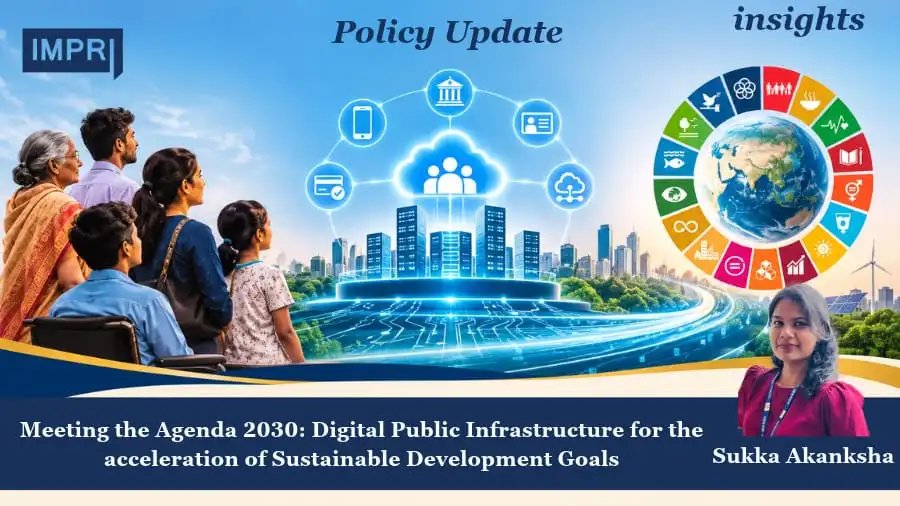
Policy Update
Sukka Akanksha
Background
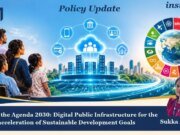
Digital public infrastructure is referred to a collection of common digital systems that must be secure and compatible, and can be developed on open standards and specifications to provide and ensure fair access to public or private services on a societal level and are managed by proper legal structures to promote growth, inclusivity, creativity, while honouring human rights and liberties.
Sustainability as a term is used in accordance with development often refereeing todevelopment that does not deplete the natural resources, making sure to conserve and pass on the resources to the coming generations. In the context of India, sustainability remains as a task that is necessary rather than an option, given the overwhelming population size and the probability of overconsumption of the available resources. One initiative of the United Nations that stands out in the context of sustainability is the formation of SDGs (Sustainable Development Goals)
The agenda 2030 talks about achieving sustainable development goals by the year 2030, but when one looks at the status of implementation of SDGs in India, it is evident that the agenda 2030 is far from possible considering we have only 5 years left with us. The status of SDG implementation in India as mentioned in the UN dashboard is that only 33.3 % is on track,only 38.3% has limited progress and 28.4% is worsening (Sustainable Development Report, 2025).
Functioning
India’s DPI works as a stack. A digital ID verifies who a person is, a payment rail moves money, and sector platforms deliver the service. All of them expose open APIs, so public agencies and private firms can build on the same base.
Table 1: Mapping Indian DPIs with SDGs
| SDGs | Indian Digital Public Infrastructures (DPIs) |
| No Poverty | Aadhar. OCEN, UPI |
| Zero hunger | FarmStack (agri advisory) |
| Good health and well-being | ABDM (Ayushman Bharat Digital Mission) DIVOC |
| Quality Education | DIKSHA |
| Gender equality | UPI, LokOS |
| Clean water and sanitation | Sujalam Bharat |
| Affordable and clean energy | India Energy Stack |
| Decent work and economic growth | ONDC, UPI, OCEN |
| Industry, innovation and infrastructure | India Stack (Aadhaar, UPI, DigiLocker, eSign) |
| Reduced inequalities | Bhashini |
| Sustainable cities and communities | NIUS (National Urban Innovation Stack) |
| Responsible consumption and production | Government e Marketplace (GeM) |
| Climate action | National Carbon registry, PRISM |
| Life below water | – |
| Life on land | – |
| Peace, justice and strong institutions | e-Courts |
| Partnership for the Goals | UPI, ONDC |
Source: (United Nations Development Programme, 2023)
Performance
India’s DPI platforms now run at national scale, reaching hundreds of millions of users across payments, health, education, commerce and justice. The table below sets out each platform’s performance
Table 2: Performance of DPI Platform
| Platform | Performance |
| Aadhaar | 49% of residents used a public service (such as food distribution or social pensions) for the first time through Aadhaar (UNDP, 2023) |
| Jan Dhan | Over 56 crore accounts opened in 11 years, 56% held by women (Finance Minister, 2025) |
| UPI | About 80% of India’s digital payments (The Hindu, 2024); roughly 640 million transactions a day (FT, 2025) |
| DigiLocker | Over 211 million users and 6 billion stored documents (NeGD, 2025) |
| CoWIN | Over 2 billion doses administered, with peak days above 25 million shots (IIPA, 2025) |
| ABHA / ABDM | About 50 crore ABHA accounts, with over 33 crore using ABHA-based instant OPD registration |
| DIKSHA | 4.94 billion learning sessions and 150.9 million course registrations as of 2022 (PIB) |
| ONDC | Over 7 lakh sellers and 20.4 crore transactions, including 1.6 crore orders in March 2025 |
| e-Courts | Over 3.38 crore cases heard online across district courts and high courts |
| MyGov | Over 3 crore registered users and 55 lakh comments |
Impact
The article assesses impact through social inclusion: marginal communities, women and children.
- Poverty and inequality (SDGs 1, 10): Large groups that had no bank account now receive benefits directly. DBT reduces leakages from duplicate beneficiaries, ghost accounts and informal payments, and the savings give the state fiscal room for health, education and infrastructure.
- Health (SDG 3): CoWIN made vaccination more efficient and transparent, and public dashboards strengthened trust in health services. ABHA makes records portable across providers.
- Education (SDG 4): DIKSHA and SWAYAM kept learning going during Covid-19 and built digital literacy among young people preparing for the knowledge economy.
- Gender equality (SDG 5): Women hold 56% of Jan Dhan accounts, and digital payments support women-led small businesses. Yet women are only about 25% of UPI users, and fewer still in rural areas. Adoption rises when local agents or women community influencers introduce the service (ETBFSI, 2024).
- Work and innovation (SDGs 8, 9): Among MSMEs, UPI is the top payment choice at 48%, and 33% of those reporting gains cite better operational efficiency. ONDC lets small sellers compete on a more level field and strengthens India’s role as a model for open digital networks.
- Institutions (SDG 16): e-Courts raise judicial transparency and accountability, and MyGov widens citizen participation in policy discussion.
Emerging Issues
Even though there is exceptional growth in various sectors through DPI, there are some unavoidable challenges that we need to face while the implementation of the DPI:
- Only 24% of the rural households are connected to the internet, whereas urban areas have higher connectivity rates, limiting the fair access to digital services (Bridging the Digital Divide: Empowering Rural India- NIIT Foundation, 2024).
- DPI ecosystem is based on gathering and handling of personal information, that often raises issues with privacy and security that comes from misuse, insufficient transparency and inadequate regulations. Numerous DPIs function through public private partnerships that restrict the accountability and government.
- Not every state or institution will be fully prepared to effectively integrate, if the implementation process is not the same in all the states, the scalability and measurement of the effectiveness hinders.
- Evaluating results like inclusion, empowerment, or trust through the digital ecosystem continues to be difficult due to its nature of subjectivity.
Way Forward
DPI is a strategic tool for sustainable development, not merely a technology. The paper makes four recommendations.
- Keep DPI a public good: Systems should stay open, interoperable and grounded in rights. Open APIs on Aadhaar, UPI and DigiLocker already let public and private actors innovate on a shared base.
- Invest in the last mile: Affordable devices, content in local languages and targeted skill development are needed to close the rural and gender divide.
- Build in safeguards: Grievance redressal and privacy protection create trust and accountability. The Digital Personal Data Protection (DPDP) Act requires grievance processes and gives individuals rights over their data.
- Lead the Global South: Through G20 leadership and south-south cooperation, India can share open standards, technology, knowledge and capacity-building so other developing countries can adopt DPI.
Digital Public Infrastructure (DPI) accelerates towards Sustainable Development Goals (SDGs) in developing nations by establishing basic digital systems that improve inclusion, efficiency, and transparency in the provision of public services. If utilized properly DPI is a strategic tool for sustainable development and inclusive growth and not merely a technical tool. If nurtured with equity, security and accountability, it can bridge structural gaps, and bring potentially many other developing nations closer to the reality of Agenda 2030.
Selected References and Important Links
- DigiLocker – NeGD – National e-Governance Division. (2025).https://negd.gov.in/our_projects/digilocker/
- Ministry of Education, G. of I. (2021). DIKSHA – Learnings from India Experience.https://obj.diksha.gov.in/ntp-content-
- MyGov | National Informatics Centre | India. (без дата). Изтеглен на 31 Август 2025, от https://www.nic.gov.in/project/mygov/
- Press Release: Press Information Bureau. (2023).https://www.pib.gov.in/PressReleaseIframePage.aspx?PRID=198976
- Sustainable Development Report 2025. (без дата). Изтеглен на 29 Август 2025, отhttps://dashboards.sdgindex.org/profiles/india/
- United Nations Development Programme. (2023). Accelerating the SDGs through digital public infrastructure: A compendium of the potential of digital public infrastructure. 1–47.
- Primus Partners and iSport. (2024). Beyond boundaries: India’s Digital PublicInfrastructure (DPI) model for global progress.
About the Contributor
Akanksha Sukka is a Public Administration and Governance postgraduate from the Central University of Karnataka, interested to contribute to governance through research that translates into practical impact. She works on urban governance, policy making and digital public infrastructure, with a focus on how policies are experienced by citizens.
Acknowledgments ( Reviewers)
The author sincerely expresses gratitude to the reviewers Gowri Kodali and Viksha A for their guidance and feedback through the writing process. I also express my sincere gratitude to IMPRI (Impact and Policy Research Institute) for providing me with the opportunity to prepare this policy update article and for fostering a rigorous learning environment that connects research with public policy practice
Disclaimer
The views and opinions expressed in this article are solely those of the author and do not necessarily reflect the views, policies, or positions of IMPRI (Impact and Policy Research Institute) or any other affiliated organisation.
Read more at IMPRI:
Ayush Grid(2018): India’s Digital Backbone for Ayush Healthcare Ecosystem
Chief Minister’s Breakfast Scheme (2022): Tamil Nadu’s Journey from Breakfast to Better Learning