







Ms. Jagriti Shankar
Policies are often described as gender neutral. In reality, they are rarely neutral. Women, men, and different social groups experience policies differently because they do not have equal access to resources, opportunities, or decision-making power. Social norms, unequal asset ownership, unpaid care responsibilities, mobility constraints, access to finance, education, and institutional power all shape how people engage with public programs.
When policies ignore these realities, they tend to benefit those who are already better positioned-often men-while unintentionally excluding women and other marginalized groups. Gender-sensitive policies acknowledge these differences and respond to them, ensuring that public interventions are fair, effective, and inclusive rather than reinforcing existing inequalities.
Importantly, gender sensitivity is not only about women. An inclusive policy lens recognizes overlapping and intersecting vulnerabilities linked to caste, class, disability, age, geography, and livelihood status. Without this intersectional understanding, even well-intentioned policies can deepen exclusion.
Why Gender Sensitivity and Inclusion Matter in Renewable Energy Policies?
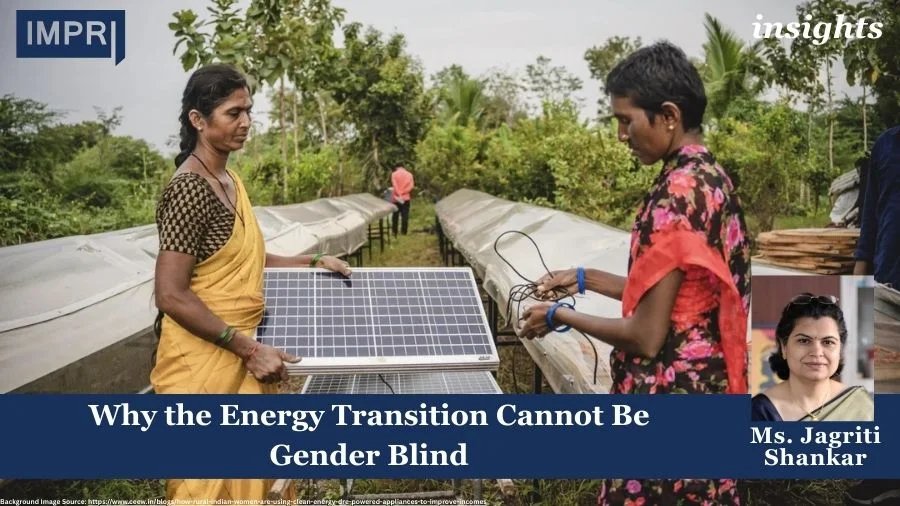
Energy systems are deeply embedded in social structures-and these structures are gendered. Women and men experience energy access, use, and decision-making very differently due to unequal access to resources, time, mobility, education, and institutional power. In most societies, women are the primary users and managers of household energy for cooking, lighting, water, and care work. Yet they remain significantly underrepresented in energy planning, technology ownership, and the renewable energy workforce.
In India, women comprise only 11% of the workforce in the renewable energy sector, which is significantly lower than the global average of 32% (GEAPP, 2024). At the same time, women bear a disproportionate share of energy-related burdens. The World Health Organization estimates that household air pollution causes millions of premature deaths annually, with women and children facing the highest exposure due to reliance on polluting cooking fuels.
Energy poverty also contributes to women’s time poverty-women in energy-poor households spend several hours daily collecting fuel and managing energy-intensive domestic tasks, limiting opportunities for education and income generation.
The global energy transition is often framed as a technical shift-from fossil fuels to renewables, from centralized grids to decentralized systems. However, this transition is not only about how energy is produced, but also about who benefits, who participates, and who is left behind. This is where gender sensitivity and inclusivity become central to energy transition policies.
Energy transition policies are often shaped by technocratic and expert-driven perspectives that prioritize efficiency, infrastructure, and emissions metrics. While valuable, this approach tends to overlook everyday, lived experiences of energy use—particularly those of women and marginalized groups. When women’s knowledge about cooking practices, care work, safety, and household energy management is excluded from policy design, it results in what scholars describe as epistemic injustice: the systematic undervaluing of certain forms of knowledge. Gender-blind energy policies, therefore, are not neutral; they reflect whose knowledge counts and whose voices remain unheard.
Gendered Gaps in the Energy Transition
- Energy poverty and safety risks
Women are disproportionately affected by energy poverty. Limited access to clean cooking, reliable electricity, and safe lighting exposes women and girls to health risks, indoor air pollution, and safety concerns-particularly in poorly lit public spaces. - Underrepresentation in planning and decision-making
Despite being primary energy users, women are often excluded from household- and community-level energy decisions. Their limited participation in planning processes results in energy systems that fail to reflect their needs and priorities. - Exclusion from economic benefits
When renewable energy policies are designed without a gender lens, they may be technically successful but socially unequal. Subsidies linked to land ownership or formal enterprises tend to benefit men, while women-especially from poor, rural, tribal, or marginalized communities-remain excluded. Skill development programs often overlook women’s care responsibilities, mobility constraints, and safety concerns, leading to low participation despite formal eligibility. - Structural inequalities
Gender-sensitive energy transition policies recognize that equal access does not guarantee equal outcomes. Structural barriers-such as women’s limited land ownership and restricted access to formal finance-shape who can adopt clean energy technologies and who gains economically from the transition. In some contexts, renewable energy projects may also disrupt women’s livelihoods without adequate consultation or compensation. - Social and Non-Economic Impacts of Energy Transitions
Energy transitions are often assessed in terms of jobs created, emissions reduced, or technologies deployed. However, transitions also carry social and non-economic consequences that are rarely acknowledged. In regions dependent on fossil fuels or traditional energy systems, transitions can disrupt livelihoods, social identities, and community cohesion. Such disruptions may increase household stress, migration pressures, and, in some contexts, even domestic conflict. These impacts are experienced differently by women, who often absorb social and emotional costs through increased care responsibilities and reduced economic security. Ignoring these dimensions risks designing transitions that are environmentally green but socially fragile.
If these gaps remain unaddressed, the energy transition risks becoming green but unequal-reducing emissions while leaving gender inequalities untouched or even exacerbated.
What Does a Gender-Sensitive Renewable Energy Policy Look Like
A gender-sensitive renewable energy policy goes beyond viewing women merely as beneficiaries. It recognizes women as users, workers, entrepreneurs, and decision-makers in the energy transition.
Such a policy:
- Acknowledges gender-specific energy needs and constraints
- Integrates gender considerations across policy goals, budgets, and implementation mechanisms
- Recognizes unpaid care work as a critical but invisible dimension of energy access and infrastructure choices
- Designs energy solutions that reduce drudgery and avoid shifting care burdens onto women
- Aligns renewable energy objectives with broader gender equality, livelihood, and social protection frameworks.
- Focuses on outcomes such as time savings, health improvements, income generation, and women’s agency
Crucially, gender-sensitive renewable energy policy is not a separate ‘women’s policy’. It is a mainstream energy policy designed to work effectively for everyone.
How Can Gender Sensitivity and Inclusion Be Ensured
Gender and inclusion must be systematic, not symbolic.
At the policy design stage
- Conduct gender and inclusion analyses to examine who has access to, control over, and decision-making power around energy resources
- Use sex-and-socially disaggregated data to make visible intersecting inequalities across gender, caste, class, and location
- Consult women’s collectives, SHGs, and grassroots leaders as sources of local knowledge, not merely as beneficiaries
At the institutional level
- Assign clear responsibility within energy institutions for achieving gender and inclusion outcomes
- Build gender capacity among policymakers, regulators, and implementing agencies to move beyond gender-neutral approaches
- Strengthen coordination with women, rural development, and livelihood departments to address energy needs in an integrated manner
During implementation
- Design financing, training, and outreach models that reflect women’s lived realities, including time poverty, care responsibilities, and mobility constraints
- Enable women’s participation across the renewable energy value chain—as users, workers, entrepreneurs, and decision-makers
For monitoring and accountability
- Track not only access and uptake, but also control, affordability, and decision-making power
- Use qualitative methods to capture lived experiences and unintended impacts, especially for marginalised groups
- Create feedback loops that allow women and communities to influence course correction and policy learning
Conclusion
The renewable energy transition is often framed as a technical or environmental challenge, while in reality, it is also a profound social transformation. A just energy transition should not be only about including women in existing systems, but about questioning how those systems are structured in the first place. The shift to renewable energy offers an opportunity to rethink gender roles, redistribute care responsibilities, and democratize decision-making in energy governance.
A truly just transition should be inclusive, equitable, and empowering-especially for women and marginalized groups who have long been at the margins of energy systems. Gender-sensitive renewable energy policies ensure that the transition does not merely change how energy is produced, but also transforms who benefits from it.
Without gender sensitivity, the energy transition risks reproducing old inequalities in a new, greener form. With it, renewable energy can become a powerful pathway toward social justice, economic empowerment, and sustainable development.
References
- Buechler S. et al (2020), Patriarchy and (electric) power? A feminist political ecology of solar energy use in Mexico and the United States, Energy Research & Social Science, Volume 70, ISSN 2214-6296, https://doi.org/10.1016/j.erss.2020.101743.
- Elmhirst R. (2011), Introducing new feminist political ecologies, Geoforum, Volume 42, Issue 2, ISSN 0016-7185, https://doi.org/10.1016/j.geoforum.2011.01.006.
- ENERGIA/DfID. (2006). From the Millennium Development Goals towards a gender-sensitive energy policy research and practice: Empirical evidence and case studies. Collaborative Research Group on Gender and Energy (CRGGE).
- ESMAP. (2013). Integrating gender considerations into energy operations. The World Bank. https://documents.worldbank.org/en/publication/documents-reports/documentdetail/729161468327340252/integrating-gender-considerations-into-energy-operations
- GEAPP. (2024). Gender empowerment in the renewable energy sector. Global Energy Alliance for People and Planet. https://energyalliance.org/gender-empowerment-in-the-renewable-energy-sector/
- ILO (2015), Guidelines for a just transition towards environmentally sustainable economies and societies for all, accessed at: https://www.ilo.org/sites/default/files/wcmsp5/groups/public/%40ed_emp/%40emp_ent/documents/publication/wcms_432859.pdf
- International Renewable Energy Agency (IRENA). (2019). Renewable energy: A gender perspective. https://www.irena.org/publications/2019/Jan/Renewable-Energy-A-Gender-Perspective
- WHO (2025), Household air pollution, https://www.who.int/news-room/fact-sheets/detail/household-air-pollution-and-health
About the Author
Jagriti Shankar is a gender and social development expert with over 15 years of experience
across Asia. She works at the intersection of women’s empowerment, energy transition,
climate action, and inclusive policy, with strong expertise in research, capacity building, and
gender-responsive development practice.
Acknowledgement: This article was posted by Vatsala Sinha, Research Intern at IMPRI.
Disclaimer: All views expressed in the article belong solely to the author and not necessarily to the organisation.
Read More at IMPRI
From Code To Coal: The Energy Footprint Of India’s Digital Ambitions