





Anil Trigunayat
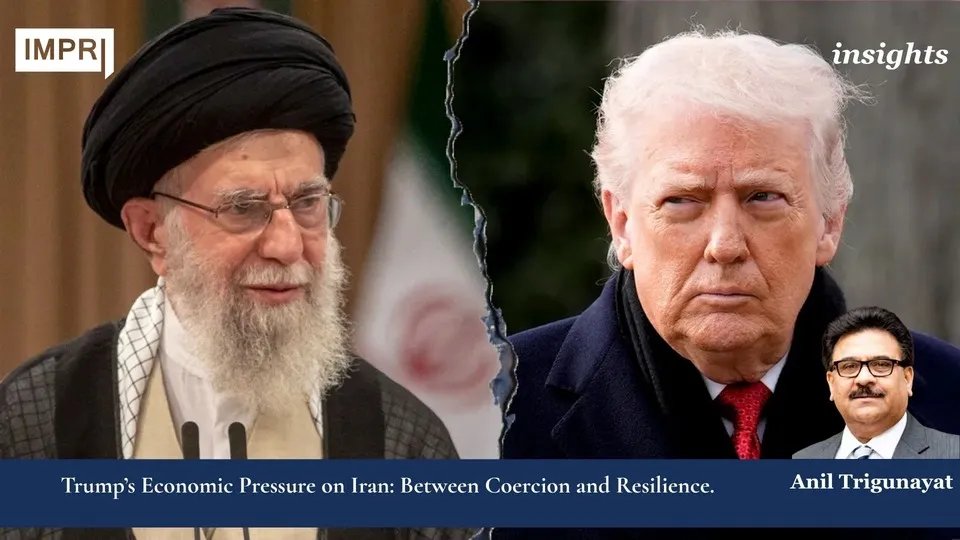
The grammar of the West Asia war is changing yet again. While on the battlefront Iran may have comparatively lost in grey-zone warfare, it has been perceived as a winner, even if in wars there are only losers, since it is seen as an unjust aggression given the limited credibility of the US and Israel and the lack of international support, even from their NATO allies. Tehran, on the other hand, has been able to survive thus far despite its own unjust aggression and attacks against its Gulf neighbours.
Iranian President Masoud Pezeshkian, as per media reports, claimed that, “It is better that we bring the war to an end now as we are in a position of power and dignity”, even if his hardline and IRGC comrades might not be on the same page.
The 60-day memorandum of understanding, or misunderstandings, has expired and talks are supposedly not happening even though the mediators are burning the midnight oil. In the meantime, most of the regional majors have achieved some pecuniary understandings with Tehran. For Tehran, while its ‘Mosaic Defence Strategy’ may have helped against the US-Israeli attacks, some trigger-happy autonomous IRGC commanders could as well undermine the temporary adjustments that Tehran and the Gulf countries had reached.
The alleged attacks on the UAE on August 19, which were intercepted, led to Abu Dhabi suspending all trade with Iran. It is the most important trade artery, which had helped Iran bypass the decades-long sanctions and secured its huge Iranian investments in the UAE, which have yielded good dividends. These have now been threatened once again, even though Tehran denied it and indicated some false-flag operations, which is difficult to ascertain amid the crafty disinformation campaigns by all sides.
Several reports averred to the fact that since the visit of the Iranian NSA to Tehran, both sides had agreed to bury the hatchet as the UAE unfroze Iranian assets and no major strikes happened until now. The timing is critical since a day before, President Trump vowed to impose the most severe economic measures unheard of and unseen thus far.
Trump, on his Truth Social, threatened Iran and Iranian allies and trading partners: “This will be economic warfare and isolation on an unprecedented scale. ANY country that allows its financial institutions, businesses, airports, or government entities to provide any type of lifeline to Iran will itself face TREMENDOUS Economic Consequences.” The Iranian Foreign Minister dismissed these with a cool assessment: “the so-called ‘Economic D-Day’ is a diversion from America’s own crisis: unprecedented debt and surging interest costs. US economic terrorism” will threaten the global economy and sovereignty worldwide.”
There is no doubt that the Iranian economy is under stress due to prolonged sanctions and the Hormuz blockade, but then the US is in no good shape either, with its highest-ever debt crossing $40 trillion, making it the most indebted nation in the world.
Most observers believe that since the US could not overpower Iran on the battlefield, it is unlikely that these economic measures will be any more effective, given the tremendous resilience and adaptation and mitigation strategies Tehran has devised during the prolonged imposition of Western sanctions laced with occasional relief. It is also counting on its dozen-plus major trading partners, including China, Russia, India, Afghanistan, Pakistan, Armenia and Azerbaijan, including its seven neighbouring countries, as well as Germany, etc.
China has obviously decried these unilateral measures, stating that it opposes unilateral US sanctions against Iran that do not have authorisation from the United Nations Security Council, and it considers normal, lawful economic cooperation with Iran legitimate. A Chinese Professor Jiang went a step further, saying that the US is running a textbook Ponzi scheme and the petrodollar is under real stress.
He warned that America’s debt system works like a giant Ponzi scheme. US Treasury Secretary Scott Bessent just proved him right in real time. The UK, China, Japan, South Korea and others are now selling US Treasuries. ‘When sellers outnumber buyers, the price of the bonds drops… and the interest rate (the “yield”) shoots up’. This has become a war among stressed economies, which by itself will impose new limitations, worsening their military capabilities even more.
Several European countries have begun to engage with Iran, diverging from the US position. Spain is one of the most vocal. Reportedly, Iran’s South Khorasan has issued its first Spanish mining investment licence: Iran’s South Khorasan has issued its first investment licence to a Spanish mining company, one of four countries entering the province recently, even as the UAE halts all trade with Iran. As usual, Scott Bessent has threatened allies, “if you are not with us, you are against us”, an admission of their inability to take everyone along since it is not only this war alone but a behavioural pattern of the second Trump administration.
Let alone the Europeans, even Pakistan, the so-called close ally of the USA, has opened up new border trade corridors with Iran. By activating the SRO 691 regulatory order, Tehran and Islamabad have opened six strategic transit routes that allow third-party cargo to reach Iran via Pakistani territory, effectively bypassing a maritime blockade. This shift not only preserves Iran’s access to regional markets but also revives a dormant infrastructure project that connects the Pakistani ports of Karachi, Port Qasim, and Gwadar directly to the Iranian border crossings of Taftan and Gabd. Recently, Iran, a new member of BRICS, has expressed a desire to join the New Development Bank (NDB) to diversify its risks even more.
Iran may have options, but without an end to the war, the smooth functioning of these cannot be guaranteed. Majles Speaker Qalibaf has rightly stated that no matter how much military power Iran possesses, if the people are hungry, it will not be able to endure.
As such, this war has been driven by 3 Ms, i.e. Markets, Munitions and MAD Syndrome. While the ammunition and interceptors and offensive and defensive capabilities of the superior powers have been tested, dented and exhausted, the Iranians are still posturing with alacrity, yet hoping for the war to be over as they do realise that the state of play cannot go on. The double blockade of the Strait of Hormuz is impacting Iranian oil supplies as well as the region and beyond, but alternative supply chains and pipelines and maritime waterways are being explored with great urgency.
Even though the former Russian President called Hormuz a more potent weapon than even the nuclear one for Iran, combined with the thermonuclear weapon of Bab el-Mandeb, the economic distress will surely become untenable and hunger will lead to domestic discontent. However, the US sanctions or extraneous economic measures will not hold, as arbitrary US decisions have alienated a vast majority of countries.
The great Indian epic Mahabharata has a lesson for leaders when, at the end of the war, Sanjaya (gifted with divine vision) asked King Dhritarashtra with sadness, “Maharaj, I showed you every truth of the battlefield exactly as it unfolded. Even after seeing it all, why did you not change your course while there was still time?” Dhritarashtra lowered his head and replied, “Sanjaya, you gave me the vision to see what was happening before my eyes, but the attachment (ignorance or blind faith or overconfidence) within me would not allow me to see the truth.
When the eyes are open but the mind is covered by selfishness and attachment, even the clearest truth becomes invisible.” But for that to happen, arrogance and impertinence need to be tempered, else the wars will conflagrate yet again. Let not the blind lead the blind.
About the Author:
(Anil Trigunayat is a former Indian ambassador to Jordan, Libya and Malta and a distinguished fellow and head of the West Asia Experts Group at the prestigious Vivekananda International Foundation. He is also a Distinguished Fellow at the oldest Indian think tank, the United Services Institution of India. Views expressed in the above piece are personal and solely those of the author. They do not necessarily reflect Firstpost’s views.)
This article was first published in the Firstpost. as Trump’s economic noose on Iran may be looser than he thinks
Disclaimer: All views expressed in the article belong solely to the author and not necessar8ily to the organization.
Read more at IMPRI:
IMPRI Impact And Policy Research Institute
Acknowledgement:
The article was posted by Kaustav Majumdar, a Research and Editorial Intern at IMPRI.