








Policy Update
Purbaa Jagannath
Background
The estimated biomass generation in India is 750-754 MT per year of which 228-230 MT is surplus after utilizing biomass for conventional purposes like fodder, manure and for industries (Administrative Staff College of India, cited in Ministry of Power, 2023). Most of this surplus, especially paddy straw and other crop residues from northern states, has traditionally been burned in the open, which is a major source of seasonal air pollution in Delhi-NCR and neighbouring areas (Ministry of Power, 2023).
Meanwhile, coal-fired thermal power plants (TPPs) continue to dominate India’s electricity supply, with a total actual thermal power capacity of about 210 GW (Power Line Magazine, 2025), mainly to combat the effects of pandemic flu. A solution that could successfully tackle both issues – stubble burning and substituting some of the coal firing in the existing TPPs with a carbon-neutral fuel – was to supply a portion of the surplus agricultural residue, converted to pellets, to the TPPs for co-firing.
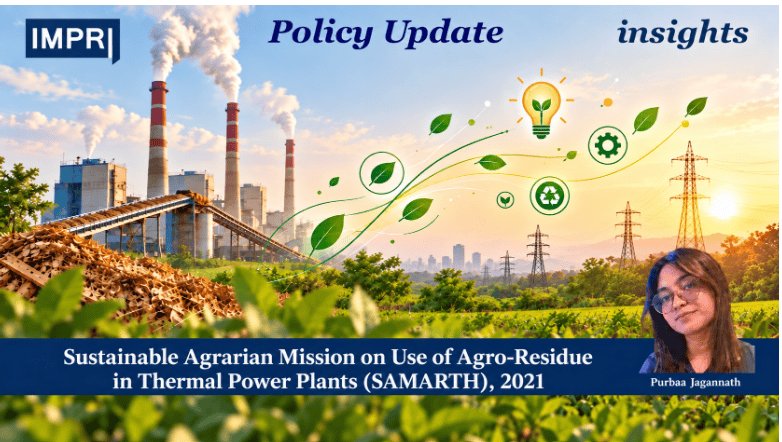
In November 2017, the Ministry of Power issued directions to implement biomass pellet co-firing in pulverised coal fired boilers, but this was limited to a few plants only (Power Line Magazine, 2025). To scale this up, the Ministry has constituted the National Mission on Use of Biomass in (Coal Based) Thermal Power Plants — SAMARTH or the Sustainable Agrarian Mission on Use of Agro-Residue in Thermal Power Plants in July 2021 (SAMARTH Mission, Ministry of Power, n.d.).
This was followed by the “Revised Policy for Biomass Utilization for Power Generation through Co-firing in Coal based Power Plants” dated 8 October 2021 which brought the co-firing mandate into all TPPs, Central Sector, State Sector and Independent Power Producers (IPP) and introduced an initial target range of 5-10% biomass co-firing (Ministry of Power, 2021).
SAMARTH is functioning under the umbrella of the Ministry of Power, with the Biomass Division of NTPC(National thermal power corporation) giving direction to the Mission on day-to-day basis and the Ministry of New and Renewable Energy (MNRE) provides direction to SAMARTH through its National Bioenergy Programme (NBP) for two phases of the Mission, with a combined budget outlay of ₹1,715 crore for the period of FY21-22 to FY25-26 (Energy Portal, 2025; Mercom India, 2024).
The goalof the Mission is to increase the percentage of co-firing beyond the initial 5%, reduce air pollution due to the burning of farm residues, generate additional income for farmers by selling agro-residue, promote carbon neutral power generation and resolve regulatory challenges in the co-firing value chain (SAMARTH Mission, Ministry of Power, n.d.). This initiative is in addition to the National Clean Air Programme (NCAP) of India and India’s overall decarbonisation targets, and is complementing the Commission for Air Quality Management (CAQM) in the NCR and adjoining region, India’s PM Gati Shakti and National Bioenergy Programme (SAMARTH Mission, Ministry of Power, n.d.; Power Line Magazine, 2025).
Functioning
SAMARTH is not a capital subsidy scheme, it is a collection of progressively tougher regulations. The policy for 5-10 per cent co-firing for all TPPs was also extended to the Bubbling and Circulating Fluidised Bed Combustion (BFBC/CFBC) boilers, apart from the PF boilers, as per a letter of the Ministry of Power dated 7 April 2022 (SAMARTH Mission, Ministry of Power, n.d.). The list of eligible agro-residues was expanded on 3 May, 2023 with the inclusion of bamboo and its by-products, horticultural waste, pine cone/needle, elephant grass and sarkanda, etc. (PIB, 2023).
On 16 June 2023, the Ministry made co-firing compliance mandatory in stages: 5% from FY2024-25, rising to 7% from FY2025-26 (PIB, 2023; Power Line Magazine, 2025). In a separate development, the CAQM has instructed qualified TPPs and coal-based TPPs in the NCR and its surrounding airshed to increase their minimum co-firing requirement of 30% and 20%, respectively, and to use paddy straw as the co-firing fuel (Energetica India, 2025; PelletRates, 2026), with the enforcement backed by financial penalties in case of failure to meet the targets (PelletRates, 2026).
The Ministry of Power has issued a detailed and consolidated circular which incorporated the use of biomass pellets and torrefied Municipal Solid Waste (MSW) based charcoal in the same set of norms for blending, procurement and compliance (Power Line Magazine, 2025).
Institutional Architecture
The Mission is guided by the Steering Committee led by the Union Power Secretary and the Executive Committee which meets from time to time to discuss the progress of co-firing and address the problems being faced by the pellet vendors and generating companies (PIB, 2022). NTPC’s Biomass Division is the secretariat of the Mission and NTPC’s Executive Director (Biomass) is the Mission Director (Power Line Magazine, 2023) of SAMARTH. Standard Operating Procedures are available on a dedicated web portal (samarth.powermin.gov.in), which includes a nationwide database of vendors, tender notifications and contact information for the nodal officers of individual TPPs, and a training calendar (SAMARTH Mission, Ministry of Power, n.d.).
Financial and Procurement Support
SAMARTH has a complementary financing instrument subsidy outlay, but does not have a capital subsidy outlay like manufacturing linked schemes. Under MNRE’s Biomass Programme, under the National Bioenergy Programme, Central Financial Assistance (CFA) of up to ₹21 lakh per MTPH (maximum ₹1.05 crore per project) is provided for non-torrefied pellet plants, and up to ₹42 lakh per MTPH (maximum ₹2.10 crore per project) is provided for torrefied pellet plants (Mercom India, 2024; FABON, 2025).
RBI has defined biomass pellet manufacturing as an eligible activity under PSL, a dedicated Biomass procurement category has been introduced on Government e-Marketplace (GeM) and Ministry of Power has released a Revised Model Long-Term Contract for biomass supply which provides more revenue certainty to the biomass manufacturers (PIB, 2023).
Technical Standards and Quality Assurance
SOP for biomass pellet co-firing has been released separately for PF boilers and Fluidised Bed Combustion (FBC) boilers, which include the specification for pellets (gross calorific value (GCV), moisture content and size (SAMARTH Mission, Ministry of Power, n.d.)). In addition, the BIS’ certificate of conformity in accordance with IS17225-6:2016 is encouraged with the aim of establishing credibility in the long-term negotiations with TPPs (PelletRates, 2026).
Capacity Building, Training and Awareness
SAMARTH is conducting on-going Training-cum-Awareness Programmes for farmers about the adverse effects of stubble burning and the income opportunity from agro-residue, Skill Development Training Programmes for pellet manufacturers and vendors, delivered through National Power Training Institute (NPTI) campuses and district-level sessions (for example, at Panipat, Neemrana, Shamli and Betul under 2025–26) (SAMARTH Mission, Ministry of Power, n.d.). These are complemented by advertising campaigns in the national and regional dailies with the Bureau of Energy Efficiency (BEE) and the Power Foundation of India (PIB, 2022).
Co-ordination with Air-Quality Regulation and Enforcement
SAMARTH’s implementation is closely correlated with the CAQM’s regulatory mandate for the NCR and the surrounding region which stipulates that identified TPPs must co-fire biomass and give priority to paddy straws. The enforcement has been tightening over time as six thermal power plants in the vicinity of Delhi were fined a combined amount of ₹61.85 crore for not achieving the co-firing targets in December 2025 (PelletRates, 2026).
Performance
As SAMARTH is a regulatory mission layered on an existing generation fleet rather than a new capital project, its performance is best read through the growth in the number of participating TPPs, the volume of biomass co-fired, and associated air-quality and emissions outcomes, drawn from Ministry of Power press releases, parliamentary replies and CAQM data.
Table 1: Number of Coal-Based Thermal Power Plants Undertaking Biomass Co-Firing
| Period | Number of TPPs Co-Firing Biomass |
| FY2020-21 (baseline) | 8 |
| July 2022 | 35 |
| May 2023 | 47 |
| August 2025 | 71 (including 11 in the NCR) |
Source: PIB, 2022 (Inter-ministerial meeting update); Mercom India, 2022; PIB, 2023 (Rajya Sabha reply); Energetica India, 2025 (CAQM data).
Emissions and Air-Quality Outcomes
The CAQM reports that biomass co-firing across 71 TPPs had cumulatively avoided an estimated 34.77 lakh tonnes of CO2 emissions as of mid-2025, with NCR plants alone accounting for about 25.79 lakh tonnes of this avoidance (Energetica India, 2025). For reference, SAMARTH’s own estimates suggest that achieving 5% co-firing nationally could avoid approximately 38 million tonnes of CO2 emissions annually (SAMARTH Mission, Ministry of Power, n.d.) — indicating that actual cumulative avoidance to date remains a small fraction of the mandate’s full potential.
On air quality, the CAQM notes that Delhi-NCR’s average Air Quality Index (AQI) between January and September 2023 was 167, its second-best reading in six years, that July 2025 was the region’s cleanest July in a decade with an AQI of 79, that PM10 levels have declined by 15% since 2017-18, and that GRAP Stage III restrictions were revoked in early 2025 amid sustained improvement — outcomes the CAQM attributes in part to biomass co-firing and other emission-reduction measures (Energetica India, 2025).
Domestic pellet manufacturing capacity has also expanded to support this demand: the SAMARTH Mission’s ABC Booklet 2025 reports that rated pan-India pellet production capacity had doubled to approximately 30,800 tonnes per day, alongside a cumulative reduction of about 25.5 lakh tonnes of CO2 by FY2024-25 (Napier Grass/SAMARTH ABC Booklet 2025, 2025).
Impact
1. Impact on Stubble Burning and Air Quality: By creating a paying market for agro-residue that would otherwise be burnt, SAMARTH gives farmers a direct incentive to divert crop residue to pellet manufacturers rather than set it alight. CAQM data linking the expansion of co-firing TPPs to improved seasonal AQI readings in Delhi-NCR suggests a measurable, if still partial, contribution to this goal (Energetica India, 2025).
2. Impact on Carbon Emissions: Cumulative CO2 avoidance of roughly 34.77 lakh tonnes by mid-2025 demonstrates that co-firing is delivering real decarbonisation, but this remains well below the roughly 38 million tonnes of annual avoidance the Mission itself estimates is achievable at just 5% national co-firing — underlining the gap between mandate and achieved blending ratios (Energetica India, 2025; SAMARTH Mission, Ministry of Power, n.d.).
3. Impact on Farmer Income and Rural Livelihoods: Agro-residue that was previously a disposal cost for farmers is now sold into an organised supply chain, through GeM and e-NAM-linked procurement and long-term contracts with TPPs, generating a supplementary income stream, particularly in paddy-growing states such as Punjab, Haryana and Uttar Pradesh (PIB, 2022; Napier Grass/SAMARTH ABC Booklet 2025, 2025).
4. Impact on Domestic Pellet Manufacturing and MSMEs: RBI’s Priority Sector Lending classification, MNRE’s Central Financial Assistance and the doubling of rated pellet capacity to about 30,800 TPD point to the emergence of a new agro-processing MSME segment built around pelletisation, with NTPC citing over 2.5 lakh tonnes of biomass co-fired across its own plants by early 2025 (New Kerala/Argus, 2025; Napier Grass/SAMARTH ABC Booklet 2025, 2025).
5. Impact on Enforcement and Compliance Culture: CAQM’s shift toward financial penalties — including ₹61.85 crore levied on six Delhi-adjoining TPPs in December 2025 — signals a move from a voluntary, advisory mission toward a more binding compliance regime, at least within the NCR airshed (PelletRates, 2026).
Emerging Issues
1. Gap Between Mandated and Achieved Co-Firing Ratios: Even after the mandatory 5% (rising to 7%) target took effect, national biomass consumption of about 16.2 lakh tonnes in FY2024-25 remains far short of the 15–20 million tonnes per year that full 5% blending across India’s roughly 210 GW coal fleet would require (Argus Media, 2025; Power Line Magazine, 2025).
2. Feedstock Aggregation and Logistics Constraints: SAMARTH’s own leadership has flagged the absence of a robust collection, aggregation and transportation mechanism for raw biomass, volatile raw-material prices, and diversion of pellets to other industries willing to pay more, as persistent bottlenecks (Power Line Magazine, 2023).
3. Limited Vendor Base and Financing Gaps: Despite PSL status and CFA support, a limited number of pellet-machine vendors and inadequate working-capital financing continue to constrain the pace at which new manufacturing capacity can be added (Power Line Magazine, 2023).
4. Uneven Regional and Utility-Level Participation: Co-firing remains concentrated among NTPC’s own plants and a subset of NCR-adjacent states; many State-sector and private TPPs outside these regions have been slower to adopt co-firing at scale (PIB, 2022; New Kerala/Argus, 2025).
5. Funding Continuity Risk: MNRE’s National Bioenergy Programme Phase-I window runs only to 31 March 2026, and proposals received after October 2024 are pending approval under a Phase-II budget allocation, creating uncertainty for pellet manufacturers planning new capacity (PelletRates, 2026; MNRE BioUrja, n.d.).
6. Data Consistency and Transparency: Cumulative co-firing figures reported across different Ministry of Power press releases, parliamentary replies and CAQM statements do not always align precisely, making it harder for external stakeholders to track the Mission’s real-time progress against its targets.
Way Forward
Closing the gap between the 7% co-firing mandate effective from FY2025-26 and current national blending levels will likely require extending CAQM-style graded penalties and compliance monitoring beyond the NCR airshed to TPPs nationwide, paired with clearer, time-bound disbursement of Central Financial Assistance under National Bioenergy Programme Phase-II to remove funding uncertainty for pellet manufacturers.
Strengthening feedstock aggregation — through Farmer Producer Organisations acting as consolidators, dedicated collection centres and transport support — would help address the logistics and price-volatility concerns raised by the Mission’s own leadership. Expanding long-term, GeM- and e-NAM-linked procurement contracts can further improve revenue predictability for both farmers and pellet manufacturers.
Deeper coordination between SAMARTH, MNRE’s BioUrja portal, CAQM and state GENCOs on standardised procurement, quality certification (such as BIS IS 17225-6) and vendor onboarding can help widen participation beyond NTPC and the NCR states. The November 2025 unified policy integrating torrefied MSW-based charcoal alongside biomass pellets also opens a path to diversify feedstock beyond seasonal crop residue, reducing dependence on any single agro-residue stream. Finally, a consolidated, regularly updated public dashboard on the SAMARTH portal — reconciling figures currently spread across press releases and parliamentary replies — would improve transparency and make it easier to track progress toward the Mission’s co-firing targets.
References
Argus Media (2025). Indian coal plants raise biomass co-firing in FY2024-25.
Energetica India (2025). 71 Thermal Power Plants Across India Have Adopted Biomass Co-Firing: CAQM.
FABON (2025). How to Apply for MNRE Subsidy for Biomass Pellet Plant in India.
Energy Portal (2025). National Bio Energy Programme (NBP).
Mercom India (2024). MNRE Revises CFA Rate for Biomass Pellet Manufacturing Units.
Mercom India (2022). Co-firing of Biomass in 35 Thermal Power Plants Cuts Carbon Emissions by 100,000 Tons.
Ministry of New and Renewable Energy, BioUrja (n.d.). About the Programme.
Ministry of Power (2021). Revised Policy for Biomass Utilization for Power Generation through Co-firing in Coal based Power Plants, 08.10.2021.
Napier Grass / SAMARTH Mission (2025). ABC Booklet 2025 – National Mission on Use of Biomass in Thermal Power Plants (SAMARTH Mission).
New Kerala (2025). India’s Biofuel Sector Shows Partial Progress Amid Policy Push.
PelletRates (2026). New Biomass Plant Opportunities in India: Maharashtra & MP Lead the Way in 2025–26.
Press Information Bureau (PIB) (2022). Power Secretary reviews status of Biomass utilization in Thermal Power Plants in the country: SAMARTH.
Press Information Bureau (PIB) (2022). Inter-ministerial meeting to review progress of biomass co-firing in thermal power plants held in New Delhi today.
Press Information Bureau (PIB) (2023). Ministry of Power issues revised policy on biomass utilisation for power generation through co-firing in coal based power plants.
Power Line Magazine (2023). Burning Issue: Case for utilising excess biomass for co-firing.
Power Line Magazine (2025). Decarbonising Coal: Co-firing as a viable pathway to cleaner thermal power generation.
SAMARTH Mission, Ministry of Power (n.d.). About Us / Home.
SAMARTH Mission, Ministry of Power (n.d.). FAQ by SAMARTH Mission.
About the Contributor
Purbaa Jagannath is a Research Intern at the Impact and Policy Research Institute (IMPRI), working on policy writing. She is currently pursuing a Master’s in Social Work (Women-Centred Practice) at TISS Mumbai, and holds a Bachelor of Social Work (Honours with Research), with a minor in Political Science, from University of Delhi. Her research interests span social work, political science, policy research and grassroots fieldwork across India, with recurring focus areas including youth empowerment, governance and community development.
Acknowledgement
The author extends sincere gratitude to the reviewers and the IMPRI India team for their valuable guidance, support and review of this Policy Update.
Disclaimer
All views expressed in the article belong solely to the author and not necessarily to the organization.
Read More at IMPRI:
India Electric Mobility Index 2025: Measuring State-Level Progress in Electric Mobility.
Geographical Indications of Goods (Registration and Protection) Act, 1999.