







Policy Update
Aditi Natasha Bhuinyan
Background
The Micro, Small, and Medium Enterprises (MSME) sector serves as the backbone of the Indian economy, contributing to employment generation, entrepreneurship and industrial development across urban and rural landscapes. However, many MSMEs face technological constraints, like limited access to modern machinery, inadequate technical skills, and high costs of technology adoption. This technological divide can affect productivity, product quality, innovation, and competitiveness.
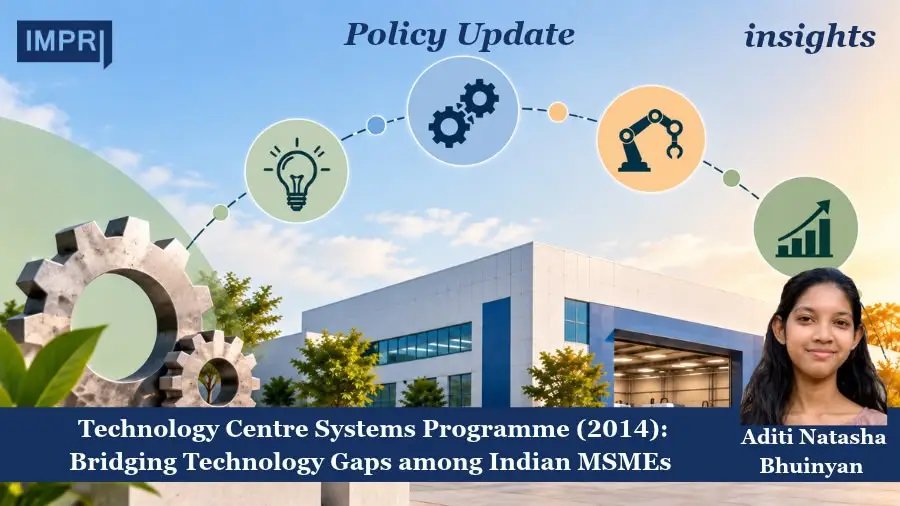
Recognising the importance of technology infrastructure in addressing these challenges, the Government of India introduced the Technology Centre Systems Programme (TCSP) under the Ministry of Micro, Small and Medium Enterprises (MoMSME). The programme received Cabinet approval in 2014, and its implementation commenced in January 2015 (Development Commissioner, Ministry of Micro, Small and Medium Enterprises, n.d.). It was designed to expand and upgrade the network of MSME Technology Centres (TCs) across India.
The programme was initially approved at an estimated cost of ₹2,200 crore, including US$200 million in World Bank assistance (World Bank, 2014). It aims to empower MSMEs, startups, and local industrial clusters who gain access to manufacturing infrastructure, advanced tools, and technical consulting.
The program has three principal objectives:
- To improve the competitiveness of MSMEs in key manufacturing industries.
- To improve access to advanced technologies and provide technical and business advisory support to MSMEs.
- To offer opportunities for technical skill development to youth at varying levels and provide skilled manpower to industry.
To achieve these objectives, the programme focuses on setting up new Technology Centres and upgrading existing ones (Development Commissioner, MoMSME, n.d.). These centres provide MSMEs with access to modern machinery, product design, testing, tooling, and technical consultancy. They also offer training to help workers develop the skills required by the industry. Through these facilities and services, TCSP aims to help MSMEs improve their production processes, manufacture better-quality products, and keep pace with changing technologies.
Functioning
The Technology Centre Systems Programme (TCSP) operates through a network of Technology Centres that provide specialised manufacturing facilities, technical services, and industry-oriented training. The Office of the Development Commissioner (MSME), under the Ministry of Micro, Small and Medium Enterprises (MoMSME), serves as the implementing agency (Development Commissioner, MoMSME, n.d.).
Approved in 2014, the programme initially aimed to establish 15 new Technology Centres and upgrade 18 existing ones, with an estimated cost of ₹2,200 crore, including US$200 million in World Bank assistance. Following the conclusion of World Bank financing in December 2020, the programme continued with funding from the Government of India. Its revised estimated cost was ₹2,402 crore, and its implementation period was extended until September 2026 (Department-related Parliamentary Standing Committee on Industry, 2026).
Its original design included three principal components: technical assistance to Technology Centres, investment in upgrading existing centres and developing new ones, and technical assistance to the Ministry for programme implementation, monitoring, and evaluation (World Bank, 2014).
Access to advanced manufacturing technologies
The programme combines infrastructure development with technical assistance and institutional capacity-building. Technology Centres provide access to advanced manufacturing facilities, including computer numerical control (CNC) machinery, robotics, additive manufacturing, and precision measurement equipment (Development Commissioner, MoMSME, n.d.). They also offer product design, tooling, testing, calibration, and technical consultancy to support product development and improvements in manufacturing processes. These shared facilities enable MSMEs to access specialiseRd technologies without bearing the entire cost of establishing equivalent infrastructure independently.
Skill development and technical consultancy
Technology Centres also offer technical training to young people and existing workers, helping develop skills relevant to industrial needs (Development Commissioner, MoMSME, n.d.). Training opportunities help improve the availability of technically competent personnel, while technical consultancy supports enterprises in addressing production and product-development challenges.
Industry linkages and institutional development
The programme’s original design also envisaged collaboration with specialised manufacturing technology partners and technology cluster managers. These arrangements were intended to strengthen the technical capabilities of Technology Centres and connect them more closely with industrial needs. The effectiveness of this model depends on the ability of centres to respond to actual industry requirements, maintain advanced equipment, provide affordable services, and build sustained relationships with MSMEs.
Performance
The programme initially envisaged establishing 15 new Technology Centres and upgrading 18 existing centres. However, establishing infrastructure is only one stage of implementation. The number of completed facilities, their operational status, and the extent to which enterprises use their services are equally important indicators.
According to a December 2025 government update, out of the 15 new Technology Centres, nine had been dedicated to the nation, while construction and training activities were progressing at additional locations (MoMSME, 2025). Between January and November 2025, the new centres assisted 1,520 MSMEs and trained 59,357 trainees, indicating their growing role in technical service delivery (MoMSME, 2025).
The Ministry’s Performance Smartboard records the following achievements across its existing network of 18 Technology Centres:
Table 1. Annual Performance of MSME Tool Rooms/Technology Centres
| Financial Year | Trainees Trained (Nos.) | MSME ][\Units Assisted (Nos.) | Revenue Earned (₹ crore) |
| 2015–16 | 178,183 | 36,156 | 13.16 |
| 2016–17 | 148,538 | 34,983 | 13.75 |
| 2017–18 | 144,971 | 37,757 | 9.64 |
| 2018–19 | 208,534 | 39,859 | 11.55 |
| 2019–20 | 273,437 | 43,762 | 15.20 |
| 2020–21 | 133,301 | 27,831 | 3.52 |
| 2021–22 | 144,229 | 31,554 | 11.39 |
| 2022–23 | 176,131 | 33,501 | 12.41 |
| 2023–24 | 204,128 | 41,446 | 11.92 |
| 2024–25 | 286,548 | 46,256 | 12.95 |
| 2025–26 | 353,744 | 53,029 | 15.17 |
| 2026–27* | 143,426 | 23,001 | 18.33 |
Source: Ministry of Micro, Small and Medium Enterprises, Performance Dashboard: Tool Rooms/Technology Centres.
*Note: The 2026–27 figures are provisional, as the financial year is ongoing.
The Ministry of MSME’s Performance Dashboard indicates an expansion in training and enterprise outreach (MoMSME, n.d.-a). These figures should not be interpreted as the consolidated performance of all 15 new centres established under TCSP. Between 2015–16 and 2025–26, trainees trained increased by 98.6%, from 178,183 to 353,744, while units assisted rose by 46.7%, from 36,156 to 53,029, reflecting an increase in annual performance of the beneficiaries (MoMSME, n.d.-a). Both indicators declined sharply in 2020–21 due to the COVID-19 pandemic before recovering in subsequent years (MoMSME, n.d.-a). Although these trends indicate increased service delivery, they do not independently establish improvements in MSME productivity or technological adoption. Moreover, the figures represent the broader network, not TCSP’s standalone performance.
More direct evidence of TCSP’s reach is provided by the Parliamentary Standing Committee on Industry, which reported that the 15 new Technology Centres had trained 1,27,642 trainees and assisted 4,347 MSMEs since inception (Department-related Parliamentary Standing Committee on Industry, 2026). However, beneficiary numbers alone do not establish whether enterprises adopted new technologies or achieved measurable productivity gains.
TCSP’s financial performance indicates a gap between budgetary allocations and actual expenditure. According to the Parliamentary Standing Committee on Industry’s 2026 report, expenditure under the programme’s externally aided project component stood at ₹94.10 crore against a revised estimate of ₹96.96 crore in 2023–24. In 2024–25, expenditure was ₹161.06 crore against a budget estimate of ₹350 crore. For 2025–26, the initial budget estimate of ₹400 crore was revised to ₹228.50 crore, while expenditure of ₹56.42 crore was reported at the time of Parliamentary Standing Committee’s review (Department-related Parliamentary Standing Committee on Industry, 2026).
This figure reflects expenditure reported up to the date of the review and should not be interpreted as final full-year expenditure. The Parliamentary Standing Committee on Industry highlighted delays in machinery procurement, contractor-related issues, and slow civil works as reasons for lower expenditure. It recommended linking budget allocations to construction progress and operational readiness (Department-related Parliamentary Standing Committee on Industry, 2026).
Overall, TCSP has expanded technical infrastructure, training, and MSME outreach. However, its long-term effectiveness will depend on whether these services improve technology adoption, production efficiency, product quality, and sustained productivity gains among Indian MSMEs.
Impact
Overall, TCSP has expanded access to technical infrastructure, training, and specialised services for MSMEs. These initiatives are intended to help enterprises improve their technological capabilities and competitiveness. But further enterprise-level evidence is needed to assess the programme’s contribution to sustained productivity gains and competitiveness. Thus the potential impacts of TCSP are:
1. Technological Upgrading:
TCSP gives MSMEs access to modern machinery, testing facilities, product design, and technical consultancy (Development Commissioner, MoMSME, n.d.). These services can help small enterprises improve their manufacturing processes and access technology that might otherwise be expensive. However, the available programme data largely focus on the number of MSMEs assisted and the services provided. There is limited data on the number of MSMEs that have adopted new technologies, or upgraded their machinery, or improved their manufacturing processes as a result of TCSP support. Tracking these outcomes would help assess whether TCSP support leads to actual technological improvements among MSMEs.
2. Productivity and Competitiveness:
Technology Centres can help MSMEs improve precision, product quality, and production efficiency while reducing manufacturing costs. By making specialised technological facilities accessible without requiring MSMEs to invest in expensive infrastructure, TCSP can help strengthen their competitiveness. But assessing the programme’s actual impact requires enterprise-level evidence on cost savings, product quality, and market performance.
3. Skill Development and Employment:
Technical training is an important component of TCSP, equipping young people and industry workers with skills relevant to modern manufacturing (Development Commissioner, MoMSME, n.d.). However, the number of trainees alone cannot establish improvements in employability. Evidence on post-training employment, earnings, and the application of acquired skills would provide a clearer assessment of outcomes.
4. Innovation and Enterprise Development:
Technology Centres assist MSMEs with product design, prototyping, and manufacturing processes. Such support can help enterprises develop new products, diversify production, and adopt advanced technologies. However, evidence on how many supported enterprises have commercialised innovations or expanded their businesses remains limited.
Emerging Issues
1. Uneven access to technology infrastructure:
The geographical distribution of Technology Centres may affect access to specialised services for MSMEs in underserved regions (MoMSME, n.d.-b). While 18 existing centres operate across 14 states, MSMEs are concentrated in states such as Maharashtra, Uttar Pradesh, Tamil Nadu, West Bengal, and Karnataka (MoMSME, n.d.-b, n.d.-d). Comparing centre-wise distribution with regional MSME concentration can help identify potential gaps in service coverage.
2. Affordability of technological services:
Even where facilities are available, service charges, transportation costs, and other operational expenses may influence whether smaller enterprises can use them regularly. Evidence on service costs and beneficiary profiles would help determine the extent of this constraint.
3. Conversion of training into employment:
Training targets provide information about programme activity but do not independently establish employment outcomes. More systematic information on placements, employment retention, and the application of acquired skills would strengthen performance assessment.
4. Financial constraints on technology adoption:
Access to specialised machinery does not necessarily enable an enterprise to modernise its own production unit. MSMEs may face difficulties financing equipment purchases, maintenance, and complementary investments needed to integrate new technologies into their production processes.
5. Outcome-based monitoring:
Assessing programme effectiveness requires more than tracking infrastructure creation and the number of trainees. Centre-wise data on facility utilisation, enterprise-level outcomes, equipment maintenance, and service delivery are essential for determining whether the programme is achieving its broader development objectives.
Way Forward
To make the programme more effective, the focus should extend beyond establishing Technology Centres to ensuring that MSMEs can access and benefit from their services.
First, the Ministry of MSME should increase awareness of available facilities, particularly among smaller enterprises and those in underserved industrial clusters. Collaborations with MSME associations and local industry bodies could help reach potential beneficiaries.
Second, Technology Centres should regularly consult local industries to understand their technological needs. This would help keep their equipment, training programmes, and consultancy services relevant to industry requirements.
Third, training programmes should be better aligned with industry requirements through apprenticeships, employer partnerships, and placement support. Tracking employment outcomes would also help assess the practical benefits of these initiatives.
Fourth, MSMEs receiving technical assistance should be connected, where eligible, with appropriate credit facilities and other government support programmes, such as the Credit Guarantee Scheme for Micro and Small Enterprises (CGTMSE) and the MUDRA scheme. Such linkages would make it easier for MSMEs to explore financing options and put the technical guidance received through TCSP into practice.
Such linkages could help MSMEs meet the costs of adopting new technologies and upgrading their production processes.
Finally, the Ministry should improve monitoring by publishing centre-wise data on service utilisation, enterprise outreach, expenditure, and training outcomes. Periodic evaluations could help determine whether the programme is improving productivity, product quality, and technological capabilities.
By improving access to technology, strengthening industry-relevant skills, and monitoring outcomes, TCSP can help MSMEs adopt modern technologies and become more competitive.
References
- Department-related Parliamentary Standing Committee on Industry. (2026, March). Three hundred and thirty-third report on demands for grants (2026–27) pertaining to the Ministry of Micro, Small and Medium Enterprises. Rajya Sabha Secretariat. https://sansad.in/getFile/rsnew/Committee_site/Committee_File/ReportFile/17/215/333_2026_3_14.pdf?source=rajyasabha
- Development Commissioner, Ministry of Micro, Small and Medium Enterprises. (n.d.). Technology Centre Systems Programme (TCSP). https://dcmsme.gov.in/CLCS_TUS_Scheme/TCSP/Scheme_Guidelines.aspx
- Ministry of Micro, Small and Medium Enterprises. (n.d.-a). MSME Tool Rooms/Technology Centres: Year-wise achievements. https://dashboard.msme.gov.in/tool_rooms.aspx
- Ministry of Micro, Small and Medium Enterprises. (n.d.-b). Technology Centre Systems Programme: Centre-wise implementation status. https://dashboard.msme.gov.in/tcsp_details.aspx
- Ministry of Micro, Small and Medium Enterprises. (n.d.-c). Tool Rooms/Technology Centres: Targets and achievements, 2025–2026. https://dashboard.msme.gov.in/tool_room_tc_wise.aspx?FY=2025-2026
- Ministry of Micro, Small and Medium Enterprises. (2026). Annual report 2025–26. Government of India. https://msme.gov.in/sites/default/files/MSMEANNUALREPORT2025-26ENGLISH_0.pdf
- Ministry of Micro, Small and Medium Enterprises. (2025, December 5). 9 additional Technology Centres established under Technology Centre Systems Programme (TCSP). Press Information Bureau. https://www.pib.gov.in/PressReleasePage.aspx?PRID=2199255&lang=2®=48
- World Bank. (2014). India: Technology Centre Systems Program (Project Appraisal Document, Report No. 82484-IN). https://documents1.worldbank.org/curated/en/684821468041392038/pdf/824840PAD0P145010Box385177B00OUO090.pdf
- Ministry of Micro, Small and Medium Enterprises. (n.d.). State-wise Udyam registration including Udyam Assist Platform. MSME Dashboard
About the Contributor
Aditi Natasha Bhuinyan is an Economics postgraduate from the Delhi School of Economics, University of Delhi, with research interests in public policy, development economics, governance and environmental sustainability. With experience in empirical analysis and data-driven research, she is keen to explore how evidence-based research can inform policy solutions to contemporary development challenges.
Acknowledgement
The author sincerely expresses gratitude to the reviewers Siddhant and Khushi, and the IMPRI team for their expert guidance and constructive feedback throughout the process.
Disclaimer
The views and opinions expressed in this article are solely those of the author and do not necessarily reflect the views, policies, or positions of IMPRI (Impact and Policy Research Institute) or any other affiliated organisation.
Read more at IMPRI:
APAAR ID : Automated Permanent Academic Account Registry ID, 2023
Financial Inclusivity at the Margins: Policy Review of Haryana’s Mahila Samriddhi Yojana (2021)