







Policy Update
Paridhi Passi
Background
Centrally Sponsored Schemes (CSS) form the backbone of India’s welfare and infrastructure delivery, jointly funded by the Centre and states but implemented through state-level agencies. For years, the fund flow architecture behind these schemes suffered from a structural inefficiency: money was released in advance rather than as spending actually occurred, leaving large sums idle across thousands of implementing-agency bank accounts.
Under the earlier system, the Centre released CSS funds to states in advance, in instalments tied to the budget calendar rather than to actual expenditure. States and implementing agencies received money upfront and drew it down over time, which meant unspent balances routinely piled up in thousands of bank accounts, earning states interest while the Centre continued to borrow to finance the same releases. SNA-SPARSH inverts this logic: instead of pushing funds ahead of need, it pulls funds only at the point a payment is actually due, so money moves in step with real expenditure rather than in anticipation of it.
Since 2021-22, the government had already been running a Single Nodal Agency (SNA) model to bring visibility to CSS fund flows, consolidating the unspent balances that were previously scattered across more than 15 lakh bank accounts into a much smaller set of designated SNA accounts.
Even this consolidation did not fully solve the underlying problem: large sums continued to sit unutilised each year, and the exact scale of this idle float was not publicly itemised scheme-by-scheme. SNA-SPARSH (Samyochit Pranali Ekikrit Shighra Hastantaran) was introduced to close that residual gap, replacing advance-transfer with a real-time, need-based release mechanism. The model was first piloted in mid-2023 in six states, for two schemes, before being expanded nationally in phases.
Functioning
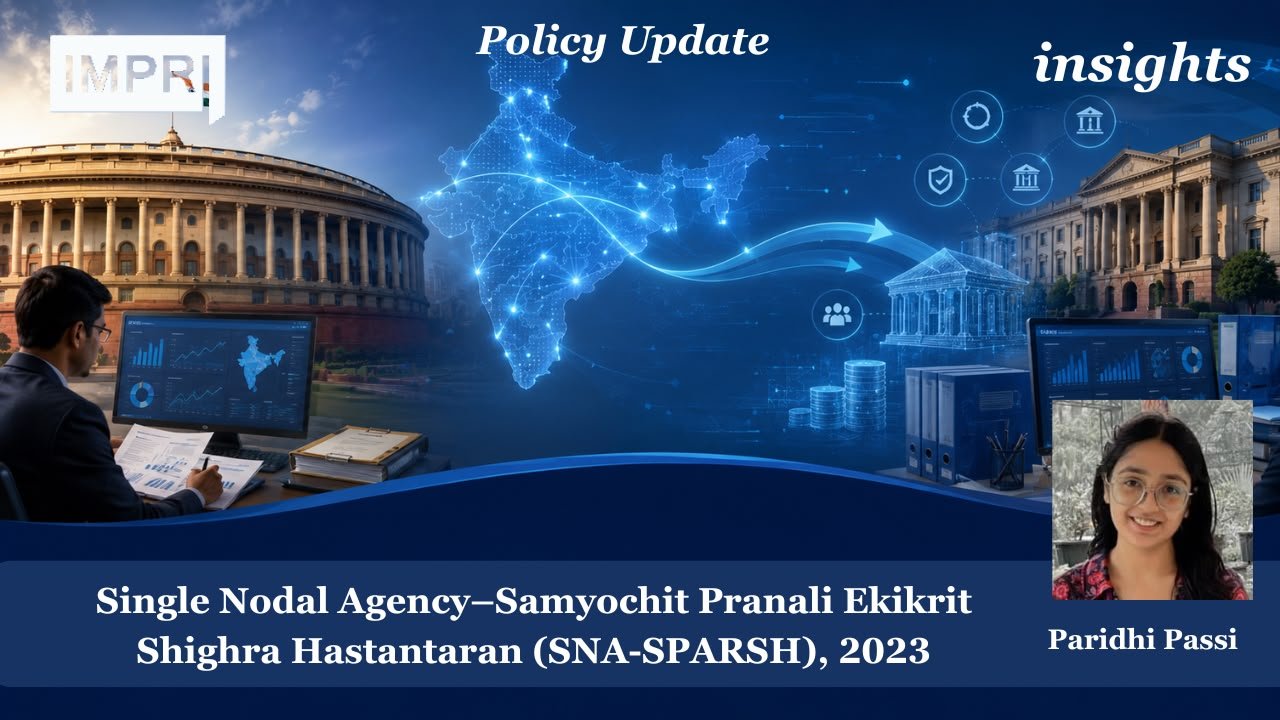
SNA-SPARSH links the Centre, the states, and the Reserve Bank of India into a single settlement chain, so funds move only at the moment a payment is actually due.
Table 1: Key Institutional Pillars of SNA-SPARSH
| Pillar | Mechanism | Purpose |
| Single Nodal Agency (SNA) | One designated agency per CSS per state, linked to the State Treasury | Centralised bill submission and accountability |
| Integrated settlement network | Integration of State IFMS/IFMIS with RBI’s e-Kuber platform and PFMS | Real-time, “just-in-time” fund transfer |
| Cyber Treasury | State-level treasury unit receiving tagged payment files from SNAs/Implementing Agencies | Compiles and verifies vouchers before release |
| Just-in-time release principle | Funds released only when payment is due to a beneficiary or vendor, with no advance parking in any bank or deposit account | Prevents idle float and avoids unnecessary borrowing cost |
In practice, this integration works as a payment chain. An implementing agency initiates a bill through the state’s IFMS/IFMIS, which routes it to the Cyber Treasury for verification. Once verified, the payment instruction is passed to PFMS, which is linked to RBI’s e-Kuber platform, the RBI’s core banking and settlement system for government transactions. e-Kuber then settles the payment directly to the beneficiary or vendor’s account, drawing funds from the Centre at that exact moment rather than from a pre-funded SNA balance. This chain is what allows the “just-in-time” principle to function in real time rather than as a periodic reconciliation exercise.
Rollout has proceeded in stages: a pilot in 6 states for two schemes in mid-2023 was followed by phased expansion covering 14 states and 23 schemes by mid-2024, 37 schemes by mid-2025, and the remaining notified schemes from November 2025. The Northeastern states and Union Territories with legislatures were brought in by end-2024, and from November 2025, participation became mandatory for all Centrally Sponsored Schemes across all states and UTs with legislature.
Performance
Table 2: SNA-SPARSH Progress Indicators
| Indicator | Figure |
| CSS notified under SNA-SPARSH | 81 schemes |
| CSS actually onboarded | 50 of 81 notified schemes |
| States/UTs onboarded | All notified states and UTs |
| Implementing-agency accounts consolidated | Over 15 lakh accounts consolidated into about 4,500 SNA accounts |
| Interest savings from reduced float | Over ₹11,000 crore since FY 2023-2024 |
| FY 2025-26 CSS budget outlay | ₹5.41 lakh crore, about 50% of total capital expenditure outlay |
A major transparency step came through the Union Budget process itself, which for the first time disclosed a program-wise breakdown of unspent balances lying in State SNA accounts, covering schemes with annual outlays above a defined threshold. This disclosure gave the float problem a concrete, scheme-level face rather than an aggregate one.
Table 3: Trend in Unutilised CSS Funds
| Year | Unutilised/Idle CSS Funds | Stage of Reform |
| FY 2022-23 | Sizeable gap between sanctioned and actual expenditure | Pre-SNA-SPARSH (SNA model only) |
| FY 2023-24 | Gap persists, marginally wider | Pilot phase (6 states, 2 schemes) |
| FY 2024-25 | Roughly half of sanctioned funds (₹24,369 crore sanctioned; ~₹13,851 crore released) reached beneficiaries under the older release pattern | Phased rollout underway |
| FY 2025-26 onward | Mandatory nationwide coverage; funds released only against actual payment instructions | Full rollout |
The trajectory across these years shows the reform moving from a system where a substantial share of sanctioned funds sat unreleased, toward one structurally designed to close that gap rather than address it through periodic administrative correction.
Emerging Issues
The transition has not been friction-free. States accustomed to holding funds in advance have reported temporary liquidity strain as departments adjust to drawing funds only when payments are imminent, with some scheme-level disruptions reported during the changeover period.
A second concern is uneven scheme coverage: even after more than two years of phased rollout, only 50 of 81 notified schemes had been onboarded by the end of 2025, with some large flagship schemes still pending inclusion even as the mandate for universal coverage took effect. This gap between policy mandate and ground-level systems readiness is a recurring feature of CSS reform generally.
A third issue is administrative capacity. Because payments must now be tagged, routed through Cyber Treasuries, and reconciled against scheme-linked codes before release, states with less digitised treasury systems face a steeper adjustment curve, risking delays for the very beneficiaries the reform aims to serve faster.
Way Forward
A short-term contingency mechanism should be built in for departments transitioning from advance-funded to just-in-time models, so that essential services are not disrupted mid-changeover. Scheme onboarding should be sequenced by administrative readiness rather than uniform deadlines, prioritising high-value, high-float schemes, since these carry the largest efficiency gains. States with weaker treasury digitisation should receive dedicated technical assistance and realistic phased timelines rather than being held to the same pace as digitally mature states.
Alongside contingency support, states should receive regular, structured training for treasury and implementing-agency officials on SNA-SPARSH’s tagging, routing, and reconciliation requirements, so operational errors don’t become a source of payment delay. Investment in digital infrastructure, treasury system upgrades, reliable connectivity, and staff capacity at the Cyber Treasury level, should accompany onboarding rather than follow it. A dedicated monitoring plan, with clearly defined milestones and regular public progress reports, would help track implementation quality state-by-state and flag issues before they compound, ensuring the rollout proceeds smoothly across states of varying administrative readiness.
Suggestions
The scheme-wise disclosure of unspent balances should be extended to cover all notified schemes rather than only those above the current reporting threshold, so both Parliament and the public retain full visibility as the system matures. A standing grievance and liquidity-support channel should be created for implementing agencies facing transitional fund gaps, distinct from the routine SNA-SPARSH payment pipeline, so genuine service disruptions can be flagged and resolved quickly. Finally, periodic public reporting on onboarding progress, scheme-by-scheme and state-by-state, would help track whether the remaining schemes are onboarded within a reasonable timeframe rather than indefinitely pending.
Conclusion
SNA-SPARSH marks a genuine structural shift in how India manages public money for centrally sponsored schemes, moving from static, advance-based allocations to a dynamic, real-time release model tied to actual payment needs. The savings already realised, together with the transparency introduced through scheme-wise fund disclosures, suggest the reform is functioning as intended where administrative capacity is strong. Whether the remaining schemes and states can be onboarded without repeating the transitional disruptions seen among early adopters will determine how fully the reform’s efficiency gains are realised nationwide.
References
- Department of Expenditure, Ministry of Finance, Government of India. (2024, January 16). “Just-in-Time” release of Centrally Sponsored Scheme (CSS) funds through SNA SPARSH model – procedure for return of unspent balances lying in the SNA accounts and State Treasury. https://doe.gov.in/circulars/just-time-release-centrally-sponsored-scheme-css-funds-through-sna-sparsh-model-procedure
- Department of Expenditure, Ministry of Finance, Government of India. (2025). “Just-in-Time” release of Centrally Sponsored Schemes (CSS) funds through SNA SPARSH model – uninterrupted availability of funds in 2025-26 in CSS implemented through SNA SPARSH. https://doe.gov.in/circulars/just-time-release-centrally-sponsored-schemes-css-funds-through-sna-sparsh-model
- Department of Expenditure, Ministry of Finance, Government of India. (2025). “Just-in-Time” release of Centrally Sponsored Schemes (CSS) funds through SNA SPARSH model – avoiding last-minute rush in processing of payment files in 2024-25. https://doe.gov.in/circulars/just-time-release-centrally-sponsored-schemes-css-funds-through-sna-sparsh-model-avoiding
- Ministry of Finance, Government of India. (2026, February). Expenditure Profile 2026-2027, Statement 4AA: Fund balances under Single Nodal Agency (SNA) Accounts & Status of SNA SPARSH. https://www.indiabudget.gov.in/doc/eb/stat4aa.pdf
- Press Information Bureau, Government of India. (2026, February 10). PFMS ensuring timely release of funds, transparency significantly enhanced by PFMS. https://www.pib.gov.in/PressReleseDetailm.aspx?PRID=2226039®=3&lang=1
- Ministry of Panchayati Raj, Government of India. (2024, January 16). DoE OM dated 16th January, 2024 – “Just in Time” release of CSS funds through SNA SPARSH model. https://panchayat.gov.in/en/document/doe-om-dated-16th-january-2024-just-in-time-release-of-css-funds-through-sna-sparsh-model-procedure-for-return-of-unspent-balances-lying-in-the-sna-accounts-and-state-treasury/
About the Contributor
Paridhi Passi is a Research and Editorial Intern at IMPRI and a Political Science (Hons.) student at Daulat Ram College, University of Delhi. Her academic interests lie in public policy and governance.
Acknowledgement
The author extends sincere thanks to the IMPRI team for their guidance.
Disclaimer: All views expressed in the article belong solely to the author and not necessarily to the organization.
Reviewed by: Rashi Kothari & Shivali Yadav
Read More at IMPRI:
PALNA SCHEME: CHILDCARE FOR WOMEN’S ECONOMIC EMPOWERMENT (2022)
Lakhpati Didi: Reimagining Rural Development Through Women-Led Entrepreneurship