







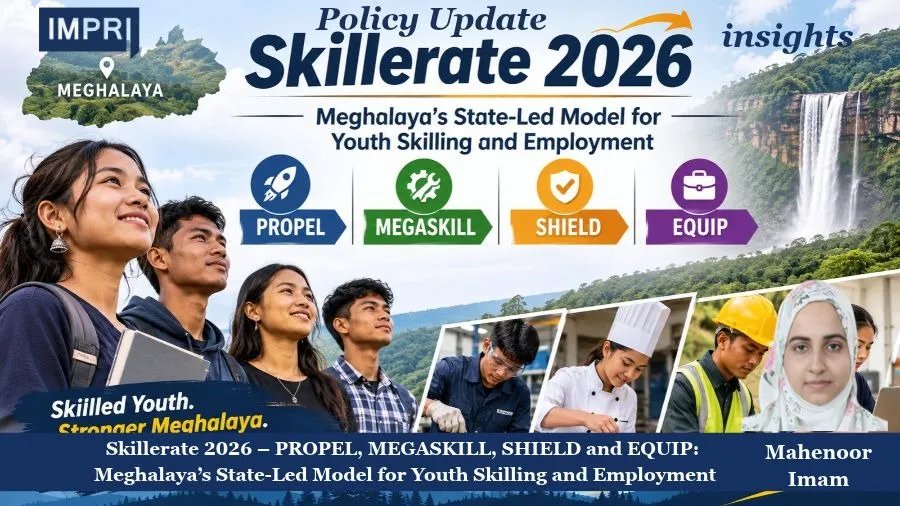
Policy Update
Mahenoor Imam
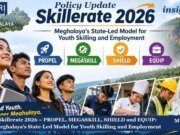
Meghalaya launched four state-designed skilling schemes worth over ₹50 crore at Skillerate 2026 (May 2026) to turn training into livelihoods for the roughly 60,000 young people who join its workforce every year.
Background
The four schemes were launched by Chief Minister Conrad K. Sangma on 13 May 2026 at Skillerate 2026, NEHU, Shillong. The event was organised by the Department of Labour, Employment and Skill Development (LESD) with the Meghalaya State Skill Development Society (MSSDS) and Skills Meghalaya. A second leg at Tura on 21 May 2026 began disbursement. All four sit under the umbrella of Skills Meghalaya and the Chief Minister’s Skills Mission, announced in the State Budget 2025-26 (PRS Budget Analysis 2025-26).
Need of the scheme:
- Demographic pressure: nearly half of Meghalaya’s population is under 20, and about 60,000 young people enter the workforce every year (DIPR PR No. 81/26).
- Youth unemployment: PLFS 2022-23 put youth (15–29) unemployment in Meghalaya at about 18%, against roughly 10% for India. The State Government cites other data showing a declining trend; registered unemployed youth fell from 31,374 (2018) to 18,757 (2024).
- Distress migration: the CM framed the goal as avoiding “any form of forceful migration to get jobs.”
- Gaps in central schemes: the CM said several centrally sponsored skilling schemes did not deliver the desired outcome locally, so the State chose to design and fund its own programme that it can adjust.
- The post-training gap: trainees reported, through the CM Connect feedback platform, that they finished courses but lacked the tools to start working.
Timeline:
| Date | Milestone |
| March 2025 | State Budget 2025-26 announces the CM’s Skills Mission: 1 lakh youth for the local economy, 10,000 for the national and 5,000 for the global economy over three years. |
| June 2025 | Revamped CM Skills Mission launched for 2025-26, targeting about 23,000 candidates |
| Feb 2026 | Budget 2026-27: Rs 241 crore for entrepreneurship, skills and innovation, target of 70,000 more youth trained by 2028 |
| May 2026 | First PROPEL toolkits and Rs 16.59 crore in training work orders |
| FY 2026-27 | Targets of 30,000 candidates trained |
| 2028 | MEGASKILL’s goal: Meghalaya youth at the WorldSkills Competition, Japan |
Key provisions and beneficiaries
| Scheme | What it does | Target Beneficiaries | Key provisions |
| PROPEL | Support after training | Certified Trainees (about 21,000) | Rs 9000 toolkits, mobility aids, salary top up |
| MEGASKILL | Path to Global skill competition | High performing trainees | Contests, advanced training, cash awards, etc |
| SHIELD | Skilling for care work | Youth entering caregiving and home support jobs | Certified care training, placement (India and abroad), welfare |
| EQUIP | Inclusive skilling | Persons with disabilities, children in institutional care, inmates, domestic workers, marginalized labour communities | Tailored courses for excluded groups |
The schemes are new, with no amendments yet. They build on the CM’s Skills Mission (2025), which was revamped in July 2025 to judge success by jobs and earnings, not just course completions.
Functioning
- The schemes run on a state-owned chain: the Labour, Employment and Skill Development department (LESD) sets policy, the Meghalaya State Skill Development Society (MSSDS) implements, and local training partners deliver in the districts (DIPR PR No. 81/26).
| Level | Who | Role |
| Policy | LESD and its Directorate of Employment and Craftsmen Training | Nodal department; runs ITIs and skill competitions |
| Implementation | MSSDS, with district skill committees | Issues work orders, empanels partners, certifies trainees, runs district calls |
| Delivery | 136+ training partners; about 150 local providers formed since COVID-19 | Free training in districts |
| Convergence | Planning Dept. (ADB project), Commerce & Industries (TIOS scheme), PRIME and CM ELEVATE | Funding, training outside the State, enterprise support |
MSSDS issues district work orders → youth are trained free and certified → PROPEL gives toolkits, mobility and salary support, or market links. MEGASKILL picks top performers through contests; SHIELD and EQUIP run as targeted tracks. In the Garo Hills alone, 34 work orders worth ₹16.59 crore will train 4,830 youth (India Today NE, 21 May 2026). .
Skills Meghalaya is designed and funded by the State, not a centrally sponsored scheme. About half its money comes from ADB’s Supporting Human Capital Development in Meghalaya – Phase 2 loan ($64 million). The CM says the Centre repays nearly 80% of that share. Budget 2026-27 adds ₹241 crore for entrepreneurship, skills and innovation. 798 PROPEL toolkits have been handed out at Tura, and FY 2026-27 aims to train 30,000 (India Today NE). Construction of the Skills and Innovation Hub at New Shillong has begun. No enrolment data is public yet for MEGASKILL, SHIELD or EQUIP.
Performance
The four schemes are six months old, so their performance is judged against the Skills Meghalaya programme they build on (about 2021–2026). The record shows training at scale, but only about one in four trained youth has reached a recorded livelihood. That gap is the reason PROPEL exists (Budget Speech 2026-27).
The Budget Speech 2026-27 reports 716 training centres training over 51,000 youth in four years. The CM’s Skills Mission alone has trained 30,000 since 2025, and the State aims for 70,000 more by 2028 (Budget Speech 2026-27). Enrolments across all programmes total about 1.58 lakh through more than 136 training partners (India Today NE, 22 May 2026).
Outcome analysis: from training to livelihood.
Source- Govt of Meghalaya, Budget Speech 2026-27, cited by author.
Self-employment, not wage jobs, accounts for most outcomes. That is why PROPEL concentrates on toolkits and market linkages.
Financial efficiency
The State reports investing nearly ₹80 crore in the Meghalaya Skills Programme over the last three years. It estimates that trained youth earned about ₹150 crore in the same period (Morung Express (IANS); Sentinel Assam). That works out to roughly ₹1.9 earned for every rupee spent (author’s calculation). Spending is about ₹40,000 per trainee (Oh Meghalaya). The earnings figure is the State’s own estimate; no independent evaluation of it was found in public sources.
Comparative analysis: labour market context

Source- PLFS 2022-23, MOSPI in the Shillong Times, cited by author.
The State Government argues that Meghalaya’s unemployment rate is below the national average. Citing PLFS data averaged over roughly 2017–2024, the Deputy Chief Minister put Meghalaya’s average unemployment rate at about 2.92%, against a national average of 4.7%. The age group and measure (usual status or current weekly status) were not specified (Syllad, 27 Aug 2024; EastMojo, 28 Aug 2024). Registered unemployed youth on the live register fell from 31,374 in 2018 to 18,757 in 2024 (Labour Minister, Assembly, Mar 2025). The registers count only those who sign up, so they are a weak measure of unemployment. A Lok Sabha question in 2024 listed Meghalaya among states with unemployment above the national average (Lok Sabha Unstarred Q. 144).
Meghalaya placed 60 nurses overseas in Japan and Singapore by February 2026, each remitting about ₹1 lakh a month (Budget Speech 2026-27). About 19 tourism trainees were placed at a five-star hotel in Mumbai (MSSDS, via Oh Meghalaya). Businesses supported under PRIME and CM ELEVATE have created over 15,000 jobs across 4,500 enterprises since 2018 (Budget Speech 2026-27, para 3.6.1). The State reports 3.6 lakh livelihood opportunities created between FY19 and FY25 (ThePrint, PTI). About 150 local training providers have emerged since COVID-19 (DIPR).
Impact
The model has built a strong local skilling base but has only partly turned training into livelihoods. Most evidence so far is the State’s own data.
- Livelihood conversion– the share of trained youth who move into a recorded job or self-employment is partly met. About 13,100 of roughly 51,000 trained youth (about 26%) reached a livelihood: 10,300 in self-employment and 2,800 in wage jobs. PROPEL is designed to raise this share (Budget Speech 2026-27).
- Income gains– extra earnings of trained youth compared with public money spent are promising but unverified. The State estimates trainees earned about ₹150 crore against ₹80 crore invested over three years, at about ₹40,000 per trainee. No independent audit has checked this (Morung Express (IANS); Oh Meghalaya).
- Safe and global mobility– regulated jobs outside the State or abroad, as distinct from distress migration shows early results. Sixty nurses work in Japan and Singapore, each remitting about ₹1 lakh a month. The State targets 10 overseas placements from every block within two years, and MEGASKILL aims at WorldSkills 2028. Migration itself is not yet tracked against any baseline (Budget Speech 2026-27).
- Inclusion– reaching groups usually left out of skilling, persons with disabilities, inmates, children in institutional care, domestic workers is too early to judge. EQUIP and SHIELD launched in May 2026, and no enrolment data is public yet.
- Ecosystem strength– the capacity of local providers, infrastructure and finance to sustain the programme is largely met. About 150 local training providers have emerged since COVID-19, and the Skills and Innovation Hub at New Shillong is under construction. The Youth Budget rose 45% to ₹4,824 crore (Budget Speech 2026-27). The ADB Phase 2 project is under way, though ADB’s review of Phase 1 found implementation delays (ADB monitoring report, Apr 2026).
Emerging Issues
The central risk is that spending is growing faster than the evidence of what it achieves. Five issues stand out, each with a remedy.
- The conversion gap and thin local demand- Self-employment makes up nearly four in five recorded livelihoods (10,300 of 13,100) (Meghalaya Monitor). A ₹9,000 toolkit without credit, workspace or buyers may not sustain a business, and Meghalaya’s industrial base is small.
- Unclear and loan-dependent financing- The State says Meghalaya’s unemployment is below the national average. In the Assembly in August 2024, the Deputy Chief Minister cited PLFS data averaged over 2017–2024: 2.92% for Meghalaya against 4.7% for India (age group not specified). He added CMIE figures showing a fall from 8.8% (2017-18) to 1.9% (2021-22) (Syllad; EastMojo). PLFS 2022-23, however, puts Meghalaya at 6% against India’s 3.2%, and youth unemployment at 18% against 10% (The Shillong Times). The gap depends on the source and year used, so the State needs one agreed baseline to judge its schemes.
- Counting outputs, not outcomes- Public data counts trainees, certificates and toolkits, not job retention, earnings or business survival. The ₹150 crore earnings figure is unverified (Morung Express (IANS)). Unemployment data from PLFS, the State and the live register also disagree, and skilling is spread across four departments with no shared register of beneficiaries.
- The migration paradox and worker protection- The goal is to end “forceful migration”, yet placements in Mumbai, Japan and Singapore are counted as successes (DIPR PR No. 81/26). SHIELD’s care workers, many in private homes, need enforceable contracts and grievance routes.
- Inclusion and delivery capacit- EQUIP has no published budget for accessible centres or specialist trainers. More than 716 centres across hill districts are hard to monitor (Budget Speech 2026-27), and ADB found Phase 1 of its project was delayed by weak capacity.
Way Forward
The remedies above fix today’s gaps. The five suggestions below are new ideas that could carry the model into the State’s Vision 2032 “Meghalayan Decade” (Budget Speech 2026-27).
- Skill Wallet- Give each young person a digital credit, linked to DigiLocker certificates, to spend at any accredited provider. Choice by trainees would reward the providers with the best placement results.
- Green skills track- Tie skilling to the State’s ₹5,572 crore Climate Budget 2026-27 (IANS via NewKerala). Train solar technicians, watershed and forest workers, and eco-tourism guides.
- Global language and care corridors- Expand the existing German and Japanese language training (Govt. of Meghalaya, May 2025) into government-to-government agreements with ageing economies. These would set fixed quotas and protections for caregivers and nurses.
- Homecoming Fund- Offer start-up grants and mentoring to workers who return from other states or abroad, so their savings and skills create local businesses.
- Labour-market intelligence unit- Use job-portal, EPFO and GST data to forecast district-level demand each year and redesign courses accordingly.
Conclusion
Skillerate 2026 marks Meghalaya’s move from implementing central skilling schemes to designing its own. PROPEL closes the post-training gap, MEGASKILL raises ambition, SHIELD opens the care economy, and EQUIP widens inclusion. The next step could be one integrated scheme, a possible Meghalaya Lifelong Skills Mission. It would give every young person a Skill Wallet, a verified record of livelihood outcomes, and safe routes to jobs at home or abroad. With transparent data and local job creation, Meghalaya could show how state-designed skilling, backed by central standards and finance, turns a young population into a demographic dividend for Viksit Bharat 2047.
Here they are in your format (Author. (Year). Title. Publishing details), with the publishing details as the hyperlink. Copy from the formatted text below, not a code block, so the links and italics come with it into Word or Google Docs:
References
- Asian Development Bank. (2026). India: Supporting human capital development in Meghalaya (Phase 2) project – Social monitoring report. Semiannual report, April 2026, Asian Development Bank. https://www.adb.org/sites/default/files/project-documents/46166/46166-003-smr-en_0.pdf
- Directorate of Information and Public Relations, Government of Meghalaya. (2026). Skillerate 2026: Meghalaya bets on skills economy as 60,000 youth enter the workforce every year. Press Release No. 81/26, 13 May 2026, DIPR Meghalaya. https://megipr.gov.in/pr/PR-2026-05.html
- Government of Meghalaya, Finance Department. (2026). Budget speech 2026-27. Delivered 23 February 2026, Finance Department, Government of Meghalaya. https://megfinance.gov.in/budget_documents/2026-2027/others/budget_speech.pdf
- IANS. (2026). Meghalaya launches four major skill initiatives to strengthen employment, livelihood opportunities for youth. Morung Express, 13 May 2026. https://morungexpress.com/meghalaya-launches-four-major-skill-initiatives-to-strengthen-employment-livelihood-opportunities-for-youth
- India Today NE. (2026). Meghalaya targets future-ready workforce as CM Conrad Sangma launches Skillerate 2026 in Tura. India Today NE, 21 May 2026. https://www.indiatodayne.in/meghalaya/story/meghalaya-targets-future-ready-workforce-as-cm-conrad-sangma-launches-skillerate-2026-in-tura-1395275-2026-05-21
- PRS Legislative Research. (2025). Meghalaya budget analysis 2025-26. PRS Legislative Research, New Delhi. https://prsindia.org/budgets/states/meghalaya-budget-analysis-2025-26
- The Shillong Times. (2024). The inadequacy of measures of unemployment. The Shillong Times, 10 September 2024. https://theshillongtimes.com/2024/09/10/the-inadequacy-of-measures-of-unemployment
About the Contributor
Mahenoor is a postgraduate in Political Science from University of Calcutta, Kolkata. She is a former UPSC Civil Services Aspirant. Her interests lie in governance, social equity and welfare policy, with a focus on the gap between policy design and on-ground implementation.
Acknowledgement
The author is grateful to the Impact and Policy Research Institute (IMPRI), New Delhi, for the opportunity to prepare this policy brief and for its guidance and support throughout. The author also thanks the reviewers for their valuable comments and suggestions, which helped improve the quality and clarity of this work. Any errors or omissions remain the author’s own.
Reviewers
Shiva Karthik and Aditya Chavan
Disclaimer
All views expressed in the article belong solely to the author and not necessarily to the organization.
Read More at IMPRI :
Rebuilding Trust in Public Recruitment: West Bengal’s One Lakh Jobs Drive under Budget 2026-27