






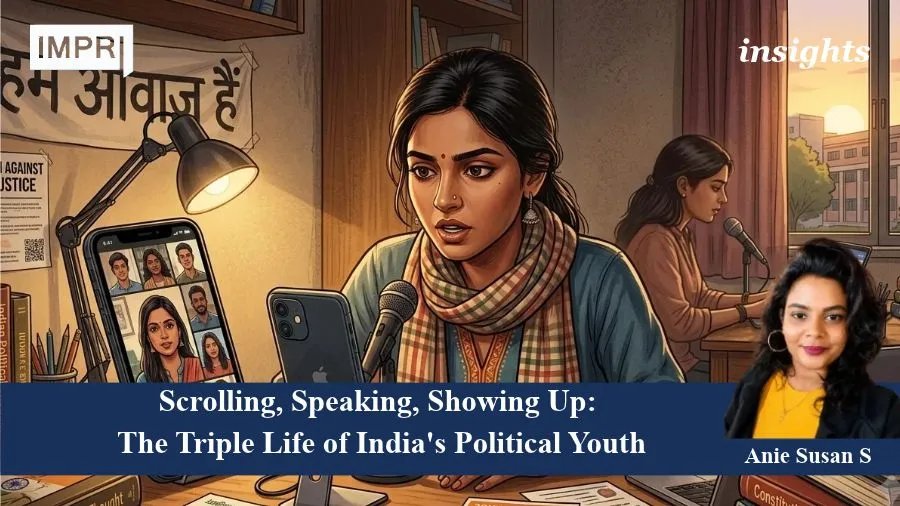
Anie Susan S
Introduction
The persistent narrative of youth apathy towards politics has become empirically untenable in contemporary India. Contrary to the perception of a depoliticized, digitally distracted generation, evidence suggests a profound transformation in youth political engagement. Young Indians, particularly those in the 18-35 age cohort comprising Gen Z and young Millennials, are not disengaged; rather, they are redefining the very nature of political participation. Their concern is not peripheral but central, and their vocalness is not anecdotal but structural. This shift is driven by material insecurities, digital mediation, and a critical civic consciousness that challenges traditional forms of political mobilization.
The Structural Roots of a Hyper-Political Generation
The politicization of contemporary youth must be understood within its specific historical and economic conjuncture. Unlike previous generations for whom politics was largely an episodic electoral exercise, for today’s youth, politics is an everyday lived reality.
This cohort has come of age amidst a series of systemic ruptures: demonetization, the COVID-19pandemic and its unequal impact on education and employment, the CAA-NRC movement, the farmers’ protests, recurrent recruitment examination paper leaks, and an escalating climate crisis.
Digital Mediation: The Smartphone as a Site of Political Socialization
The defining characteristic of this new political consciousness is its mediation through digital technology. With over 800 million internet users in India, the smartphone has emerged as a de facto parliament, archive, and public sphere for youth.From the perspective of political socialization theory, social media platforms have supplemented, and
in some cases supplanted, traditional agents such as family, party, and educational institutions.
a) As a Pedagogical Tool: Youth increasingly bypass mainstream prime-time debates in favour of independent digital journalism, data-driven explainers on platforms like YouTube and Instagram, and threaded analyses on X [formerly Twitter]. Concepts such as fiscal federalism, the implications of the four Labour Codes, and electoral populism are being learned through peer-produced content, fostering a more critical and data-literate political literacy.
b) As a Discursive Space: Digital platforms have drastically lowered the entry barriers to political discourse. The ability to directly question elected representatives, tag ministries to demand accountability regarding recruitment scams, and initiate nationwide hashtag campaigns has democratized voice. This affords youth a sense of political efficacy that was previously inaccessible.
c) As a Mobilizational Infrastructure: The organizational logic of recent youth-led mobilizations illustrates this shift. Movements ranging from anti-CAA protests [2019-20], climate justice campaigns by Fridays for Future India, to solidarity mobilizations around NEET and CUET irregularities, have relied less on formal student party structures and more on decentralized, networked organization facilitated by Instagram posters, Google Forms, and encrypted messaging. Vocalness, therefore, is not merely expressive but instrumentally mobilizational.
These events have demonstrated the direct consequences of policy decisions on their life chances.The most significant driver is the crisis of educated unemployment. The India Employment Report 2024, jointly published by the International Labour Organization [ILO] and the Institute for Human Development [IHD], reports graduate unemployment at 29.1%, starkly higher than 3.4% among the illiterate. Periodic Labour Force Survey [PLFS] 2023-24 further indicates urban youth unemployment exceeding 10%. For a generation that has invested heavily in formal education, this structural mismatchbetween degrees and dignified employment transforms unemployment from an economic indicator into an existential question of dignity and social mobility. Consequently, their political concern is not abstract idealism but a rational response to precarity.
Thematic Concerns: Beyond the Employment Paradigm
While employment remains the fulcrum, youth political concerns exhibit considerable thematic diversity, reflecting an intersectional understanding of governance.
First, Employment and the Dignity of Labour: The demand is not merely for jobs but for productive,formal, and meaningful employment. Youth critique the political economy of employment governance, questioning whether schemes like Rozgar Melas and Skill India represent structural reform or what can be termed as “employment visibility” – a populist strategy privileging transient, optical job creation over sustainable industrial policy. Their discourse interrogates the failure of the skill-education-industry nexus.
Second, Education as a Contested Domain: Education is perceived as a primary site of political
contestation. Debates around the National Education Policy [NEP] 2020, exponential fee hikes in central universities, the rationalization of scholarships, and curricular revisions are interpreted as directly impacting their social mobility. The university thus becomes a crucial site for political articulation.
Third, Identity, Social Justice and Intersectionality: This generation demonstrates a heightened fluency in discourses of caste, gender, and social justice. Drawing from Ambedkarite, feminist, and subaltern perspectives, they engage with questions of representation, substantive equality beyond formal reservation, mental health, and LGBTQ+ rights. Social justice is thus re-framed from a constitutional principle to a lived, everyday negotiation.
Fourth, Climate and Intergenerational Justice: Unlike previous cohorts, this generation articulates a clear link between local governance failures – such as urban flooding, air pollution in metropolitan cities like Bangalore and Delhi, and water scarcity – and global climate governance. Climate change is increasingly viewed as a political and electoral issue, reflecting an intergenerational justice framework.
Fifth, Demand for Accountability and Data Transparency: Socialized in an era of the Right to
Information Act, open data portals, and fact-checking initiatives, this cohort exhibits low tolerance for purely rhetorical politics. Their recurrent demand to “show the data” signifies a shift towards evidence- based citizenship, where PLFS data, budget documents, and National Family Health Survey [NFHS] statistics are routinely invoked to counter official narratives.
The New Repertoire of Vocalness
The manner in which youth express dissent has also evolved, creating a new repertoire of contention.
a) Memetic Satire as Political Critique: Internet memes function as contemporary political cartoons.Utilizing irony, humour, and pop-cultural references, memes serve as a potent tool for deconstructing dominant political narratives in a highly shareable format, often circumventing censorship through coded humour.
b) Long-Form Engagement and Deliberation: Contrary to assumptions of short attention spans, there is significant engagement with long-form political content. The popularity of political podcasts and detailed YouTube analyses of complex issues like electoral bonds or labour reforms indicates a desire for substantive, nuanced deliberation beyond 280 characters.
c) From Petitioning to Calling Out: The political language has shifted from deferential petitioning to direct accountability-seeking. Rather than merely requesting intervention, youth actively call out tokenism, misinformation, and performative welfarism. This signifies a transition from being subjects of governance to active auditors of governance.
d) The Hybridity of Online-Offline Action: Digital engagement does not signify the end of physical politics. Campus elections in institutions like Jawaharlal Nehru University [JNU], Delhi University, and University of Hyderabad, as well as street mobilizations in regions like Puducherry where youth debate colonial legacies and federal identity, demonstrate that digital mobilization is complemented by embodied, offline presence.
Conclusion: Critical Citizenship in Practice
Today’s youth embody a paradox that is best understood through the lens of critical citizenship. They exhibit deep cynicism toward traditional institutions, political parties, mainstream media, and even electoral processes, while simultaneously displaying remarkable optimism and agency in collective action.
Their partisanship is not traditional or inherited; it is conditional, issue-based, and volatile. Loyalty is extended based on positions on specific issues rather than unconditional party affiliation. This makes them an unpredictable yet powerful political constituency.
Therefore, to frame young Indians as the future of Indian democracy is analytically inaccurate. They are its present. They are concerned because contemporary policy decisions have immediate, material consequences for their futures, and they are vocal because digital democracy has provided them with unprecedented tools to articulate that concern without mediation.
For scholars of political science, policymakers, and political actors, the implication is clear: this generation cannot be managed through symbolic gestures or populist spectacles. It demands institutional reforms, data transparency, and substantive employment governance. It has already taken the microphone, and it intends to be heard.
References
- Altbach, P. G., & Klemencic, M. (2024). Student activism and politics in a changing world.
Johns Hopkins University Press. - Bennett, W. L., & Segerberg, A. (2013). The Logic of Connective Action: Digital Media and
the Personalization of Contentious Politics. Cambridge University Press. - Bhatt, A., et al. (2023). Youth and digital democracy in India. Economic and Political Weekly,58(15).
- Fridays for Future India. (2023). Climate Justice and Youth Mobilization Report.
- Government of India. (2024). Periodic Labour Force Survey [PLFS] Annual Report 2023-24.
Ministry of Statistics and Programme Implementation. - International Labour Organization & Institute for Human Development. (2024).India
Employment Report 2024: Youth Employment, Education and Skills. ILO. - Internet and Mobile Association of India. (2024). Internet in India Report 2024. IAMAI &
Kantar. - Jaffrelot, C., & Verniers, G. (2020). The reconfiguration of India’s political elite. India Review,19(1).
- Jeffrey, R., & Doron, A. (2020). Cell Phone Nation. Hachette India.
- Malhotra, S., & Chatterjee, S. (2022). Memes as political speech in India. Journal of Digital Culture, 6(2).
- Mehrotra, S. (2020). Informal employment trends in India. Economic and Political Weekly,55(21).
- Ministry of Statistics and Programme Implementation. (2024). Periodic Labour Force Survey.
- Nambissan, G., & Rao, S. (2023). Sociology of Education in India. Oxford University Press.
- Norris, P. (1999). Critical Citizens: Global Support for Democratic Government. Oxford
University Press. - Rege, S. (2022). Caste, Gender and Intersectionality in Indian Youth Movements. Sage.
About the Author
Anie Susan is a fellow at Data Analysis for Policy Research Fellowship, IMPRI, and she holds a degree in M.A. in Political Science from Pondicherry University
Read More at IMPRI
Biotechnology Research Innovation and Entrepreneurship Development (Bio-RIDE), 2024
AyushSuraksha: Digital Surveillance and Data-Driven Regulation in the Ayush Sector