



Policy Update
Arjya Shree Pande
Background
The department of Non Resident Keralites Affairs (NORKA) was established by the Government of Kerala on 6th December 1996 as India’s first dedicated state level institution to address the grievances, safeguard the rights and promote the welfare of Non Resident Keralites (NRKS) living or working outside the state, both within India and abroad. Its field agency NORKA Roots, was created in 2002 as a public sector undertaking to serve as the operational interface between NRKs and the state government, implementing welfare schemes, facilitating safe migration, providing legal emergency support, and aiding the rehabilitation of returnees.
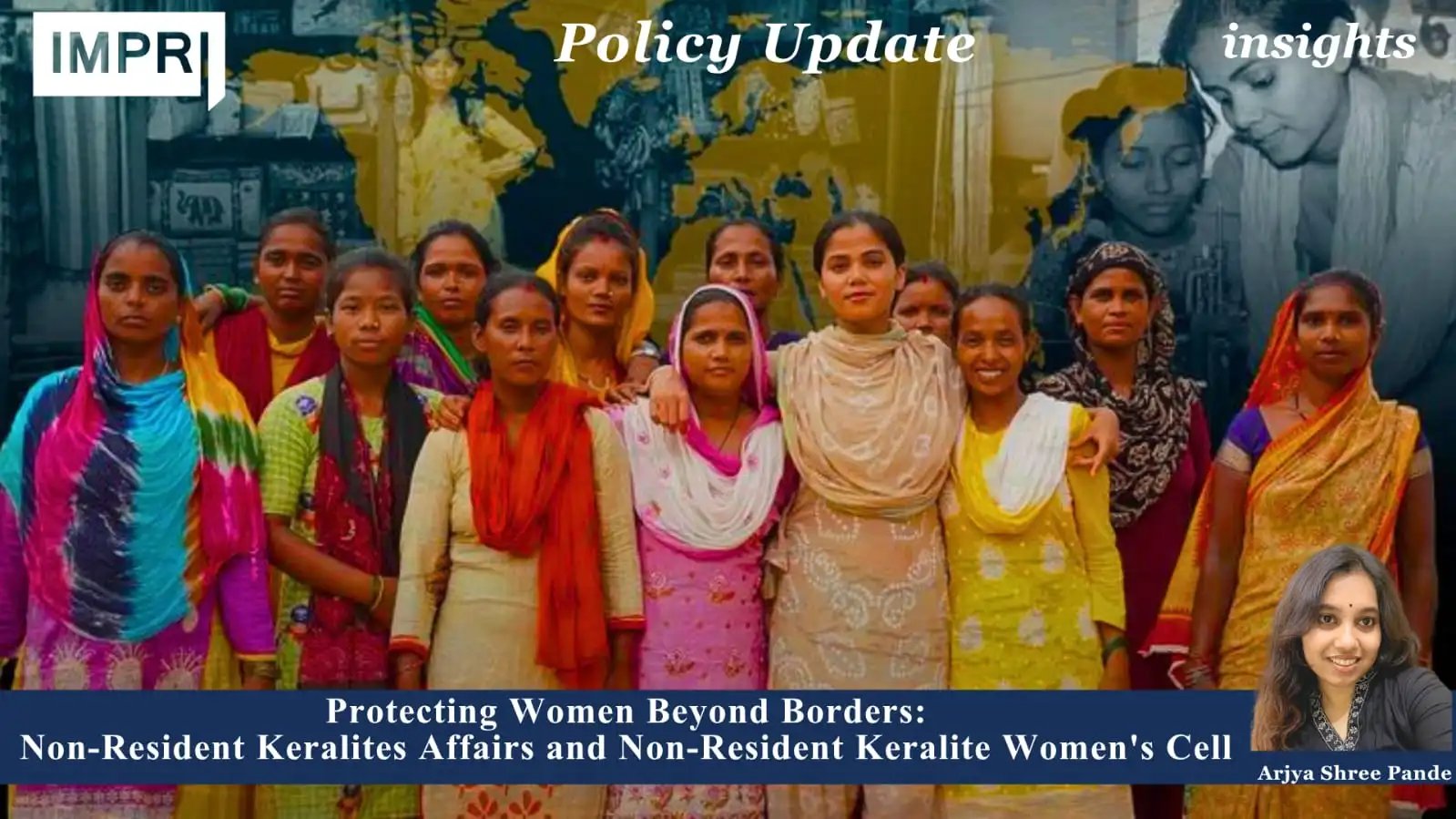
The NRK Women’s cell was established at the headquarters of NORKA Roots in Thiruvananthapuram as a major initiative recommended by the Loka Kerala Sabha (LKS). It was launched in August 2019 to create a dedicated single window system specifically for Malayali women abroad (NORKA Roots, n.d.). This responded to the growing volume of female migration particularly of domestic service workers to Gulf Cooperation Council (GCC) countries and the distinct vulnerabilities these women face, including non payment or delayed wages, unauthorised retention of passports, ill treatment and harassment, irregular or fraudulent recruitment, employment contract violations (Thimothy, 2022). Many such migrants travel through informal channels limiting official oversight and data availability, which heightens their exposure to exploitation.
The core rationale is therefore to institutionalise gender sensitive protection within Kerala’s broader migration governance framework. By providing an accessible, women centred channel, the cell aims to ensure safe and secure migration, raise awareness of rights and responsibilities, and deliver timely grievance resolution. Its objectives include acting as a streamlined platform that enables women to correspond with the Government of Kerala, Indian missions abroad, and other relevant authorities, thereby facilitating resolution of workplace vulnerabilities and complementing NORKA Roots existing pre departure orientation, legal aid and welfare services.
Target beneficiaries are primarily expatriate Malayali women residing or working overseas, with particular attention to domestic workers and those in distress situations involving visa or passport issues, wages, contracts, confinement or harassment (NORKA Roots, n.d.).Family members in Kerala may also approach the cell on their behalf and services are free of charge.
Functioning
The NRK Women’s Cell operates as a dedicated single window grievance resolution mechanism under NORKA Roots. Distressed Malayali women abroad, or their family representatives in Kerala, access services primarily through a 24/7 hotline, email, WhatsApp or written petitions addressed to the Chief Executive Officer Of NORKA Roots (NORKA Roots, n.d.).
A woman nodal officer handles interactions to ensure comfort and confidentiality. Upon receipt complaints typically involving visa or passport problems, wage non payment, contract violations, confinement, harassment or repatriation barriers are registered, acknowledged within 3 working days and escalated to Indian missions abroad, host country authorities or the Pravasi Legal Aid Cell as required. Resolution timelines vary with case complexity and all services remain free of charge.
Institutionally, the Cell sits within NORKA Roots, a section 25 public sector company that functions as the field agency of the NORKA department. It reports to the CEO of NORKA Roots and coordinates with the department’s broader ecosystem, including the Global Contract Centre, legal aid mechanisms, and pre departure orientation programs. Implementation relies on inter agency liaison rather than independent field offices abroad, the Cell channels petitions and monitors progress without direct enforcement powers in destination countries.
It draws from the general budget allocation of NORKA Roots and the NORKA department under state plan heads. NORKA roots itself generates operational revenue through services such as certificate attestation and recruitment facilitation, supplemented by annual state grants.
Progress remains modest and largely reactive. After a 2024 relaunch emphasising 24/7 accessibility, approximately 20 complaints were registered in the immediate period (The Hindu, 2024). Secondary literature and official statements highlight persistent concerns that the predominance of irregular domestic worker migrants limits database coverage and protective outreach. Effective resolution depends heavily on cooperation from foreign governments and missions. Under reporting continues due to fear or lack of awareness, and the mechanism remains more responsive than preventive. These constraints underscores the Cell’s value as an accessible entry point while revealing the need for stronger data systems, expanded preventive measures and deeper bilateral engagement to enhance its protective reach.
Key provisions include a 24/7 dedicated hotline missed call service from abroad: +91 88020 12345, a toll free from India: 1800 425 3939, email – womencell.norka@Keral.gov.in and the option to submit petitions addressed to the Chief Executive Officer of NORKA Roots (NORKA Roots, n.d.). Complaints are processed through escalation to embassies or the Pravasi Legal Aid Cell as needed, with a woman nodal officer to facilitate confirmed comfortable interaction. The platform was further strengthened and publicly reemphasised in August 2024 amid rising grievance numbers, and continues to be supported by awareness workshops and integration with NORKA’s wider safe migration programs.
Performance
Over the last 2 to 5 years, the performance of NRK Women’s Cell and the broader NORKA Roots framework in supporting migrant women has been marked by institutional consolidation and expanding fiscal commitment, yet it is constrained by limited publicly available outcome metrics and persistent operational challenges.
Budgetary evidence indicates substantial growth in the parent department’s resources. Kerala’s allocation for NORKA rose from approximately ₹25.4 crore in 2016 to 17 to ₹150.81 crore in 2025 to 2026, which highlights rising state prioritization of diaspora welfare, including gender specific measures (Kerala State Planning Board, 2026). The 2025 – 26 state budget was ₹150.81 crore for NORKA Roots initiatives, with significant portions directed toward rehabilitation of returnees and welfare assistance.
Loka Kerala Sabha related plan allocations have supported secretariat functions, diaspora engagement, and awareness activities that indirectly strengthen the Women’s Cell. Alongside schemes such as NORKA Department Project for Returned Emigrants (NDPREM), it has supported 8,904 entrepreneurial ventures as of 2024–25, with cumulative disbursements of ₹120.4 crore (Kerala State Planning Board, 2026). NDPREM was supported under the Santhwana scheme. Santhwana is a welfare scheme implemented by NORKA, the scheme is mainly meant for returnees, whose annual family income does not exceed a prescribed limit, mentioned as rupees 1.5 lakh.
Under the Santhwana scheme, cumulative disbursement reached ₹188.8 crore to 38,606 beneficiaries, with 4,748 beneficiaries in 2024–25 (Kerala State Planning Board, 2026).
Kerala development reports 2026 positions NORKA as India’s pioneering comprehensive migration governance model covering pre departure, in-destination and return phases.
However, secondary literature and RTI based assessment highlight gaps. Independent evaluations of NORKA programs have described many initiatives as statements of intent rather than fully effective interventions, citing historically modest fund utilization relative to NRK contributions to the state economy, staff constraints and limited long term impact tracking.
No detailed programme MIS dashboards, CAG performance audits, or comprehensive Parliamentary Committee quantifications of Women’s Cell caseloads, resolution rates, or gender disaggregated outcomes for 2021 to 2025 appeared in the public domain. Comparative analysis with other Indian states shows Kerala remaining ahead in institutionalising diaspora focused women’s protection. However, the absence of systematic trend data on complaint volumes, resolution times or prevention of irregular migration for domestic workers’ limits rigorous assessment of effectiveness.
On a sectorial basis, performance is stronger on accessibility and responsiveness than on preventive reach or measurable reduction in vulnerabilities, particularly for irregular female migrants. Overall while fiscal expansion and operational continuity demonstrate commitment, the lack of robust public reported outcome indicators constraints of full evidence based evaluation of the Cell’s impact over recent periods.
Impact
The NRK Women’s Cell, has partially achieved its core objectives of promoting safe migration, raising awareness of rights and providing accessible grievance resolution for Malayali women abroad, though systematic limitations constraint fuller impact. Official statements and news reports indicate that the Cell has created a functional single window channel.
After its 2024 strengthening of 24/7 helpline access, complaints primarily from domestic workers in the Gulf concerning wages, passport retention, harassment and repatriation have been registered. Broader NORKA efforts, including expanded pre departure orientation training numbers increasing from 750 to 1,000 to 2,250 candidates in 2024, have contributed to safer pathways, particularly for nurses and supported returnee women through skill programs and micro enterprise assistance.
Research studies and expert analysis offer a more measured assessment. Early evaluations of NORKA Roots (Rajan, 2012) identified a low public awareness as a major barrier to program reach.
Later reviews (Harilal and Akhil,2017) characterised many NORKA interventions as statements of intent rather than consistently effective actions, citing modest funding relative to diaspora contributions, staff constraints and limited long term planning. Studies on women domestic workers (Timothy/CSES; kodoth) highlight persistent vulnerabilities linked to irregular channels and the need for sustained, regular pre-departure and skill training areas where NORKA has engaged but not fully scaled. Recent literature notes that while the Cell improves responsiveness, the absence of a comprehensive data basis for irregular migrants, dependence on host country for cooperation, and scarcity of outcome metrics limit demonstrable reductions in vulnerability.
News coverage and expert commentary acknowledge the Cell’s values as an accessible entry point in Kerala’s relative leadership among Indian states, yet emphasise that impact remains stronger on reactive support than on preventive transformation.
Emerging Issues
Several significant concerns emerge from the analysis of the NRK Women Cell’s and the broader NORKA roots framework for safeguarding migrant women.
Data and monitoring gaps remain prominent – Publicly available MIS data, resolution rates, gender disagreed outcomes and long term impact indicators for the Cell are scarce. Without systematic tracking of complaint volumes, resolution timelines, or prevention metrics particularly for irregular domestic workers, evidence based evaluation and adaptive policy making are constrained.
Reach and inclusion challenge persists – A large share of vulnerable women migrants, especially domestic workers in the gulf, travel through informal channels and remain outside official databases (Thimothy, 2022; The Hindu, 2024).This limits proactive outreach, awareness of the helpline and the Cell’s ability to intervene before exploitation occurs. Awareness levels among potential beneficiaries continue to be uneven, reducing uptake of available support.
Reactive rather than preventive orientation characterises – The single window system improves accessibility for those who contact it, structural factors of vulnerability, fraudulent recruitment, weak enforcement of contracts abroad and limited bilateral labour protections are only partially addressed. Dependence on the host country cooperation and Indian missions abroad further restricts enforcement capacity.
Institutional and coordination limitations are evident – The cell operates within NORKA Roots without independent field presence overseas and relies on interagency escalation. Staffing constraints, historical underfunding relative to the scale of Kerala’s diaspora, and the absence of dedicated resources for gender specific migration protection can dilute sustained focus. Coordination with central agencies, embassies and civil society organisations, though improving remains incomplete.
Accountability and transparency issues – As there is limited independent evaluation, spares public reporting of outcomes and the lack of clear performance benchmarks. Without regular third party reviews or Comptroller and Auditor General (CAG) style audits focused on the Cell’s effectiveness, learning and course correction are hindered.
Way Forward
To strengthen the NRK Women’s Cell and NORKA ROOTS’ contribution to the safe migration and women’s protection, several practical and strategic measures are recommended.
Strengthening data systems and real time monitoring
Establish a robust, gender disaggregate Management Information System with publicly accessible dashboards tracking complaint volumes, resolution rates, timelines and outcomes. Integration with national platforms such as eMigrate and state databases would enable real time monitoring, early warning alerts for high risk corridors and evidence based resource allocation. This aligns with India’s Digital India and data driven governance priorities.
Expensive preventive outreach and inclusive awareness
Regular, mandatory pre departure orientation and skills training for domestic workers and other vulnerable categories should be scaled through local self governments, nursing colleges and community networks. Targeted awareness campaigns in high migration districts, using regional languages and digital platforms, can raise knowledge of rights and the Cell’s helpline. Partnerships with civil society organisations experienced in domestic worker issues would improve reach among irregular migrants.
Enhancing institutional capacity and bilateral cooperation
Dedicated staffing for the Women’s cell, including women officers and legal specialties, should be ensured. Stronger coordination protocols with Indian missions, host country authorities and central agencies can improve enforcement of contracts and timely repatriation. Kerala can leverage its pioneering model to advocate for gender sensitive bilateral labour agreements that incorporate grievance mechanisms and social protection.
Improving accountability and sustainable financing
Creating allocations within the NORKA budget for gender specific migration protection, combined with independent impact evaluation every 2 years, would improve transparency and learning. Linking outcomes to Sustainable Development Goals (SDG 5 on gender equality and SDG 8 on decent work) and national priorities such as women’s domestic empowerment and safe mobility would reinforce Cell’s development relevance.
Advancing technology enabled support and reintegration
Promote technology enabled case management and survivor support, including confidential digital filing, follow up tracking and linkages to reintegration schemes for returnee women. These steps would shift the framework from reactive resolution toward comprehensive protection, enhancing both Kerala’s diaspora governance leadership and India’s broader commitments to inclusive and sustainable development.
References
NORKA Roots. (n.d.). NRK women cell. https://norkaroots.org/nrk-women-cell
NORKA Roots. (2024). FAQ for NRK Women Cell [PDF]. https://norkaroots.org/documents/20126/119099116/FAQ+Approved.pdf/33ee8864-722a-97f4-f9d7-72d30d7c5e26
Government of Kerala, Department of Non-Resident Keralites Affairs. (n.d.). About NORKA.
https://norkaroots.org/about-norka
State Planning Board, Government of Kerala. (2026). Kerala development report 2026. http://spb.kerala.gov.in/wp-content/uploads/2026/01/kdr-2026-eng.pdf.pdf
State Planning Board, Government of Kerala. (n.d.). NORKA [Working group report]. https://spb.kerala.gov.in/sites/default/files/inline-files/NORKA.pdf
The Hindu. (2024, August 18). Kerala govt.’s 24×7 call centre for women expats to register complaints. https://www.thehindu.com/news/national/kerala/kerala-govts-24×7-call-centre-for-women-expats-to-register-complaints/article68539814.ece
Joseph, S. (2019, August 19). Women cell for Malayali women working or residing abroad launched. The Times of India. https://timesofindia.indiatimes.com/city/thiruvananthapuram/women-cell-for-malayali-women-working-or-residing-abroad-launched/articleshow/70728419.cms
The Guardian. (2025, March 12). How not to be deported: India’s nurses seeking work abroad learn how to migrate safely. https://www.theguardian.com/global-development/2025/mar/12/how-not-to-be-deported-indias-nurses-seeking-work-abroad-learn-how-to-migrate-safely
Rajan, S. I. (2012). Assessment of NORKA-ROOTS (an implementing agency of the Department of NORKA – Non-resident Keralites Affairs of the Government of Kerala) and the applicability of a similar organisation to other states in India. Centre for Development Studies. http://mfasia.org/migrantforumasia/wp-content/uploads/2012/02/rajan_cds_norka-reportfeb2012.pdf
Harilal, K. N., & Akhil, C. S. (2017). [Chapter on subnational migration governance]. In The South Asia to Gulf migration governance complex. Bristol University Press. https://www.jstor.org/stable/pdf/j.ctv2mgg2p4.9.pdf
Thimothy, R. (n.d.). Migration of women domestic workers from Kerala to the Gulf: Challenges and policy options. Centre for Socio-economic and Environmental Studies (CSES).
Kodoth, P. (2018). An uncertain shift from ‘protectionism’ to ‘empowerment’? Probing the decision by NORKA to recruit women domestic workers for Kuwait (Commentary Series No. 3). Centre for Development Studies. https://cds.edu/wp-content/uploads/2021/02/3Commentary-Series-min.pdf
Wikipedia. (n.d.). Department of Non-Resident Keralites Affairs. https://en.wikipedia.org/wiki/Department_of_Non-Resident_Keralites_Affairs
New Indian Express. (2026, January 31). Loka Kerala Sabha records progress on 28 proposals, says CM Pinarayi. https://www.newindianexpress.com/cities/thiruvananthapuram/2026/Jan/31/loka-kerala-sabha-records-progress-on-28-proposals-says-cm-pinarayi
Deshabhimani. (2025). Building a bridge home: NORKA schemes as Kerala Government’s lifeline for non-resident Keralites. https://www.deshabhimani.com/deshabhimani-english-/kerala-news/nrk-remittances-economic-growth-welfare-kerala-76401
Contributor
Arjya Shree Pande is a Research and Editorial Intern at IMPRI. She is currently pursuing a Masters in Sociology and Advanced Post Graduate Diplomas in Communication for Social Behaviour Change, technical support (UNICEF) and Global Politics. She is seeking analytical, policy, or programme oriented roles in international, governmental, or development settings where she wants her experience in research, behavioural insights, and governance expertise can be applied to evidence based decision making, public service delivery, and technology enabled social impact.
Acknowledgments
The author sincerely expresses gratitude to the reviewers (Ambika Sharma and Amrutha Lahari Kolluru), IMPRI India ,the editorial team and publisher (Prisha Sachdeva )for their valuable comments, constructive suggestions, and continuous guidance throughout the preparation of this article.
Disclaimer
All views expressed in the article belong solely to the author and not necessarily to the organisation.