








Policy Update
Shivali Yadav
Background
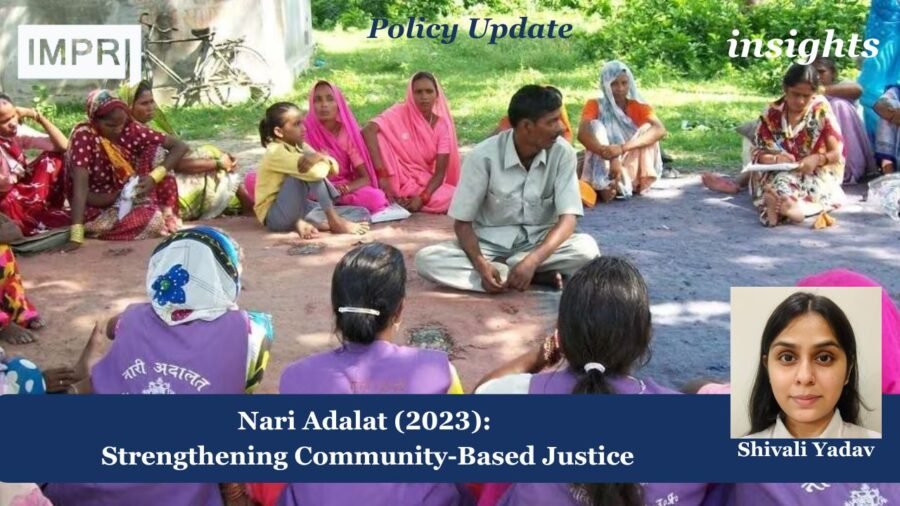
The Ministry of Women and Child Development launched Nari Adalat in 2023 under the Sambal sub-scheme of Mission Shakti (2021–26) to improve women’s access to justice through community-based dispute resolution. Inspired by the Parivarik Mahila Lok Adalats, it addresses issues such as domestic violence, dowry harassment, child custody, maintenance, and property rights through mediation at the Gram Panchayat level.
However, Nari Adalat’s decisions are not legally binding and depend on voluntary compliance. Serious or unresolved cases must be referred to the police, courts, or other authorities. The programme was piloted in 100 Gram Panchayats (50 each in Assam and Jammu & Kashmir) and aims to complement the formal justice system. Its long-term success depends on strong institutional support, effective referral mechanisms, and coordination with the formal legal system.
Functioning
Each Nari Adalat is made up of 7 to 11 women who are called Nyaya Sakhis. These women include people from the Gram Panchayat and the local community, like teachers and doctors. One of the Nyaya Sakhis is in charge for six months; she is the Mukhya Nyaya Sakhi. The Nari Adalat helps to resolve disputes by talking to people and finding a solution that works for everyone. Nari Adalat also tells people about the rights of women and the schemes that the government has. If a dispute cannot be resolved, the Nari Adalat sends the case to the justice system.
The Nari Adalat is different from the Lok Adalat. Nari Adalat does not have the power to make decisions that people have to follow. So people have to agree to follow the decisions made by the Nari Adalat. This is why the Nari Adalat needs to work with the police, the District Legal Services Authorities, and the One Stop Centres. The police help to keep people safe. The District Legal Services Authorities provide help to people. The One Stop Centres provide help to women who’re in trouble.
During the pilot phase from 2023 to 2024, the Centre gave money to the programme. Jammu & Kashmir got ₹21.6 lakh. Assam got ₹20.8 lakh. The pilot phase showed that there were some problems. The Nyaya Sakhis did not get the training they needed. There was no system to track the cases. The different organizations did not work well together. The programme was not available in all states.
To make the Nari Adalat work, the training and the coordination need to be improved. This will help the Nari Adalat to be a system for community-based justice for women, and it will help the Nari Adalat to really make a difference in the lives of women. The programme will be able to support women more effectively if it is institutionally strengthened.
Performance
The performance of Nari Adalat is hard to judge because the Ministry of Women and Child Development does not share budget or performance details. Nari Adalat works under Mission Shakti, so its progress cannot be checked on its own. Mission Shakti got a lot of money. ₹3,144 Crore for 2023-2024, ₹3,146 crore for 2024-2025, and ₹3,150 crore for 2025-2026. This includes ₹629 crore for Sambal. There is no data on how much money was spent on Nari Adalat or what it achieved. Nari Adalat has been introduced in states like Sikkim, following its launch in 100 Gram Panchayats in Assam and Jammu & Kashmir.
The Ministry has not shared how many cases it received, how many disputes it solved, or how long it took to resolve them. Because of this lack of information, we cannot say if Nari Adalat is effective, if it is a use of money, or if it is better than existing systems like One Stop Centres or formal courts. This lack of transparency, along with underutilisation of Mission Shakti funds, means we need to monitor Nari Adalat’s performance publicly and have state-wise data before expanding it further.
Limitations
A key challenge in evaluating Nari Adalat is the lack of scheme-specific data. Since it is funded under the Sambal component of Mission Shakti, there is no separate information on cases, resolution rates, timelines, or state-wise performance. This makes it difficult to assess its effectiveness, cost-efficiency, or to compare it with One Stop Centres and formal courts. As a result, the programme is expanding without adequate evidence or proper monitoring.
Table 1: Mission Shakti / Nari Adalat Budget and Coverage Trend
| Year | Mission Shakti Allocation (₹ crore) | Sambal Sub-scheme Allocation (₹ crore) | Nari Adalat Coverage |
| 2023-24 | 3,144 | 562 (BE) | Pilot launch: 100 Gram Panchayats (50 in Assam, 50 in J&K) |
| 2024-25 | 3,146 | Not separately disclosed | Pilot continues; Assam reports 52 operational Nari Adalats |
| 2025-26 | 3,150 | 629 | Nationwide expansion invited; Sikkim launches its programme |
Source: PRS Legislative Research, Demand for Grants Analyses (2023-24, 2024-25, 2025-26); PIB (2023); Deccan Herald (2025).
Impact
Nari Adalat helps women access justice within their communities. It solves problems like property issues, violence, and family disputes through mediation. This way, women get a chance to resolve their issues locally. Nari Adalat also gives women leadership roles as Nyaya Sakhis. This can reduce the workload of courts and police.
Nari Adalat’s impact is still small. The programme is new. The programme is still in its early stages. The decisions made by Nari Adalat are not legally binding. This means that people have to agree to follow them. Some people worry that Nari Adalat may focus more on keeping the family than on women’s rights. This is especially a concern in cases of violence.
To make Nari Adalat better, it needs to work with the formal justice system. Regular checks are also needed to ensure that Nari Adalat protects women’s rights and provides justice. Nari Adalat must ensure that women’s rights are a priority. The programme should work to gain the trust of the community. Nari Adalat has the potential to make a difference in women’s lives.
Emerging Issues
Nari Adalat is an important community-based initiative for women’s justice, but several challenges limit its effectiveness. Since it is not a legally recognised court, its decisions are not legally enforceable and depend on both parties’ willingness to comply. In cases where cooperation is lacking, women must approach the formal legal system, reducing the programme’s ability to provide quick and effective justice. Another major concern is the lack of standardised training for Nyaya Sakhis. Differences in training lead to inconsistent quality of mediation and legal guidance, which can reduce women’s confidence in the system.
The programme’s focus on community reconciliation may also pressure women into compromising, particularly in cases involving domestic violence or other forms of gender-based violence, instead of ensuring their rights are protected. Limited geographical coverage further restricts access, especially in many rural areas. The absence of a digital case-management and monitoring system makes it difficult to measure case outcomes, evaluate effectiveness, or ensure accountability. Financial transparency is another issue, as Nari Adalat does not have a separate budget, making it impossible to assess its cost-effectiveness or resource utilisation.
In addition, weak institutional coordination with the police, legal services, and other support agencies often limits timely assistance to women. Social stigma and fear of retaliation also discourage many women from approaching Nari Adalats.To strengthen the programme, legal recognition, uniform training for Nyaya Sakhis, a digital case-tracking system, dedicated funding, and formal coordination with justice and support institutions are needed. Regular monitoring, public awareness campaigns, and evidence-based expansion can help make Nari Adalat a more accessible, transparent, and effective community-based justice mechanism for women.
Way Forward
To make Nari Adalat work well, we need to make its legal, institutional, and administrative framework stronger. Nari Adalat should be a way for communities to resolve disputes on their own, and it should work closely with the formal justice system so people can get help easily. We need to set rules for choosing, training, and certifying Nyaya Sakhis, and we should get help from legal aid institutions and Panchayati Raj Institutions to do this.
The government should make a plan to expand Nari Adalat across the country within a certain time frame. Nari Adalat should work well with One Stop Centres, the Women’s Helpline, police, District Legal Services Authorities, and courts so that cases that need legal help can be sent to the right place quickly and women can get all the support they need.
We should have a system to monitor how cases are going and how money is being used, and we should do this by making separate budget reports and having regular audits. Institutions like NITI Aayog or universities can help us make policies by looking at the results of Nari Adalat and giving us feedback. Nari Adalat can help women get access to justice, make things more equal for men and women, and help create a peaceful and just society with strong institutions.
Nari Adalat and Nyaya Sakhis can play a role in helping India become a better country for women, which is the goal of Viksit Bharat 2047. With stronger legal backing, institutional coordination, transparent monitoring, and dedicated funding, Nari Adalat can evolve into an effective community-based justice mechanism for women. Strengthening the programme would improve access to justice, promote gender equality, and support the vision of Viksit Bharat 2047 through more inclusive and accountable local governance.
References
Advocate Tanwar. (2024). Nari-Adalat aka Women’s Courts: A New Approach to Conflict Resolution. https://advocatetanwar.com/
Deccan Herald. (2025). Centre Has Sought Proposals from All States for Expanding Nari Adalat Programme: Minister Annapurna Devi. https://www.deccanherald.com/
Feminism in India. (2022). Nari Adalat – Accessible Alternative Justice Systems Structured for, of and by Women. https://feminisminindia.com/
Jus Corpus. (2025). ‘Nari Adalat’: An Endeavour Toward an Alternative Dispute Resolution System for Women. https://www.juscorpus.com/
JETIR. (2025). Nari Adalat: Balancing Tradition and Justice in Resolving Disputes. https://www.jetir.org/
Ministry of Women and Child Development. (2023). Nari Adalat. Government of India. https://wcd.gov.in/
PMFIAS. (2025). Nari Adalat: Composition, Functions & Need. https://www.pmfias.com/
Press Information Bureau. (2023). Government Decides to Implement the Component of ‘Nari Adalat’ in a Phased Manner Under Mission Shakti. Ministry of Women and Child Development, Government of India. https://pib.gov.in/
PRS Legislative Research. (2023). Demand for Grants 2023–24 Analysis: Women and Child Development. https://prsindia.org/budgets/parliament/demand-for-grants-2023-24-analysis-women-and-child-development
PRS Legislative Research. (2024). Demand for Grants 2024–25 Analysis: Women and Child Development. https://prsindia.org/budgets/parliament/demand-for-grants-2024-25-analysis-women-and-child-development
PRS Legislative Research. (2025). Demand for Grants 2025–26 Analysis: Women and Child Development. https://prsindia.org/
PWOnlyIAS. (2025). Nari Adalat Program, Members, Role of Nyaya Sakhis, Mission Shakti. https://pwonlyias.com/
ResearchGate. (2018). Interpretations of Justice: Conceptions of Family and Gender Justice at a Nari Adalat (Women’s Court) in South India. https://www.researchgate.net/
ResearchGate. (2025). Legal Empowerment Through Nari Adalat: A Study of Women’s Courts in India. https://www.researchgate.net/
The Academic. (2025). Nari Adalat as an Alternative Dispute Resolution Mechanism. https://theacademic.in/
Universal Institutions. (2023). Government to Implement ‘Nari Adalat’ Under Mission Shakti. https://universalinstitutions.in/
Vajiram & Ravi. (2025). Nari Adalat Program: Objective, Structure, Implementation. https://vajiramandravi.com/
About the Contributor
Shivali Yadav is pursuing an M.A. in Liberal Studies at Govind Ballabh Pant Social Science Institute, Prayagraj, and is an IMPRI intern. Her work focuses on gender, education, youth, and public policy, with interests in educational equity and qualitative research.
Acknowledgement
The author sincerely thanks the reviewers and editorial team for their valuable comments, constructive suggestions, and guidance. Their feedback helped improve the clarity, structure, and analytical depth of this policy update.
Reviewers: Shreeya Dixit and Pallavi Lad
Disclaimer: All views expressed in the article belong solely to the author and not necessarily to the organisation.
Read More at IMPRI:
Beyond the Vote: What India’s UNSC Campaign Means for Its Global Role 2028-29