







Atharva Salunke
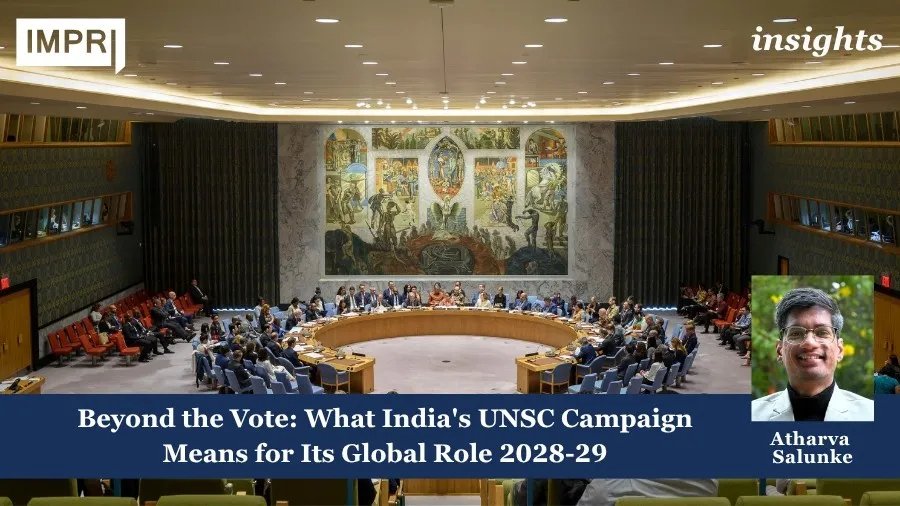
When Hon. Minister of External Affairs Dr. S. Jaishankar formally launched India’s campaign for a non-permanent seat on the United Nations Security Council (UNSC) for the 2028-29 term in New York this week, it was more than the beginning of another diplomatic campaign. It marked the unveiling of SHANTI—Securing Holistic Advancement through Norms, Trust and Integrity, a framework that encapsulates India’s attempt to redefine its role in an increasingly fractured international order.
At first glance, the campaign may appear procedural. India has served eight terms on the Security Council and has historically enjoyed broad international support. Yet the geopolitical landscape today is markedly different. Great-power rivalry has deepened, multilateral institutions are under strain, and electoral contests within the United Nations have become increasingly competitive. Against this backdrop, India’s campaign is as much about consolidating diplomatic influence as it is about securing another two-year tenure.
SHANTI: A Framework Beyond a Campaign Slogan
The SHANTI framework reflects this shift. Rather than centring the campaign solely on India’s long-standing aspiration for permanent membership of the Council, New Delhi has chosen to foreground issues that resonate across regions: strengthening the voice of the Global South, reforming multilateral institutions, modernising UN peacekeeping, promoting human-centric Artificial Intelligence, ensuring maritime security, and combating terrorism and terror financing.
These priorities closely mirror India’s recent diplomatic activism. From its G20 Presidency to the Voice of the Global South Summit and initiatives such as the International Solar Alliance, India has increasingly sought to project itself as a bridge between developed and developing countries. SHANTI, therefore, is less a campaign slogan than an attempt to package India’s broader foreign policy narrative for a multilateral audience.
Understanding the UNSC Election
The electoral challenge, however, is far from symbolic.
Unlike domestic elections, the contest for a non-permanent Security Council seat takes place through a secret ballot in the 193-member UN General Assembly. Candidates require a two-thirds majority of members present and voting—approximately 129 votes if all member states participate. The election is conducted under regional groupings, and India is contesting the single Asia-Pacific seat available for the 2028–29 term. If no candidate secures the required majority in the initial round, voting continues until one does.
This means that winning the election depends not merely on diplomatic stature but on sustained lobbying, bilateral engagement and coalition-building across every region of the world.
The Contest: India versus Tajikistan
India’s principal challenger is Tajikistan.
While the Central Asian republic lacks India’s diplomatic reach or economic weight, it enters the race with an important strategic advantage: the endorsement of the Organisation of Islamic Cooperation (OIC), comprising 57 member states. Tajikistan has framed its candidature around regional security, Afghanistan, water diplomacy, climate resilience and the concerns of landlocked developing countries.
This has prompted some commentary suggesting that religious solidarity could significantly shape voting patterns. Such an assessment, however, oversimplifies how Security Council elections usually unfold.
Although the OIC often coordinates positions on international issues, General Assembly elections are conducted through secret ballots, giving member states considerable flexibility. National interests frequently outweigh bloc commitments. Several influential Muslim-majority countries—including Saudi Arabia, the United Arab Emirates, Indonesia and Egypt—today maintain extensive economic, strategic and security partnerships with India. Their foreign policy calculations are driven as much by trade, investment, energy security and regional stability as by organisational affiliations. Consequently, OIC endorsement should be viewed as Tajikistan’s diplomatic foundation rather than a guaranteed vote bank.
India’s Electoral Strengths
India, meanwhile, approaches the election with structural advantages that extend well beyond numerical diplomacy.
Its credentials as one of the world’s largest contributors to UN peacekeeping continue to carry significant weight. Indian peacekeepers have served in some of the most challenging conflict zones under the UN flag for decades, lending credibility to New Delhi’s emphasis on reforming peacekeeping operations.
Equally important is India’s expanding development footprint. Programmes ranging from capacity-building initiatives and digital public infrastructure partnerships to disaster relief operations and vaccine diplomacy have strengthened India’s standing across Africa, the Pacific, Latin America and parts of Asia. These engagements create political goodwill that often translates into multilateral support.
Unlike smaller candidates that rely heavily on regional blocs, India seeks votes across multiple constituencies simultaneously—Western democracies, African partners, island states, Southeast Asia, the Gulf and Latin America. This diversified diplomatic network is arguably its greatest electoral asset.
Why the UNSC Seat Matters
However, the significance of winning the election extends far beyond the symbolism of another Security Council term.
A persistent misconception is that non-permanent members exercise limited influence because they lack veto power. While veto authority remains exclusive to the five permanent members, elected members participate in every substantive discussion, vote on all resolutions, negotiate draft texts, chair committees and receive confidential briefings on international security issues. During their rotating month-long presidency, they determine the Council’s agenda, convene debates and shape diplomatic priorities.
For India, these institutional powers intersect directly with contemporary strategic concerns.
Counter-terrorism
Counter-terrorism remains one such area. India has consistently argued for stronger international mechanisms against terror financing and politically motivated delays in sanctions processes. Membership would provide New Delhi greater influence in committee negotiations and agenda-setting, even if final outcomes remain subject to permanent-member dynamics.
Maritime Security
Maritime security represents another priority. With growing strategic competition across the Indo-Pacific and increasing concerns regarding freedom of navigation, piracy and critical sea lanes, India has positioned itself as a proponent of a rules-based maritime order grounded in the United Nations Convention on the Law of the Sea (UNCLOS). The Security Council offers an important forum to reinforce these positions.
Global South Leadership
Perhaps equally significant is India’s effort to consolidate its position as the leading voice of the Global South. The Council provides India with a platform to institutionalise many priorities articulated during its G20 Presidency including development financing, climate justice, food security and equitable technology governance. Rather than representing only national interests, India seeks to portray itself as the collective voice of developing countries.
Strengthening India’s Permanent Membership Campaign
Perhaps the greatest long-term benefit is political rather than procedural.
Each successful term reinforces India’s argument that the world’s largest democracy, fifth-largest economy and one of the largest contributors to UN peacekeeping deserves permanent representation in a reformed Security Council. Consistent electoral success demonstrates international confidence in India’s diplomatic leadership and strengthens its reform narrative.
A Reflection of India’s Evolving Foreign Policy
The launch of SHANTI should also be viewed in the context of a changing foreign policy doctrine.
India’s diplomacy has evolved from emphasising normative leadership to combining values with practical governance. Issues such as Artificial Intelligence regulation, maritime security, resilient supply chains and development financing illustrate this transition. Rather than merely advocating institutional reform, New Delhi increasingly seeks to shape emerging global norms within existing institutions.
Conclusion
Whether SHANTI ultimately succeeds will depend less on the appeal of its acronym than on the effectiveness of India’s diplomatic outreach over the coming year. Security Council elections are won through sustained engagement in capitals across continents, patient coalition-building and careful management of competing interests.
Yet irrespective of the final vote, the campaign itself reflects a broader reality. India’s foreign policy today is no longer confined to its immediate neighbourhood or traditional bilateral relationships. It increasingly seeks influence within the institutions that define global governance.
In that sense, the campaign is about more than securing a seat. It is about reinforcing India’s claim that its expanding economic weight, diplomatic activism and developmental partnerships must be matched by a commensurate role in shaping international peace and security. The SHANTI framework provides the narrative; the election will determine how widely that narrative resonates.
About the Contributor:
Atharva Salunke is a Policy Research Associate at NITI TANTRA and a Visiting Researcher and Assistant Editor at IMPRI.
Disclaimer: All views expressed in the article belong solely to the author and not necessarily to the organisation.
Read more at IMPRI:
SPARROW (Smart Performance Appraisal Report Recording Online Window) 2013: Digitising Bureaucratic Performance
Project Mausam (2014): Reimagining Cultural Diplomacy as Strategic Statecraft