



Policy Update
Gargi Bisht
Background
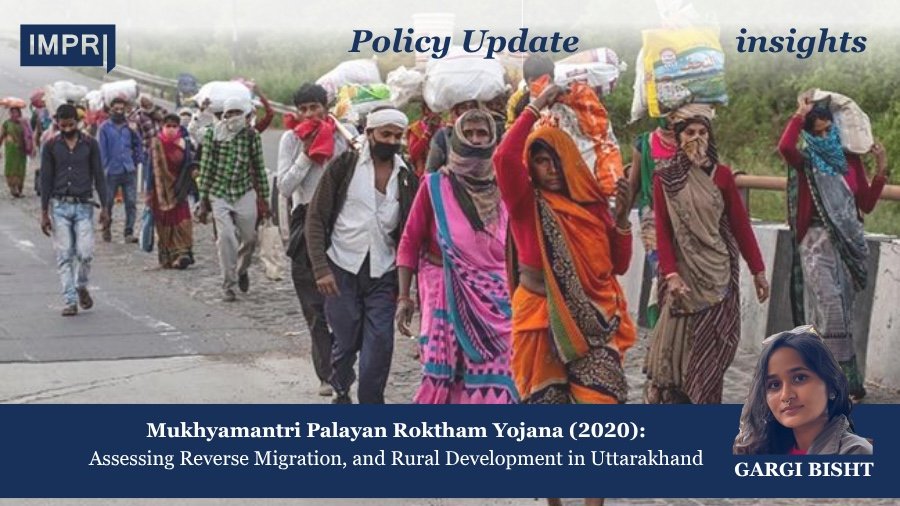
Uttarakhand’s migration crisis presents one of India’s most acute demographic challenges. Between 2008 and 2018, approximately 118,981 persons migrated permanently from rural areas of the state, while 383,726 undertook semi-permanent migration for employment (Rural Development and Migration Commission, 2018). This exodus has fundamentally altered the state’s demographic composition: hill districts recorded a population growth rate of merely 0.70% during 2001–2011, compared to the state’s average of 1.74%. More starkly, Almora and Pauri Garhwal districts experienced absolute population decline, with Almora and Pauri losing 17,868 persons over the decade (Census 2011). By 2022, the number of “ghost villages” – settlements abandoned or near-uninhabited due to sustained out-migration reached around 1,792. (Rural Development and Migration Prevention Commission, 2023).
The structural drivers of this exodus are multifaceted but concentrated. The Rural Development and Migration Commission’s gram panchayat-level survey identified livelihood and employment deficits as the primary cause (50.16%), followed by inadequate education (15.21%), poor infrastructure including roads, electricity, and water (3.74%), and declining agricultural productivity (5.44%) (Rural Development and Migration Commission, 2018). Geographic inequality compounds these pressures. Historically, data also shows substantial income disparity, with per capita income in hill districts such as Bageshwar and Champawat being less than half that of plains districts like Dehradun and Haridwar, creating powerful economic incentives for outward migration (Rural Development and Migration Commission, 2018).
It was against this backdrop that the Uttarakhand government, recognizing the unsustainability of undirected out-migration, launched the Mukhyamantri Palayan Roktham Yojana (MPRY) in September 2020. The scheme targets 474 villages identified by the Rural Development and Migration Commission as migration-affected, distributed across all 13 districts of the state. Its stated objective is explicit: to provide self-employment opportunities and financial assistance to families, unemployed youth, and reverse migrants, thereby arresting outward migration and facilitating return migration. The scheme prioritizes livelihoods connected to agriculture, horticulture, and animal husbandry – sectors historically central to the hill economy.
Functioning
MPRY operates through a decentralized, participatory model that emphasizes community engagement at the gram panchayat level. Proposals for livelihood projects are developed bottom-up, incorporating inputs from villagers through Block Development Officers, who then compile and forward recommendations to the state for approval by District Level Screening Committees (DLSCs) following due diligence (Uttarakhand Rural Development Department, 2020). This institutional design attempts to align scheme implementation with grassroots needs and local knowledge, a departure from more centralized approaches.
Beneficiary eligibility encompasses three categories: families residing in the 474 identified villages seeking livelihood diversification; unemployed youth (particularly those aged 26 – 35, who constitute 42.25% of migrants according to the Migration Commission) (Rural Development and Migration Commission, 2018); and reverse migrants – individuals who have returned to villages following employment loss or voluntary repatriation. The scheme’s sectoral focus reflects the comparative advantage of hill regions: priority is given to enterprises in agriculture, horticulture, and animal husbandry, recognizing both livelihood potential and skill retention in these domains.
From a fiscal perspective, MPRY remains modestly resourced. The scheme received an allocation of ₹10 crore for FY 2026 – 27, which scales to approximately ₹21 lakh per village across 474 target settlements (Uttarakhand Department-wise Scheme Update, 2026). By comparison, the concurrent Mukhyamantri Swarojgar Yojana (MSOY) – a related state self-employment initiative received ₹60 crore for the same fiscal year, suggesting that MPRY, despite its broader geographical reach, commands significantly lower per-capita resource intensity. This budgetary constraint shapes both the depth of support individual beneficiaries can access and the scheme’s realistic scope for transformative intervention.
Performance
Evaluating MPRY’s performance presents an immediate methodological challenge: the scheme lacks publicly available, disaggregated performance data. This data absence is itself analytically significant, suggesting either nascent implementation capacity or insufficient institutional emphasis on monitoring and evaluation.
What is discernible from broader migration trends post-launch offers cautiously encouraging context. The Rural Development and Migration Prevention Commission reported a marked deceleration in permanent migration: the 28,531 permanent migrants recorded between January 2018 and September 2022 represent a 76% reduction from the 118,981 migrants of the preceding decade (Business Standard, 2023). Vice Chairman S.S.
Negi attributed this reversal partly to “increasing inclination among locals towards availing self-employment avenues available at home” and explicitly cited schemes including Mukhya Mantri Swarojgar Yojana as contributing factors (Business Standard, 2023). However, attributing this decline exclusively or primarily to MPRY would be analytically premature; the COVID-19 pandemic’s role in reverse migration cannot be discounted, around 59,360 migrants returned to 10 Uttarakhand districts during the March – April 2020 lockdown alone (Rural Development and Migration Prevention Commission, 2020).
More recent data on agricultural sector engagement provides indirect evidence of shifting rural livelihood choices. According to the All India Rural Financial Inclusion Survey (2023- 24), agricultural households in Uttarakhand increased from 41% to 57% between 2016- 17 and 2023 – 24 – suggesting re-engagement with farming and allied activities (Tribune India, 2024). Whether this shift reflects MPRY’s direct impact or broader post-pandemic rural relocation patterns remains unclear without scheme-specific data.
Impact
The theoretical logic of MPRY is straightforward: by reducing livelihood constraints in migration-affected villages through self-employment support, the scheme should dampen migration incentives and enable reverse migration. However, evidence on the scheme’s actual impact on this stated objective remains fragmentary.
A critical finding from the Migration Commission’s post-COVID assessment complicates this narrative. When surveyed about willingness to engage with livelihood schemes, 60% of returning migrants declined to participate in the Mahatma Gandhi National Rural Employment Guarantee Act (MGNREGA), citing preference for private employment or self-employment (Rural Development and Migration Prevention Commission, 2020, p. 8). This reluctance suggests that reverse migrants possess employment expectations – income levels, work autonomy, skill deployment- that rudimentary self-employment support may not satisfy. The implication is that livelihood schemes alone, absent complementary infrastructure and market integration, risk creating employment opportunities that migrants view as economically inferior to urban alternatives.
Additionally, the Migration Commission’s 2018 interim report, submitted three years after the commission’s establishment in 2017, noted that “no visible efforts have been seen to revitalise these villages during the last 3 years since the Commission was constituted” and that despite comprehensive organizational structures, “no action plans have been prepared to create sustainable livelihoods” (Rural Development and Migration Commission, 2018). Although MPRY was subsequently launched, this baseline observation underscores institutional implementation capacity constraints that may persist.
Emerging Issues
Four interconnected challenges limit MPRY’s potential effectiveness:
1. Insufficient Resource Intensity. At ₹21 lakh per village, MPRY’s per-village allocation falls substantially short of what evidence suggests is necessary for meaningful enterprise development. By contrast, successful livelihood interventions documented by NIRD in Uttarakhand – including the Uttarakhand Livelihoods Improvement Project for the Himalayas (ULIPH) – combined farm productivity enhancement, market access support, credit linkage, and skill training at considerably higher per-household investment levels (National Institute of Rural Development and Panchayati Raj, 2015). Without clearer per-beneficiary disbursement norms within MPRY, fund allocation risks diffusion across villages at sub-critical levels.
2. Infrastructure and Market Integration Gaps. The Migration Commission’s enumeration of uninhabited villages reveals systematic infrastructure deficits that outpace livelihood interventions. Of the 734 villages de-populated after 2011, 482 lack road connectivity, 358 lack electricity, and 399 lack drinking water access within 1 kilometer (Rural Development and Migration Commission, 2018). For agriculture and horticulture-based livelihoods to be viable, such infrastructure gaps must be addressed concurrently. Without reliable roads, farmers cannot access markets; without electricity, value-addition and cold-storage remain infeasible. MPRY’s design does not explicitly mandate or fund infrastructure development, creating a critical implementation bottleneck.
3. Monitoring and Accountability Vacuum. The absence of public data on scheme performance prevents meaningful accountability and adaptive management. Without baseline data on beneficiary numbers, project types, fund absorption rates, and enterprise survival, neither government nor external stakeholders can assess whether MPRY is functioning as designed or whether mid-course corrections are needed.
4. Sectoral Mismatch with Migrant Skills and Aspirations. The Migration Commission’s skill mapping of return migrants revealed that 58% were engaged in hospitality and service sectors prior to return migration (Rural Development and Migration Prevention Commission, 2020). MPRY’s emphasis on agriculture and animal husbandry, while aligned with village-based livelihood potential, may not leverage return migrants’ existing skill portfolios developed in urban sectors. This sectoral mismatch risks creating employment opportunities that migrants perceive as economically or professionally regressive, undermining retention.
Way Forward
Strengthening MPRY requires addressing not only the scale of financial support, but also the scheme’s ability to identify viable livelihoods, retain beneficiaries, and measure whether it is actually reducing migration. First, the relatively modest allocation of ₹10 crore should be reconsidered in relation to the scheme’s coverage of 474 villages. An increase would provide greater fiscal space for enterprise development, working capital and market-linked livelihood interventions. However, simply increasing allocations may not be sufficient; funding should be linked to viable enterprise plans and differentiated according to local economic potential rather than distributed uniformly across villages.
NABARD’s Livelihood and Enterprise Development Programme combines grant support with skill development, handholding, market linkages and access to bank credit across successive credit cycles, recognising that enterprise sustainability requires financing beyond initial assistance. MPRY could similarly establish formal linkages with banks and suitable microfinance institutions, allowing initial government assistance to finance enterprise creation while institutional credit provides working capital and expansion finance. This would help shift the scheme from one-time financial assistance towards a more sustainable pathway of enterprise graduation and reduced dependence on repeated government support.
Second, the scheme’s livelihood portfolio could be aligned more closely with the skills and aspirations of returning migrants. MPRY’s existing emphasis on agriculture, horticulture and animal husbandry is consistent with village-based livelihood creation, but a predominantly primary-sector approach may not accommodate migrants whose previous employment was concentrated in services and other urban occupations. Expanding support to eco-tourism, handicrafts, food processing and locally relevant service-sector enterprises could therefore widen the range of viable opportunities available to return migrants. Rather than supporting isolated enterprises, the scheme could facilitate sector-specific clusters with common infrastructure, training, credit, branding and market linkages, allowing individual enterprises to benefit from economies of scale.
Finally, MPRY’s success should be measured through outcomes rather than expenditure or the number of projects sanctioned. The scheme could establish measurable indicators such as the proportion of return migrants engaged in supported enterprises, changes in beneficiary household income, enterprise survival rates, employment generated and the proportion of beneficiaries remaining in their villages after one, three and five years. Incorporating baseline data and periodic impact assessments from the outset would allow policymakers to distinguish between activities that merely generate short-term employment and those that contribute to sustained rural livelihood creation and migration retention.
References
- Business Standard. (2023, March 10). Decline in Rate of Migration from Uttarakhand Over the Last Five Years: Report. https://www.business-standard.com/article/current-affairs/decline-in-rate-of-migration-from-uttarakhand-over-the-last-5-years-report-123031001024_1.html
- Garhwal Post. (2025, August 28). Policy Solution to Transforming Uttarakhand’s Migration Pattern. https://garhwalpost.in/policy-solution-to-transforming-uttarakhands-migration-pattern/
- Mamgain, R. P., & Reddy, D. N. (2015). Out-migration from the hill regions of Uttarakhand: Magnitude, challenges and policy options. National Institute of Rural Development and Panchayati Raj, Hyderabad.https://www.gids.org.in/DownloadMaterials/WP%20218.pdf
- Chandra, S. (2020, December). Uttarakhand Budget Analysis 2026 – 27. IMPRI https://www.impriindia.com/insights/policy-update/uttarakhand-department-wise-scheme/
- Rural Development and Migration Commission, Uttarakhand. (2018). Interim Report on the Status of Migration in Gram Panchayats of Uttarakhand. Government of Uttarakhand, Pauri Garhwal. https://www.uttarakhandpalayanayog.com/pdf/English%20version.pdf
- Uttarakhand Department of Rural Development. (2020). Mukhyamantri Palayan Roktham Yojana: Scheme Guidelines and Implementation Framework. Government of Uttarakhand. https://ukrd.uk.gov.in/scheme/mukhiya-mantri-palayan-roktham-yojnampry/
About the Contributor
Gargi Bisht is a history postgraduate from Miranda House, specializing in medieval history. Her interest lies at the intersection of history, research, and public policy, exploring issues related to governance, society, development, and international relations.
Acknowledgement
The author would like to express sincere gratitude to the IMPRI team for providing this valuable opportunity and for facilitating a platform to engage in and contribute to research and policy discourse, and also the reviewers Anooran and Nivedya.
Disclaimer
All views expressed in the article belong solely to the author and not necessarily to the organisation.
Read More at IMPRI:
ATAL BEEMIT VYAKTI KALYAN YOJANA (ABVKY) – INDIA’S UNDERUSED UNEMPLOYMENT BENEFIT
Advancing Digital Social Security for Coal Workers in India through C-CARES 2.0