








Policy Update
Pritha Chowdhury
Background
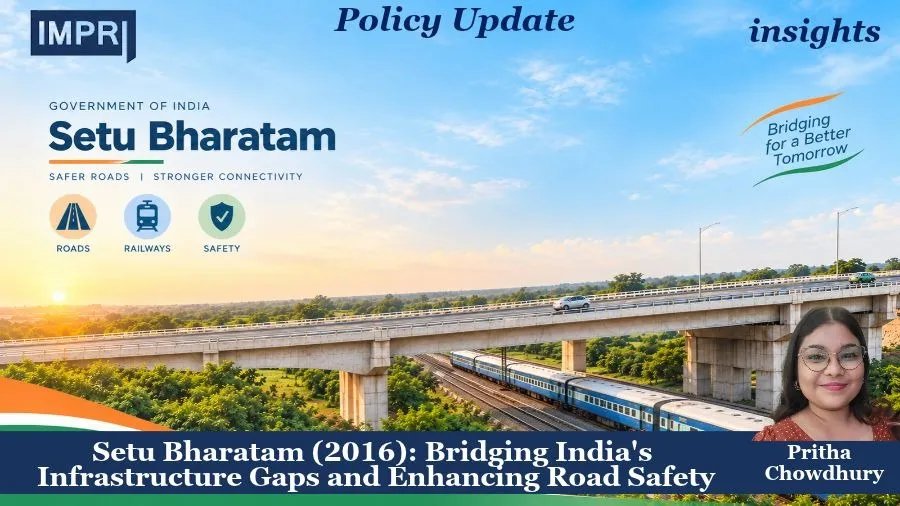
Setu Bharatam was launched by the Government of India on 4 March 2016 to address the safety risks and traffic bottlenecks created by railway level crossings on national highways. Before the programme was introduced, road vehicles frequently had to stop at railway crossings to allow trains to pass, leading to traffic congestion, longer travel times and inconvenience for commuters and freight operators. These crossings also posed serious safety concerns, as collisions between trains and road vehicles could result in loss of life and damage to property. At the same time, several existing bridges on national highways required repair, rehabilitation or replacement to ensure safe and uninterrupted transportation.
Recognising the need to improve road safety and strengthen transport infrastructure, the Ministry of Road Transport and Highways introduced Setu Bharatam to eliminate railway level crossings on national highways through the construction of railway overbridges (ROBs) and railway underbridges (RUBs). The programme also sought to improve the condition of existing bridges through systematic inspection and rehabilitation. Its introduction reflected the government’s broader objective of developing a safer, more efficient and better-connected road network, reducing travel delays, facilitating the movement of goods and passengers, and supporting economic growth through improved transport connectivity.
Functioning
At its launch, the government identified the construction of 208 railway overbridges and underbridges at level crossings, alongside the rehabilitation of approximately 1,500 existing bridges on national highways (PIB, 2016).
The programme also introduced a technology-driven approach to bridge management. The Indian Bridge Management System (IBMS) was developed to create a comprehensive database of bridges, assess their structural condition and identify those requiring repair, rehabilitation or replacement. Bridge inspections and technical assessments were intended to support evidence-based prioritisation of infrastructure investments.
Implementation involved coordination between the Ministry of Road Transport and Highways, the National Highways Authority of India (NHAI), state agencies and Indian Railways, depending on the project and its administrative jurisdiction. The construction of ROBs and RUBs required coordination in planning, design, funding, land acquisition and railway-related approvals. This institutional coordination was essential to ensure that infrastructure development translated into safer and more seamless road connectivity.
Performance
At its launch, Setu Bharatam was announced with an overall investment of approximately ₹50,000 crore, including the construction of ROBs/RUBs and the improvement of existing bridges (PIB, 2016). The original plan envisaged making national highways free of railway level crossings by 2019. However, implementation progressed more slowly than initially anticipated.
According to the Ministry of Road Transport and Highways, as reported by the Press Information Bureau (PIB) on 20 July 2017, 208 railway level crossings had been identified for intervention, and feasibility studies had been completed for 87 ROBs. Subsequently, a PIB update dated 16 December 2021 reported that administrative approval and financial sanction had been granted for 123 ROB/RUB projects under the programme. These figures indicate progress in project identification and approval, while also highlighting the gap between initial targets and implementation.
According to the Parliamentary Standing Committee on Transport, Tourism and Culture, as summarised by PRS Legislative Research on 10 August 2023, only 37 out of 149 identified ROB/RUB projects had been completed, equivalent to approximately 24.8%. A further 68 projects (45.6%) were under construction, 27 (18.1%) had received sanctions but physical work had not commenced, and 17 (11.4%) were expected to receive sanctions during 2023–24. The programme’s bridge-management component has also been important.
Impact
Setu Bharatam has the potential to improve road safety by reducing the risks associated with railway level crossings, where road vehicles and trains intersect. ROBs and RUBs separate the two traffic streams, reducing the need for vehicles to stop and wait for trains and helping minimise the possibility of collisions at these intersections. The programme can also improve travel-time reliability, particularly for freight vehicles, public transport and commuters travelling along busy national highway corridors.
Improved bridges contribute to the broader efficiency and resilience of India’s road network. Stronger and better-maintained structures can accommodate traffic more safely, reduce disruptions caused by structural deficiencies and support the movement of goods between production centres, markets and logistics hubs. These improvements may also benefit nearby communities by facilitating access to employment, education, healthcare and other essential services.
Nevertheless, the programme’s actual impact should not be measured solely by the number of projects sanctioned. Reliable assessment requires information on completed and operational bridges, changes in accidents at targeted crossings, reductions in waiting times and improvements in traffic flow. The distinction between intended benefits and independently measured outcomes is essential when evaluating the programme’s effectiveness.
Emerging Issues
Despite its important objectives, Setu Bharatam has faced several implementation challenges. A major concern has been the delay in completing projects within the original timeframe. The Parliamentary Standing Committee on Transport, Tourism and Culture, in its report summary published by PRS Legislative Research in August 2023, noted that the programme had achieved only about 25% completion since its launch in 2016. This highlighted the gap between infrastructure targets and actual delivery.
Coordination between the Ministry of Road Transport and Highways, Indian Railways, state public works departments and other implementing agencies can also delay approvals and construction. Land acquisition, utility shifting, railway clearances, funding arrangements and technical design requirements may further extend project timelines. In addition, construction activities in densely populated areas can create temporary traffic disruptions and affect nearby residents and businesses.
Another challenge is ensuring that bridge construction is accompanied by adequate maintenance and safety inspections. Delays in repairing older structures, inadequate drainage, poor approach roads and insufficient maintenance can reduce the long-term benefits of new infrastructure. Therefore, effective monitoring, transparent reporting and consistent quality control are essential for ensuring that public investment translates into lasting improvements in road safety and connectivity.
Way Forward
To strengthen the effectiveness of Setu Bharatam, the government should prioritise the completion of pending projects according to their safety risks, traffic volumes and regional importance. Time-bound implementation plans, regular progress reviews and stronger coordination between the Ministry of Road Transport and Highways and Indian Railways can help reduce administrative delays.
The government should also improve public reporting by publishing updated, project-wise information on approvals, expenditure, construction progress and operational status. Such transparency would make it easier to distinguish between sanctioned projects and completed infrastructure and would strengthen accountability.
Furthermore, the Indian Bridge Management System should be used consistently to support preventive maintenance, structural inspections and evidence-based investment decisions. Digital monitoring, standardised engineering designs and timely railway clearances can improve project execution. Environmental safeguards, appropriate drainage, pedestrian access and the safety of adjoining roads should also be integrated into project planning.
Finally, impact assessments should examine whether operational bridges have reduced accidents, waiting times and traffic congestion. This would help policymakers identify implementation gaps and direct future investments towards locations where they can deliver the greatest public benefit.
References
- Press Information Bureau. (2016, March 4). PM launches “Setu Bharatam”-A programme for bridge building to ensure seamless travel on National Highways. Government of India. https://www.pib.gov.in/newsite/PrintRelease.aspx?lang=2®=48&relid=137318
- Press Information Bureau. (2016, November 21). Improvement of 1500 old bridges planned under Setu Bharatam Scheme. Ministry of Road Transport and Highways, Government of India. https://www.pib.gov.in/newsite/PrintRelease.aspx?lang=2®=48&relid=153965
- Press Information Bureau. (2017, July 20). ROBs under Setu Bharatam Scheme. Ministry of Road Transport and Highways, Government of India. https://www.pib.gov.in/PressReleasePage.aspx?PRID=1496479&lang=2®=48
- Press Information Bureau. (2019, January 1). Mandaviya says, all level crossings on National Highways to be replaced by overbridges and underbridges. Ministry of Road Transport and Highways, Government of India. https://www.pib.gov.in/newsite/PrintRelease.aspx?lang=2®=48&relid=187001
- Press Information Bureau. (2021, December 16). Setu Bharatam Programme. Ministry of Road Transport and Highways, Government of India. https://www.pib.gov.in/PressReleasePage.aspx?PRID=1782187&lang=2®=48
- PRS Legislative Research. (2023, August 10). Construction of road over bridges, road under bridges, service roads, and review of road survey guidelines. https://prsindia.org/policy/report-summaries/construction-of-road-over-bridges-road-under-bridges-service-roads-and-review-of-road-survey-guidelines
About the Contributor
Pritha Chowdhury is a postgraduate in Economics from Jadavpur University. Her academic interests include public policy, economic development, innovation policy, and data-driven policy analysis.
Reviewers:
Sandra Menon, Karnavi Shende
Acknowledgment
The author extends sincere thanks to the IMPRI team for their guidance and support in developing this Policy Update.
Disclaimer
The views and opinions expressed in this policy update are those of the author and do not necessarily reflect the official position of IMPRI or any affiliated institution. While every effort has been made to ensure the accuracy of the information and data presented, readers are encouraged to verify facts independently before relying on them for any decision-making purpose.
Read more at IMPRI:
Dumpsite Remediation Accelerator Programme (DRAP), 2025.
Sixteenth Finance Commission (2026–31): Tax Devolution and Fiscal Federalism in India