







Policy Update
Rashmi Kumari
Introduction
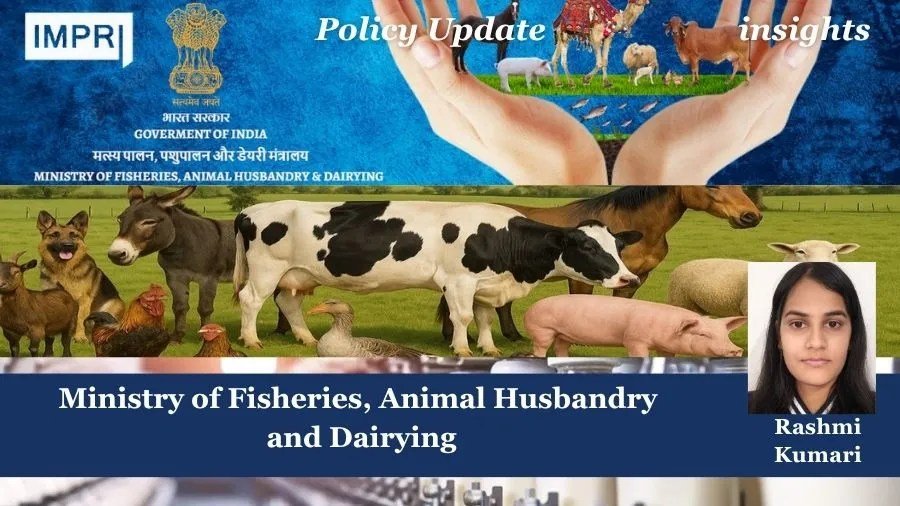
The Ministry of Fisheries, Animal Husbandry, and Dairying is an important ministry under the Government of India. It was formed in May 2019 after being separated from the Ministry of Agriculture and Farmers’ Welfare. This ministry is responsible for the regulation and promotion of the sustainable development of the livestock, dairy, and fisheries sectors. These sectors form the backbone of rural livelihood and nutrition security in India. According to the Economic Survey 2022–23, around 65% of India’s population resides in rural areas, with approximately 47% dependent on agriculture and allied activities for their livelihood. The ministry supports millions of farmers across India and contributes significantly to the country’s GDP, employment generation, export earnings, and nutritional needs.
Structure of the Ministry
The Ministry comprises two main departments: the Department of Animal Husbandry and Dairying and the Department of Fisheries. The departments cooperate in developing policies, schemes, and sustainable growth & development of activities in the sector. Each department is headed by a secretary, with other officers assisting them in managing operations. All the officers work directly under the Union Minister and the Ministers of State.
Department of Animal Husbandry and Dairying (DAHD)
The Department of Animal Husbandry and Dairying came into existence on 1st February 1991. It was formed by merging two divisions of the Department of Agriculture and Cooperation, namely Animal Husbandry and Dairy Development, into a separate Department. The Department manages issues related to livestock production, disease prevention, stock preservation, and dairy development. It also manages the Delhi Milk Scheme (DMS) and supports the National Dairy Development Board (NDDB).
Department of Fisheries (DOF)
The Department of Fisheries was established in February 2019. It plays a key role in improving fishers’ income, promoting exports, ensuring food and nutritional security, and creating jobs. Recognized as a “Sunrise Sector,” fisheries support the livelihoods of almost 30 million people, particularly in marginalized and vulnerable communities. The Department develops policies and implements programs for inland, marine, and coastal fisheries, along with fishery institutes.
Objectives & Responsibilities
- Improving Livelihoods and Employment-Aims to make animal husbandry, dairying, and fisheries reliable sources of income in rural areas
- Improving Productivity and Production-Intends to implement scientific breeding, promote artificial insemination and crossbreeding, and ensure India leads globally in milk, meat, egg, and fish production.
- Maintaining Animal Health and Biosecurity-Oversees disease control programs, builds veterinary infrastructure, and promotes the One Health approach to prevent zoonotic diseases.
- Supporting Infrastructure Development-Focuses on developing cold chains, fish landing centers, processing plants, veterinary hospitals, and other infrastructure facilities to enhance farmers’ earning capacity.
- Encouraging Sustainable and Climate-Resilient Production-Promotes sustainable practices to address climate change by adopting eco-friendly technologies, improving breed efficiency, and conserving natural resources.
- Encouraging New and Innovative Technology-Encourages technological innovations for improving rural livelihoods.
Key Schemes & Initiatives
Fisheries Sector
- Pradhan Mantri Matsya Sampada Yojana (PMMSY):
The PMMSY is a flagship scheme rolled out by the Department of Fisheries in the year 2020. It aims to double fishers’ income by increasing fish production & productivity, upgrading infrastructure, and ensuring responsible fishing practices in both marine and inland areas. For 2024-25, ₹2,352 crore has been allocated to the PMMSY- a 56% increase from ₹1,500 crore in 2023-24.
- Fisheries Infrastructure Development Fund (FIDF):
The FIDF scheme was started in 2018 to improve fisheries infrastructure. It has an approved fund size of ₹7,522 crore and helps build harbors, cold chains, hatcheries, and processing units. FIDF aims to increase fish production, exports, and rural livelihoods through institutional financing.
- Kisan Credit Card (KCC) to Fishers & Fish Farmers
KCC was extended to fishers and fish farmers in the financial year 2018-2019. The eligible farmers under this scheme receive loans at a subsidized interest rate of 7%. There is also a provision of Prompt Repayment Incentive, which further reduces the interest rate to merely 4%.
- Pradhan Mantri Matsya Kisan Samridhi Sah-Yojana (PM-MKSSY)
The PM-MKSSY has been introduced as a sub-scheme under the Pradhan Mantri Matsya Sampada Yojana (PMMSY). Approved on 8th February 2024 for four years from FY 2023-24 to FY 2026-27, this scheme has a projected spending of Rs 6000 crore, through which it aims to reform the institutional setup for long-term development in the fisheries sector.
Animal Husbandry and Dairying
- Rashtriya Gokul Mission (RGM):
The RGM works to conserve and develop the indigenous cattle breeds of India. It began in December 2014 and operates through 16 Gokul Grams, IVF centers, and sex-sorted semen technology through genetic improvement, sustainable breeding, and productivity enhancement. It contributes to the development and conservation of indigenous breeds by assisting Gaushalas, Gosadans, and Pinjarapoles.
- National Livestock Mission (NLM):
The NLM supports the sustainable development of the livestock sector of India. Launched in 2014, NLM incentivizes the institutes carrying out research and development related to sheep, goat, feed and fodder sector, livestock insurance, and innovation. The NLM has a budget of ₹410.00 crore for the financial year 2024-25, with ₹370.31 crore utilized up to March 27, 2025.
- Animal Husbandry Infrastructure Development Fund (AHIDF):
The AHIDF is a ₹15,000 crore central-sector initiative, which has been extended to ₹29,610 crore until FY 2025-26. This initiative, launched under Atma Nirbhar Bharat, is responsible for providing subsidized loans for dairy and meat processing, feed plants, breed farms, vaccines, and waste management.
- Livestock Health and Disease Control (LHDC):
The LHDC scheme aims to prevent, control, and eliminate important animal diseases. It supports nationwide vaccination programs for diseases such as FMD and Brucellosis, along with disease surveillance and veterinary infrastructure. It has three components- (i) National Animal Disease Control Program (NADCP), (ii) Livestock Health & Disease Control (LH&DC), and (iii) Pashu Aushadhi.
Performance
The following data provide insights into the achievements and performance metrics of the ministry:
- The livestock sector achieved a CAGR of 7.93% (2014-15 to 2020-21)
- The dairy sector contributed 5% to the national GDP, directly empowering over 80 million farmers
- Milk production grew 51% from 146.3 MT (2014–15) to 221.1 MT (2021–22), at an annual growth of 6.4%, while the global growth was only about 1.2% per year.
- It has introduced digital platforms for monitoring, a livestock management app called e-Gopala, and a National Digital Livestock Database.
- Egg output rose from 78.5 billion (2014–15) to 129.6 billion (2021–22), with an 8% annual growth rate and availability reaching 95 eggs per person.
- Meat output increased from 6.7 MT to 9.3 MT in the same period
- The fisheries sector grew at an average of 6.3% per year over the last 5 years.
- In 2022–23, fisheries added ₹1.65 lakh crore to the economy. It made up 1.12% of national GVA and 7.26% of agriculture GVA.
- Fish output rose from 5.66 MMT in 2000–01 to 18.40 MMT in 2023–24.
Challenges
Despite numerous government schemes and increasing investments, several persistent challenges are:-
- Fragmented and Small-Scale Farming-According to the Agriculture Census of India 2015-16, more than 85% of operational landholdings are less than 2 hectares in size. This limits their ability to innovate and increase productivity, trapping them in poverty.
- Low Productivity-Dairy income suffers due to low-yield indigenous cattle. Poor breeding practices and insufficient nutrition lead to low productivity, thereby affecting the farmers’ income.
- Climate Change and Disease Outbreaks-Rising temperatures, unpredictable rains, and droughts make it tough to find enough fodder and water for livestock and fisheries, while frequent disease outbreaks hurt farmers’ incomes and food supply.
- Infrastructure Gaps-Insufficient infrastructure, such as insufficient veterinary services and the absence of cold chain systems, significantly undermines the productivity and livelihoods of rural farmers.
- Lack of Awareness-Schemes like AHIDF and PMMSY exist, but many small farmers aren’t aware, limiting their use and progress.
Way Forward
- Sustainable Practices
Eco-friendly practices in farming reduce waste, conserve resources, and ensure lasting productivity. Examples include integrated fish farming in West Bengal, combining rice and fish cultivation, and NDDB’s ration balancing programme to reduce methane emissions and improve animal health.
- Technological Advancements
Smart tech enables disease control, efficient farming, and access to schemes, driving rural growth.
- Enhanced livestock productivity
Improving livestock productivity by using strategies such as genetic improvement, advanced breeding techniques, disease-resistant breeds, and better nutrition and healthcare.
- Promote value chain development.
Strengthening dairy and fish value chains will certainly lead to better storage, processing, and market access to boost incomes.
- Encourage Public-Private Partnerships (PPP)
Encouraging PPPs in livestock and fisheries can improve services, bring in technology, and raise farmer incomes. Models like Amul in dairy and ITC’s Aqua-Choupals in fisheries show how such partnerships improve infrastructure, market access, and value chains.
Conclusion
The Ministry of Fisheries, Animal Husbandry, and Dairying plays an important role in improving the livelihoods of rural India. It helps farmers and fishers by providing financial support via loans and subsidies, incorporating technology, and encouraging entrepreneurship at the grassroots level. The ministry also promotes the use of modern tools and technologies to boost productivity and enhance earnings.
As India aims for efficient and effective utilization of its agricultural base and aquatic resources, the ministry plays a central role in realizing the goal. Supported with ample budget allocation, innovative ideas, and collective efforts, India’s livestock and fisheries sector is exhibiting the potential to become globally competitive, economically resilient, and environmentally sustainable.
References
- Ministry of Fisheries, Animal Husbandry & Dairying. (n.d.). Official website. Government of India. https://minfahd.gov.in/
- Department of Animal Husbandry & Dairying. (n.d.). Official website. Government of India. https://dahd.gov.in/
- Department of Fisheries. (n.d.). Official website. Government of India. https://dof.gov.in/
- Wikipedia contributors. (n.d.). Ministry of Fisheries, Animal Husbandry and Dairying. Wikipedia. Retrieved June 11, 2025, from https://en.wikipedia.org/wiki/Ministry_of_Fisheries,_Animal_Husbandry_and_Dairying
- Press Information Bureau. (2024, March 6). Union Minister Parshottam Rupala chairs national conference on investment in animal husbandry and dairying sector. https://www.pib.gov.in/PressReleasePage.aspx?PRID=2117740
- Press Information Bureau. (2023, October 6). Cabinet approves continuation of Animal Husbandry Infrastructure Development Fund (AHIDF). https://www.pib.gov.in/PressReleaseIframePage.aspx?PRID=1988233
- Department of Agriculture & Farmers Welfare. (2019). Agriculture census 2015–16: All India report. https://agcensus.da.gov.in/document/agcen1516/ac_1516_report_final-220221.pdf
- Udyami Mitra – National Livestock Mission. (n.d.). Official portal. https://nlm.udyamimitra.in/
About the contributor: Rashmi Kumari is a Research Intern at IMPRI and a Master’s student in Economics at Gokhale Institute of Politics and Economics, Pune.
Acknowledgement: The author extends her sincere gratitude to the IMPRI team and Ms. Aasthaba Jadeja for her invaluable guidance throughout the process.
Disclaimer: All views expressed in the article belong solely to the author and not necessarily to the organisation.
Read More at IMPRI
AICTE Training and Learning (ATAL) Academy (2023)
The Complex Realities of Water Management