








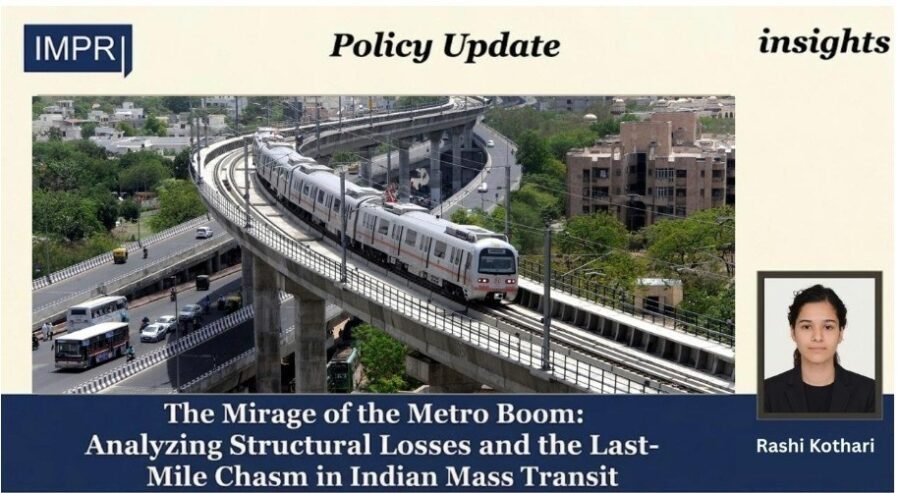
Policy Update
Rashi Kothari
Abstract
Over the past two decades, India’s urban transport planning has shifted heavily toward high-cost, capital-intensive metropolitan rail systems. Promoted as the definitive solution for traffic congestion, vehicular emissions, and rapid urbanization, billions of dollars have been systematically funneled into building heavy rail infrastructure.
However, an empirical evaluation of operational realities across several Tier-1 and Tier-2 networks reveals a stark divergence between overly optimistic Detailed Project Reports (DPRs) and actual daily footfall. This policy update critically evaluates the escalating structural revenue deficits plaguing Indian metro projects, explores the persistent “last-mile problem” that stops people from using them, and assesses the financial burden placed on state budgets due to stalled, half-finished capital assets. Ultimately, it advocates for a shift toward right-sized transit options and better integration between different modes of transport.
Background
India’s urban landscape is expanding at an unprecedented rate, with urban areas projected to house over 40% of the nation’s population by 2030 (Ministry of Finance, Economic Survey 2023–24). To mitigate the severe externalities of this rapid growth- namely prolonged travel gridlock, deteriorating air quality, and economic delays, the Government of India formulated the National Urban Transport Policy (NUTP). This framework advocated for a massive shift toward high-capacity public mass transit systems, directly aligning with India’s international commitments under Sustainable Development Goal (SDG) 11 for Sustainable Cities and Communities, and SDG 13 for Climate Action.
This led to a nationwide “Metro Boom.” A centralized policy consensus emerged: heavy rail Mass Rapid Transit Systems (MRTS) were treated as a one-size-fits-all solution for almost any city. As a result, funding shifted away from flexible, low-cost bus options toward highly rigid, capital-intensive metro corridors. As of 2026, over 900 kilometers of metro lines are operational across more than 15 Indian cities, with an additional several hundred kilometers in various stages of planning and execution (Ministry of Housing and Urban Affairs). However, forcing heavy rail systems onto cities with completely different urban densities has created a deep divergence between administrative expectations and actual commuter behaviour.
Functioning
The institutional and financial architecture of Indian metro rail projects relies on a shared governance model:
- Institutional Framework: Most metro networks are structured under a Special Purpose Vehicle (SPV) model, established as a 50:50 joint venture between the Central Government (Ministry of Housing and Urban Affairs – MoHUA) and the respective State Government (e.g. Jaipur Metro Rail Corporation, Lucknow Metro Rail Corporation). This corporate framework is designed to bypass the bureaucratic delays and speed up construction.
- Funding and Financial Benchmarks: The funding of these mega-projects requires taking on heavy debt. Typically, 40% of the project cost is met through equal equity investments by the central and state governments. The remaining 60% is heavily financed via long-term, multilateral sovereign-guaranteed loans from international development banks, such as the Japan International Cooperation Agency (JICA), the European Investment Bank (EIB), and the New Development Bank (NDB).
- Foreign Exchange Exposure: These long-term sovereign-guaranteed loans, particularly from agencies like JICA, are frequently denominated in Japanese Yen (JPY). When the Indian Rupee (INR) depreciates over a standard 30-year amortization period, the debt burden on state budgets shoots up independently of operational performance, creating a severe macroeconomic vulnerability.
- Operational Execution: Metros utilize high-capacity trains operating on dedicated elevated or underground corridors, governed by Communication-Based Train Control signaling systems. Revenue generation relies on farebox revenue (ticket sales) and non-farebox revenue (station advertising, commercial space leasing, and Transit-Oriented Development charges).
Performance: The Counter-Narrative of Low Ridership
While a small handful of ultra-dense networks maintain high operational utility, the performance metrics across most Indian cities reveal a profound crisis of underutilization. The Metro Rail Policy 2017 explicitly mandated a strict 14% threshold for both the Financial Internal Rate of Return (FIRR) and the Economic Internal Rate of Return (EIRR) for project approvals. However, an empirical audit reveals an institutional incentive misalignment: Detailed Project Reports (DPRs) consistently overestimate ridership projections and the Peak Hour Peak Direction Traffic (PHPDT) to artificially cross this 14% legal hurdle and secure capital approvals.
Table 1: A Comparison of Target and Realized Daily Ridership Across Tier-2 Metro Networks
| Metro Project | Projected Daily Ridership (DPR Target) | Actual Average Daily Ridership | Percentage of Target Achieved |
|---|---|---|---|
| Jaipur Metro (Phase 1) | ~250,000 | ~50,000–60,000 | ~24% |
| Lucknow Metro | ~200,000 | ~65,000 | ~32% |
| Kanpur Metro (Initial Stretches) | ~150,000 | < 30,000 | ~20% |
Source: Comptroller and Auditor General (CAG) of India Audit Reports, respective Detailed Project Reports (DPRs), and Ministry of Housing and Urban Affairs (MoHUA) operational updates.
This ridership mismatch fundamentally degrades the system’s Operating Ratio (OR). In Jaipur, Phase 1 has consistently operated at a severe structural deficit. Because planners inflated DPRs to secure capital approvals for heavy rail over lower-cost alternatives like Bus Rapid Transit (BRT), the network operates as an isolated peripheral corridor that cannot cover its basic operating costs and interest payments. In Lucknow and Kanpur, heavy rail was prioritized due to the political prestige associated with “monumental infrastructure” rather than for practical reasons, resulting in massively underutilized assets that cannot compete with local, informal intermediate transport options.
Impact: The Fiscal Burden on State Exchequers
When these systems fail to break even or pay back their international debt, it creates a permanent fiscal drain on state budgets. If a metro’s ticket sales and ad revenues cannot cover its costs, the financial shortfall has to be paid entirely by the state government.
State budgets are forced to step in with continuous operational subsidies to keep the trains running. This creates a severe misallocation of public funds and creates a serious fairness issue in urban transport financing: state governments are effectively subsidizing a high-cost asset predominantly utilized by salaried formal-sector workers and middle to lower-middle-income brackets, while neglecting the municipal bus systems and walking infrastructure that serve the urban poor. This crowding-out effect deprives critical social sectors like public healthcare and primary education of essential funding.
Emerging Issues: The Last-Mile Chasm and Stalled Projects
The Last-Mile Chasm
The primary reason metros fail to attract riders is a total breakdown in connectivity, caused by a lack of physical and ticket integration. From an economic standpoint, a commuter evaluates a transit mode based on its total generalized cost of travel, which combines monetary fare, in-vehicle travel time, and the physical discomfort or friction of transfers.
Currently, when a commuter exits a metro station, they must cross unpedestrianized major roads and haggle over prices with unmetered auto-rickshaws and cycle rickshaws. The extra costs, separate tickets, and general hassle of switching between these unlinked systems drive up the actual cost of the trip. Consequently, the economic balance tips heavily back in favor of personal two-wheelers, which eliminate transfer penalties by offering seamless door-to-door flexibility at a lower marginal cost per kilometer.
The “Half-Undone” Pipeline Risk
Metro rail systems rely entirely on network externalities-their economic utility scales exponentially as more destinations are connected to a cohesive grid. Currently, multiple ongoing expansions across India are caught in execution bottlenecks, leaving cities with highly inefficient, short “stub lines.”
- Land Acquisition and Litigation: Complicated land disputes, environmental approvals, and shifting political alignments leave key connecting corridors stalled mid-way across urban centers.
- Stranded Capital Externalities: A half-built metro line leads to negative externalities. Stranded construction equipment, blocked traffic lanes, and decades-long delays create severe traffic bottlenecks and localized air pollution long before any operational relief is delivered.
Way Forward
To stop current and future transport investments from becoming permanent financial liabilities, Indian cities need to change how they plan:
- Tying Funds to City Density: To stop the political race to build prestige heavy-rail systems, the Central Government should change how it distributes funds. Central funding should be strictly tied to whether a city meets a specific population density threshold per square kilometer. Cities that do not meet this density should be legally required to use lower-cost alternatives like BRTS, MetroLite, or MetroNeo.
- Fixing Institutional Roadblocks: Setting up Unified Metropolitan Transport Authorities (UMTAs) usually fails because municipal corporations, state transport departments, and metro companies refuse to give up their control or funding. To fix this, policy must mandate that all transport funding for a city be routed through a single UMTA pool. Controlling the money will force these separate agencies to work together under one central plan.
- Multimodal Infrastructure and Fare Integration: To eliminate the physical and economic “transfer penalties” deterring commuters, cities can implement mandatory Common Mobility Cards (like the National Common Mobility Card – NCMC) to unify metro, municipal bus, and intermediate public transport (IPT) ticketing. Furthermore, metro stations must be physically retrofitted with Safe Access Zones, including pedestrianized skywalks, traffic-calming crossings, and dedicated, regulated docking bays for digital/metered feeder services like e-rickshaws and auto-rickshaws to systematically lower the total generalized cost of travel.
- Inclusive Transit-Oriented Development (TOD): Cities need to update local building laws within an 800-meter radius of metro stations to increase Floor Area Ratio (FAR/FSI) limits and generate revenue from property values. Crucially, these areas should not just be for high-end commercial spaces; they must include high-density affordable housing zoning. This ensures that working-class families can actually afford to live near transit lines and use the metro.
References
- Comptroller and Auditor General of India. (2022). Performance Audit on Implementation of Metro Rail Projects (Report No. 34 of 2022). Government of India. https://prsindia.org/policy/report-summaries/implementation-of-metro-rail-projects-an-appraisal
- Government of India. (2017). Metro Rail Policy 2017. Ministry of Housing and Urban Affairs. https://ncrtc.in/wp-content/uploads/2022/09/METRO-RAIL-POLICY.pdf
- IMPRI Desk. (2026). Last Mile Connectivity Problem in Urban India. IMPRI Impact and Policy Research Institute. https://www.impriindia.com/insights/policy-update/last-mile-connectivity-in-urban-india/
- Institute of Urban Transport (India). (2017). Proceedings of the 10th Urban Mobility India (UMI) Conference: Intelligent, Inclusive and Sustainable Mobility. https://www.urbanmobilityindia.in/pdf/Proceeding_UMI__2017.pdf
- Mahadevia, D., Joshi, R., & Datey, A. (2012). Low-Carbon Urban Transport in India: Case of Bus Rapid Transit System, Jaipur. UNEP Risø Centre. https://unepccc.org/wp-content/uploads/2019/01/bus-rapid-transit-brt-case-studies-in-india-to-unep-risoe.pdf
- Ministry of Housing and Urban Affairs. (2017). National Transit Oriented Development (TOD) Policy. Government of India. https://www.india.gov.in/my-government/documents/details/national-transit-oriented-development-tod-policy
- https://www.pib.gov.in/PressReleasePage.aspx?PRID=2240324®=3&lang=2
- Ministry of Finance. (2024). Economic Survey 2023–24. Department of Economic Affairs, Economic Division, Government of India.
- https://www.pib.gov.in/PressReleaseIframePage.aspx?PRID=2042542®=48&lang=2
- NITI Aayog. (2021). Transforming India’s Urban Transport: Opportunities and Challenges. Government of India. https://www.niti.gov.in/sustainable-urban-transport-way-forward
- Sharma, D. K., & Sharma, A. (2017). Study on Low Ridership of Jaipur Metro Phase 1 (A). Trends in Transport Engineering and Applications, 4(3). https://engineeringjournals.stmjournals.in/index.php/TTEA/article/view/121
- WRI India. (2023). Financing Sustainable Urban Transport in India. World Resources Institute India. https://www.wri.org/cities/integrated-transport
About the Contributor
Rashi Kothari is a Research & Editorial Intern at IMPRI. She is currently pursuing an undergraduate degree in Economics at Delhi University. An aspiring policy researcher, she has a keen interest in advanced econometrics, public policy, and urban sustainability. With a long-term goal of contributing to national policy-making frameworks, she is focused on utilizing rigorous data analysis to address contemporary economic and structural challenges.
Acknowledgement
I would like to express my sincere gratitude to IMPRI (Impact and Policy Research Institute) for providing the opportunity to draft this policy update article and for offering a rigorous environment that connects research with policy practice. Special thanks go to the editorial board and coordinators for their insightful feedback and guidance in structuring this piece in the required format.
Reviewed by: Riddhi Suthar and Madhesh Raj P R
Disclaimer
All views expressed in the article belong solely to the author and do not necessarily represent the views or policies of the organisation.