








Policy Update
Ayana N K
Background
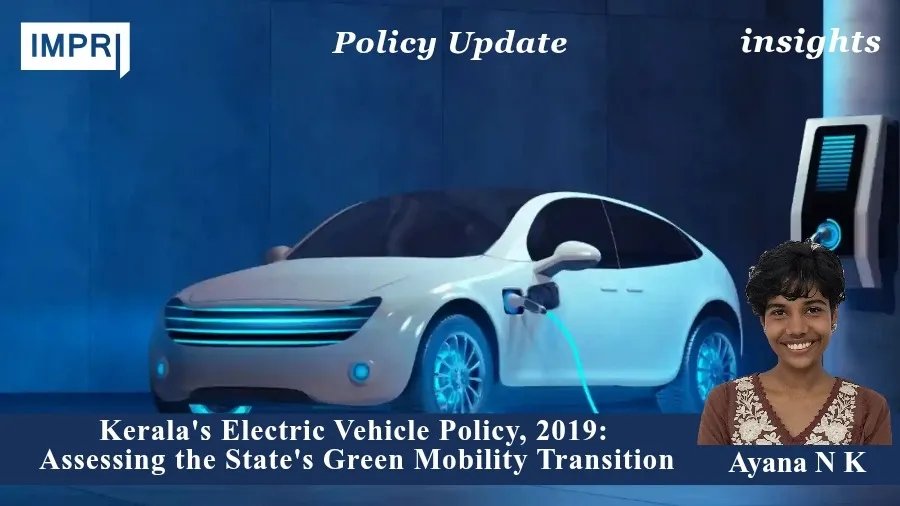
Kerala was among the earliest Indian states to formally recognise electric mobility as a policy priority. The Kerala Electric Vehicle Policy was notified by the Transport Department on 10 March 2019, with a validity period of five years from the date of notification. The policy was framed around the vision of embracing electric mobility as a tool to promote shared and clean transportation, ensure environmental sustainability, improve energy efficiency, and build a domestic ecosystem for manufacturing EV components within the state.
The rationale behind the policy stemmed from Kerala’s high vehicle density, rising urban air pollution, and the state’s stated commitment to national and global decarbonisation goals. The policy also sought to reduce the state’s dependence on imported fossil fuels by shifting road transport towards electricity, much of which Kerala sources from relatively cleaner hydel and renewable generation.
The most widely cited target of the policy was to bring one million (10 lakh) electric vehicles onto Kerala’s roads by 2022. This was to be achieved through an interim pilot fleet of 20,000 two-wheelers, 50,000 three-wheelers, 1,000 goods carriers, 3,000 buses, and 100 ferry boats by 2020. The policy also envisaged the progressive electrification of the Kerala State Road Transport Corporation’s (KSRTC) fleet of over 6,000 buses by 2025, beginning with pilot operations in Thiruvananthapuram.
To support adoption, the state offered a range of fiscal incentives: a 50 per cent concession on motor vehicle tax for five years for e-rickshaws and a 25 per cent concession for other EV categories, a purchase subsidy of ₹25,000–30,000 for electric three-wheelers procured from empanelled vendors, and an “e-mobility fund” of approximately ₹12 crore to support these subsidies. Kerala Automobiles Limited (KAL) was also identified as a nodal agency for developing local e-auto manufacturing capacity.
Functioning
Implementation of the policy has rested on a multi-agency framework. The Transport Department oversees registration incentives and regulatory provisions, while the Kerala State Electricity Board Limited (KSEBL) has been the principal agency for charging infrastructure roll-out, in coordination with central public sector entities such as NTPC and the Energy Efficiency Services Limited (EESL).
Under the policy’s charging infrastructure provisions, KSEBL was tasked with establishing public and bulk charging stations along highways at intervals of approximately 25 kilometres connecting major cities, along with pilot swapping outlets for two- and three-wheelers in Thiruvananthapuram, Ernakulam, and Kozhikode. A Time-of-Day (ToD) tariff structure was introduced for public and bulk charging stations to encourage off-peak charging and manage grid load. Building regulations were also amended to mandate that new non-residential complexes with more than 10 equivalent car spaces reserve at least 20 per cent of parking for EVs, while new residential complexes were required to fully demarcate EV-ready parking.
On public transport, KSRTC was mandated to install charging infrastructure at its depots and to progressively induct electric buses, supported where possible by central schemes such as PM e-Bus Seva. The policy also proposed a Centre of Excellence for EVs and autonomous vehicles, along with curriculum updates in technical institutions to build a skilled workforce for the sector.
Performance
Kerala’s EV adoption trajectory shows a clear inflection after 2022, even though the original headline target was missed by a wide margin. Against the goal of one million EVs by 2022, actual on-road adoption has climbed gradually rather than reaching that scale. According to the state’s Motor Vehicles Department (MVD), 83,268 electric vehicles were registered in Kerala in 2024, rising sharply to 1,06,993 in 2025, a year-on-year increase of 28.5 per cent. In 2025, EVs accounted for 12.1 per cent of the 8,78,863 total vehicles registered in the state that year, up from a total of 7.59 lakh registrations in 2023.
This growth has translated into a notable shift in EV-to-ICE (internal combustion engine) penetration. Data compiled by market analysts at Envirocatalysts shows Kerala’s EV penetration rising from barely 5 per cent in 2022 to 12.08 per cent in 2025, the second-highest among major EV-selling states after Delhi (13.91 per cent), and ahead of Karnataka (10.64 per cent) and Uttar Pradesh (9.89 per cent). Notably, Kerala’s adoption pattern differs from that of other leading states: while two-wheelers dominate EV sales nationally, four-wheelers make up around 18 per cent of Kerala’s EV sales compared to roughly 9 per cent in Karnataka, suggesting deeper middle-class adoption of personal electric cars in the state.
On infrastructure, data from the Ministry of Heavy Industries indicates Kerala had 1,389 charging stations by 2025, comprising 553 fast chargers and 836 slow chargers, developed jointly by private operators and KSEBL. This represents meaningful progress from the near-negligible base in 2019, though the pace and geographic spread of station roll-out remains uneven, with concentration in urban centres such as Thiruvananthapuram, Kochi, and Kozhikode.
Public transport electrification, however, tells a less encouraging story. Against the 2019 target of transitioning the KSRTC’s entire fleet of over 6,000 buses to electric by 2025, actual induction of e-buses has been limited, and in 2024 the state’s own Transport Minister publicly signalled a possible reversal toward diesel buses, citing cost concerns, a marked departure from the original policy’s cost-parity assumptions built around battery financing and lower running costs.
Impact
The policy’s impact must be assessed against its twin objectives of adoption and ecosystem-building. On the adoption front, Kerala has emerged as a genuine national leader in personal EV uptake, particularly for four-wheelers, and its EV-to-ICE penetration ratio now trails only Delhi among major states. This suggests that the combination of tax concessions, consumer awareness, and relatively developed charging infrastructure has meaningfully influenced household purchasing decisions, especially in urban and semi-urban Kerala.
However, the numerical target of one million EVs by 2022 was missed by a wide margin, and cumulative registrations have only crossed roughly two lakh in the years since, reflecting the gap between policy ambition and ground realities of vehicle cost, charging access outside cities, and consumer hesitancy in the early years of the policy.
The public transport component of the policy has underperformed most visibly. The wavering commitment to KSRTC electrification, including recent statements favouring diesel procurement, indicates that fiscal stress within the state transport corporation and underestimated capital costs have undermined one of the policy’s most visible decarbonisation levers. On the manufacturing front, envisaged outcomes such as a robust in-state EV component ecosystem and KAL-led e-auto manufacturing have seen only modest, localised progress rather than the ecosystem-scale transformation originally proposed.
Emerging Issues
Several structural concerns emerge from this assessment. First, there is a widening gap between personal vehicle electrification, which has accelerated well, and public/commercial fleet electrification, which has stagnated, raising equity concerns, since private EV adoption disproportionately benefits car- and two-wheeler-owning households rather than the wider public relying on state transport.
Second, charging infrastructure, while expanded, remains concentrated in major urban corridors, with rural and highway coverage falling short of the original 25-km interval commitment, creating range-anxiety barriers for inter-district travel.
Third, the policy’s five-year validity period lapsed in March 2024, and there is limited public evidence of a comprehensively updated or re-notified EV Policy 2.0 that resets targets against the state’s actual post-pandemic adoption curve, financing capacity, and grid-readiness — creating a degree of policy ambiguity for manufacturers and investors relying on long-term regulatory certainty.
Fourth, the reversal in commitment to KSRTC bus electrification highlights a broader financing challenge: state transport corporations across India, including Kerala’s, face fiscal stress that complicates the higher upfront capital costs of electric buses, even where lifecycle costs are lower, suggesting a need for dedicated capital financing instruments rather than reliance on operational budgets.
Finally, KSEBL’s capacity to absorb rising EV charging load through Time-of-Day tariffs and grid upgrades will require continuous monitoring as personal EV penetration approaches and potentially exceeds 15 per cent of new registrations in the coming years.
Way Forward
Kerala’s experience offers useful lessons for recalibrating the next phase of its EV transition. A formally updated EV Policy, reflecting realistic targets grounded in the 2022–2025 adoption trend rather than the original 2019 projections, would restore policy clarity for investors and consumers alike. This update should explicitly address financing mechanisms for KSRTC’s bus electrification, potentially through central schemes such as PM e-Bus Seva, green bonds, or public-private leasing models that separate capital cost from operational budgets.
Expanding charging infrastructure beyond urban clusters, particularly along tourist and inter-district highway corridors, would help sustain the state’s four-wheeler adoption momentum and address range-anxiety concerns for longer journeys. Strengthening the manufacturing and component ecosystem, including targeted support for battery assembly, e-auto production, and workforce skilling through the proposed Centre of Excellence, could help Kerala capture more value from its adoption leadership rather than remaining primarily a consumption market for vehicles manufactured elsewhere.
Finally, given Kerala’s comparatively high renewable and hydel share in its electricity mix, the state is well positioned to market its EV transition as a genuinely low-carbon mobility shift rather than merely a fuel-source substitution, provided grid capacity and tariff design keep pace with rising charging demand.
References
- EVreporter. (2024). Kerala EV Policy – Summary. https://evreporter.com/kerala-ev-policy-summary/
- EVreporter. (2024). Kerala Electric Vehicle Policy. https://evreporter.com/kerala-electric-vehicle-policy/
- Onmanorama. (2026, January 8). EVs make up 12% of new vehicle registrations in Kerala, record 28.5% rise. https://www.onmanorama.com/news/kerala/2026/01/08/kerala-vehicle-registration-rises-2025-mvd.amp.html
- Business Standard. (2026, January 15). Kerala overtakes bigger states in 2025 personal 4-wheeler EV adoption. https://www.business-standard.com/industry/auto/kerala-personal-ev-adoption-2025-126011500807_1.html
- Business Standard. (2026, January 14). Kerala charges ahead of bigger states in 2025 personal EV adoption. https://www.business-standard.com/industry/auto/kerala-charges-ahead-of-bigger-states-in-2025-personal-ev-adoption-126011401074_1.html
- The News Minute. (2024, January 21). Kerala Transport minister hints at reverting to diesel KSRTC buses. https://www.thenewsminute.com/kerala/kerala-transport-minister-hints-at-reverting-to-diesel-ksrtc-buses
- Drishti IAS. (2026, January 19). Kerala Leads Personal Electric Vehicle Adoption in 2025. https://www.drishtiias.com/state-pcs-current-affairs/kerala-leads-personal-electric-vehicle-adoption-in-2025
About the Contributor
Ayana N K is a Political Science graduate from the University of Calicut. With a keen interest in public policy, international relations, and development studies.
Acknowledgement
The author extends her sincere gratitude to the IMPRI team for their expert guidance and constructive feedback throughout the process.
Reviewed by Kaustav Majumdar and Shruthi Chandra.
Disclaimer
All views expressed in the article belong solely to the author and not necessarily to the organization.
Read more at IMPRI:
Tamil Nadu’s Kalaignar Magalir Urimai Thoga (2023): A State-Level Women’s Cash-Transfer Programme
Indian Resource Panel (InRP), 2015: From Resource Consumption to Resource Productivity.