









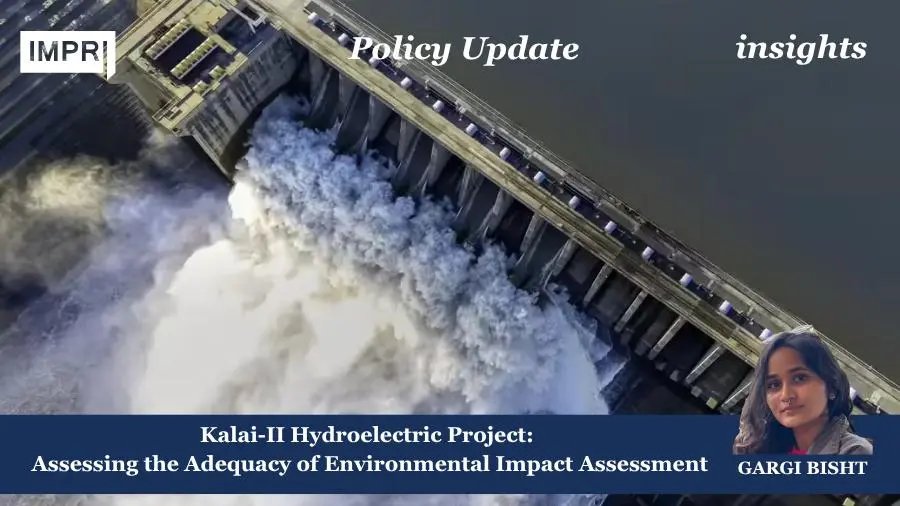
Policy Update
Gargi Bisht
Background
The Kalai II Hydroelectric project, a 1200 MW run of the river project on the Lohit river in Arunachal Pradesh received environmental clearance from the Ministry of Environment, Forest and Climate Change (MoEFCC) in June 2026. The project aims at strengthening India’s energy security by producing 4852.95 million units of energy annually.
Positioned as the capital of hydroelectricity generation, Arunachal Pradesh possesses around 40% of India’s total hydropower potential (Investment Division, Government of Arunachal Pradesh, 2021). With projects like the Ranganadi, and Kameng, including mega projects like Subansiri lower and Dibang in place, the state’s hydropower footprint continues to expand with this recent addition. Additionally, in face of China’s aggressive upstream dam building process, counter dams in India have emerged as the need of the hour to secure water flow and prevent sudden droughts and floods.
Functioning:
The Cabinet Committee on Economic Affairs in April 2026, approved an investment of Rs 14,105.83 Crore for construction of Kalai- II Hydro Electric Project (HEP, located on Lohit river in Anjaw district of Arunachal Pradesh, with an installed capacity of 1200 MW(6 x 190 MW x 60 MW)(PIB, 2026). Under the Environmental Impact Assessment (EIA) framework, Category – A projects undergo scoping, EIA preparation, public consultation and appraisal. The EIA process is intended to identify environmental impacts before approval, while the EAC evaluates the proposal and makes recommendations to MoEFCC. The EIA application is required to address ecological sensitivity, natural-resource use, risks and cumulative impacts.
The Kalai II project received the environmental clearance from the MoEFCC on 19th June 2026, and the estimated completion period for the project is 78 months (PIB, 2026) The project aims to generate 4852.95 MU of energy annually, to improve the infrastructure in Namsai and Anjaw district of Arunachal Pradesh, by building around 29 km of roads.
The project and its Environmental Clearance incorporates biodiversity and fish management measures alongside provisions for social rehabilitation. The project provides for compensation for acquired land under the Right to Fair Compensation and Transparency in Land Acquisition, Rehabilitation and Resettlement Act, 2013, and requires the commitments made during Public Hearing to be fulfilled.
The clearance also establishes safeguards for disaster and environmental management, including proper excavation, transport and disposal of muck and other solid waste. A Wildlife Conservation Plan, duly approved by the Chief Wildlife Warden, is required to be implemented in a time bound manner. Additionally, in the study area, the Takin (Budorcas taxicolor) has been identified as a Schedule I species and is classified as Vulnerable under the IUCN Red List, and Rs. 100 lakh has been allocated for implementation of its conservation plan. Additionally, compliance with these conditions is to be monitored by the Integrated Regional Office of MoEFCC through regular site visits and periodic compliance reports.
For Kalai II, the baseline environmental monitoring was conducted in three seasons – winter 2024, monsoon 2024, and pre monsoon 2025. Public consultation was conducted with 314 people attending, and the concerns raised were regarding impacts on fisheries, impact on flora and fauna, and outdated EIA data. However, the response clarified that the Cumulative Environment Impact Assessment Report has been prepared on new data and after consultation with the locals, field studies for which were undertaken in 2024.
Furthermore, to address the impact on aquatic life and fisheries, the response noted that sewage from labour camps during construction would be treated in sewage treatment plants (STP), prior to disposal, with a monitoring programme also in place. In order to conserve the migratory fishes, a detailed plan has been formulated that accounts for the environmental flows, stocking of reservoirs and development of hatcheries. (Kumar & THDC INDIA LIMITED, 2026)
The hydro-development financing model creates a joint venture company between the THDC (Tehri Hydro Development Corporation) and the Govt. of Arunachal Pradesh, where the Government of India extends budgetary support for construction of roads, bridges and transmission lines, besides Central Finance Assistance of Rs. 750 crore contributes towards equity share of the State. Furthermore, the State will receive 12% free power and an additional 1% earmarked for the Local Area Development Fund , along with significant infrastructure development and socio-economic benefits for the region (PIB, 2026).
Performance
Since the project has recently been given a clearance, there can be no performance analysis yet. Therefore, performance should be assessed through the quality of appraisal, and baseline assessment. On the positive end, the project underwent a formal Category A appraisal and incorporated cumulative impact assessment based on Lohit’s carrying capacity with environmental flow requirements set at a minimum of 15% of the average flow of the four leanest months, whichever is higher.
However, the assessment has attracted criticism over data adequacy and biodiversity coverage. The public consultations noted that EIA used old data and did not adequately address the challenges to fauna. Out of the 28 avian species listed in the EIA avian chapter, no reference has been made to the white bellied heron, protected under the Wildlife Protection Act. The white bellied heron is the second largest heron in the world, and it depends strictly on the free flowing Brahmaputra river by feeding on fishes in the rapids.
It has been claimed that its habitat overlaps with the downstream ecosystem of the Kalai II project. The Assam based environmentalist Bimal Gogoi pointed out that the EIA failed to make a single mention of the endangered species, despite the area being one of the few places that the species inhabits. Rohit Naniwadekar, a scientist with the Nature Conservation Foundation wrote that, “While the IUCN Red List notes that there are less than 250 birds in the wild, experts argue that the true number is possibly only 60.”
This is not the first incident of insufficient content in the EIA. An ORF analysis identifies weaknesses in Arunachal’s hydroelectric development. It argues that the Subansiri Lower EIA did not adequately address downstream areas in Assam, as it relied on data from 10km of the project site.
However, this criticism needs to be assessed as the government records indicate that the species was not recorded within the project area and the 2026 Forest Advisory Committee (FAC) noted the presence of White Bellied Heron is the larger and wider forest landscape, and argued that the project’s Wildlife Management Plan be reviewed by the Wildlife Institute of India, with special focus on protecting the bird’s habitat. The EC also mentions that the project proponent shall prepare a site- specific conservation plan and Wildlife Management Plan approved by the Chief Wildlife Warden. The recommendations of the same shall be implemented in consultation with the State Forest Department, furnished along a six- monthly compliance report.
The Kalai II project has therefore succeeded in creating multiple layers of appraisal and clearance. The assessment seems to have satisfied the formal stages of clearance while leaving important, downstream biodiversity questions insufficiently resolved.
Emerging Issues
- Under its Terms of Reference, the EC mentions “The height of the dam from river bed level is 128.5 m and the fish passage is not feasible in high dams”. Yet the EC under Green belt and Wildlife Management subsequently requires that a fish ladder/ pass be provided that is effectively monitored. This raises a significant question about the technical feasibility of the proposed mitigation.
- Independent environmental and post-Environmental and Social Impact Assessment studies are required only five years after commissioning. This creates an important accountability mechanism but means that the project’s actual environmental and social outcomes cannot be evaluated until substantially after implementation begins giving leeway to delayed detection, inadequate compliance and sub-standard initiatives.
- Arunachal’s hydroelectric projects operate in a geologically and tectonically sensitive region. Earlier projects have highlighted the inadequate sediment data, downstream impacts and disaster risk concerns, and suggest the dam appraisal moving beyond project-site engineering assessment towards basin-scale risk assessment.
- The focus on project side based assessment renders ignorance to the presence of the White Bellied heron, and the pooling of water poses direct threat to the survival of the already Critically Endangered species unless plans are made for its conservation.
Way Forward
The Kalai II project targets generating around 4,852.96 GWh of energy annually and aligns with India’s Nationally Determined Contribution commitments to renewable energy (500 GW by 2030). The project seems to highlight the distinction between procedural compliance and substantive environmental adequacy. While the project has completed the prescribed stages of environmental clearance, the effectiveness of the EIA process should be judged by the quality and completeness of the environmental evidence on which the clearance is based. Same has been iterated in the National Green Tribunal, which argues that merely going through the procedural steps of appraisal does not necessarily demonstrate that the environmental assessment itself was adequate (T. Muruganandam Case & Ors. v. Union of India & Ors).
Therefore, the biodiversity assessments for the Himalayan hydro projects should adopt an ecosystem approach rather than one being based only on project-site observations. Cumulative Impact Assessments should inform substantive and potential cumulative effects, rather than being treated primarily as information to be provided in Form 1. Furthermore, the basin level assessments should precede the approval of individual projects, and basin ecological studies should use multi-season and multi year dataset with independent validation in areas where threatened species and major ecosystem changes are involved. While the Kalai II project has undergone a comprehensive environmental assessment, ensuring long term ecological wellbeing will require a basin – level approach that accounts for cumulative impacts across the Lohit river basin .
References:
- Cabinet approves Investment Proposal for construction of 1200 MW Kalai-II Hydro Electric Project in Anjaw District of Arunachal Pradesh with an outlay of Rs.14105.83 crore. https://www.pib.gov.in/PressReleasePage.aspx?PRID=2250043®=3&lang=1
- https://nenow.in/environment/arunachal-environment-panel-clears-1200-mw-kalai-ii-hydro-project-amid-white-bellied-heron-concerns.html
- Hazarika, P. (2020, January 30). Dams do not mean development: the case of Hydro-Electric projects in north east India. Economic and Political Weekly. https://www.epw.in/engage/article/dams-do-not-mean-development-case-hydraulic
- Observer Research Foundation. (n.d.). Dams as disasters: Are the dams in Arunachal Pradesh aggravating flood damages in Assam? orfonline.org. www.orfonline.org/expert-speak/dams-as-disasters
- View of DEMYSTIFYING THE ENVIRONMENTAL CLEARANCE PROCESS IN INDIA. https://nujslawreview.org/index.php/lr/article/view/399/346
- Kumar, H. & THDC INDIA LIMITED. (2026). Kalai II Hydro Electric Project (Run-of-the-River) of (1200 MW) – Environmental Clearance (EC) – reg. In Ministry of Environment, Forest and Climate Change. https://thdc.co.in/sites/default/files/2026-06/Environment_Clearance_EC_Kalai_II_HEP_20260619_0.pdf
About the Contributor:
Gargi Bisht is a history postgraduate from Miranda House, specializing in medieval history. Her interest lies at the intersection of history, research, and public policy, exploring issues related to governance, society, development, and international relations.
Acknowledgement :
The author would like to express sincere gratitude to the IMPRI team for providing this valuable opportunity along with the reviewers Ameya Satam and Khushi for their valuable feedback.
Disclaimer:
All views expressed in the article belong solely to the author and not necessarily to the organisation.