









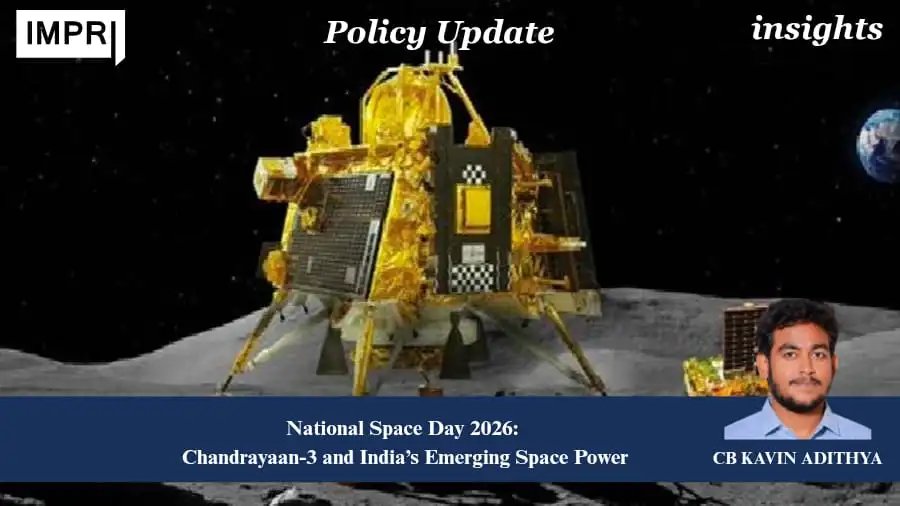
Policy Update
CB Kavin Adithya
Background
The annual observance of National Space Day on August 23rd serves as a commemoration of a significant national achievement: the successful soft landing of a spacecraft near the lunar south pole. This event represents a substantial advancement in the country’s scientific and technological capabilities, particularly within the domain of space exploration. The mission, identified as Chandrayaan-3, was conceived as a successor to the earlier Chandrayaan-2 mission.
Its launch was successfully executed on July 14, 2023, from the Satish Dhawan Space Centre (SDSC) SHAR, utilizing the LVM3-M4 launch vehicle. The primary objectives of Chandrayaan-3 were multifaceted, encompassing the demonstration of a secure and controlled landing on the lunar surface, the subsequent operation of a rover on this extraterrestrial terrain, and the performance of scientific experiments directly on the Moon to gather in-situ data.
The strategic importance of the Chandrayaan-3 mission was further amplified by the context of India’s expanding planetary exploration agenda and the promulgation of the Indian Space Policy in 2023. This policy framework, building upon earlier space sector reforms enacted in 2020, has substantially reshaped the landscape of space activities within the nation. The 2020 reforms were particularly pivotal as they formally sanctioned the participation of non-governmental entities, including non-governmental organizations (NGOs), across the entire spectrum of the space value chain.
This inclusive approach signals a broader national perspective that equates advancements in space technology with the nation’s overall progress, encompassing not only scientific and economic development but also strategic security interests and the cultivation of international partnerships. The integration of private and non-governmental actors into space endeavors underscores a recognition of their potential to contribute to national objectives and foster innovation.
Functioning
Chandrayaan-3 adopted a complex mission plan in three phases:
Launch and Transfer: The LVM3 rocket placed the integrated spacecraft into an Earth-centred orbit, and the Propulsion Module (PM) transferred it to a 100 km circular orbit around the Moon.
Descent and Landing: The Vikram lander separated from the propulsion module and executed a powered, autonomous descent using a suite of sophisticated navigation algorithms, including laser and RF altimeters, laser Doppler velocimeters, inertial sensors, throttleable liquid engines, and algorithms for hazard detection and avoidance.
Surface operation: The Pragyan Rover It was first deployed with the help of a ramp in order to undertake mobile,in situ investigation of the lunar surface.
Payload Configuration:
The payloads flown were RAMBHA-LP (to measure plasma density), ChaSTE (to investigate thermal properties), ILSA (to observe seismic activities), and LRA (Laser Retroreflector Array) provided by NASA. The rover payloads include LIBS and APXS, which are both qualitative and quantitative tools to analyze elemental and mineralogical composition. The SHAPE payload is mounted on the propulsion module, so it can observe the spectral and polarimetric features of the Earth from lunar orbit.
Performance
The Chandrayaan-3 mission, during its operational phase extending from 2023 to 2026, successfully achieved its primary objectives. The mission’s performance data provided detailed insights into the operational capabilities of the Pragyan Rover. This rover traversed approximately 100 meters across the lunar surface, performing in-situ analysis. A significant scientific outcome was the detection of sulfur (S) and other trace elements in the vicinity of the landing zone. This elemental analysis was facilitated by advanced instruments, notably the Laser-Induced Breakdown Spectroscopy (LIBS) instrument, which enabled precise identification of the chemical composition of the lunar regolith. The data gathered contributes substantially to our understanding of the Moon’s geological and chemical makeup, particularly in the South Polar region.
Ecosystem Growth and Space Technology Development:
The Indian space sector has experienced substantial growth, as documented in the Economic Survey 2025–26. This expansion is partly attributable to strategic financial support mechanisms. The Indian National Space Promotion and Authorization Centre (IN-SPACE) established a venture capital fund amounting to ₹1,000 crore, specifically aimed at fostering innovation and growth within the space industry.
Complementing this, a Technology Adoption Fund of ₹500 crore was also created to facilitate the integration and utilization of advanced space technologies. These financial instruments have demonstrably stimulated the private sector, leading to a significant increase in the number of active space start-ups in India, which has surpassed the 300 mark. This proliferation of start-ups indicates a vibrant and dynamic ecosystem, driving competition and novel solutions.
Furthermore, the Department of Space is projected to deliver approximately 231 key outputs and services leveraging space technologies by the year 2025. This ambitious target reflects a marked acceleration in the development and deployment of space-based technological services and operational capabilities. The increased pace signifies a maturation of the sector, enabling a wider range of applications and a greater impact on national development and scientific exploration. The synergy between government initiatives, financial support, and private sector entrepreneurship is evidently driving this upward trajectory in India’s space endeavors.
Impact
Strategic Autonomy: Proficiency in precision landing, autonomous navigation, and robust propulsion technologies reduces dependence on foreign systems, thereby strengthening India’s independent high-technology capabilities.
Space Security and Situational Awareness (SSA): The technical foundations established through planetary missions are essential for national space resilience, protecting assets, and managing orbital debris, especially as satellite constellations expand to support critical civilian infrastructure.
Space Diplomacy and The Global South: The success of Chandrayaan-3 has elevated India’s international standing, enabling New Delhi to lead development-focused diplomatic initiatives, disseminate scientific data worldwide, and advocate for the interests of developing nations within global space governance discussions.
Economic Transformation: The shift from a state-controlled framework to a collaborative network involving IN-SPACE, academic bodies, and private companies has stimulated the creation of high-skilled jobs and enhanced commercial competitiveness.
Emerging Issues and Stakeholder Priorities
Long-Term Scientific Utilization: A key issue is maximizing academic output from raw mission datasets. To address this, ISRO and academic institutions should expand collaborative open-research platforms and provide grants for student-led data analysis initiatives.
Lunar Mission Endurance: Surviving the extreme thermal and vacuum fluctuations of the lunar night presents a significant challenge. Future missions require the integration of advanced thermal management systems and backup power solutions, such as nuclear isotopes or enhanced solar technologies.
Space Security and Traffic Management: Increasing orbital congestion and the associated collision risks are critical concerns. Government and defense stakeholders must prioritize investment in indigenous Space Situational Awareness (SSA) networks.
Private-Sector Scalability: Start-ups face challenges in accessing specialized testing facilities and risk capital. IN-SPACE should streamline the sharing of public testing infrastructure and optimize the disbursement mechanisms for recently established venture funds.
International Governance: Evolving norms surrounding lunar resource extraction and orbital traffic management necessitate proactive engagement. The Ministry of External Affairs and the Department of Space should actively contribute to shaping multilateral frameworks that promote responsible space behavior.
Way forward
Chandrayaan-3 mission represents a crucial steppingstone, establishing a bedrock of capability upon which India can build a more comprehensive and enduring spacefaring presence. Its success is not merely an end in itself, but rather a catalyst for future endeavors that will require a multifaceted and integrated approach. To solidify India’s position among the world’s leading space nations, a strategic fusion of distinct yet interconnected domains are imperative.
This includes the sustained advancement of planetary science, fostering a resilient and technologically sophisticated defense infrastructure, harnessing the dynamism of private sector innovation, and engaging in proactive and strategic international collaborations. The objective is to systematically translate discrete mission achievements into robust, long-term institutional strengths.
By achieving this integration, India will transition from a position of merely demonstrating its capacity to access space technologies to one where it can actively influence and contribute to the evolving global space landscape, shaping its trajectory and setting new standards for international cooperation and exploration. This strategic alignment will enable the nation to leverage its scientific and technological prowess to address complex global challenges and opportunities within the space domain, thereby securing its long-term interests and enhancing its global standing.
References
Government of India. (2023). Indian Space Policy 2023. IN-SPACe. https://www.inspace.gov.in
Indian Space Research Organization. (2023). Chandrayaan-3 Details. Government of India. https://www.isro.gov.in/Chandrayaan3_Details.html
Indian Space Research Organization. (2024). Discovery of a buried crater on the Moon! Chandrayaan-3 Vikram lander and Pragyan rover landed within it. Physical Research Laboratory & ISRO Study published in Icarus. https://www.isro.gov.in/ch3_Discovery_of_a_buried_crater_on_the_moon.html
Indian Space Research Organization. (2025). Chandrayaan-3 Fly-by Mission Operations & Flight Dynamics Update. Government of India. https://www.isro.gov.in/Chandrayaan_3_Fly_by.html
Indian Space Science Data Center. (2024). Release of Chandrayaan-3 Science Data via PRADAN Portal. https://pradan.issdc.gov.in/ch3/
Ministry of Finance. (2026). Economic Survey 2025–26. Government of India. https://www.indiabudget.gov.in
About Contributor:
Kavin Adithya C.B. is a Research and Editorial Intern at IMPRI (Impact and Policy Research Institute). He is currently pursuing an M.A. in International Relations at Loyola College, Chennai. His academic and research interests include International Relations, International Political Economy, Defence and Security Studies, Public Policy, Geopolitics, and Human Rights. He is passionate about analyzing contemporary global affairs and strengthening his research and policy analysis skills through academic writing and public policy engagement.
Acknowledgement:
The author sincerely expresses gratitude to the reviewers and the editorial team for their valuable comments, constructive suggestions, and continuous guidance throughout the preparation of this article. Their insightful feedback significantly enhanced the clarity, organization, and analytical quality of the manuscript. The author also acknowledges the support and encouragement received during the research and writing process, which contributed to the successful completion of this work.
Reviewers:
Viksha and Ashi Verma, I sincerely thank the reviewers for their valuable time, careful evaluation, and constructive comments. Their insightful suggestions have helped improve the quality, clarity, and overall presentation of this article. I greatly appreciate their thoughtful feedback and the opportunity to revise the manuscript accordingly.
Publisher: Neha Kumari
Disclaimer:
All views expressed in the article belong solely to the author and not necessarily to the organization.
Read More at IMPRI:
Kalai-II Hydroelectric Project: Assessing The Adequacy Of Environmental Impact Assessment