




Policy Update
Riya Singh
Background
Integrated Coastal Zone Management (ICZM) is a coastal management process that considers geographical and political boundaries and focuses on sustainability. The concept was developed in 1992 during the Earth Summit in Rio de Janeiro and outlined in the proceedings of Agenda 21, Chapter 17.
The four documented goals of ICZM are:
- Maintaining functional integrity of coastal resource systems
- Reducing resource-use conflicts
- Maintaining environmental health
- Facilitating economic development
India has a long coastline of 7,500 km, harbouring diverse ecosystems and unique biodiversity. However, the coast faces myriad issues. The ‘Integrated Coastal Zone Management (ICZM) Project’ was launched by MoEF&CC in 2010 with assistance from the World Bank, operating under the Coastal Regulation Zone (CRZ) Notification, 2011 and Island Protection Zone (IPZ) Notification, 2011 framework.
Functioning
Five-step approach
- Situation assessment
- Plan
- Institutionalisation of plan
- Implementation
- Evaluation
The National Centre for Sustainable Coastal Management (NCSCM) was established by the Ministry of Environment, Forest and Climate Change (MoEF&CC) in 2011, as an autonomous institution to support the protection, conservation, rehabilitation, management, and policy advice of the coast. NCSCM supports the nationwide adoption of the Integrated Coastal Zone Management (ICZM) approach by utilizing decision support systems based on cutting-edge science and knowledge, and through networking with communities, government structures, and relevant reputable national and international institutes.
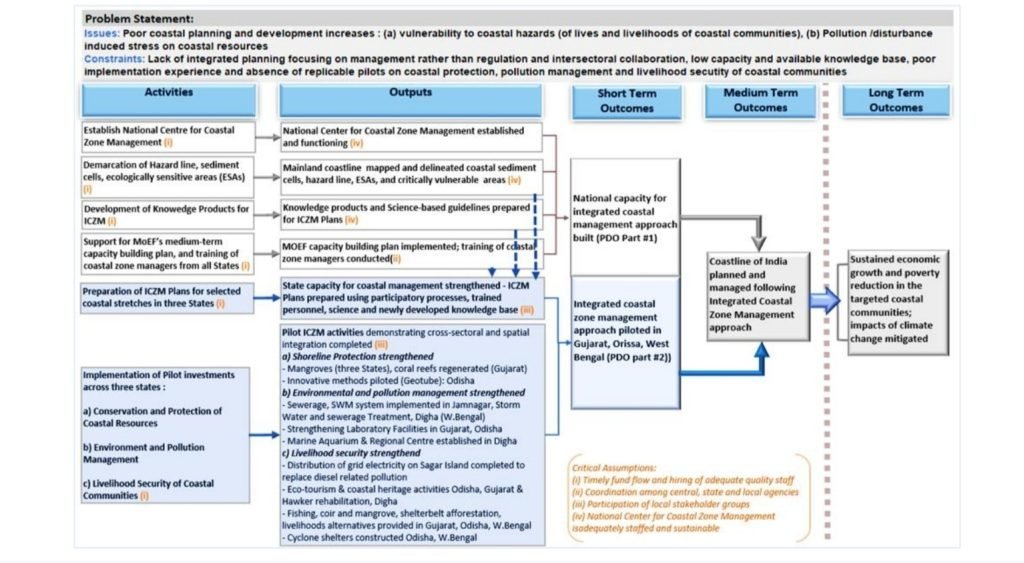
The project assists the government of India in building national capacity for implementation of a comprehensive coastal management approach in the country, and piloting the integrated coastal zone management in three states: Gujarat, Odisha and West Bengal. The primary objective of the ICZM is to focus on protecting the life and property of vulnerable coastal communities, as continuous depletion and degradation of coastal areas will impact their livelihood, health and well-being, and so prospects for India’s sustained economic growth. So that lessons learnt can be used and replicated in other Indian coastal states. On-field technical activities will include (1) construction of coastal protection infrastructure, (2) bioshield solutions associated with mangrove plantations and casuarina trees, (3) rehabilitation of coral reefs (4) sewage treatment plant

Performance
Over the last decade, the ICZM Project has demonstrated measurable progress in environmental restoration and community resilience.
National level evaluation:-
Institutional Development: Establishment of SICOM and NCSCM as central coordinating and scientific entities.
Mapping and Data Systems: Hazard line mapping for the entire 5,500 km mainland coast, delineation of 26 sediment cells, and identification of 34,160 km² of ecologically sensitive areas.
Capacity Building: More than 220 training programs, 26 workshops, and 13 international exposure visits conducted for officials and stakeholders.
State-level evaluation
Gujarat: Investment of US$58.18 million; mangrove plantation and coral reef regeneration covering 1,050 m²; a 71 MLD sewage treatment system in Jamnagar city with 60 MLD recycling capacity; and eco-tourism promotion benefiting over three million people.
Odisha: Investment of US$44.56 million across two coastal stretches (Gopalpur–Chilika and Paradeep–Dhamra). Construction of 13 cyclone shelters, mangrove restoration, shoreline protection at Pentha using geo-tubes, and livelihood improvement programs in 60 coastal villages.
West Bengal: Investment of US$48.77 million; restoration of mangroves, improvement of beaches, establishment of 24 cyclone shelters, and grid electrification of Sagar Island serving over 200,000 residents.
Collectively, these interventions have resulted in 199.41 km² of mangrove plantations, benefitting 1.5 lakh individuals across five cyclones. Livelihood diversification programs have led to a 20–25% increase in tourist arrivals and improved micro-enterprise income generation in coastal communities.
Impact
The implementation of the project leads to an overall Carbon Balance of around -5 million t CO2-e over the full analysis duration of 20 years. This is equivalent to -280 t CO2-e per hectare or -14 t CO2-e per hectare and year. With this impact, the project can be characterised as having very high benefits for climate change mitigation based on our assumptions.
Odisha -: Odisha State Disaster Management Authority (OSDMA) has executed & completed 14 Multipurpose Cyclone Shelters (MCS) within the project area without any environmental & social degradation, strengthened the community by providing corpus fund, shelter-level standardised emergency equipment and enhanced the capacity through different trainings.
Gujarat -: enhanced coastal and marine pollution monitoring capability of the Gujarat Pollution Control Board; completion of livelihood activities in 169 coastal villages, Odisha Pollution Control Board; construction of 14 cyclone shelters with community support for Operation and Maintenance
Tamilnadu-: The SICOM has established and operationalised a world-class Institute- National Centre for Sustainable Coastal Management (NCSCM) at Anna University, Chennai, which aids in the better protection, conservation, rehabilitation, management and policy design of the coast.

Emerging issues
Although the project is working efficiently towards growth, some problems persist that need to be resolved. Some of the important issues prevailing are-
- Information and Awareness Gaps:- There is a huge information gap among stakeholders regarding the basic goal and scope of the ICZM project.
- Weak Internal Communication:- It has no coordination mechanisms among various departments working on coastal areas (including fisheries, shipping, rural development, etc.).
- Limited Stakeholder Participation:- Due to low involvement of fishermen, SHGs, NGOs, and local communities in planning stages, the Coastal communities often viewed ICZM as government-driven, not participatory.
- Transparency and Accountability Gaps:- There is a lack of clear grievance redressal mechanisms within the project for beneficiaries.
Way Forward
- Integrated Governance:- There is a need to add an ICZM Coordination Cell under MoEF&CC to ensure coordination across ministries and coastal authorities.
- Improved Communication:- Developing multilingual knowledge sharing campaigns and digital platforms to popularise ICZM objectives, its success stories, and CRZ information.
- Transparency Over Data:- Need to build a transparent dashboard system which uses live project data, costings and environmental statistics.
- Capacity & Gender Cultivation:- Regular training in ICZM principles or gender concepts to support women’s role in coastal governance.
- Community-based Conservation drive:- Developing capacities of local institutions and SHGs for grassroots level operation and maintenance of coastal assets.
- Research & Innovation: Utilisation of NCSCM’s scientific strength for creating decision support tools and AI-based coastal vulnerability mapping through geospatial analytics.
Conclusion
These actions will enhance the ICZM vision of “Saving Lives and Livelihoods, Saving the Coast” by supporting long-term sustainability, resiliency and equitable development in their coastal areas.
References–
United Nations Conference on Environment & Development. (1992). Agenda 21: The United Nations programme of action from Rio [PDF]. https://sustainabledevelopment.un.org/content/documents/Agenda21.pdf United Nations+2Sustainable Development Platform+2
Thia-Eng, C. (1993). Essential elements of integrated coastal zone management. Ocean & Coastal Management, 20(1-3), 149-163. https://www.sciencedirect.com/science/article/abs/pii/096456919390021P?via%3Dihub ScienceDirect
The World Bank. (2020, December). India – Integrated Coastal Zone Management Project: Implementation completion and results report [Report No. ICR00005155; Project ID P097985] [PDF]. https://documents1.worldbank.org/curated/en/790091609383933691/pdf/India-Integrated-Coastal-Zone-Management-Project.pdf World Bank
National Centre for Sustainable Coastal Management. (n.d.). About us. https://ncscm.res.in/about-us/ ncscm.res.in
Food and Agriculture Organization of the United Nations. (n.d.). India mangrove restoration: Blue carbon case studies [PDF]. https://www.fao.org/fileadmin/templates/ex_act/pdf/Blue_Carbon_case_studies/India_mangrove_restoration.pdf
Odisha State Disaster Management Authority. (n.d.). Integrated Coastal Zone Management Project. https://www.osdma.org/integrated-coastal-zone-management-project/#gsc.tab=0
Envirobiotech Journals. (2021, February). Environmental Engineering & Computers (Vol. 27). https://www.envirobiotechjournals.com/EEC/v27FebSupplIssue2021/EEC-27.pdf
IESWM – Water Resource Main Project Progress. (n.d.). Project progress: Physical. https://ieswm.wb.gov.in/water-resource/main/project_progress_physical.php
The World Bank. (2020, December). India – Integrated Coastal Zone Management Project: Implementation completion and results report [Report No. ICR00005155; Project ID P097985] [PDF]. https://documents1.worldbank.org/curated/en/790091609383933691/pdf/India-Integrated-Coastal-Zone-Management-Project.pdf (See item 3 above)
IESWM – Water Resource. (n.d.). Communication strategy for Gujarat, Orissa, West Bengal [PDF]. https://ieswm.wb.gov.in/water-resource/main/pdf/media_plans/communication-strategy%20for%20gujarat-%20orissa-westbengal.pdf
About the Contributor:
Riya Singh is a Research Intern at IMPRI. She is a student of the Master of Arts in Public Policy and Governance at the Tata Institute of Social Science, Hyderabad and holds a bachelor’s degree in Political Science from the University of Delhi. Her research interests lie in government policy and data analysis.
Acknowledgment: The author sincerely thanks Ms. Aasthaba Jadeja, Ms. Bhaktiba Jadeja and the IMPRI team for their valuable support
Disclaimer: All views expressed in the article belong solely to the author and not necessarily to the organisation.