







Asmatwali
Background
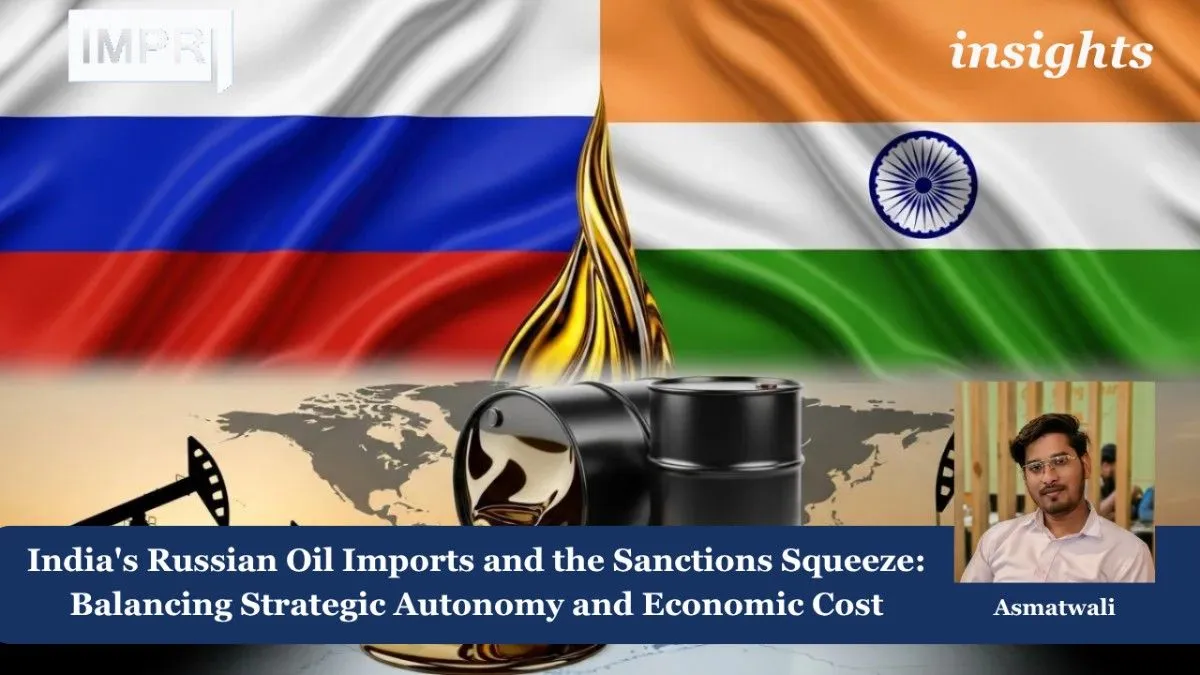
Since 2022, India’s energy import strategy has undergone a dramatic transformation. Following Russia’s invasion of Ukraine and the resulting Western sanctions on Moscow, European buyers shunned Russian crude, creating a large pool of discounted oil. India, as the world’s third-largest crude oil consumer after the US and China, capitalised on this opportunity. Russia’s share of India’s crude oil imports rose from a negligible 1.7% in 2019-20 to approximately 35-39% by 2024-25 — transforming Russia from a marginal supplier into India’s single largest source of crude oil, displacing traditional partners Iraq, Saudi Arabia, and the UAE. (Center for Strategic and International Studies, 2025; Vision IAS, 2025)
India’s government has consistently defended these purchases on three grounds: energy security for a price-sensitive economy of 1.4 billion people, the stabilisation of global oil markets (preventing a supply-shock-driven price spiral that would have hurt all consumers, including Western ones), and the principle of strategic autonomy — India’s longstanding doctrine of independent foreign policy decision-making, irrespective of bloc pressures. Notably, the Ministry of External Affairs (MEA) has pointed out that in 2022, the United States itself had encouraged India to continue purchasing discounted Russian oil to help stabilise global energy markets.
However, by 2025, this arrangement came under unprecedented multilateral pressure. Three separate but converging tracks of sanctions and tariffs — from the United States, the European Union, and the United Kingdom — began directly targeting India’s oil trade with Russia, marking the first time India faced tangible economic costs for a policy it had defended as sovereign and strategically autonomous.
Functioning
The sanctions architecture targeting India’s Russian oil trade functions through three overlapping and mutually reinforcing mechanisms:
US Tariff Mechanism
The United States employed a two-tier tariff structure. Executive Order 14326 (July 31, 2025) imposed a baseline 25% reciprocal tariff on Indian goods as part of a broader global tariff recalibration under the Trump administration. Executive Order 14329 (August 6, 2025) added a further 25% penalty — explicitly justified by India’s continued Russian crude purchases — bringing the cumulative tariff on Indian exports to the US to 50%. This made India’s tariff burden among the highest applied to any major US trading partner, despite ongoing bilateral trade negotiations.
EU Secondary Sanctions Mechanism
The European Union’s 18th sanctions package introduced an indirect or ‘secondary’ sanctions logic — rather than directly sanctioning India, it banned the import of refined petroleum products derived from Russian crude, regardless of the refining country. Since India exported approximately USD 14.3 billion worth of petroleum products to the EU in 2024-25, much of it refined from discounted Russian crude, this measure structurally threatened a significant revenue stream for Indian refiners, particularly Nayara Energy and Reliance Industries. (Centre for Social and Economic Progress, 2025; Oil & Gas Journal, 2025).
UK and Targeted Entity-Level Sanctions
The United Kingdom directly designated Nayara Energy Limited operator of the Vadinar refinery in Gujarat (20 million tonnes per annum capacity, ~8% of India’s refining capacity) citing its import of about 100 million barrels of Russian crude, valued at over USD 5 billion, in 2024. Nayara’s structural vulnerability stems from Rosneft’s 49.13% ownership stake, which exposes it directly to sanctions regardless of operational decisions, distinguishing it from other Indian refiners that have greater flexibility to diversify.
Corporate-Level Differentiation
The sanctions regime has produced sharply divergent corporate responses, reflecting India’s market-driven (rather than state-directed) energy procurement model:
India’s largest crude buyer, with a long-term Rosneft supply contract (up to 500,000 b/d), announced suspension of new Russian imports following October 2025 US sanctions, while retaining flexibility to process non-Russian crude for EU-compliant exports (Reliance Industries).
Both state-linked refiners announced plans to suspend future Russian crude imports. Mangalore Refinery and Petrochemicals Ltd (MRPL) and HPCL-Mittal Energy Ltd:
Due to Rosneft’s 49.13% ownership, continued Russian crude intake even after EU/UK sanctions, reportedly resorting to a ‘dark fleet’ of unregistered tankers and Russian-arranged shipping/insurance to sustain operations at 70-80% capacity (Nayara Energy).
Performance
Trade and Import Data
| Indicator | Figure |
| Russia’s share of India’s crude imports, FY 2019-20 | 1.7% |
| Russia’s share of India’s crude imports, FY 2024-25 | ~35.1% – 39% (estimates vary by source: MEA, CFR, The Diplomat) |
| India’s total crude consumption, 2025 | 265.7 million metric tonnes (3.7% annual growth) |
| Peak Russian oil imports, August 2025 | ~2 million barrels/day (~38% of total crude purchases) |
| Russian crude inflows, January 2026 | 436,000 b/d (down from ~1.5 million b/d in January 2025) |
| US crude/LNG/LPG exports to India, January 2026 | 235,000 b/d (up from 141,000 b/d, January 2025) |
| India’s petroleum product exports to the EU, 2024-25 | ~USD 14.3 billion (majority refined from discounted Russian crude) |
| Cumulative US tariff burden on Indian goods | 50% (25% reciprocal + 25% Russia-linked penalty) |
| India-Russia bilateral trade target by 2030 | USD 100 billion |
| Nayara Energy refining capacity | 400,000 b/d (Vadinar, Gujarat); ~8% of India’s total refining capacity |
| Nayara post-sanctions operating capacity | 70-80% (down from near-full capacity) |
Diplomatic Performance — India’s Counter-Narrative
| Argument Advanced by India (MEA / EAM Jaishankar) | Supporting Evidence |
| India is not the ‘biggest buyer’ of Russian energy | China and the EU continue to outpace India’s Russian energy purchases in absolute terms |
| Double standards by Western critics | The EU maintained EUR 67.5 billion in goods trade with Russia in 2024, plus an estimated EUR 17.2 billion in services trade (2023) |
| The US itself encouraged the policy in 2022 | Jaishankar (Feb 2026, Munich; June 2026, Kultaranta Talks): US officials said buying Russian oil would stabilise global prices |
| Strategic autonomy is non-negotiable and cross-partisan | Jaishankar, Munich Security Conference, Feb 2026: ‘very much wedded to strategic autonomy… cuts across the political spectrum’ |
| Diversification is market-driven, not coerced | Piyush Goyal: purchase decisions rest with companies based on commercial interest, not government directive |
Impact
Economic Cost of the Tariff Penalty
The cumulative 50% US tariff represents the most direct economic cost India has incurred for its Russian energy policy. This tariff level places Indian exports — particularly in textiles, gems and jewellery, and engineering goods — at a severe competitive disadvantage relative to peer exporting nations such as Vietnam and Bangladesh, which face substantially lower US tariff rates. The penalty tariff specifically linked to Russian oil purchases also sets a precedent: it is the first instance of a major Western power imposing a direct trade penalty against India over a strategic autonomy disagreement.
Financial Sector Spillover
The EU and UK sanctions on Nayara Energy created ripples across India’s banking sector. State Bank of India, India’s largest lender, halted trade and foreign currency transactions linked to Nayara as a pre-emptive measure to protect its own US and European operations from secondary exposure. This illustrates how sanctions on a single entity can generate broader de-risking behaviour across India’s financial system — a dynamic with precedent in how Indian banks handled Iran-related sanctions in the past.
Validation — and Limits — of Strategic Autonomy
India’s diplomatic response has been notably assertive rather than defensive. By publicly highlighting the European Union’s own continued trade with Russia (EUR 67.5 billion in goods in 2024), and by revealing that the US itself had encouraged the 2022 purchases, India has sought to reframe the issue from ‘India violating sanctions norms’ to ‘the West applying double standards’. This rhetorical strategy has had moderate success in shaping the narrative domestically and among Global South audiences, but has not reversed the underlying tariff and sanctions measures themselves, indicating that strategic autonomy, as a rhetorical posture and as an economic shield, has diverging trajectories.
Market-Driven Diversification as De Facto Policy Adjustment
Despite the rhetoric of unwavering autonomy, actual import data shows substantial behavioural change: Russian crude inflows fell from ~1.5 million b/d (January 2025) to 436,000 b/d (January 2026), a decline of over 70%, while US energy exports to India rose by two-thirds over the same period. The government’s framing of this shift as purely ‘commercial’ and ‘company-driven’ allows India to simultaneously claim continuity of strategic autonomy (no policy reversal) while quietly accommodating Western pressure (substantial import diversification), an exercise in diplomatic ambiguity rather than open recalibration.
Differential Impact Across the Refining Sector
The episode has revealed structural vulnerabilities specific to ownership structures rather than to India’s energy policy per se. Nayara Energy’s predicament continued Russian crude dependency due to Rosneft’s near-50% equity stake, a company-specific liability that has become a national diplomatic and reputational issue, illustrating how foreign direct investment structures from a decade ago can generate unanticipated foreign policy complications years later.
Emerging Issues
As long as Rosneft retains its 49.13% stake, Nayara will remain a sanctions target irrespective of India’s broader diversification trend. The Government of India, along with Indian lenders and regulators, needs a clear policy on whether to facilitate a stake restructuring or divestment by Rosneft, and how to protect the ~6,600 fuel stations and downstream employment dependent on Nayara’s operations. Nayara Energy as a Standing Diplomatic Liability:
The cumulative 50% US tariff creates a structural disadvantage for India relative to ASEAN exporters. A sustained trade negotiation track distinct from the energy dispute is needed to de-link tariff relief from the Russian oil question, or to negotiate a phased reduction tied to verified diversification. Tariff Asymmetry vis-à-vis Competitor Economies:
The gap between India’s public ‘undiminished strategic autonomy’ narrative and the empirically observed >70% drop in Russian crude inflows risks being characterised internationally as policy reversal under pressure rather than principled autonomy, a framing India should proactively manage through transparent communication of its energy diversification roadmap. Narrative vs. Reality Gap:
SBI’s pre-emptive halt of Nayara-linked transactions illustrates a broader risk: Indian financial institutions with global exposure may pre-emptively comply with foreign sanctions even in the absence of formal Indian government direction, effectively allowing foreign sanctions regimes to shape domestic financial sector behaviour. This warrants a coordinated RBI-MEA-Ministry of Finance framework for managing future sanctions exposure. Banking Sector De-Risking Precedent:
With the EU’s Russian LNG import ban taking effect from April 2026 (with legacy-contract exemptions until 2027), India must assess whether Indian LNG importers face similar downstream restrictions on LNG-derived products in European markets, and proactively diversify LNG sourcing (US, Qatar, Australia) ahead of any extension of secondary sanctions logic to gas. LNG Diversification Timeline:
Given the volatility demonstrated by this episode, India’s strategic petroleum reserve capacity (currently sufficient for under 10 days of consumption) should be expanded as a buffer against future supply-side sanctions shocks, regardless of which supplier relationship is affected. Strategic Petroleum Reserve Expansion:
Way Forward
India’s handling of the Russian oil sanctions squeeze illustrates both the strengths and the structural limits of strategic autonomy as a foreign policy doctrine in an era of weaponised interdependence. Four priorities should guide India’s approach going forward.
First, India should institutionalise a transparent, publicly communicated energy diversification roadmap, one that frames the ongoing shift away from Russian crude not as capitulation to sanctions, but as a long-planned diversification strategy consistent with energy security goals. This would help close the gap between rhetoric and observable trade data.
Second, India must pursue a structural resolution to the Nayara Energy situation, including exploring options for Rosneft’s partial or full divestment, government-facilitated refinancing through non-exposed lenders, or formal government engagement with EU/UK authorities to seek an operational carve-out, given Nayara’s importance to India’s domestic fuel retail network.
Third, India should de-link the trade negotiation track from the energy policy track in talks with Washington, pursuing an India-US trade agreement on its own merits (covering tariffs on textiles, pharmaceuticals, and engineering goods) while continuing diversification of energy imports as a parallel, separately justified commercial process.
Fourth, India should expand its Strategic Petroleum Reserve and accelerate diversification of LNG and crude sourcing across the Gulf, the Americas, and Africa, reducing structural dependence on any single supplier and thereby reducing the leverage that future sanctions regimes, whichever country they target, could exert over India’s energy security.
Ultimately, the episode underscores that strategic autonomy in the 21st century cannot rest solely on the principle of non-alignment; it requires the economic and infrastructural depth of diversified suppliers, robust reserves, and resilient financial institutions to make that principle materially sustainable when tested by great-power competition.
About the Contributor
Asmatwali is a research and editorial intern at IMPRI. He is a scholar at Aligarh Muslim University, working on the Iran–Israel rivalry in a multipolar world and its implications for India’s foreign policy since 2014.
Disclaimer: All views expressed in the article belong solely to the author and not necessarily to the organisation.
Read More at IMPRI:
India Between Iran and Israel: Balancing Strategy in a Time of Crisis
India–Middle East–Europe Economic Corridor (IMEC): A New Connectivity Vision
Acknowledgement
The author expresses his sincerest gratitude to IMPRI (Impact and Policy Research Institute) for providing him with the opportunity to prepare this policy update article and for fostering a rigorous learning environment that connects research with public policy practice.
He also extends his sincere thanks to Lubina Dua & Simona Miriam Hughes for their valuable feedback, useful suggestions, and support in shaping this article.
This article was posted by Yashkirti Pal, a Research and Editorial Intern at IMPRI.