








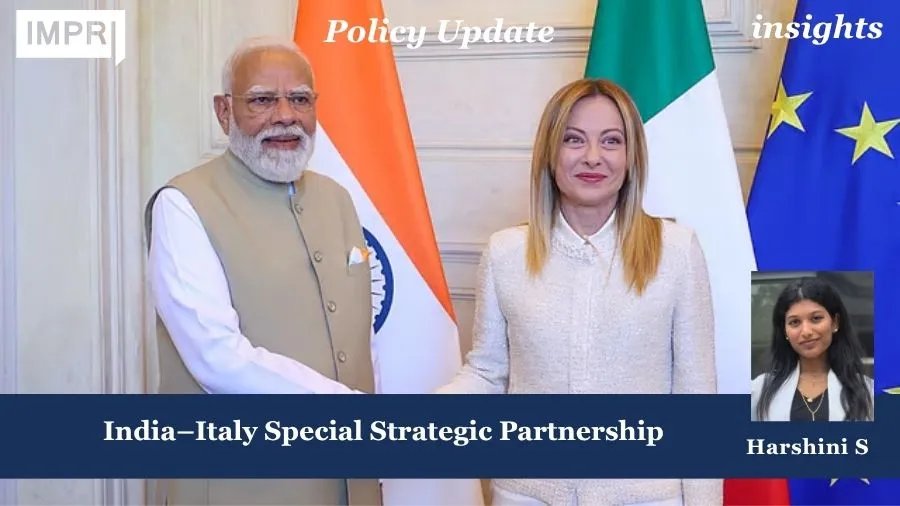
Policy Update
Harshini S
Background
The elevation of the India–Italy relationship to a Special Strategic Partnership in March 2023 during the official visit of Italian Prime Minister Giorgia Meloni to New Delhi marked a decisive shift in the trajectory of bilateral engagement between India and Italy. While diplomatic ties between the two countries date back to the post-independence period, the partnership upgrade reflected a recognition that the existing framework was insufficient to address the scale and complexity of emerging geopolitical and economic challenges (Ministry of External Affairs, 2023). The decision was shaped by converging interests in supply chain diversification, advanced manufacturing, clean energy transitions, defence cooperation and greater coordination in multilateral governance forums.
Historically, India–Italy relations were characterised by steady but limited engagement, largely focused on trade, cultural exchanges and periodic political dialogue. Italy has traditionally been among India’s important economic partners within Europe, though overshadowed by India’s deeper ties with countries such as Germany, France and the United Kingdom. The post-2020 global context, marked by the COVID-19 pandemic, disruptions in global value chains and intensifying geopolitical competition, created new incentives for both sides to re-evaluate their partnership. Italy’s industrial structure, dominated by globally competitive small and medium enterprises specialising in precision manufacturing, machinery, automotive components and design-intensive goods, aligns closely with India’s domestic development priorities under initiatives such as Make in India and Atmanirbhar Bharat (PIB, 2023).
The objectives of the Special Strategic Partnership are broad but clearly articulated. They include strengthening political and strategic coordination, expanding defence and security cooperation, scaling up bilateral trade and investment, deepening collaboration in clean energy and climate action and promoting innovation-led growth through science, technology and academic cooperation. The partnership also aims to enhance people-to-people ties, particularly through education, research and skilled mobility. Since 2023, the policy timeline has emphasised moving from declaratory statements to actionable cooperation, with sector-specific Memoranda of Understanding, institutional dialogues and business and innovation platforms forming the core instruments of implementation. The beneficiaries of this partnership span a wide spectrum, including industrial firms, defence manufacturers, startups, research institutions, universities, students and skilled professionals in both countries.
Functioning
The functioning of the India–Italy Special Strategic Partnership is underpinned by a multi-layered institutional architecture designed to ensure political continuity, sectoral depth and operational follow-through. At the highest level, summit meetings between political leaders provide strategic direction and signal commitment, while regular interactions between foreign and defence ministers enable alignment on regional and global issues such as maritime security, counter-terrorism and multilateral reform (MEA, 2023). These dialogues have assumed greater significance as India’s role in the Indo-Pacific has expanded and Italy has sought to recalibrate its external engagement beyond its immediate European neighbourhood.
Economic cooperation operates primarily through the India–Italy Joint Commission for Economic Cooperation, which serves as the principal platform for trade, investment and industrial collaboration. This mechanism is supported by business forums, investment promotion agencies and sector-specific working groups involving industry associations from both sides. Invest India, in coordination with Italian trade and investment bodies, plays a facilitating role by identifying investment opportunities, assisting with regulatory navigation and addressing operational bottlenecks faced by firms (Ministry of Commerce and Industry, 2024). In recent years, this framework has increasingly focused on high-value sectors such as advanced manufacturing, renewable energy equipment, automotive components and digital technologies.
Defence cooperation forms a central pillar of the partnership’s strategic dimension. The operational framework emphasises industrial collaboration, co-development and co-production, consistent with India’s defence indigenisation objectives. Italy’s strengths in aerospace platforms, naval systems, avionics and defence electronics offer complementarities with India’s expanding defence manufacturing ecosystem. Scientific and technological cooperation functions through joint research calls, university-to-university partnerships and innovation ecosystems that connect startups, incubators and public research institutions. Programmes facilitating academic exchanges and collaborative research in areas such as materials science, clean energy and artificial intelligence have gained prominence in recent years (OECD, 2024).
Despite this dense institutional framework, several implementation challenges persist. Secondary literature on India–EU economic engagement highlights regulatory complexity, slow project approvals, limited awareness among SMEs and differences in procurement and compliance norms as recurring constraints (European Commission, 2024). These issues have limited the pace at which institutional intent is translated into tangible outcomes, particularly in defence and high-technology sectors.
Performance
In quantitative terms, the performance of the India–Italy Special Strategic Partnership over the last two to three years presents a mixed picture. Bilateral trade has demonstrated moderate but consistent growth, reaching approximately USD 14–15 billion in 2024–25, according to official data from the Ministry of Commerce and Industry (2024). India’s exports to Italy have been led by engineering goods, pharmaceuticals, chemicals, textiles and refined petroleum products, reflecting India’s competitive strengths in manufacturing and process industries. Italy’s exports to India have largely comprised high-end machinery, industrial equipment, automotive components and luxury goods, underscoring Italy’s comparative advantage in precision manufacturing and design-intensive sectors.
Foreign direct investment flows from Italy into India have remained stable but below estimated potential. Data from the Department for Promotion of Industry and Internal Trade indicate that Italian investments are concentrated in automotive manufacturing, renewable energy equipment, food processing and industrial automation, with relatively limited penetration into emerging sectors such as digital technologies and advanced materials (DPIIT, 2024). Policy signals from budget documents, ministry updates and Press Information Bureau releases suggest increased diplomatic and trade facilitation efforts, including high-level business delegations, sector-focused investment roadshows and targeted dialogues aimed at addressing market access and regulatory issues (PIB, 2024).
Defence cooperation has progressed more slowly in measurable terms. While pilot-level industrial engagements and exploratory discussions on co-development have taken place, large-scale procurement contracts or major co-production projects remain limited. Parliamentary debates and official assessments indicate that procedural complexity, long procurement timelines and technology transfer sensitivities continue to constrain outcomes in this area (MEA, 2024). Overall, performance data suggest that while trade and diplomatic engagement have shown steady improvement, defence and high-technology cooperation have yet to realise the full potential envisaged under the Special Strategic Partnership.
Impact
The impact of the India–Italy Special Strategic Partnership extends beyond immediate trade and investment metrics, influencing broader strategic and developmental objectives. For India, the partnership has contributed to diversifying European engagement beyond a narrow set of traditional partners, reducing over-dependence on any single country or region. Access to Italian expertise in advanced manufacturing, industrial design and high-quality machinery has supported India’s efforts to upgrade domestic manufacturing capabilities and integrate into specialised European value chains (European Commission, 2024).
For Italy, deeper engagement with India offers a pathway to internationalise its SME sector, access a large and growing consumer market and participate in India’s infrastructure, renewable energy and urban development programmes. Strategically, the partnership enhances Italy’s presence in the Indo-Pacific and aligns with its broader objective of expanding partnerships with democratic and economically dynamic countries outside Europe.
At the geopolitical level, the partnership supports India’s pursuit of strategic autonomy by expanding defence and technology partnerships beyond a limited group of suppliers. Italy benefits from closer ties with a major Asian power that plays an increasingly influential role in global governance and regional security. Early impacts are visible in joint innovation initiatives, academic collaborations and closer coordination in multilateral forums such as the G20. However, policy analysts caution that the partnership’s long-term strategic significance will depend on sustained implementation, institutional learning and the ability to scale up successful pilot initiatives into durable cooperation frameworks (OECD, 2024).
Emerging Issues
The execution of the India–Italy Special Strategic Partnership has revealed a number of emerging challenges that merit policy attention. Defence industrial cooperation has been constrained by sensitivities surrounding technology transfer, complex procurement procedures and differences in regulatory and certification standards, limiting the scale and speed of joint projects. SME collaboration has underperformed relative to potential due to information asymmetries, compliance costs and insufficient institutional support for smaller firms navigating cross-border regulations. Investment flows remain below estimated potential, reflecting investor concerns regarding regulatory predictability, dispute resolution mechanisms and the availability of sector-specific incentives.
In addition, despite growing demand for skilled professionals, researchers and students, constraints related to mobility regimes, visa procedures and mutual recognition of qualifications continue to limit people-to-people and knowledge exchanges. These issues are frequently highlighted in industry feedback, policy reviews and European Commission assessments of EU–India economic engagement (Ministry of Commerce and Industry, 2024; European Commission, 2024).
Way Forward
Looking ahead, the India–Italy Special Strategic Partnership requires consolidation through focused, outcome-oriented implementation rather than further expansion of broad frameworks. Greater alignment between flagship initiatives such as Make in India, Digital India and Italy’s industrial innovation and SME strategies can unlock complementarities and improve delivery. Shifting from a proliferation of Memoranda of Understanding to a smaller number of high-impact projects in defence manufacturing, clean energy, advanced materials and industrial automation would enhance credibility and momentum.
Strengthening SME facilitation mechanisms through dedicated support platforms, accelerating regulatory coordination and expanding academic and skill mobility arrangements can deepen the partnership’s economic and social foundations. Over time, such an approach can ensure that the partnership contributes meaningfully to India’s broader global engagement strategy and Italy’s long-term interests in the Indo-Pacific, transforming the Special Strategic Partnership from a declaratory framework into a results-oriented strategic relationship.
References
European Commission. (2024). EU–India economic relations and member state engagement. Brussels. https://commission.europa.eu/index_en
India-Italy Joint Declaration, elevation to Special Strategic Partnership. Press Information Bureau / Prime Minister of India, May 2026.
https://www.pmindia.gov.in/en/news_updates/india-italy-joint-declaration/?comment=disable
India-Italy Joint Statement during the State Visit of the Prime Minister of Italy to India, 02-03 March 2023. Government of Italy. https://www.governo.it/sites/governo.it/files/India-Italy_JointStatement_20230302_EN.pdf
Italy-India Joint Strategic Action Plan 2025-2029 (Official).
https://www.pmindia.gov.in/en/news_updates/italy-india-joint-strategic-action-plan-2025-2029/
India–Italy Trade and Economic Relations overview (IBEF).
https://www.ibef.org/indian-exports/india-italy-trade
Ministry of External Affairs, Secretary (West) on bilateral MoUs and elevated partnership. ANI report. https://economictimes.indiatimes.com/news/economy/foreign-trade/india-italy-signed-critical-mous-in-various-sectors-says-mea-secy-west/articleshow/131238030.cms
PM pens a joint op-ed with Italian Prime Minister Giorgia Meloni on India-Italy relations. Press Information Bureau / Prime Minister of India, May 2026. https://www.pmindia.gov.in/en/news_updates/pm-pens-a-joint-op-ed-with-italian-prime-minister-giorgia-meloni-on-india-italy-relations/
About The Contributor
Harshini S is a research intern at IMPRI. She’s pursuing M.A.(International Relations) from Loyola College, University of Madras as of May, 2026. Belonging from a humanities background, she has developed strong critical thinking, research skills and creative writing skills. Her interest lies in Strategic studies, Human Rights and Public Policy.
Acknowledgment
The author extends sincere gratitude to the C. B. Kavin Adithya, Shivani Chauhan and IMPRI team for their expert guidance and constructive feedback throughout the process.
Reviewers
The article was reviewed by C. B. Kavin Adithya and Shivani Chauhan.
Disclaimer
All views expressed in the article belong solely to the author and not necessarily to the organisation.
Read more at IMPRI
India–South Korea: Evolving Strategic Partnership in Defence Cooperation