








Asmatwali
Background
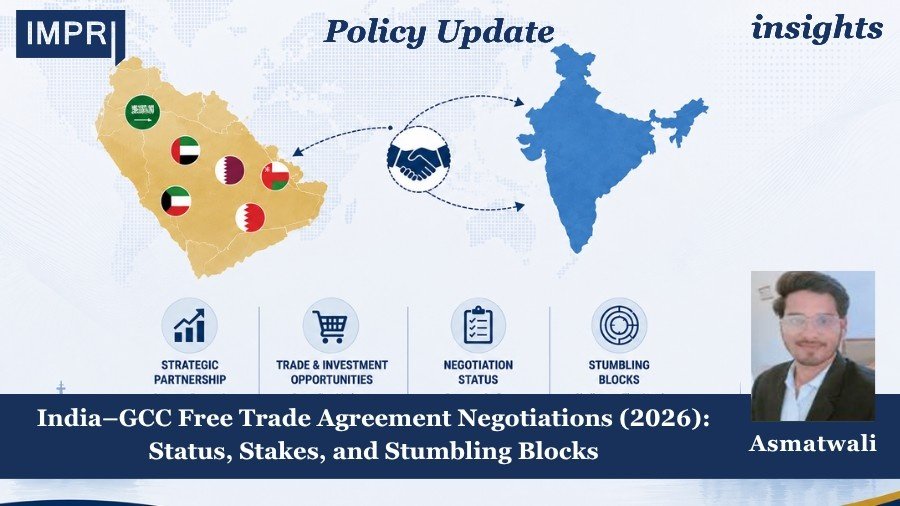
The Gulf Cooperation Council (GCC), comprising Saudi Arabia, the UAE, Qatar, Kuwait, Oman, and Bahrain, is one of India’s largest trading partner blocs. In FY 2024-25, bilateral trade touched USD 178.56 billion (exports of USD 56.87 billion and imports of USD 121.68 billion), accounting for 15.42 per cent of India’s global trade and growing at an average annual rate of 15.3 per cent over the last five years. India’s exports to the bloc are led by engineering goods, rice, textiles, machinery, and gems and jewellery, while imports are dominated by crude oil, LNG, petrochemicals, and gold, resulting in a persistent and substantial trade deficit with the bloc.
A framework trade agreement was first signed in 2004, and formal negotiations opened in 2006, but the process stalled by 2008 (Ministry of External Affairs) and was effectively suspended for close to two decades after the GCC chose to pause external trade talks. Over that period, India instead pursued bilateral trade with individual Gulf states, concluding a Comprehensive Economic Partnership Agreement (CEPA) with the UAE (in force since May 2022) and finalising a CEPA with Oman in December 2025, both of which now serve as templates for the bloc-wide negotiations.
The bloc-level talks were formally revived when India and the GCC signed the Terms of Reference (ToR) on 5 February 2026 in New Delhi, followed by a Joint Statement formally launching FTA negotiations on 24 February 2026, signed by Commerce and Industry Minister Piyush Goyal and GCC Secretary General Jasem Mohamed Albudaiwi.
Functioning
The ToR, negotiated between India’s Chief Negotiator Ajay Bhadoo and the GCC’s Chief Negotiator Dr Raja Al Marzouqi, lays out the scope and modalities for talks across Trade in Goods, Customs Procedures, Trade in Services, Digital Trade, Sanitary and Phytosanitary (SPS) measures, Intellectual Property Rights, and cooperation on Micro, Small, and Medium Enterprises. Structurally, the GCC negotiates as a single bloc on behalf of its six member states, a format that requires internal coordination among economies with differing tariff structures, regulatory regimes, and negotiating priorities before positions can be tabled to India, a process that itself contributed to delays in scheduling the first formal round.
One procedural breakthrough that enabled the resumption was India’s insistence on delinking the FTA from a proposed Bilateral Investment Treaty (BIT), a track that Saudi Arabia had wanted to advance first (Ministry of Commerce and Industry). India, wary of reopening older investment-treaty obligations, kept the two processes separate, a compromise that appears to have helped move the FTA talks forward independently. Momentum has also been aided by timing: the ToR and Joint Statement followed closely on India’s conclusion of a trade agreement with the European Union (27 January 2026) and progress toward a deal with the United States (2 February 2026), lending the GCC talks a degree of diplomatic sequencing and urgency.
However, the pace of actual negotiation has been affected by regional instability. Reports in March 2026 indicated that the first formal negotiating round was likely to be pushed to the second half of 2026, with sources citing the West Asia crisis, including disruption around the Strait of Hormuz amid the Iran-Israel-US conflict, as a contributing factor, alongside the GCC’s characteristically deliberate internal review process on sensitive sectors, tariff lines, services commitments, and investment protections.
Performance
Judged purely on the diplomatic calendar, the relaunch has moved with unusual speed relative to its own history: from the ToR (5 February 2026) to the Joint Statement formally launching negotiations (24 February 2026) took under three weeks, compared to the multi-year gaps that characterised the 2004-2008 attempt. Both governments have framed the relaunch in ambitious terms. Minister Goyal has described the FTA as a potential “force multiplier”, and the GCC Secretary General has called for a comprehensive agreement that eliminates tariff and non-tariff barriers and boosts two-way investment.
On the economic fundamentals underpinning the talks, the GCC represents a combined market of 61.5 million people and roughly USD 2.3 trillion in GDP, ranking ninth globally. The bloc is also a significant source of foreign investment into India, with cumulative GCC investment exceeding USD 31.14 billion (Ministry of Commerce and Industry) as of September 2025, alongside sovereign wealth fund exposure to Indian infrastructure, renewable energy, and start-ups.
According to data from the Reserve Bank of India’s official Remittances Survey, this deep economic corridor is reinforced by human-capital ties, with nearly nine to ten million members of the Indian diaspora residing in the Gulf region. Financial inflows from these six nations collectively account for roughly 38 per cent of India’s global inbound transfers, amounting to over USD 45 billion annually and providing a critical, resilient anchor for India’s current account balance.
Against this, however, sits the trade-deficit reality that shapes India’s negotiating leverage: India recorded bilateral deficits of roughly USD 26.76 billion with the UAE, USD 18.36 billion with Saudi Arabia, and USD 10.78 billion (Directorate General of Commercial Intelligence and Statistics) with Qatar in 2024-25, with the bloc-wide imbalance estimated above USD 64 billion, a gap driven structurally by India’s dependence on Gulf energy, which supplies close to 35 per cent of its crude oil imports and around 70 per cent of its gas imports. (Ministry of Petroleum and Natural Gas)
Impact
For India, a concluded FTA would extend the market-access template already established through bilateral agreements with the UAE and Oman across the full six-member bloc. This unified framework is poised to improve export competitiveness in key sectors—specifically engineering goods, textiles, pharmaceuticals, agro-products, and IT and healthcare services. Crucially, it would provide a structured legal framework to institutionalise and scale capital inflows from Gulf sovereign wealth funds, moving beyond ad-hoc investment pledges toward predictable, long-term bilateral corridor growth.
For the GCC states, deeper Indian market access supports economic diversification agendas, including Saudi Vision 2030, the UAE’s Vision 2071, Qatar’s National Vision 2030, Oman’s Vision 2040, Kuwait’s New Kuwait 2035, and Bahrain’s Economic Vision 2030. each of which seeks to reduce hydrocarbon dependence by expanding manufacturing, logistics, fintech, and renewable energy sectors, where India’s labour force and technological base are seen as complementary.
Geopolitically, the relaunch also intersects with connectivity ambitions such as the India-Middle East-Europe Economic Corridor (IMEC), which, though still at a conceptual stage, envisages trade routes linking South Asia to Europe via West Asia while bypassing conflict-prone chokepoints; a harmonised tariff and regulatory architecture from an FTA would materially support such a corridor. More broadly, the talks reflect a shift in how both sides position each other: India’s “Look West” outreach converging with the GCC’s own strategy of multi-alignment, balancing ties among the US, China, and India in an increasingly multipolar system.
Emerging Issues
i. Persistent trade imbalance: India’s structural energy-import dependence means any tariff liberalisation must be carefully sequenced to avoid locking in an even larger deficit; Indian negotiators are expected to seek reciprocal opening in services and manufactured-goods exports to offset this.
ii. Labour mobility and services: the GCC hosts over eight million Indian workers, yet visa and work-permit regimes differ by country; India is reportedly seeking mutual recognition of professional qualifications, unified e-visa verification, and liberalised short-term business-visitor quotas, while Gulf states are expected to seek greater capital and labour flexibility in return.
iii. Sensitive sectors: agriculture, petrochemicals, and services liberalisation remain the same contentious areas that stalled the 2006-2008 round, requiring India to balance domestic industry protection against export ambition.
iv. GCC bloc-level coordination: negotiating as a single bloc across six economies with varying tariff structures and regulatory standards introduces internal-alignment delays before the GCC can even present unified positions to India.
v. Regional geopolitical risk: the West Asia conflict and disruption around the Strait of Hormuz have already pushed back the first formal negotiating round, illustrating how regional instability can directly slow commercial diplomacy.
vi. Investment-treaty entanglement: Saudi Arabia’s preference for concluding a Bilateral Investment Treaty ahead of or alongside the FTA remains a live issue even after India’s success in delinking the two tracks for the purposes of launching talks.
vii. Suggested stakeholder responses: industry bodies such as FICCI have flagged that a harmonised labour-mobility template would significantly compress project-mobilisation timelines and eliminate costly administrative redundancies across the corridor.
Way Forward
The India-GCC FTA negotiation represents a rare instance of a two-decade-old stalled process being revived with structural advantages its predecessor lacked: bilateral templates already in force with the UAE and Oman, an accelerated diplomatic sequence following India’s EU and US trade deals, and a pragmatic delinking of the FTA from the more contentious investment-treaty track. Even so, the fundamentals that stalled the talks in 2008, sensitive sectors, labour mobility, and a wide trade imbalance, remain unresolved, and the added variable of regional conflict has already pushed the first substantive negotiating round into the second half of 2026.
Whether the agreement is concluded on an ambitious or minimalist template will likely depend on how quickly the GCC can align its six-member internal position, how India balances its energy-security dependence against its export ambitions, and whether the broader West Asia security environment stabilises enough to sustain negotiating momentum. For India’s broader foreign economic policy, the talks are best read alongside its parallel agreements with the EU, the US, the UK, and individual Gulf states as one strand in a broader diversification strategy rather than a stand-alone deal.
References
1. Gulf Cooperation Council Secretariat General. (2026, February 24). HE GCCSG: Launch of Free Trade Agreement negotiations between the GCC and India, and signing of the Joint Statement, marks a new phase of strategic partnership [Press release]. https://www.gcc-sg.org/en/MediaCenter/News/Pages/news-2026-2-24-5.aspx
2. Gulf Research Center. (2026, February 11). India-GCC Free Trade Agreement: A new phase in economic cooperation and implications for the Gulf. https://www.grc.net/single-commentary/349
3. India Briefing Export Foundation. (2026, February 25). India and Gulf Cooperation Council sign Joint Statement on the India–GCC Free Trade Agreement. IBEF. https://www.ibef.org/news/india-and-gulf-cooperation-council-sign-joint-statement-on-the-india-gcc-free-trade-agreement
4. Indian Narrative. (2026, February 19). Why does the India–GCC free trade talks matter now? https://www.indianarrative.com/opinion/why-does-the-india-gcc-free-trade-talks-matter-now/
5. Middle East Briefing. (2026, February 12). India, GCC launch Free Trade Agreement talks: Key outcomes. https://www.middleeastbriefing.com/news/india-gcc-free-trade-agreement-talks-trade-investment/
6. Ministry of Commerce and Industry, Press Information Bureau. (2026, February 24). India-GCC Free Trade Agreement (FTA) [Press release]. Government of India. https://www.pib.gov.in/PressReleasePage.aspx?PRID=2232327®=3&lang=1
7. Outlook Business. (2026, March 17). West Asia crisis pushes India–GCC FTA talks to late 2026. https://www.outlookbusiness.com/economy-and-policy/west-asia-crisis-pushes-indiagcc-fta-talks-to-late-2026
8. Sharma, A. (2026, February 15). India and GCC relaunch FTA talks: A new era for Middle East trade. The Week. https://www.theweek.in/news/middle-east/2026/02/15/india-and-gcc-relaunch-fta-talks-a-new-era-for-middle-east-trade.html
9. StratNews Global. (2026, February 5). After FTAs with EU and US, India-GCC to formalise FTA framework. https://stratnewsglobal.com/india/after-ftas-with-eu-and-us-india-gcc-to-formalise-fta-framework/
10. VisaHQ News. (2026, February 5). India and Gulf Cooperation Council restart FTA negotiations, aim to ease labour mobility. https://www.visahq.com/news/2026-02-05/in/india-and-gulf-cooperation-council-restart-fta-negotiations-aim-to-ease-labour-mobility/
11. World Trade Scanner. (2026). India and GCC sign Terms of Reference to launch Free Trade Agreement negotiations. https://worldtradescanner.com/India%20and%20GCC%20Sign%20Terms%20of%20Reference%20to%20Launch%20Free%20Trade%20Agreement%20Negotiations.htm
About the Contributor:
Asmatwali is a research and editorial intern at IMPRI. He is a scholar in the Department of West Asian and North African Studies at Aligarh Muslim University. Earlier, he worked on two project reports based on semi-structured interviews for the think tank JINF, Japan.
Disclaimer: All views expressed in the article belong solely to the author and not necessarily to the organisation.
Read More at IMPRI
Planting Doubts: The Promise and Pitfalls of India’s Green Credit Scheme (2023)
Acknowledgement:
The author extends his sincerest gratitude to the IMPRI team for their expert guidance and constructive feedback throughout the process. The author would like to thank Neha Pal & Simona Miriam Hughes for their valuable feedback.
This article was posted by Yashkirt Pal, a Research and Editorial Intern at IMPRI.