







Dolly Kaushik
BACKGROUND
This paper examines whether the India-Chile CEPA functions as more than a trade liberalisation agreement, arguing that it operates primarily as a strategic instrument for securing India’s critical mineral supply chains. Over the last two decades, the economic relationship between India and Chile has steadily evolved from a preferential trade framework to a comprehensive economic partnership agreement. The foundation of the bilateral economic engagement was laid in January 2005, culminating in the signing of the Preferential Trade Agreement (PTA) in March 2006. The agreement subsequently entered into force in August 2007, marking the beginning of institutionalised trade cooperation between the two countries. As the landscape of global trade evolved, both countries significantly broadened the scope of this PTA in 2016. The partnership gained momentum during the state visit of the President of Chile, H.E. Mr. Gabriel Boric Font, to India in April 2025.
This diplomatic engagement paved the way for India and Chile to formally sign the Terms of Reference for a Comprehensive Economic Partnership Agreement on May 8, 2025. Subsequently, the first round of negotiations was held in New Delhi from May 26 to 30, 2025, marking the official transition from the limited scope of the previous preferential framework to a comprehensive strategic partnership. By May 2026, high-level engagement, including a visit by Chile’s Minister of Foreign Affairs, Mr. Francisco Pérez Mackenna, reaffirmed both nations’ commitment to finalizing the agreement as a cornerstone of their bilateral relationship (PIB, 2025b).
The strategic impetus for upgrading the existing PTA to a comprehensive economic partnership agreement is anchored in India’s long-term vision for Viksit Bharat by 2047. The current PTA covers a restricted basket of roughly 2,300 tariff lines, which has become insufficient for contemporary economic ambitions (Department of Commerce, 2025). Furthermore, Chile occupies a critical position as India’s strategic gateway to Latin America and the wider regional network, offering a stable economic foothold in the region.
India’s transition toward green technology and electric vehicle manufacturing demands uninterrupted access to critical minerals like lithium and copper. Chile holds massive global reserves of these critical minerals, which serve as an essential hedge against single-source dependency (ICRIER, 2026). Aligning with the strategic priorities emphasized by Commerce Secretary Sunil Barthwal during the inaugural round of negotiations, CEPA transcends conventional trade relationships to actively foster a robust and diversified global value chain that mitigates geopolitical vulnerability (PIB, 2025b).
FUNCTIONING
The operational framework of CEPA is driven by active, high-level bureaucratic and diplomatic intergovernmental delegations. It is overseen by dedicated ministerial and official-level joint committees designed to continuously monitor trade flows, resolve non-tariff barriers, and streamline regulatory issues. The agreement establishes a dynamic, multi-tiered framework for long-term bilateral integration (PIB, 2025a).
The institutional negotiation process has advanced progressively across successive rounds, including the 3rd round held in Santiago, Chile (October 2025) and the 4th round, concluded successfully in New Delhi (December 2025), witnessing intensive engagement between delegations led by key officials such as India’s Chief Negotiator and Joint Secretary Vimal Anand (Department of Commerce) and his Chilean counterparts (PIB, 2026).
These working groups have structured and advanced core chapters encompassing:
● Trade in Goods and Trade in Services
● Rules of Origin and Technical Barriers to Trade (TBT) / Sanitary and Phytosanitary (SPS) measures
● Customs Procedures and Investment Promotion
● Intellectual Property Rights and Economic Cooperation
● Critical Minerals cooperation, which was officially incorporated and scaled up during these negotiating rounds (RIS, 2024)
Beyond bureaucratic negotiations, the operational framework functions through active private-sector participation and high-level stakeholder dialogues, such as the India–Chile Business Roundtable held in New Delhi. This mechanism engages industry stakeholders to map out bilateral commercial opportunities, focusing implementation efforts on key growth sectors:
● Critical minerals supply chain integration and renewable energy development
● Agri-business and infrastructure
● Pharmaceuticals, digital services, and logistics
● Advanced manufacturing and economic cooperation (PIB, 2026)
Ultimately, this multi-tiered operational framework ensures that CEPA functions not merely as a regulatory trade agreement, but as a dynamic, forward-looking blueprint for sustainable economic partnership between India and Chile.
Figure 1: India–Chile CEPA Negotiation Architecture — Dual-Track Structure (Public Sector / Private Sector)
Source: Compiled by the author, based on press releases from the Press Information Bureau (PIB), Government of India, and official communications from the Ministry of Commerce & Industry (2025–2026).
PERFORMANCE
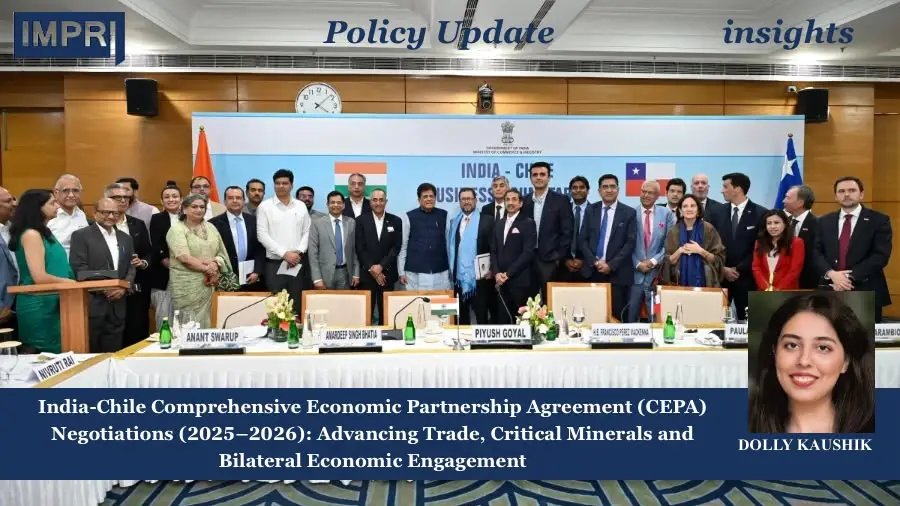
The bilateral economic engagement experienced a sharp upward trajectory following structured negotiations. High-level momentum was firmly reinforced during the May 2026 visit of Chile’s Minister of Foreign Affairs, H.E. Mr. Francisco Pérez Mackenna, to New Delhi, where he held bilateral talks with Union Minister of Commerce & Industry Shri Piyush Goyal. To operationalise these goals, parallel institutional engagements took place between the Indian Commerce Secretary and Chile’s Vice-Minister of International Economic Relations (SUBREI), Ms. Paula Estévez. These engagements prioritized overcoming core administrative friction points by streamlining trade procedures, optimizing market entry frameworks, reinforcing investment security, and deepening institutional ties between the two nations. For instance, moving beyond tariff lines, these talks established joint oversight frameworks to tackle Non-Tariff Measures (NTMs) and Sanitary and Phytosanitary (SPS) barriers that traditionally slow down agricultural and pharmaceutical trade between South Asia and South America (PIB, 2026a).
Within India’s overarching trade strategy, highlighted by landmark modern trade pacts like the India-UK CETA, the UAE-India CEPA, and the India-EFTA TEPA, the ongoing upgrade with Chile represents a critical anchor for South-South economic integration in Latin America. While major economic pacts signed in 2025 focus heavily on high-end manufacturing, mobility of professionals, and massive capital mobilization (such as the EFTA target of US$100 billion), the Chile CEPA functions primarily as a strategic resource and value-chain corridor (Department of Commerce, 2025).
Chile’s position within India’s broader critical-minerals diversification strategy becomes clearer in comparative context. Indonesia, holding some of the world’s largest nickel reserves, has pursued an increasingly assertive resource-nationalist approach since 2020, restricting raw ore exports to force domestic processing investment, a policy that has attracted major capital inflows but also created friction with trading partners seeking direct raw material access (GTRI, 2025). Chile’s regulatory environment, while not without its own debates over lithium sector state participation, has generally remained more predictable for foreign partners. This distinction matters for India: unlike a supplier pursuing export restriction as policy, Chile is more readily positioned as a long-term source of lithium and copper, making the CEPA negotiations a comparatively lower-risk vehicle for India’s mineral diversification strategy than parallel efforts with more resource-nationalist partners.
It connects India’s expanding industrial capacity directly with South America’s abundant natural resource reserves. Whereas agreements like the India-UK CETA focus primarily on opening markets for labor-intensive goods such as textiles and leather, and services, the India-Chile partnership is tailored to secure critical upstream inputs like lithium and copper. This targeted focus on raw material security directly supports India’s green energy transition, establishing a distinct model for economic diplomacy across the Global South.
Concurrently with the May 2026 ministerial reviews, the India-Chile Business Roundtable in New Delhi acted as a vital commercial conduit, mobilizing industry leaders and trade stakeholders from both nations (PIB, 2026a). Performance metrics derived from these industry dialogues highlight active commercial expansion across several high-growth vectors:
- Critical Minerals & Energy Security: Private stakeholders targeted enhanced supply chain integration for lithium and copper, essential inputs for India’s domestic electric vehicle (EV) manufacturing and renewable energy infrastructure.
- Diversified Commercial Sectors: Expanding trade performance beyond traditional goods into agri-business, pharmaceuticals, digital IT services, logistics, and advanced manufacturing partnerships.

Figure 2: Union Commerce & Industry Minister Piyush Goyal with Chile’s Foreign Minister H.E. Mr. Francisco Pérez Mackenna and Vice-Minister Paula Estévez at the India–Chile Business Roundtable, New Delhi, May 13, 2026.
Source: Office of Piyush Goyal, Union Minister of Commerce & Industry, Government of India (piyushgoyal.in)

Figure 3: Union Commerce & Industry Minister Piyush Goyal in discussion with Chile’s Foreign Minister H.E. Mr. Francisco Pérez Mackenna and the Chilean delegation, New Delhi, May 12, 2026.
Source: Office of Piyush Goyal, Union Minister of Commerce & Industry, Government of India (piyushgoyal.in)
IMPACT
Assessing the performance of India’s economic engagement with Chile requires looking past simple trade volume growth toward how effectively the partnership addresses supply vulnerabilities, leverages state-backed institutions, and builds a stable industrial corridor. Four dimensions capture this most clearly.
First, the partnership functions as a tool for macroeconomic risk mitigation. India’s clean energy transition, anchored in initiatives like the National Electric Mobility Mission and Production-Linked Incentive (PLI) schemes for Advanced Chemistry Cell (ACC) battery storage, rests on a structural vulnerability: near-total import dependence on a handful of foundational transition minerals (Kumar et al., 2026).
The ICRIER Dependency Risk Index identifies Chile as one of India’s primary global sourcing origins for lithium, but because extraction and midstream refining are heavily concentrated in single dominant markets, this dependence exposes India’s domestic battery ecosystem to real geopolitical shocks and export restrictions (Kumar et al., 2026). Viewed against this backdrop, upgrading the bilateral framework through CEPA functions less as a conventional trade upgrade and more as a strategic risk-mitigation tool, a way to escape single-source dependency and absorb potential supply-side shocks.
Second, the relationship reflects a broader shift toward state-led resource diplomacy. Since 2019, Khanij Bidesh India Ltd. (KABIL), a joint venture of central public sector enterprises, has worked to secure overseas mineral assets and long-term supply agreements, and has already signed agreements with state-owned enterprises in Australia, Argentina, and Chile to source lithium (RIS, 2024). CEPA negotiations matter here because they provide the legal and tariff certainty needed to operationalize KABIL’s framework agreements in Latin America’s Lithium Triangle. Rather than relying on volatile open-market transactions, this creates formal government-to-business pathways, streamlining exploration rights, equity investment, and joint processing ventures between Indian entities and their Chilean counterparts (CSEP, 2025).
Third, the partnership is reinforced by concrete domestic fiscal policy, not just diplomatic engagement. India’s Union Budget 2024 eliminated basic customs duty on 25 critical minerals, and Union Budget 2025 went further, removing duties on cobalt powder, lithium-ion battery waste and scrap, lead, zinc, and 12 additional critical minerals (RIS, 2024). Read alongside the CEPA negotiations, this signals that India’s tariff architecture and its trade diplomacy are moving in the same direction, lowering the cost of exactly the imports Chile is positioned to supply, and giving CEPA’s mineral provisions a domestic policy environment that can actually make use of them.
Finally, the partnership’s long-term significance lies in its shift from simple commodity exchange toward deeper industrial integration. By anchoring raw material security within a comprehensive trade agreement, India aims to insulate its manufacturing ambitions in green mobility and renewable energy from global market volatility, reinforcing a broader claim to strategic autonomy across the Global South (Kumar et al., 2026; RIS, 2024).
EMERGING ISSUES
While modern bilateral frameworks like the India–Chile economic partnership provide a critical mechanism for securing raw material inflows, India’s broader green transition faces deep-seated structural vulnerabilities. The emerging challenges confronting India’s critical mineral architecture can be broken down across the following dimensions:
- Supply Risk Ratings and Import Dependency- India’s position in the critical minerals landscape remains precarious. The country is nearly entirely import-dependent for core energy transition minerals like lithium, cobalt, nickel, and battery-grade graphite, leaving it exposed to external price shocks and supply disruptions with little domestic buffer (Chadha et al., 2025a). This vulnerability is compounded by how concentrated global extraction and refining actually are: a single country, China, dominates much of the supply chain, which hands significant geopolitical leverage to Beijing and leaves importing economies like India exposed to export restrictions and, at times, outright weaponized trade policy (Chadha et al., 2025a; GTRI, 2025). India has taken some steps to address this on the extraction side, with royalty rationalizations for minerals like graphite, zirconium, rubidium, and caesium meant to encourage domestic mining. But this response only addresses part of the problem. Prospecting and extraction alone cannot resolve raw material vulnerability unless they are paired with a broader, integrated supply strategy (GTRI, 2025).
- Midstream Refining and Processing Capacity Gaps- Even where India succeeds in securing raw mineral imports through agreements like the Chile CEPA, a second, arguably deeper problem persists: the country lacks the midstream infrastructure to convert those raw materials into anything usable. India can import semi-processed lithium or graphite, but it has little capacity to refine these into the high-purity inputs required for battery manufacturing, electronics, or energy storage (Chadha et al., 2025b; GTRI, 2025). This gap plays out differently across minerals. With graphite, some baseline upgrading exists domestically, but India still relies heavily on imports for the ultra-high-grade material battery anodes actually require. Zirconium and rare earths are worse off, with domestic output rarely moving past raw or beach-sand forms and almost no industrial capacity to process them into high-purity compounds. Rubidium and caesium lag furthest behind: exploration is still in early stages, and the purification infrastructure needed to produce high-purity salts and metals simply doesn’t exist yet (GTRI, 2025). Closing this gap isn’t cheap or fast; building midstream plants demands heavy capital investment, advanced technical expertise, and compliance with strict environmental regulations, none of which a trade agreement alone can provide (Chadha et al., 2025b; GTRI, 2025).
- Market Dynamics, Pricing, and Strategic Policy Imperatives-Beyond the question of raw access and refining capacity, the critical minerals market itself is structurally unstable. Clean energy mineral markets suffer from high price volatility, driven by speculative financing, concentrated market power, and sharp shifts in global demand, most notably the exponential rise in demand for lithium-ion batteries and electric vehicles (Chadha et al., 2025a, 2025b). This instability is compounded by a contradiction within India’s own tariff structure: existing tariff policies often inadvertently penalize domestic downstream manufacturers by inflating raw material costs, even as low-duty imports of finished goods are permitted to enter freely (GTRI, 2025). This exposes a deeper limitation in agreements like the Chile CEPA: securing external mineral access does little to correct market volatility or tariff-driven distortions that originate within India’s own policy framework. Even with diversified lithium and copper supply, Indian manufacturers remain exposed to global price swings and a tariff structure that was not designed with critical mineral value chains in mind (GTRI, 2025).
- Environmental, Social, and Governance (ESG) Compliance and Footprints- Beyond market and infrastructural constraints, the pursuit of critical mineral security carries its own environmental and social costs. Mining and refining critical transition minerals carry significant ecological footprints, ranging from intensive water consumption in fragile extraction zones, including South America’s lithium flats, to localized environmental degradation more broadly (Chadha et al., 2025a). Incorporating rigorous ESG benchmarks into India’s procurement strategy is therefore essential: without them, diversifying away from Chinese-dominated supply chains risks relocating, rather than resolving, the social and environmental costs of mineral extraction (Chadha et al., 2025a).
- Circularity, Recycling, and Waste Recovery Infrastructure- A further dimension often missing from bilateral mineral agreements is domestic circularity. Accelerating domestic recycling and circular economy frameworks is vital to reducing India’s reliance on primary extraction altogether (Chadha et al., 2025a). Institutional assessments point to several concrete steps in this direction, such as developing a graded incentive system for recycling efficiency, integrating informal recyclers into structured channels, and establishing dedicated Resource Recovery Parks (RRPs) to facilitate waste exchange and strengthen long-term resource security (Chadha et al., 2025a). Set against the Chile CEPA, this points to a broader strategic gap: securing lithium and copper imports addresses India’s immediate supply needs, but without parallel investment in recycling and recovery infrastructure, each new bilateral agreement only postpones, rather than resolves, the country’s long-term mineral dependency.
WAY FORWARD
As India accelerates its clean energy transition under mounting global supply constraints, its economic engagement with Chile must move far beyond traditional trade. Securing a stable future for critical minerals requires a deliberate shift from raw material procurement to deep industrial integration. The following policy interventions are proposed specifically for the bilateral partnership.
First, bilateral resource diplomacy needs to shift toward data-driven risk management. Policymakers should actively integrate empirical tools like the ICRIER Dependency Risk Index into trade negotiations to map import concentration and target the exact mineral grades required for India’s manufacturing ecosystems (Kumar et al., 2026). Simultaneously, ongoing CEPA negotiations must establish legally binding frameworks that convert Khanij Bidesh India Ltd. (KABIL) memorandums into active, equity-backed exploration and extraction ventures within Chile’s strategic mining corridors (CSEP, 2025; RIS, 2024). This would ensure that intergovernmental pacts move beyond passive trade agreements into enforceable resource corridors.
Second, overcoming the structural problem of raw ores being exported without domestic refinement requires a concerted push into midstream cooperation. The bilateral framework should encourage joint processing facilities that combine Chilean raw material access with Indian industrial and chemical engineering capabilities, ensuring both economies capture a fair share of value (Chadha et al., 2025b; GTRI, 2025). Aligning tariff structures through the CEPA to eliminate inverted duties on processed goods would further incentivize domestic players to import raw inputs for local refining, rather than relying entirely on finished foreign imports (GTRI, 2025).
Third, long-term stability depends on embedding circular economy models and technological innovation directly into the partnership. Establishing joint research initiatives between Indian and Chilean scientific institutions could accelerate breakthroughs in alternative battery chemistries, such as sodium-ion and solid-state batteries, thereby easing India’s absolute dependence on any single mineral (RIS, 2024). Alongside this, bilateral exchanges on circularity should focus on formalizing advanced battery recycling standards and waste recovery networks, easing the pressure of primary extraction on fragile environments (Chadha et al., 2025a).
Finally, none of these measures will hold up without embedding rigorous Environmental, Social, and Governance (ESG) compliance into every tier of the supply chain. Strict environmental benchmarks, particularly around water conservation in arid lithium-extracting regions, along with genuine attention to local community welfare, would help safeguard both nations against regulatory friction, supply chain disruptions, and reputational risk (Chadha et al., 2025a).
Shifting the bilateral dynamic in this manner elevates the relationship beyond simple trade transactions. It embeds long-term resilience into India’s green supply chains, redefining how both nations collaborate on critical resource security.
SELECTED REFERENCES AND IMPORTANT LINKS
Chadha, R., Goel, S., Goldar, A., & Jain, R. et al. (2025a). State of the sector: Critical energy transition minerals for India (Vol. I). CEEW, CSEP, ICRIER, IISD, Shakti Sustainable Energy Foundation. https://www.iisd.org/system/files/2025-02/india-critical-energy-transition-minerals-volume-1.pdf
Chadha, R., Goel, S., Goldar, A., & Jain, R. et al. (2025b). State of the sector: Critical energy transition minerals for India (Vol. II). CEEW, CSEP, ICRIER, IISD, Shakti Sustainable Energy Foundation. https://www.iisd.org/system/files/2025-02/india-critical-energy-transition-minerals-volume-2.pdf
Centre for Social and Economic Progress. (2025). Partnerships for self-reliance: Internationalising India’s critical minerals sector [Working paper]. CSEP. https://csep.org/working-paper/partnerships-for-self-reliance-internationalising-indias-critical-minerals-sector/
Department of Commerce, Government of India. (2025, May 8). India and Chile sign Terms of Reference for Comprehensive Economic Partnership Agreement negotiations [Press release]. Press Information Bureau. https://www.pib.gov.in/PressReleasePage.aspx?PRID=2127826®=3&lang=2
Department of Commerce, Government of India. (2025, May 30). 1st Round of India-Chile CEPA negotiation concludes in New Delhi [Press release]. Press Information Bureau. https://www.pib.gov.in/PressReleasePage.aspx?PRID=2132899
Department of Commerce, Government of India. (2025, November). India deepens trade engagement with Latin America [Press release]. Press Information Bureau. https://www.pib.gov.in/PressReleasePage.aspx?PRID=2186809
Department of Commerce, Government of India. (2025). Expansion of India–Chile Preferential Trade Agreement (PTA) [Press release]. Press Information Bureau. https://www.pib.gov.in/newsite/PrintRelease.aspx?relid=149558®=3&lang=2
Department of Commerce, Government of India. (2025). 2025 Year End Review for Department of Commerce [Press release]. Press Information Bureau. https://www.pib.gov.in/PressReleasePage.aspx?PRID=2201284®=3&lang=2
Department of Commerce, Government of India. (2025, October 11). India-EFTA Trade Pact: Boosting $100 billion investment and 1 million jobs [Press note]. Press Information Bureau. https://www.pib.gov.in/PressNoteDetails.aspx?NoteId=155492&ModuleId=3
Global Trade Research Initiative. (2025). Critical minerals for a tech-driven world: India’s roadmap to self-sufficiency. GTRI. https://gtri.co.in/DisplayFlagshipReports.aspx?ID=33
Kumar, A., et al. (2026). Securing India’s critical mineral future: Geopolitical foresight, research priorities, and institutional culture for cobalt, lithium, and nickel (Policy Brief No. 65). ICRIER. https://icrier.org/pdf/pb65_Securing-India-s-Critical-Mineral-Future.pdf
Ministry of External Affairs, Government of India. (2026, May). Republic of Chile Foreign Minister H.E. Mr. Francisco Pérez Mackenna leads high-level delegation to India to strengthen economic and commercial cooperation [Press release]. Press Information Bureau. https://www.pib.gov.in/PressReleasePage.aspx?PRID=2260707®=3&lang=1
Press Information Bureau / News on Air. (2025, December). India-Chile conclude 4th round of CEPA negotiations in New Delhi [News release]. Prasar Bharati. https://www.newsonair.gov.in/india-chile-conclude-4th-round-of-cepa-negotiations-in-new-delhi
Research and Information System for Developing Countries. (2024). Developing all stages of critical mineral value chain: Crucial for Viksit Bharat. RIS. https://ris.org.in/en/node/4093
Office of Piyush Goyal, Union Minister of Commerce & Industry. (2026, May 13). Chaired the India-Chile Business Roundtable [Photograph/statement]. https://www.piyushgoyal.in/
ABOUT THE CONTRIBUTOR
Dolly Kaushik is a postgraduate student of Public Administration with an interdisciplinary academic foundation in Life Science. Her work explores the geopolitical dimensions of emerging technologies, global governance, and international affairs. She is currently a Research Intern at IMPRI Impact and Policy Research Institute, New Delhi.
ACKNOWLEDGEMENT
The author extends her sincere gratitude to the IMPRI team for their invaluable guidance throughout the process. I also extend my sincere thanks to Ayaan Bordoloi and Devanandana for their valuable feedback.
DISCLAIMER
All views expressed in the article belong solely to the author and do not necessarily represent the views or policies of the organisation.
Read more at IMPRI
Why Does the G7 Keep Inviting India to its Summits?
YUVA Tourism CLUBS: Nurturing Young Ambassadors of Indian Tourism ( 2022)